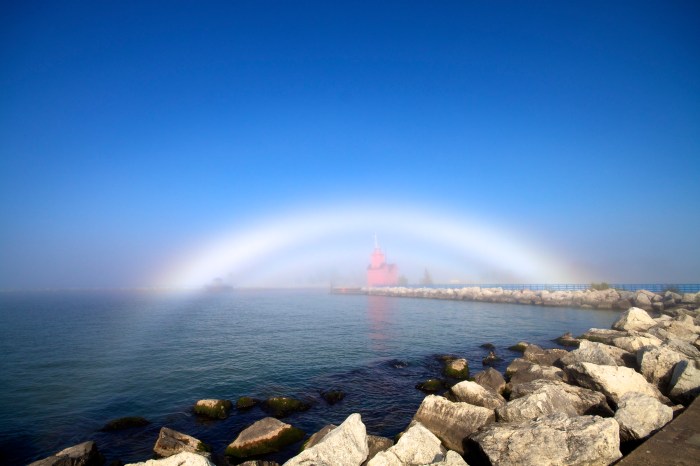
Fogbow: a White Rainbow over Big Red

fogbow-at-big-red-by-steven-karsten

White Rainbow, photo by stevedontsurf.

Today’s photo shows a fogbow. According to the Fogbow entry from Atmospheric Optics:

Fogbows form in the same way as rainbows. A small fraction of the light entering droplets is internally reflected once and emerges to form a large circle opposite the sun.

But… …beyond that there are major differences. Rainbows are formed by raindrops which are so large that rays passing through them follow well defined ‘geometrical optics’ paths. Fogbows are formed by much smaller cloud and fog droplets which diffract light extensively.

…Fogbows are almost white with faint reds on the outside and blues inside. The colours are so washed out because the bow in each colour is very broad and the colours overlap.

Read on for more, including some photos and get a little more at Wikipedia’s page on fog bows.

Steven shot this at the Holland Harbor Lighthouse aka Big Red and writes that he’s still amazed he was able to stumble upon one of these. Check his photo out big as the sky and in his Holland slideshow.
Happy Birthday to you, Thomas Edison

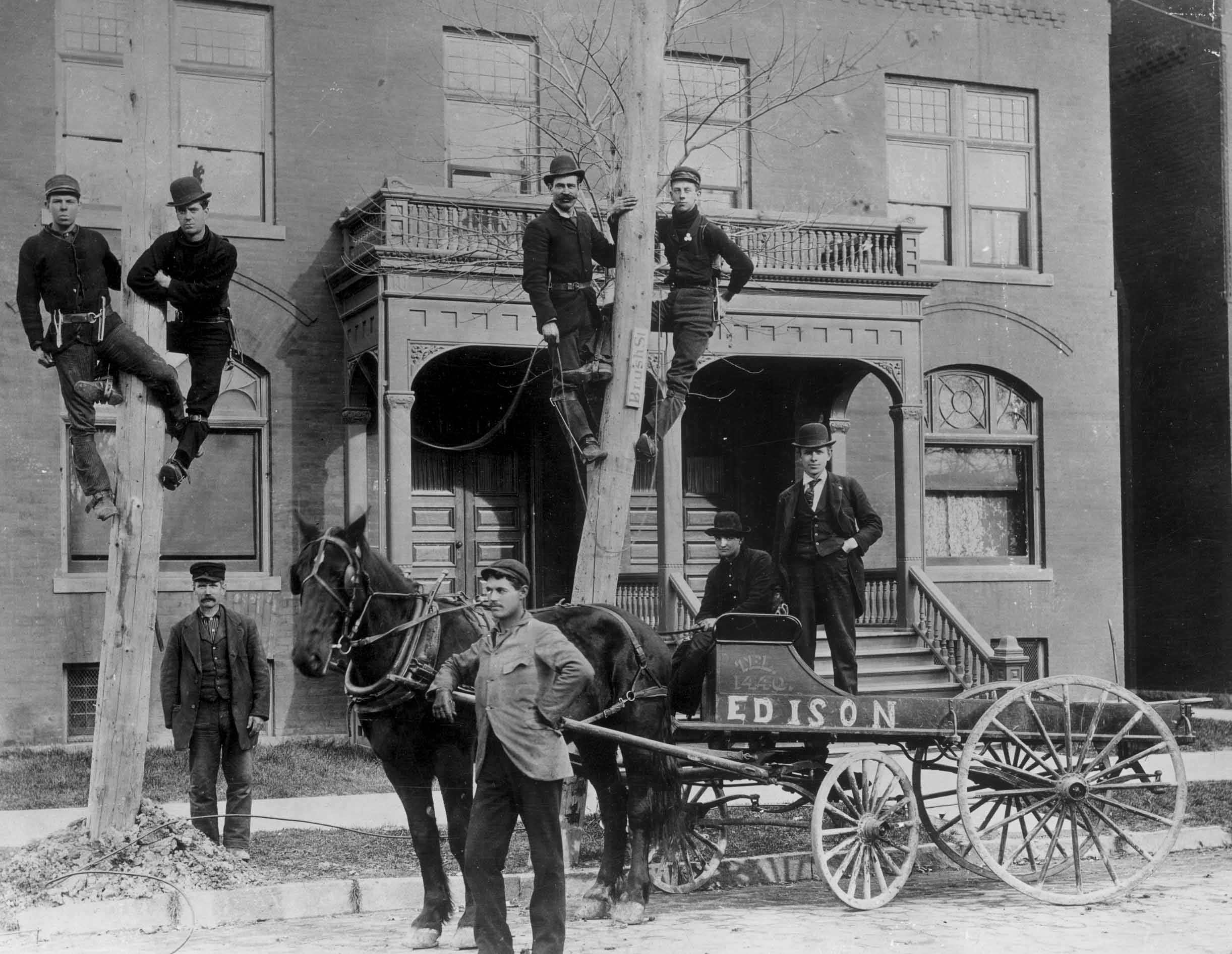
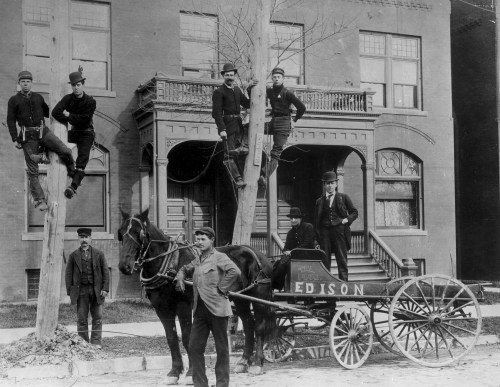
Detroit - Edison Illuminating Company high line crew

Detroit – Edison Illuminating Company high line crew, photo courtesy Seeking Michigan

The Life of Thomas Edison from American Memory at the Library of Congress says that:

Thomas Alva Edison was born to Sam and Nancy on February 11, 1847, in Milan, Ohio. Known as “Al” in his youth, Edison was the youngest of seven children, four of whom survived to adulthood. Edison tended to be in poor health when young.

To seek a better fortune, Sam Edison moved the family to Port Huron, Michigan, in 1854, where he worked in the lumber business.

Edison was a poor student. When a schoolmaster called Edison “addled,” his furious mother took him out of the school and proceeded to teach him at home. Edison said many years later, “My mother was the making of me. She was so true, so sure of me, and I felt I had some one to live for, some one I must not disappoint.”(1) At an early age, he showed a fascination for mechanical things and for chemical experiments.

In 1859, Edison took a job selling newspapers and candy on the Grand Trunk Railroad to Detroit. In the baggage car, he set up a laboratory for his chemistry experiments and a printing press, where he started the Grand Trunk Herald, the first newspaper published on a train. An accidental fire forced him to stop his experiments on board.

Read on for much more, and also see Thomas Edison at Wikipedia. While Edison’s life in Michigan didn’t include much of what one of the architects of our modern lifestyle was famous for, there’s some great places to visit to learn more about him. Two of the best are the Thomas Edison Depot Museum in Port Huron and Edison’s Menlo Park Laboratory at Greenfield Village.

Get this photo from Seeking Michigan big as the 20th Century and see a few more Edison-related photos from Seeking Michigan.

Post #350 on Michigan in Pictures!

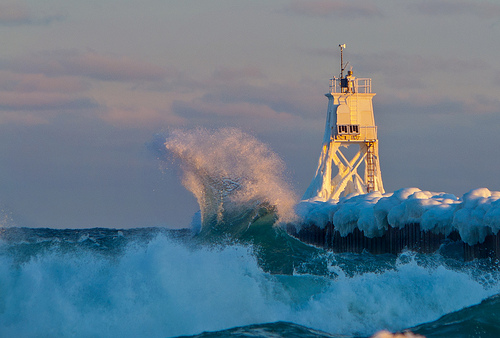
Break Wall Sunrise

Break Wall Sunrise

Break Wall Sunrise, photo by Gary of the North.

Here’s yesterday’s sunrise in Grand Marais, Michigan … it’s pretty clear that Lake Superior was wide awake.

Check it out background bigtacular and see a lot more photos from the area on Gary’s map.

More winter wallpaper from Michigan in Pictures!

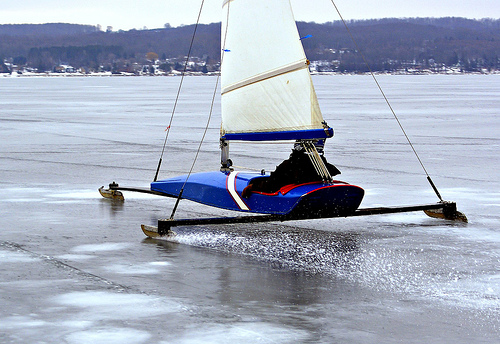
Ice Boating on Lake Charlevoix

Gordon in his Nite- Lake Charlevoix, Boyne City, Michigan

Gordon in his Nite- Lake Charlevoix, Boyne City, Michigan, photo by rickrjw.

Yesterday we took a trip under the ice of Lake Charlevoix, so it was very fitting that this morning Rick shared a photo from the other side of the ice on Lake Charlevoix! Our recent warm spell has cleared the snow and smoothed the ice on many lakes in Michigan, and that has brought ice boaters out in force.

Sail Michigan’s Michigan iceboating page explains

There are some peculiarities to ice boating (ice yachting) which are not seen with “soft water” sailing. First, most iceboats carry a single individual (so the need for crew is removed), however two or more person boats do exist. Second, because of the speeds involved (iceboats in general can travel 5-10x wind speed), ice sailors wear protective gear, including helmets. Third, iceboats do not require standard ramps for launching. And lastly, an intimate knowledge of ice conditions and lake topography is essential for a safer experience (although ice boating cannot be made 100% “safe”).

The iceboating season can’t start until snow-free hard ice is established on the lakes, usually after Christmas.

Check this photo out background big in in Ricks Iceboating 2012 slideshow!

Here’s one of our favorite iceboating videos: Ice boat vs Chevy on Lake St. Clair!

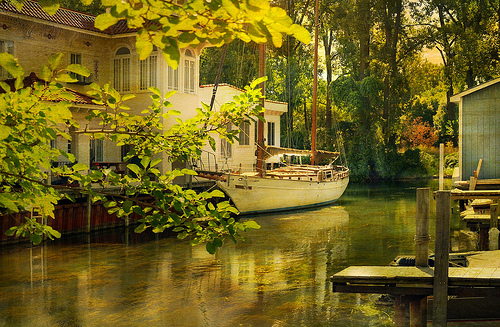
Summertime Dreaming

Summertime Fun

Summertime Fun, photo by Ann279.

I think that I want to live here. Here’s hoping your weekend is dreamy!

Check this out on black, background big and in Ann’s slideshow.

Update: a commenter below explains that this is the Harbor Island neighborhood of Detroit in case you (like me) were wondering!

#Mich175 = Happy 175th Birthday Michigan!!

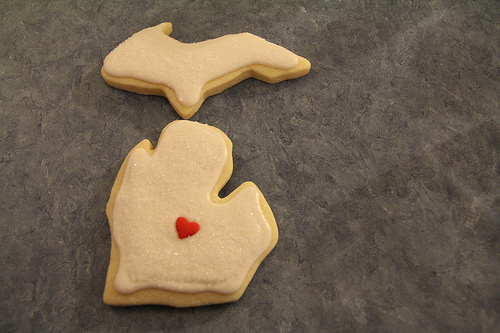
Sugar Cookies - Michigan

Sugar Cookies – Michigan, photo by betsyweber

We, the PEOPLE of the territory of Michigan … mutually agree to form ourselves

into a free and independent state, by the style and title of “The State of Michigan’”

~Constitution of Michigan of 1835

While Michigan’s Constitution was written in 1835, it took until January 26, 1837 for President Andrew Jackson to sign the bill making Michigan the nation’s 26th state (more about that right here but the short answer is, blame it on Ohio). That makes today the 175th birthday of the Great Lakes State. We’ve been making a fuss of it and giving things away on Absolute Michigan all week, and joining a whole lot of people in touting the good things about our great state at #Mich175 on Twitter.

Here’s some fun facts about Michigan:

  • Michigan is derived from the Indian word Michigama, meaning great or large lake. (more about Michigan’s name on Michigan in Pictures)
  • French explorers Étienne Brulé & Grenoble are the first recorded Europeans to set foot in Michigan (you never know though). In 1668 Fathers Jacques Marquette and Claude Dablon established the first mission at Sault Ste. Marie, and in 1701, French officer Antoine de la Mothe Cadillac founded  Fort Pontchartrain in Detroit.
  • The Michigan Territory was created, with Detroit designated as the seat of government and William Hull appointed as our first governor.
  • Michigan became the 26th state on the 26th of January, 1837. Is 26 our lucky number? FYI, our first State governor was Stevens T. Mason, the 25 year old Boy Governor (the youngest state governor in American history).
  • Michigan’s nickname is “the Wolverine State”. It is generally believed to have been coined during the 1835 Toledo War between Michigan and Ohio, when our southern rivals gave us the name due to the wolverine’s reputation for sheer orneriness!
  • The Great Seal of Michigan was designed by Lewis Cass and was patterned after the seal of the Hudson Bay Fur Company. It depicts an elk on the left and a moose on the right supporting a shield that reads Tuebor (“I will protect”).The interior of the shield shows a figure on the shore with the sun rising over a lake. His right hand is raised, symbolizing peace, but he holds a rifle in his left hand, showing readiness to defend the state and nation.Below the shield is the inscription of our state motto Si quaeris peninsulam amoenam circumspice: “If you seek a pleasant peninsula, look about you.” (I just learned that Michigan has an Office of the Great Seal – how cool would it be to say you worked there??)
  • The original State Capitol of Michigan was Detroit, and it moved to Lansing in 1847 to help develop the western side of the state and due to the need to develop the western portions of the state and for easy defense from British troops. Here’s a pic of Michigan’s original Capitol Building and an 1890s view of the current Michigan capitol.
  • Michigan is the 10th largest state by area if you count the water … and who wouldn’t count the water??
  • Speaking of water, we have 3,288 miles of Great Lakes shoreline, good for second to only Alaska in coastline!

More fun facts from the State of Michigan.

Check this out background bigilicious and in Betsy’s Cookies slideshow.

PS: I made a little Michigan Birthday cover photo for Facebook that you are free to grab.

Happy 175th Birthday Michigan!!

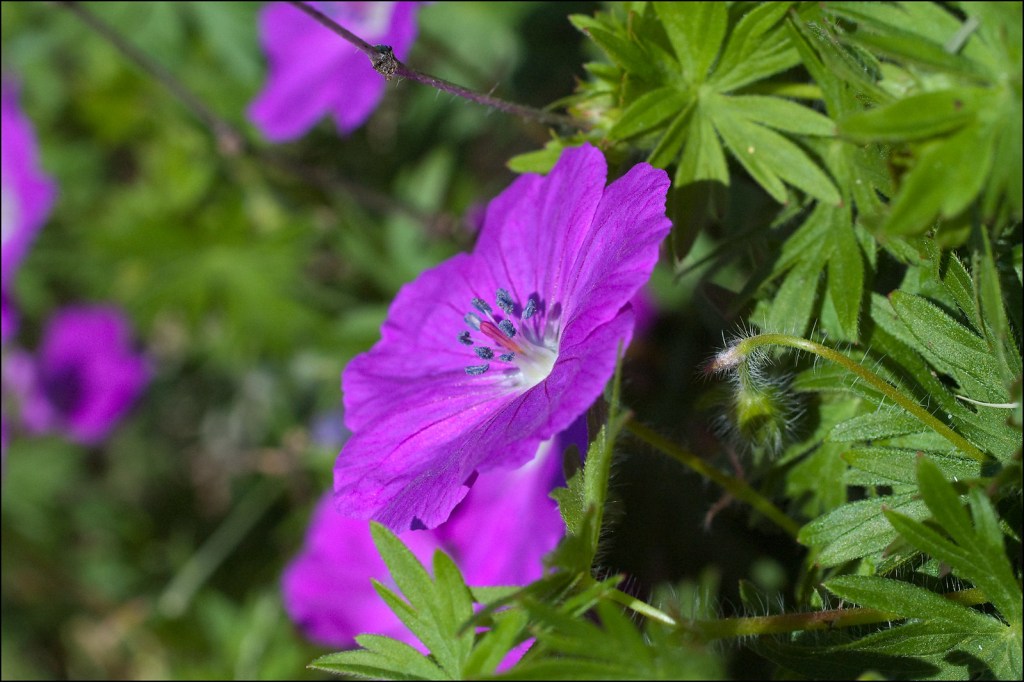
A Flower a Day for January: Cranesbill

Cranesbill, photo by joeldinda.

Because we need flowers in January.
~Joel Dinda

One of my favorite things about Michigan in Pictures is that sometimes I learn things that I really am not intending to learn. Such is the case today when I picked my favorite of Joel’s photos to highlight this year’s edition of his perennial feature, A Flower a Day for January. Joel started this in January of 2006, and every day he posts another flower to his flickr photostream.

The Wikipedia entry for Geranium sanguineum explains that it’s the county flower of Northumberland, commonly called Bloody Cranesbill or Bloody Geranium. The Geranium entry says that the genus name is derived from the Greek géranos meaning crane) and has a note:

The genus name is derived from the Greek γέρανος, géranos (meaning crane). The English name “cranesbill” derives from the appearance of the fruit capsule of some of the species. Species in the Geranium genus have a distinctive mechanism for seed dispersal. This consists of a beak-like column which springs open when ripe and casts the seeds some distance. The fruit capsule consists of five cells each containing one seed, joined to a column produced from the centre of the old flower. The common name cranesbill comes from the shape of the un-sprung column, which in some species is long and looks like the bill of a crane. Many species in this genus do not have a long beak-like column.

…Confusingly, “geranium” is also the common name of members of the genus Pelargonium (commonly known as ‘storksbill’ in distinction from ‘cranesbill’), which are also in the Geraniaceae family. Linnaeus (Swedish botanist Carl Linnaeus) originally included all the species in one genus, Geranium, but they were later separated into two genera by Charles L’Héritier in 1789.

Check this out background bigtacular More Flower a Day posts on Michigan in Pictures & see more in Joel’s 137 photo and growing A Flower a Day for January (x5) slideshow.

Support Michigan in Pictures with Patreon

Into the Icy Void at the Eben Ice Caves

Into the icy void

Into the icy void, photo by Anapko.

I know that winter is here when the searchers start showing up – 50 or 100 or more each day – for the Eben Ice Caves. In our first post on the Eben ice caves, Northern Michigan University professor Dr. John Anderton (who I got to know by chance this spring) explained that the Eben Ices Caves are located just a few miles north of the little town of Eben, within the Rock River Canyon Wilderness Area.

Within its interior there are two short user-developed trails (totaling about 1.75 miles) leading to Rock River Falls and the Eben Ice Caves. An estimated 1,700 people visit the area annually (USFS records) …

The Ice Caves are not true caves at all. They consist of walls or vertical sheets of ice that form across the face of overhanging rock outcrops. In the summer, small unimpressive waterfalls and groundwater seeps may found along the overhangs. In the winter, however, the water hits the cold air, drips downward under the influence of gravity and freezes, creating spectacular ice caves. Each winter they look a little different, but typically there are openings in the ice that allow you to walk behind the ice walls.

The rock overhangs, where the ice caves form, consist of outcrops of Munising Formation (Cambrian) with a capstone of AuTrain Formation (Ordovician). The outcrops are found along the south side of the valley of Silver Creek, which is part of a network of secondary glacial drainage channels that formed during the Marquette Advance (about 10,000 years ago). Theses secondary drainage channels flowed easterly into the AuTrain-Whitefish Channel, a primary glacial meltwater channel that flowed south to the Lake Michigan basin. Groundwater naturally seeps from these rocks, providing the water necessary to form the ice caves in the winter.

Check this out background big and definitely do not miss Anapko’s Eben Ice Caves slideshow which includes a lot of great, wallpaper sized views and also a sign with more about this incredible natural wonder!

Michigan in Pictures turns six

NC0B8495-Edit-Edit-2-1

NC0B8495-Edit-Edit-2-1, photo by [DennisT].

On December 30, 2005 Michigan in Pictures posted its first photo, a pond on Bald Mountain. 1881 posts later, Michigan in Pictures is still one of the highlights of my day.

I simply love this blog. The experience of looking through the photos shared in the Absolute Michigan pool and learning about Michigan’s waterfalls and lighthouses, points of interest like the Eben Ice Caves or Big Boy Graveyard, and everything from the history of our state to the mysteries of the northern lights is one of the most enriching and rewarding pursuits in my life.

Thanks for sharing it with me.

Dennis took this shot in Saugatuck. See it background bigtacular or in his slideshow.

Much more Michigan wallpaper can be found on Michigan in Pictures!

The Lake in Winter

DSC_0136

DSC_0136, photo by jsorbieus.

It changes every day, every hour. It is a thousand lakes, changing faces with every shift in wind and light – flurried by offshore wind, whitecapped in squalls, colored flannel gray or pearl-white or stormy black beneath the winter clouds, a dozen blues when the sky is blue.
~Jerry Dennis on Lake Michigan

Over on Absolute Michigan today we have an excerpt from The Windward Shore, the new book from Michigan outdoor writer Jerry Dennis. It’s titled The Lake in Winter and you should definitely take the time to read it!

Check this out background big and see more shots of the Lakeshore in winter in Jim’s slideshow.

More winter wallpaper on Michigan in Pictures!