Mighty Michigan Maples vs Acid Rain

mighty maple

mighty maple, photo by aimeeern.

“Though a tree grows so high, the falling leaves return to the root.”
– Malay proverb

A couple of weeks ago we reported on the threat to Michigan Eastern Black Walnut trees from Thousand Cankers Disease, but apparently they’re not the only significant Michigan tree in peril. Now the Wall Street Journal is reporting that scientists are warning that acid rain will damage Great Lakes maples in the coming decades:

Sugar maple abundance already has dropped in parts of the northeastern U.S. and southeastern Canada over the past 40 years, primarily because of high acid levels in soils. The upper Great Lakes have mostly escaped the damage because the area’s soils are rich in calcium, which provides a buffer against acid.

But in an article published this month in the Journal of Applied Ecology, scientists said they had discovered another way that acid rain harms sugar maple seedlings in upper Great Lakes forests.

It causes excessive nitrogen buildups that prevent dead maple leaves from decaying after falling to the ground, hampering growth of new trees, said Donald Zak, a professor of ecology and evolutionary biology at the University of Michigan.

“The thickening of the forest floor has become a physical barrier for seedlings to reach mineral soil or to emerge from the extra litter,” Zak said. “What we’ve uncovered is a totally different and indirect mechanism by which atmospheric nitrogen deposition can negatively impact sugar maples.”

If you’re into plant biology, you might enjoy Simulated N deposition negatively impacts sugar maple regeneration in a northern hardwood ecosystem from the Journal of Applied Ecology. If you’re into fall color or maple syrup, you might enjoy encouraging your elected representatives to take action to protect the future of these glorious trees.

Check this out big as a maple tree and in Amy’s autumn slideshow.

More beautiful maples can be found in our fall wallpaper archives.

Petit Portal and the geology of Pictured Rocks

DSC00824_tonemapped

DSC00824_tonemapped, photo by ansonredford.

While Petit Portal – also called Petit Arch and Arch Rock by some – is often confused with the partially caved in Grand Portal, it’s a smaller and as yet intact formation. You can read about some of these from the Pictured Rocks National Lakeshore website. The two arches (and many cave structures) are formed by the powerful action of Lake Superior waves on the soft sandstone that underlies the harder layers above.

You can read more about the geology of Pictured Rocks from Oh Ranger! (a cool site I just found today) and also this PDF on geology from the Lakeshore. If you want to see them up close, the boat tours from Munising are worth every penny.

Donald took this 5 years ago. Check it out background bigtacular and in his stunning Pictured Rocks Nat’l Lakeshore slideshow which includes some jaw-dropping shots of Chapel Rock and even a look from inside Petit Portal.

Much more on the Pictured Rocks on Michigan in Pictures.

Coming Home

Iraqi child won't let go of Mich. Guardsman

Iraqi child won’t let go of Mich. Guardsman, photo by The National Guard.

The Iraq War began on March 20, 2003 and was formally ended yesterday, December 15, 2011. At 8 years, 9 months it was longer than Vietnam, longer than World War II. This Detroit Free Press article on the costs of the war in Iraq says they include 4,487 dead and 32,226 wounded Americans and over 100,000 Iraqi dead. Michigan’s contribution was at least 159 dead and 1,000 wounded, according to Pentagon records. Military Times has the number at 216, and you can see the list of Michiganders who gave their lives in the Iraq War.

Retired Marine and Iraq vet Steve Maddox says that veteran’s challenges are just beginning and cannot be answered by yellow ribbons or catchy sloganeering. In addition to combat injuries and frightening suicide rates he writes:

I see post-Iraq War challenges that are as big, if not bigger than those we faced as a nation for the past eight years. Iraq and Afghanistan veterans face higher unemployment rates than their contemporaries. In Michigan, with an overall unemployment rate hovering around 10%, Iraq and Afghanistan veterans’ unemployment rate is over 29%, by far the highest in the country.

One of the articles I read noted that we’re not leaving Iraq in very good shape. The Iraqi Hope Foundation was founded by Michigan Tech alum and Iraq veteran Major Don Makay. The foundation seeks to honor the sacrifices of veterans by building stability and prosperity of Iraq through investment in small and mid-level businesses. Read more about it right here.

About this photo, the National Guard says:

U.S. Army Sgt. Thomas Loyd, assigned to Foxtrot Company, 425th Infantry (Long Range Surveillance), Michigan National Guard, based in Selfridge, Mich., holds hands with an Iraqi child in Sununi, Iraq, Oct. 29, 2009. Loyd was standing outside the mayor’s office while a meeting was taking place when the child attached himself to Loyd and would not let go. (U.S. Navy photo by Mass Communication Specialist Carmichael Yepez/Released)

See it background big and see a few more in their Michigan slideshow.

Mittengate in the Mitten State

Michigan at the Archive of Michigan

Michigan at the Archive of Michigan, photo by farlane

“Sometimes you got to put your foot down, or your mitten, so to speak.”
~Dave Lorenz, Travel Michigan

Last week the state of Wisconsin touched off a firestorm – snowstorm? – by suggesting that they might in fact qualify as a mitten state, prompting Pure Michigan to ask Who is the Real Mitten State? that for some reason we are only winning 83% – 17%. mLive has a look at the controversy that includes a the Badger’s case for Mittenhood (which appears to be no more than Mitten envy) and a really cool Vernor’s commercial with former Red Wing Petr Klima demonstrating “where it is on the hand.”

My good friend Jacob Wheeler has an excellent rundown on the Mitten Wars in which he notes that:

…the Badger state did have reason to be peeved at the Wolverine state. In 1835-36, Michigan and Ohio “fought” the Toledo War, a completely bloodless boundary dispute that resulted in Ohio getting the narrow stretch of land where the Mud Hens now play baseball, and Michigan getting three-quarters of what’s now the Upper Peninsula from Congress (it was previously considered “Indian territory”). Michigan’s gain was Wisconsin’s loss, as the western part of the U.P. would yield untold mineral wealth — and the historic Calumet Theater — over the next century and a half.

Wisconsin became a U.S. state in 1848, and contented itself with the cheese curd as its gourmet food favorite, and not the meat and potato-filled pasty, which the Finnish immigrants to the U.P. carried with them into the mines. Wisconsin’s bitterness simmered, for 175 years, like Golum clutching the ring deep in the caves of Middle Earth.

That angst finally boiled over this week when the Travel Wisconsin website posted a knit mitten shaped like the state of Wisconsin on its website as part of a winter tourism promotion campaign. Michiganders who identify themselves in the world beyond with an open-faced right hand, took the news as a humorous, yet serious, challenge.
“People in Michigan, we do identify ourselves so closely with the Mitten State,” Alex Beaton of the Awesome Mitten website told the Washington Post (seriously, the Washington Post?). We’re America’s high five!”

Jacob adds that  Wisconsin PR pro Tom Lyons suggested that “Wisconsin is the left mitten. Michigan is the right mitten. Even children know that one mitten doesn’t cut it when it comes to Midwestern winters.” Lorenz (who seems to be on fire right now) shot back “We’re not going to take this lying down. Wisconsin already took the Rose Bowl from us this year. They’re not going to take the Mitten State status from us.” Amen. Definitely read on at the Sun for more including a Michigan vs. Wisconsin matchup.

I took this photo of the 4-story map showing Michigan’s topography at the Michigan Historical Museum in Lansing several years ago. I was never able to find out who designed it, but you can see another view and check out the online tour of the museum. View this photo background big and see more from the museum in the Michigan Historical Center group slideshow.

Christmas Moon, Snow Moon, Cold Moon, Oak Moon, December Moon

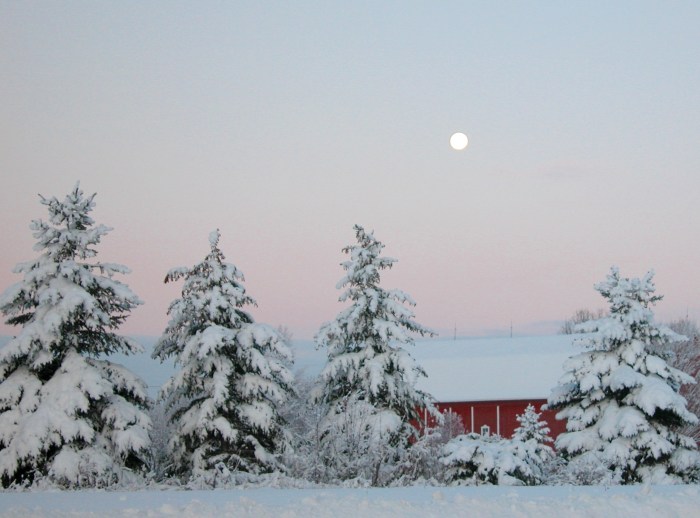
Crisp Morning in December

Crisp Morning in December, photo by CaptPiper.

The moon is officially full at 9:36 AM tomorrow morning, so tonight is the fullest moon you will get for a December night. Full Moon Names in the Farmer’s Almanac says that December’s full moon was known as the Cold Moon or the Long Nights Moon by the Algonquin.

The Full Cold Moon; or the Full Long Nights Moon – December During this month the winter cold fastens its grip, and nights are at their longest and darkest. It is also sometimes called the Moon before Yule.

The term Long Night Moon is a doubly appropriate name because the midwinter night is indeed long, and because the Moon is above the horizon for a long time. The midwinter full Moon has a high trajectory across the sky because it is opposite a low Sun.

A few other names from Wikipedia’s full moon entry and elsewhere are the Bitter Moon (Chinese), Christmas Moon (Colonial America), Snow Moon (Cherokee), and Oak Moon (England).

Check this out background bigtacular and in Julie’s Michigan Barns slideshow.

More winter wallpaper from Michigan in Pictures.

A long shot in Vehicle City

A long shot

A long shot, photo by flintstoner.

Editor’s note: Midway through writing this post, I realized that I had blogged about the Vehicle City arches four years ago. I figured that if I had forgotten, most of you probably would have forgotten too or never seen it, so here you go.

Last week Governor Rick Snyder appointed Michael Brown as Emergency Manager for Flint. You can read all about that (including some interviews) on Absolute Michigan.

When I was looking at photos for that feature, this one with all the arches on Saginaw street caught my eye so I decided to learn a little more about them. Flinn’s Journal (which is a really cool site by the way that has a dynamic Facebook page) has a column on the Flint Arches that explains:

On November 29, 2003, a part of downtown Flint’s past officially returned to become part of Flint’s present and future when the replicated Flint Vehicle City arches were dedicated and lit for the first time. The arches are reminders of Flint’s glorious past as “The Vehicle City” as the city faces an uncertain future.

The vehicles which were made in Flint when the original arches were built were horse-drawn carriages. The leading maker of horse-drawn carriages in Flint was the Durant-Dort Carriage Company which was co-founded by William C. Durant and J. Dallas Dort and was in business from 1886 to 1917. Both men would also start companies which made horseless carriages. Dort founded the Dort Motor Car Company which was in business from 1915 to 1923. Dort Highway was named in his honor. Durant took over the then-small Buick Motor Company in 1904 and made it the leading motorcar company in 1908, the year that Durant founded Buick’s parent company General Motors Corporation. The first arches were erected in 1899 and built by Genesee Iron Works.

The arches were each fitted with 50 light bulbs which were illuminated at night. The arches replaced gas lighting. To celebrate Flint’s Golden Jubilee in 1905, an additional arch was erected near the point where Saginaw Street and Detroit Street (now M.L. King Ave.) split off north of the bridge over the Flint River. This arch was topped off by an illuminated sign saying “FLINT VEHICLE CITY”. For the Christmas holiday season, the regular light bulbs were replaced by multicolored light bulbs.

Click above to read more and see some photos. The arches were fabricated by Bristol Steel of Davison Michigan – check their site for photos and video of the installation. You can see some cool old photos at the Flint Vehicle City Arches site too.

Check this out background bigtacular and in flintstoner’s Flickriver.

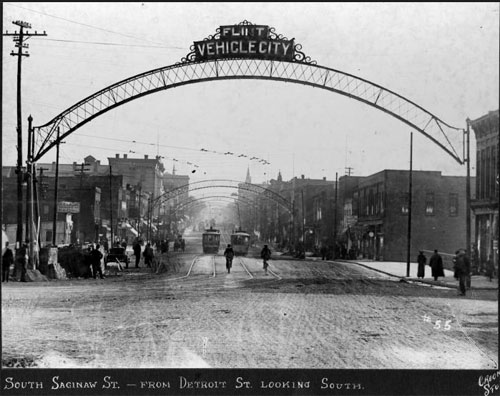
Below is a photo by Arthur Crooks from the excellent Making of Modern Michigan gallery showing the Vehicle City Arch erected in 1905 as part of the City’s 50th anniversary. The caption of the photo says “South Saginaw St from Detroit Street looking South” while the description says it’s on Saginaw Street looking north. Can anyone clarify this?

The Grand Traverse Lighthouse

The Grand Traverse Lighthouse [2/2]

The Grand Traverse Lighthouse [2/2], photo by jimflix!.

The Grand Traverse Lighthouse is located at the tip of the Leelanau Peninsula in Leelanau State Park. If you have a lighthouse buff on your holiday list, you might consider a volunteer lightkeeper position in winter or summer at the light.

Construction of the Lighthouse was approved in 1849 at the northern tip of the Leelanau Peninsula at Cathead Point, the northern point of the important Manitou Passage and Grand Traverse Bay.

The Grand Traverse Lighthouse page from Terry Pepper’s Seeing the Light notes that – as was often the case with lighthouses constructed under the “fiscally tight-fisted Pleasonton administration” – work was shoddy and:

The old tower and dwelling were demolished in 1858, and a work on a new structure began on higher ground on the point. Over that summer a dirt-floored cellar with rubble stone walls was excavated and a two-story Cream City Brick keepers dwelling took shape. A short square wooden tower with white painted clapboard siding was integrally mounted at the center of the roof ridge, and both floors contained four rooms, with a centrally located entryway with stairs connecting the two floors. A narrower second set of stairs on the second floor led through the attic into the tower. The building featured first-class construction, with hardwood floors throughout and varnished wooden trim and wainscoting.

Atop the tower, a cast iron lantern with copper sheathed roof contained a new fixed white Fifth Order Fresnel lens illuminated with a sperm oil fueled lamp. With its ventilator ball standing 48 feet above the structure’s foundation, the building’s location on high ground provided a focal plane of 103 feet, and a range of visibility of 12 miles in clear weather.

Read on for much more and some historic photos. You can see more old photos of the Grand Traverse Light in the Lighthouse collection at the Michigan Arvchives.

Check this out background big and in Jim’s Lighthouses slideshow.

There’s a whole bunch more Michigan lighthouses at Michigan in Pictures!

Where does Michigan begin?

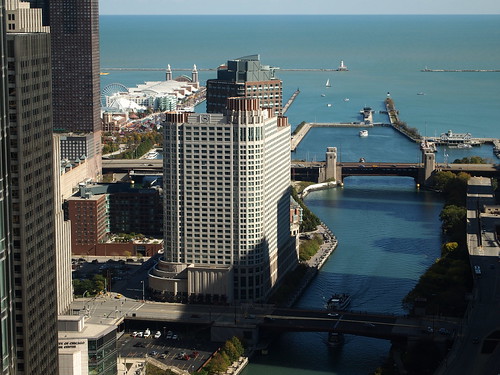
Perkins + WIll 35
Perkins + WIll 35, photo by orijinal

The headline of Gary Wilson’s editorial at the Great Lakes Echo caught my eye this morning: Great Lakes: A ship with no name in search of a captain. Gary begins:

In the past two weeks Chicago has been the center of a rare commodity in the Great Lakes region: Forward-looking thought. And I mean the future, not just until the next election or fiscal year.

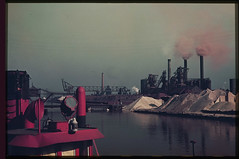
P-17= Steel Mills at mouth of Calumet river Chicago. Fire and boat at left. C.W. Cushman Nedill
Steel Mills at mouth of Calumet river Chicago by IMLS DCC

First, architect and MacArthur Foundation “Genius Award” winner Jeanne Gang presented her vision for transforming the Chicago River from that of an “open sewer” and invasive species highway to becoming a model of a 21st century urban waterway.

Gang’s proposal is conceptual, not an engineering plan. It’s meant to generate interest by the public and discussion that has been lacking. And judging by the large crowd that came to hear her speak, that interest exists.

At the same time Chicago Public Radio was also looking to the future.

Its Front & Center series that focuses on the Great Lakes hosted a one hour program about whether the region can truly collaborate for the greater good of the eight Great Lake states. Or will it continue to play in a zero sum economic game by competing with each other while the region’s combined strengths go untapped?

The consensus of the expert commentators is that the region’s governors see no political gain by collaborating. They’re focused on winning the jobs takeaway game that makes for nice press releases and ribbon cutting ceremonies when they win, but does nothing to strengthen the region.

Excellent questions. Read on for his thoughts about where the leadership to protect the amazingly interconnected wonder that are Lakes Michigan, Huron, Superior, Erie and Ontario may (or may not) come from .

There’s no doubt that it will take all the states on the lakes and the governments of the United States and Canada and their citizenry to do it. I’m pretty confident that the character & vision of our leaders and all of us on the Great Lakes will be important to generations yet unborn.

Turning Basin
Turning Basin by mindfrieze, photo by mindfrieze

Editor’s note: this isn’t the first time that Michigan in Pictures has featured multiple photos – more in the Sunday Study section. These also aren’t the first photos from outside of Michigan’s borders to appear on Michigan in Pictures – at least one is the Christmas Ship at the dock in Chicago.

Get Ready for a Cold Winter, Michigan

Untitled

Untitled, photo by Anapko.

“Harsh, brutal, snowy and cold. What other adjectives can I use?”
~AccuWeather.com meteorologist Henry Margusity

I’ve been sitting on this Detroit News feature that says Old Man Winter will pack a wallop in Michigan this year. The Farmers Almanac winter outlook for the upper Midwest says:

Winter will be colder than normal, especially in February. Other cold periods will occur in mid- and late December and mid- and late January. Precipitation and snowfall will be below normal in the east and above normal in the west. The snowiest periods will be in early and mid-December, early to mid-February, and mid-March.

Get your computer background ready for the season with Michigan Winter Wallpaper from Michigan in Pictures!

Check this out background big and in Anapko’s Ice Storm 2011 slideshow.

That old chestnut: American Chestnuts in Michigan

Beautiful Chestnuts

Beautiful Chestnuts, photo by jpwbee.

Happy Thanksgiving everyone!

Wikipedia’s entry for the American Chestnut (Castanea dentata) explains that this large, deciduous tree of the beech family was once one of the eastern United States dominant hardwoods before it was nearly wiped out by chestnut blight. Curiously enough, one of the few pockets to survive were some 600 to 800 large trees in northern lower Michigan. I couldn’t find much about these trees other than that reference, so if anyone knows something about that, post it in the comments!

I do know that Chestnut Growers, Inc. is a 37 member cooperative based in Michigan with members in Lower Michigan and Washington state. Their page on sweet chestnuts says that:

In Europe, chestnuts are consumed in a wide variety of dishes, from soups, stews, and stuffing to fancy deserts. Matter of fact, chestnut flour is the secret to many of the fancy French pastries. In other parts of the world, such as China, the chestnut is a staple food in the peoples’ diet. Chestnuts have about half the calories of other nuts and have the lowest fat content of all the main edible nuts. Chestnuts have only four to five percent fat as compared to sixty-two percent for the hazelnut and seventy-one percent for the pecan. In composition and food value, the chestnut, with its high carbohydrate content of about seventy-eight percent, is more akin to cereal grains, such as wheat, than to nuts with a low carbohydrate content. Since chestnuts are starchy rather than oily, they are readily digestible when roasted or boiled.

Read on for more and suggestions on cooking. They take orders for fresh chestnuts and ship beginning in October, and are at farm markets through the fall. You can also but them online through Michigan-based Earthy Delights. I found a recipe for Michigan chestnut pie that looks tasty too.

Julie bought these Michigan-grown beauties at Zingermans. Check them out background bigalicious and see more in Julie’s Food slideshow.