Set your backgrounds for spring

Macro Crocus

Macro Crocus, photo by MightyBoyBrian.

Brian shot this on yesterday’s toasty-warm and not very March-like Sunday and writes:

Go ahead, set your background. I declare that it’s spring. The flowers think so and I do too.

I was slithering around on the ground with my new macro lens (EF format vs EF-S with canon full-frame) to get up in close with this patch of crocuses.

Here’s a tip: instead of a typical green or brown backgound, position yourself so that other flowers are in the background of the scene giving their color to the awesomeness.

Good advice, Brian, and with highs predicted for Wednesday in the SEVENTIES around Michigan, you might need to find us a strawberry so we can go directly to summer…

Check his photo out background big or settle back for his bokeh slideshow.

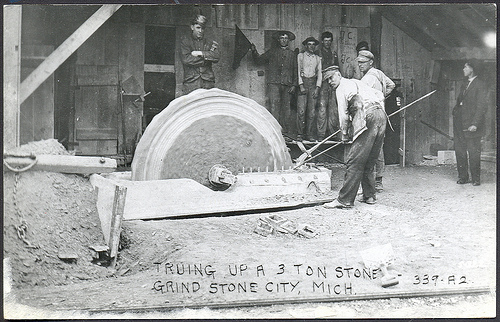
Truing up a 3 ton stone in Grindstone City

Grindstone City MI Lake Huron Village home to the old Grindstone Quarry LL Cook Card S322 1935 vintage Stamp Box Unsent

Grindstone City MI Lake Huron Village home to the old Grindstone Quarry LL Cook Card S322 1935 vintage Stamp Box Unsent, photo by UpNorth Memories – Donald (Don) Harrison.

“Grindstone City received its name in 1870. It happened in this way. Mr. James Wallace, one of the owners of the quarry at that time was talking to Mrs. Sam Kinch Sr., when she remarked that the village was growing so fast that it ought to have a name. They were discussing Stonington as a name when Mrs. Kinch suggested Grindstone and Mr. Wallace added City and from then on the village has been known as Grindstone City.”
from Mabel Cook’s “History of Grindstone City, New River and Eagle Bay” (1977).

The excellent history of Grindstone City from the Michigan State University, Department of Geography tells the fascinating story of the Huron County town that was once where the world turned for grindstones. This was due to the particular qualities of “Grindstone”, a special rock formation from Marshall Sandstone that made the finest sharpening stones. It all began:

In the year 1834, Capt. Aaron G. Peer, with his Schooner, the Rip Van Winkle, was forced to take haven in this natural harbor, during a storm. Capt. Peer is known as the “father” of Grindstone City, and located the first land in what is now Huron County. The sloop took anchorage here in a storm, and that Capt. Peer, his crew and his father came ashore to what was then a wilderness of pine, cedar, ash, beech, and maple, the cedar being so thick that snow remained in places although it was midsummer. In their exploring they found some big flat stone along the beach and on further examination, found evidence that these strata of rock was underlying the area to a lesser or greater extent . Samples were taken to Detroit where they were found superior to the Ohio flagstone which city officials were planning to use to pave some of the streets.

…On one trip, the sailors rigged up in a crude fashion a stone slab and used it to sharpen their tools. That year (1838) Capt. Peer, getting the idea from the sailors began shaping the grindstones at the place later known as Grindstone City.

Definitely read on to learn about the process that produced the grindstones from quarry to turning the stones shown above and ultimately to market.

One of the most commented posts on Michigan in Pictures is Not much remains of Grindstone City which featured a photo of one of the few remaining grindstones by Marty Hogan on a beach that was once covered in them. Here’s the Google Earth of Grindstone City, and there’s also a Grindstone City Facebook page with some photos and folks sharing memories and photos.

Don says the postcard above is from 1935. View it background big or settle back for his Grindstone City postcard slideshow.

Michigan Wild & Scenic Rivers: Manistee River

Ox Bow on the Manistee River

Ox Bow on the Manistee River, photo by jimflix!.

Michigan has 16 nationally designated Wild & Scenic Rivers. The Wild & Scenic Rivers Act of October 2, 1968 provided for federally designated rivers that “possess outstandingly remarkable scenic, recreational, geologic, fish and wildlife, historic, cultural or other similar values.” A 26 mile section of the Manistee River was added in 1992 from the Michigan DNR boat ramp below Tippy Dam to the Michigan State Highway 55 Bridge. On the Manistee’s page at the Wild & Scenic River website they say:

The Manistee Wild and Scenic River is well known for beautiful scenery, excellent fishing and a variety of recreational activities. In the spring and fall, high numbers of anglers are attracted to the superb salmon and steelhead runs. During the summer, walleye and pike fishing become the primary recreational activity. The river supports a variety of other recreational uses including wildlife viewing, hiking, canoeing and hunting.
Private businesses and government agencies have developed a variety of facilities and services to meet the expanding recreation demands of the public. Commercial guided fishing is one of the most popular activities on the Manistee River. The amount of recreational use fluctuates from year to year, mostly based on the fishing runs and local economic factors. There are eight developed river access sites within the wild and scenic river corridor. The Forest Service maintains sites at High Bridge, Bear Creek, Rainbow Bend and Blacksmith Bayou. The state of Michigan operates a river access site at Tippy Dam. Private recreation sites include Big Manistee Riverview Campground and Coho Bend Campground. The Forest Service developed recreation sites along the Manistee River require a vehicle parking pass under the Recreation Enhancement Act.

View this photo background big and in Jim’s Manistee River slideshow.

More Wild & Scenic Rivers on Michigan in Pictures!

Build-up: Inside the Eben Ice Caves

Build-up

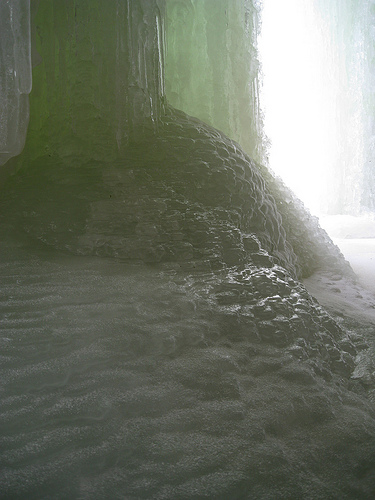
Build-up, photo by nasunto.

“The drips of water falling from above created wonderful echoes and added to the cave atmosphere. There is much variation of color and texture to the ice in different parts of the cave. Some formations were smooth and clear, others were bumpy and hollow-sounding, and there were some columns that looked like dripping candle wax.”
~Nina Asunto on being inside the Eben Ice Caves

This may be the latest I have ever posted a Michigan in Pictures. Busy, busy I guess.

Nina took this photo at the Eben Ice Caves, which are a very popular subject on Michigan in Pictures. In Monday’s Daily Michigan email (which I think you might enjoy as it is Not Too Terribly Long and also Filled With Michigan Stuff & Giveaways) we featured Nina’s video from these seasonally forming caves in the Rock River Canyon Wilderness Area.

Nona has a great blog called Black Coffee at Sunrise with writing and photos from some of Michigan’s coolest places, and her Eben Ice Caves feature is a must-read. View her photo as big as you like and see her other shots and the video in her Eben Ice Caves 2012 slideshow.

PS: Separated at birth?

Michigan Snakes: Blue Racer (Coluber constrictor foxi)

Blue Racer

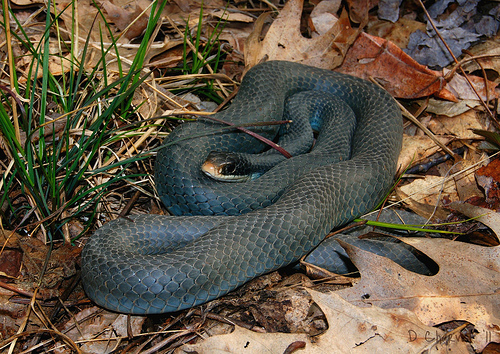
Blue Racer, photo by d charvat.

“I liked to go on the road and catch the blue racers and sort of scare my brothers,” she said. “I’d drape them around my neck and around my wrist. I was the ultimate tomboy when I grew up here in Manistee and I loved the Great Lakes. “
~Ann Romney recalling her Michigan childhood (article)

While Mitt Romney’s “the trees are the right height” memories of Michigan drew some laughter, I doubt that anyone would laugh at tomboy Ann Davies with a couple of blue racers draped around her arms.

The DNR’s page on Michigan snakes says that Michigan has 17 native species. Their Blue Racer (Coluber constrictor foxi) page explains:

A large gray or blue snake with smooth scales. The head is usually darker than the body, though the chin and throat are white. The belly is light blue or white. Young racers are grayish, with a pattern of darker blotches and spots. Adult length: 4 to 6 feet.

Racers inhabit a variety of places, including open woods, meadows, hedge rows, marshes, and weedy lake edges. They are alert, active snakes that may climb into low bushes to escape enemies. These snakes feed on rodents, frogs, smaller snakes, birds, and insects. Although they will bite if cornered or grabbed, racers are not venomous.

Females lay 6 to 25 eggs in rotting wood or underground during June and July. The young racers hatch in late summer and, as noted above, are colored differently than the adults.

Racers have been found through most of the Lower Peninsula (except the northernmost sections) and the southern tip of the Upper Peninsula. Once common, their numbers have fallen in many places. Needless persecution by humans as well as habitat loss are probable factors in this decline.

The Coluber constrictor Eastern Racer entry from Animal Diversity Web says that the blue racer is one of several different racer subpopulations and adds a lot more information and photos including that in the wild, racers have been known to live over 10 years. You can also watch a cool video of a BIG blue racer by the Saline Snake Guy.

d charvat writes that they saw this good-sized blue racer while hiking in the Middleville MI state game area. Check it out background big and see a lot more cool shots from out and about in their slideshow.

Trees such as these … Happy Birthday Dr. Seuss

Explosions in the sky

Explosions in the sky, photo by MightyBoyBrian.

He was shortish. And oldish. And brownish. And mossy.
And he spoke with a voice that was sharpish and bossy.
“Mister!” he said with a sawdusty sneeze,
“I am the Lorax. I speak for the trees.
~The Once-ler

Today is the birthday of Theodor Seuss Geisel aka Dr. Seuss. Geisel was the author of 46 children’s books and had such an impact on the genre that his birthday has been adopted as National Read Across America Day. Here’s hoping you can read something wonderful to the special young people in your life today!

While the new movie The Lorax based his book is drawing fire from both the right and the left, there’s little doubt that few people have had the kind of impact on children’s literature that he did.

You can see the Lorax trailer at the link above, and you might also want to check out the TV special from 1974 which featured voices of Eddie Albert and Bob Holt and originally included a hummingfish bashing Lake Erie with the line “I hear things are just as dreary down in Lake Erie”. In a nearly Michigan connection, twenty years later two research associates from the Ohio Sea Grant Program wrote to Seuss about the clean-up of Lake Erie and got the line removed from the book. Also see the full text of the Lorax and check out a whole world of Seussian fun at Seussville.com.

About the photo, Brian asks “What does it look like to you?” To me, it was Truffula trees. Check them out background bigtacular and in Brian’s Top 30 slideshow.

Primary Colors

Blue (Red) Yellow

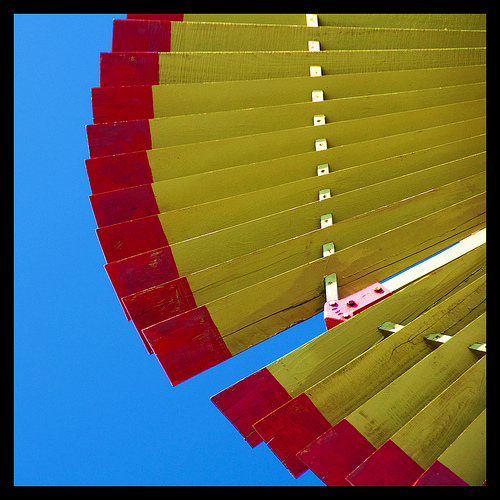
Blue (Red) Yellow, photo by Ralph Krawczyk Jr

While newspapers and television stations are probably crying today, most of the rest of us will probably be relieved to see the Republican primary in the rearview mirror at the end of the day. Get updates at our Primarypalooza on Absolute Michigan.

Check this out big as the sky and in Ralph’s Digital Goodness slideshow. Does Michigan in Pictures have more shots by Ralph? Yes, I believe we do!!

Sorting cherries … and making sense of migrant labor in Michigan

Migrant girls working in cherry canning plant Berrien County, photo by John Vachon

February is National Cherry Month and back in the day (July of 1940 to be precise), the cherry sorting machine was any able body that could tell the difference between a good and bad cherry as they sped past.

Agriculture is a vital part of the northern Michigan economy, and the League of Women Voters in Leelanau County has released an interesting study on migrant worker visas. They study contends that although the care for and harvesting of crops is a critical, labor-intensive aspect of our agriculture, Michigan workers aren’t stepping up to fill seasonal agricultural jobs, risking closure or bankruptcy for farmers and processors. The study notes that it’s an issue that’s been with us for years:

Seasonal workers have been essential to the operation of area farms since the transition from subsistence farming in the early 20th century. Agriculture was the principal livelihood for Michigan residents throughout the 1800s, but by the turn of the century, the Industrial Revolution was transforming agriculture from a small, self-sufficient family art to a large, mechanized, scientific industry. The tractor, the telephone, and the automobile revolutionized cultivation, communication, and transportation, and rural isolation was broken. Although farm conditions improved, people left the farms in droves and resettled in the cities. Rural depopulation became so severe during the 1920s that many farmers and growers had to import migrant labor.

The need for migrant labor has ebbed and flowed over the years. World War II was the catalyst for the Bracero Program, which from 1942 to 1964 brought Mexican migrant agricultural workers to the US legally. The program increased Michigan’s reliance on Mexican farm workers for harvest, and when the program ended, many workers continued to work in US agriculture.

Some crops like cherries have become largely mechanized, but apples, wine grapes and many other crops still have to be harvested by hand. Check out Migrant workers and Michigan agriculture on Absolute Michigan for a lot more about a critical issue for our farms and farmers.

You can get this photo background bigilicious and click to view the Michigan cherries gallery at the Library of Congress and you can also have a look at UpNorth Memories cherries slideshow.

The article on photographer John Vachon from the LOC’s American Memory Project says that his first job for the Farm Security Administration held the title “assistant messenger.” Vachon was twenty-one and had no intention of becoming a photographer when he took the position in 1936, but as his responsibilities increased for maintaining the FSA photographic file, his interest in photography grew. A memoir by his son quotes Stryker as telling the file clerk, “When you do the filing, why don’t you look at the pictures.”

Good advice.

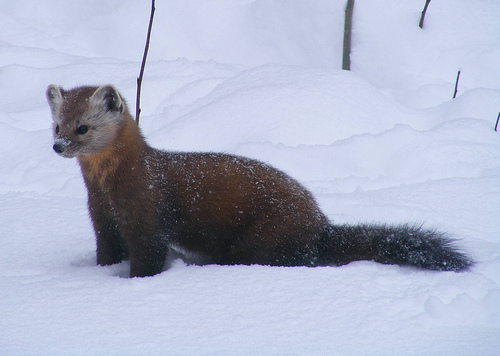
American Marten: A Michigan wildlife success story

American Marten 1

American Marten 1, photo by 13Miles.

The UM Animal Diversity web page on the American marten (Martes americana) says that American marten, also known as pine marten, are found in the northern reaches of North America and sporadically in Michigan, primarily in mature, northern forests:

These animals are closely associated with lodgepole pine, Douglas fir, spruce, and mixed harwood forests. They tend to be found in structurally complex, mature forests, and can occur at all elevations where such habitat exists. They den in hollow trees, crevices, or vacant ground burrows.

…American martens are somewhat arboreal (tree dwelling) and move with great ease in trees. They mark scent trails from tree to tree with their strong scent glands. In spite of this, they are reported to do most of their hunting on the ground. Most hunting occurs at dusk and dawn, when prey species are most active. In addition, these animals are accomplished swimmers and can even swim under water.
…Home range sizes vary considerably with habitat and prey densities. American martens do not hibernate and is active all winter.

You can read more and see pictures from Animal Diversity Web and on the American marten page at Wikipedia. The Michigan DNR’s page on the American marten says that:

According to records, the American marten was eliminated from Michigan around the 1930s. Removal of the mature evergreen forests and unregulated harvest of martens reduced the species to small populations in the Upper Peninsula. These eventually disappeared from the state. The 1927-28 Biennial Report stated, “They (marten and fisher) are so nearly exterminated in Michigan that there appears no chance they will ever come back.” Recovery efforts were initiated as early as 1958 with releases of captured martens into the Upper Peninsula Porcupine Mountains. Additional releases in the UP were conducted in the 1970s.

…Biologists have followed their progress over the years tracking pine martens to learn about their habitat use and home range needs. These studies along with sighting reports from hunters and other recreationists and incidental catches indicated the martens were readapting to their native Michigan.
During the review of the current Endangered Species List, biologists felt the population has recovered enough to upgrade its status. Martens are frequently becoming a part of the outdoor experience in Michigan with more and more encounters reported by hikers, campers, trappers, and hunters.

Once gone, the martens have returned home due to the efforts of many private organizations and agencies, but especially due to the support given by the donations of Michigan’s taxpayers to the nongame income tax checkoff.

Dixie took this photo last February around Grand Marais. Check it out bigger and see a few more shots of this beautiful animal in her marten slideshow.

More Michigan animals from Michigan in Pictures.

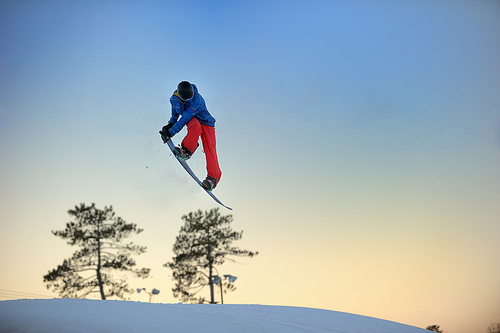
Goin’ skiing

DSC_9141copy2

DSC_9141copy2, photo by kensingt0n.

…and snowboarding. Have a great weekend!

Check this out big as this air and in Arnold’s 2/6/12 Jonas snowboarding at Pine Knob slideshow.