I was recently contracted by the Michigan Writers nonprofit organization to build a new website that will help them them bring their mission of building community for writers. The geek in me is excited about how the new site allows the organization and members to post events, announcements & opportunities that help them grow the craft of writing, while the lover of Michigan in me is amazed at how the simple inclusion of this photo by longtime Michigan in Pictures contributor Dennis Sparks perfectly transformed the look & feel of the website. In this age where AI images are supplanting actual photography, I think it’s a good thing to remember that authenticity whether in images or words or actions never loses its value.
Dennis took this photo back in September of 2022. You can see more in his Water gallery including this great photo from the beach at Ludington State Park and follow him on Flickr for his latest!!
If the forecast for mainly clear skies across Michigan’s Upper & Lower Peninsulas isn’t thrilling enough, there is a G2 (Moderate) Aurora Alert which means that Michigan has a better than usual chance to see the Northern Lights as well! I found a cool site from University of Michigan called AuroraTonight that gives you a good look at sky conditions & chances where you live.
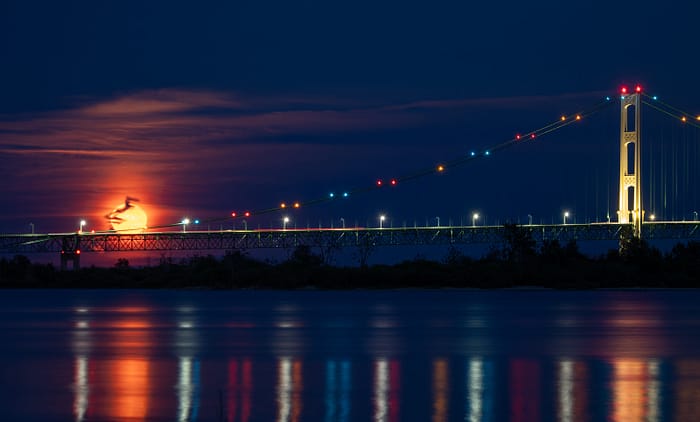
David captured this shot of the full moon rising over the Mackinac Bridge back in July of 2024. Follow him on Flickr for his latest!
PS: It’s pretty darn cool & synchronistic that the August full moon was known as the Sturgeon Moon by Michigan Natives.
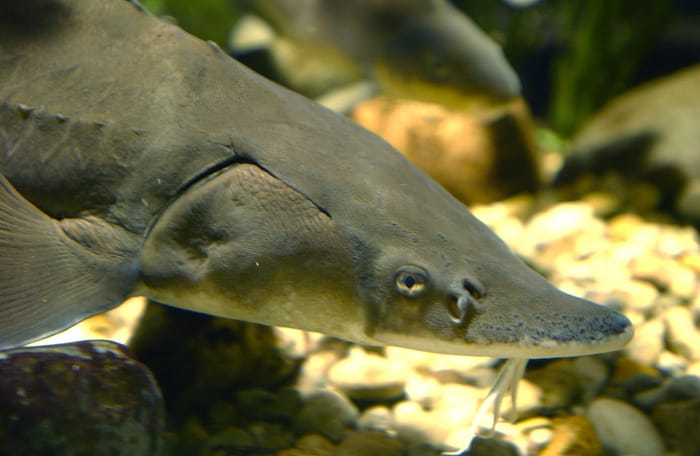
Using decades of capture-and-recapture records from five Great Lakes populations, researchers found that in some populations many lake sturgeon may routinely live well beyond 200 years, with some approaching 300 years.
“Scientists have long recognized that lake sturgeon are among North America’s longest-lived freshwater fish,” said Scott Colborne, assistant professor in Michigan State University’s Department of Fisheries and Wildlife. “But the new study suggests they may live far longer than previously appreciated. These fish are a living connection to history”.
…One conversation during the project particularly resonated with Colborne. While discussing the research with a tribal community member, he learned that some Indigenous communities had long believed lake sturgeon could live as long as 400 years. “That was one of those goosebump moments,” Colborne said. “Here we were using modern analytical approaches, and they were pointing us toward something that Indigenous communities had long understood — that these fish live incredibly long lives.“
“Summer’s lease hath all too short a date.” -William Shakespeare
Is anyone else getting the feeling that Fall is getting ready to kick Summer to the curb & take over the place?
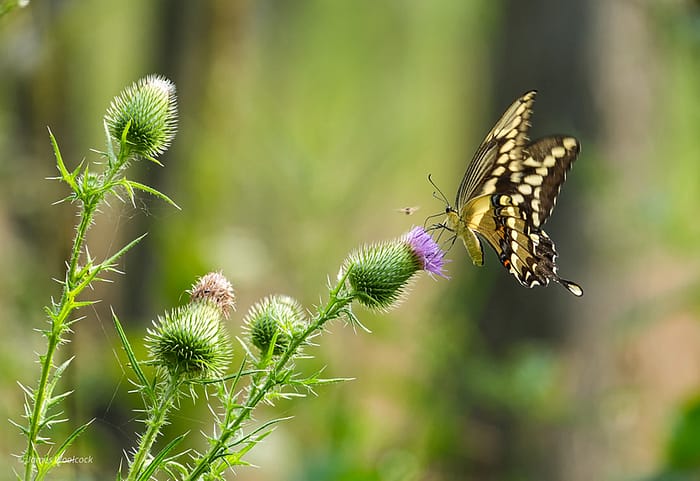
James took this photo earlier this month. He shares that it has been a summer of seeing few butterflies, so it was a delight to find this Swallowtail on his hike at the For-Mar Nature Preserve and Arboretum. See more in his awesome Genesse County Parks gallery on Flickr, and here’s hoping you’re able to grab a little more delight from the last month of summer!
If you can’t share your vision for the future of this iconic Detroit landmark in person, you can fill out the survey online.
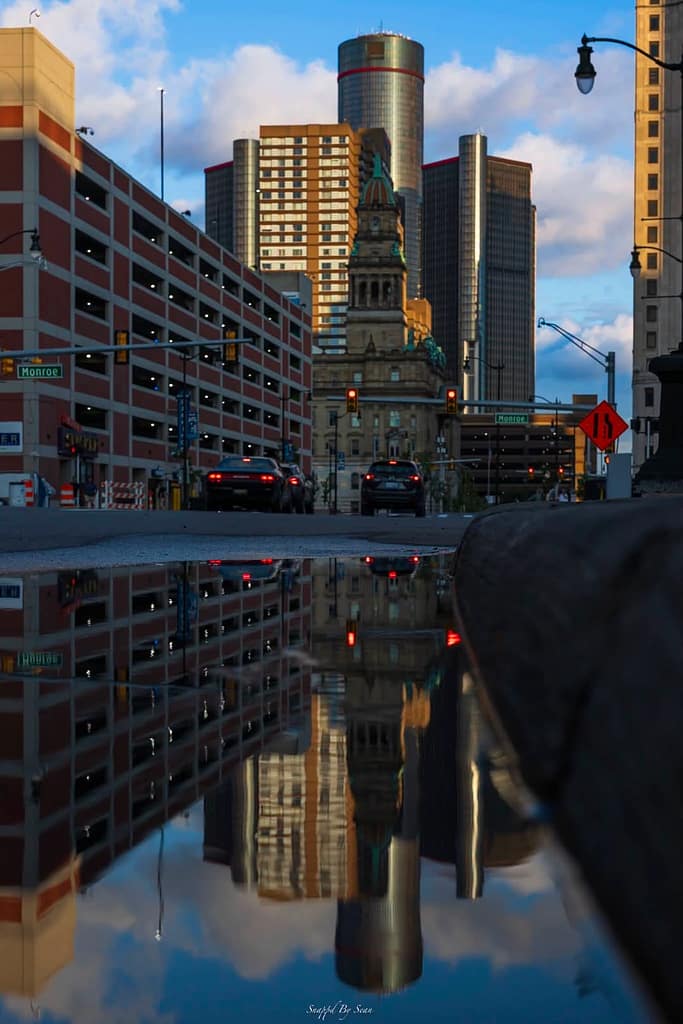
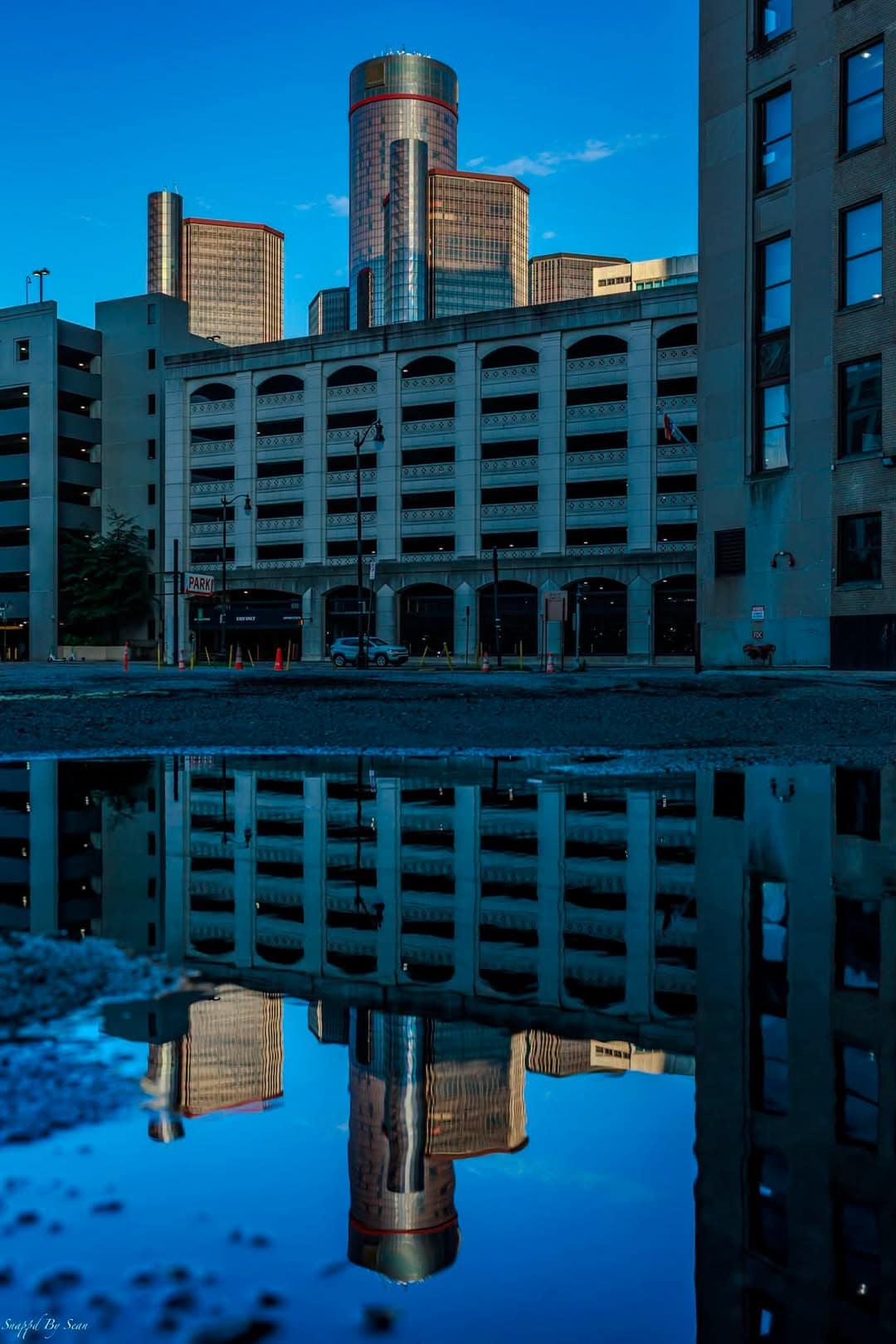
When I read about the call for input on the Ren Cen, I knew exactly which photo of Sean’s I was gonna select! I’m featuring another he took in early August and also one from a vivid colored night on Hart Plaza earlier this week! Follow Snappd By Sean Photography on Facebook or Instagram for his latest!
Stargazers on the night side of Earth (that’s us!) will catch their first glimpse of our planet’s umbra (the darkest, innermost part of its shadow) creeping onto the moon’s surface at 10:33 p.m. EDT on Aug. 27. The vast shadow will continue its advance across the crater-scarred landscape in the hours that follow, until it hits the point of maximum eclipse at 12:12 a.m. EDT on Aug. 28.
Around this time, you may notice the shadowed region of the moon take on a reddish-orange color, as sunlight filtered through Earth’s atmosphere is bent onto the lunar surface — a phenomenon often referred to as a “Blood Moon” during a total eclipse.
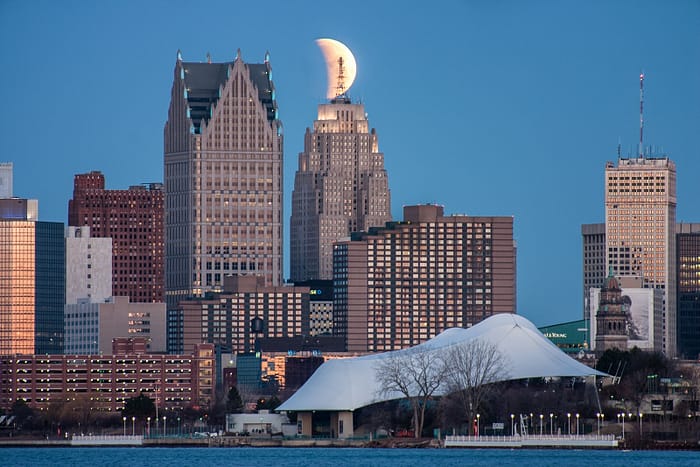
I first shared this amazing shot of a partial lunar eclipse over the Detroit skyline way back in 2015. See more great photos from Tom on Flickr.
I shared this photo waaaaaay back on August 19, 2009! Since my old posts are becoming inaccessible as the modern web leaves them behind, I’m trying to “save” at least one a week. I love Jim’s writings about the photos he takes and thought you would as well. Enjoy!
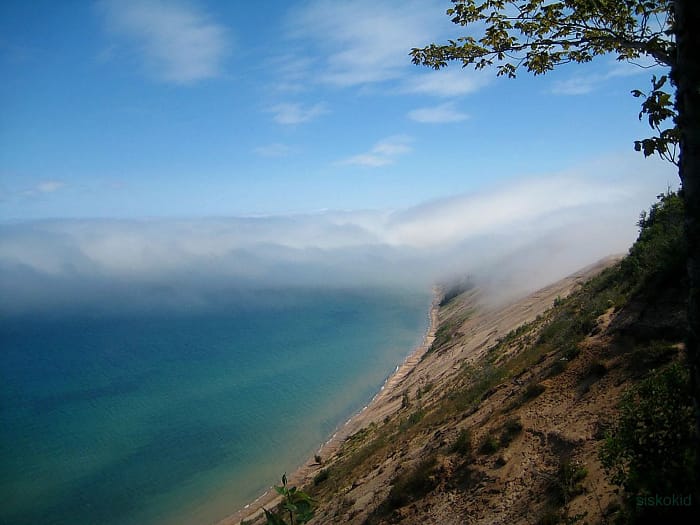
Fog rolls off of Lake Superior and up the Grand Sable Dunes on the Pictured Rocks Lakeshore as seen from the Log Slide Overlook west of Grand Marais in the Upper Peninsula Of Michigan. The Grand Sable Dunes are located on a five mile stretch between the Sable River and Au Sable Point in Alger County. The banks rise up to 275 feet high, created during the last ice age when sand and gravel filled in a deep rift in the glacier. Atop the gravelly banks, sand dunes rise another 80 feet. These are “perched dunes” because they are perched on top of another landform. They were probably formed when wind and waves piled up sand at the edge of Lake Nipissing, the forerunner of Lake Superior.
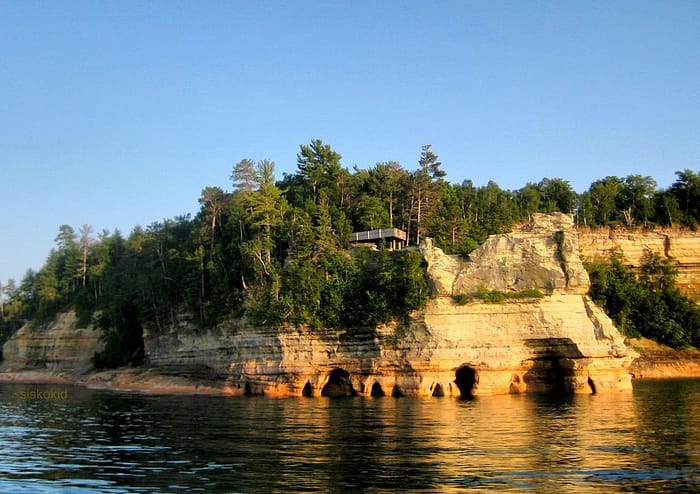
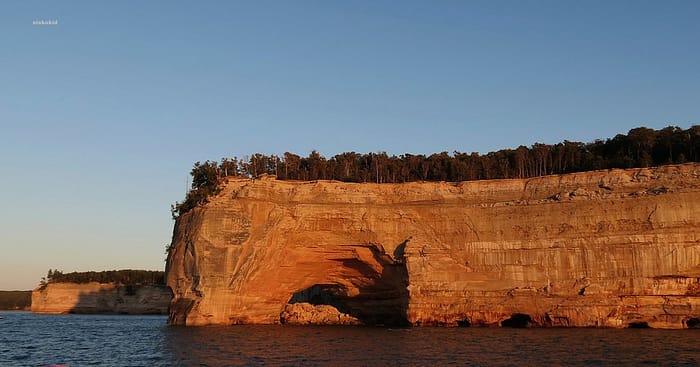
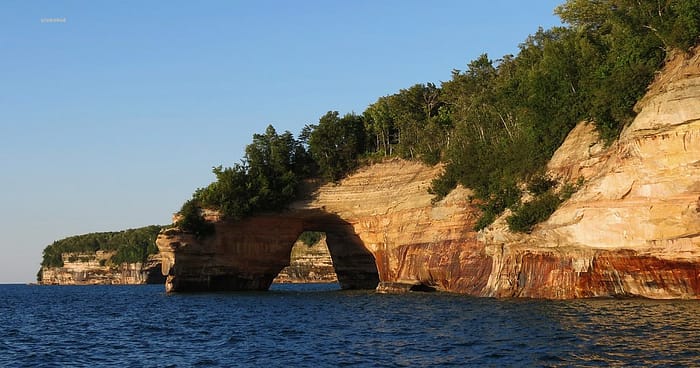
This distinct sandstone formation located on the south shore of Lake Superior northeast of Munising in the Upper Peninsula of Michigan is known as Miners Castle, for the turret-like shape caused by wind and wave erosion. Miners Castle was named by Englishman Alexander Henry’s employees when they were exploring the area for minerals in 1771. Though no minerals were ever found, the name “Miners” has endured. The nine-story-high rock formation is one of the Pictured Rocks National Lakeshore’s most popular attractions, despite the 2006 collapse of one of its signature “turrets”.Grand Portal Point is a well-known formation of rock that juts out into Lake Superior from the Pictured Rocks National Lakeshore located northeast of the Upper Peninsula town of Munising, Michigan. There was once a cavity at the end that was large enough for a good sized ship to sail through and it was perhaps a hundred feet or more in height from the surface of the water. That arch collapsed during the night of Sunday, September 16, 1900. Grand Portal Point suffered a second, significant collapse sometime between the fall of 1999 and spring of 2000. The arch is still there, but there’s now a rubble pile in the bottom large enough to inhibit any water traffic.My wife and I visited the Upper Peninsula town of Munising, Michigan recently and took a sunset cruise on Lake Superior to view the famous Pictured Rocks. One of the tour’s highlights is this imposing arch of rock that extends from the shoreline out to an outcropping located directly in Lake Superior. Lore has it that a couple displayed their love for one another by jumping off the top of this rock arch together.
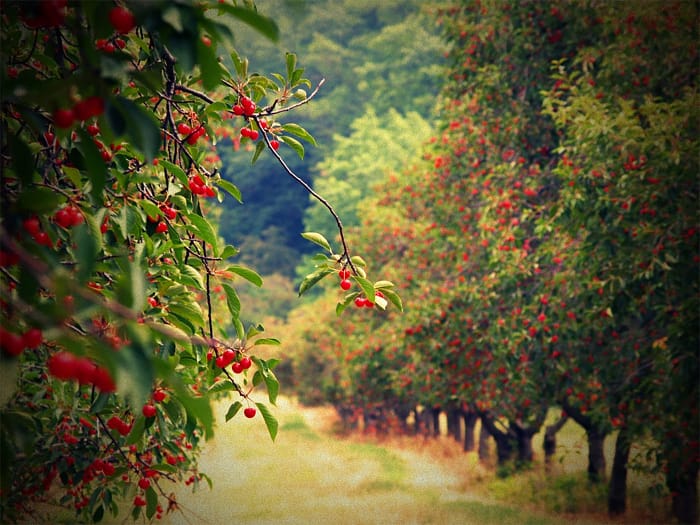
Michigan, the state famous for its cherries, has been reaching out for months with concerns about proposed AI data centers in local communities.
I’ve heard from residents in Marshall, Saline Township, Lowell, Dowagiac, Dorr, and many other towns. People are very engaged and asking important questions. The issues being raised echo what we’ve seen nationwide: water impacts/rights, utility costs rising, 765kV transmission lines, rezoning disputes, NDAs, zero transparency, among other issues.
She adds that she appreciates everyone who has shared information through the Brockovich AI Data Center Reporting website. They are working to raise community awareness nationwide about the fast-moving wave of data centers & how communities are working to block them or shape the impact on their water and power resources and the the fabric of their communities.
Please consider all of that before you uncork your brainless “how come you still use computers & the internet” attack on a person who has been using the internet to share stories since you had to capitalize Internet. If you do want to ride for Artificial Intelligence, I encourage you to educate yourself about the Facts & Myths around AI datacenters.
July averaged 76.89 degrees Fahrenheit (24.94 degrees Celsius) across the Lower 48 states, eclipsing the Dust Bowl’s July 1936 by an eighth of a degree. Records go back to 1895.
“It’s not good when you’re breaking records from the Dust Bowl, which we are in this case,” said meteorologist Jeff Masters of Yale Climate Connections. “And that was a crazy sort of situation where you put tens of millions of people in motion. You had this great migration because of the drought and the heat that hit the center of the U.S. — just a cataclysmic event in U. S. history. If we’re exceeding records from The Dust Bowl, that says that we’re in deep trouble.”
Although it was unusually cool in Alaska, hotter-than-normal conditions blanketed the Lower 48, with the most excessive heat in the Mountain West, Southwest, Northern Plains and Southeast. The heat was so widespread that every one of the Lower 48 states was at least 1 degree Fahrenheit (nearly 0.6 degrees Celsius) warmer than the 20th century average, said Russ Vose, chief of monitoring at NOAA’s National Center for Environmental Information.
The heat in the Dust Bowl years was more concentrated in parts of the Midwest and was aggravated by agricultural practices at the time, Vose said. What’s happening now is due to the burning of coal, oil and gas, scientists said.
“Extremely high temperatures across the continental U.S. this summer, along with intense drought and fire conditions, are absolutely consistent with the climate change signal,’ said Katharine Jacobs, a climate scientist at the University of Arizona.
If you’ve been following Michigan in Pictures for a while, you probably recognize Corey Seeman as Michigan’s leader in squirrel photography. Corey shared this photo back in the summer of 2021. See his latest on Flickr!