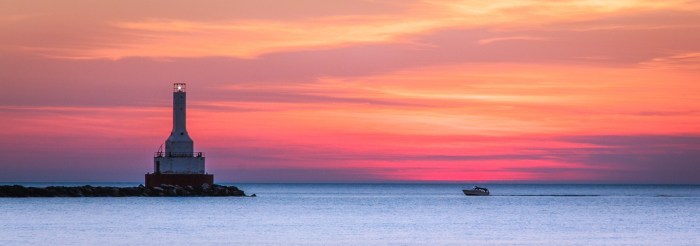
Houghton’s Keweenaw Upper Entrance Lighthouse

Keweenaw Upper Entrance Lighthouse Houghton Michigan

Homeward Bound, photo by Bobby Palosaari

Terry Pepper’s Seeing the Light is my go-to for Michigan lighthouse lore. His entry for the Keweenaw Upper Entrance Lighthouse says in part:

With the meteoric growth of copper mining in the Keweenaw between 1843 and 1968, increased shipping access to the twin cities of Houghton and Hancock became increasingly important. To this end, the Portage River Canal was cut through a tamarack swamp at its western end in 1860, creating a channel 10 feet deep and 80 feet wide, opening full Portage River navigation for the largest vessels of the day from western Lake Superior.

In 1874, to assist in safely guiding ships into this cut, a large gabled two-story brick dwelling with attached square 33 foot high brick tower was constructed on the west bank at the entrance to the canal. With increasing use of the canal, silting became a major problem, and tolls were levied for its use in order to cover the continuing expenses for repairs and dredging.

For reasons as yet undetermined, the original lighthouse was replaced with the existing fifty foot square steel Art Deco style tower at the end of the breakwater in 1950.

View Bobby’s photo background bigtacular and view & purchase more of his photos including this one at palosaariphotography.com.
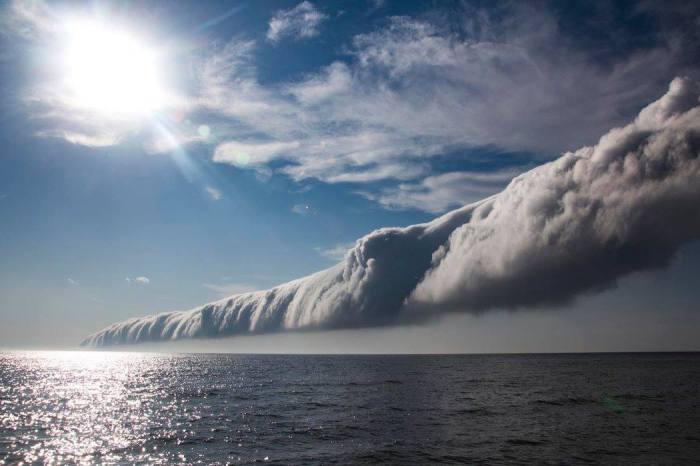
The Vortex: Roll cloud over Lake Michigan

Vortex Cloud

The Vortex, photo by Nick Nerbonne

My corner of Northern Michigan was all abuzz last weekend due to a relatively rare meteorological phenomenon known as a “roll cloud.” Wikipedia’s entry on Arcus clouds explains:

An arcus cloud is a low, horizontal cloud formation. Roll clouds and shelf clouds are the two types of arcus clouds. A shelf cloud is usually associated with the leading edge of thunderstorm outflow; roll clouds are usually formed by outflows of cold air from sea breezes or cold fronts in the absence of thunderstorms.

…A roll cloud is a low, horizontal, tube-shaped, and relatively rare type of arcus cloud. They differ from shelf clouds by being completely detached from other cloud features. Roll clouds usually appear to be “rolling” about a horizontal axis. They are a solitary wave called a soliton, which is a wave that has a single crest and moves without changing speed or shape.

View Nick’s photo background bigscroll through his pictures on Facebook, and watch this time-lapse of the cloud…

Sunset rainbow over Lake Michigan

Frankfort Rainbow

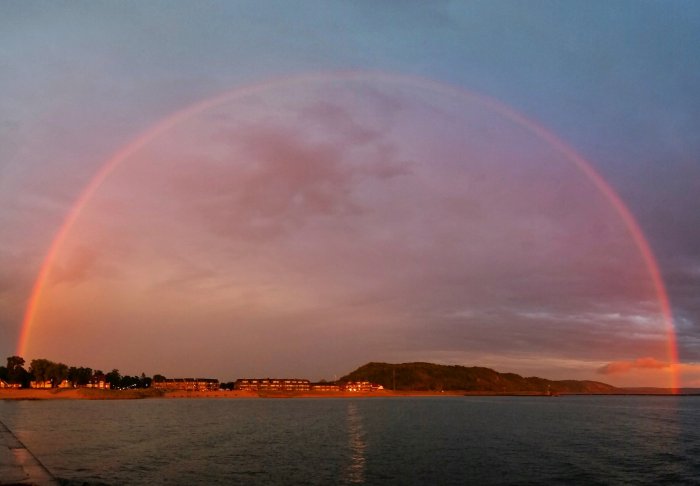
The best rainbow I’ve ever seen last night over Frankfort, photo by Noah Sorensen

Atmospheric Optics from the UK is far and away the best website for rainbow science as well as other atmospheric optical phenomena. Regarding primary rainbows as seen in Noah’s photo from Frankfort, they say:

To see a rainbow we need sunshine and falling rain. Rainbows are rarer than might be thought … Halos occur much more frequently.

Early morning and late afternoon are the best times to see them because the sun must not be too high. Rainbows are always opposite the sun and their centres are below the horizon at the the antisolar point. The lower the sun the higher is the bow.

Red is always outermost in the primary bow with orange, yellow, green and blue within. Occasionally, when the raindrops are small, fainter supernumerary arcs of electric greens, pinks and purples lie just inside the main bow.

A rainbow is not just a set of coloured rings. The sky inside is bright because raindrops direct light there too. The primary bow is a shining disk brightening very strongly towards its rim.

View Noah’s photo background bigilicious, see more in his slideshow, and be sure to follow him on Instagram!

Lots more rainbow information and more summer wallpaper on Michigan in Pictures!

Float Like a Butterfly, Sting Like a Bee

Float Like a Butterfly Sting Like a Bee

Float Like a Butterfly, Sting Like a Bee, photo by Kristina Austin Scarcelli

Float like a butterfly, sting like a bee.
His hand can’t hit what his eyes can’t see.
Now you see me, now you don’t.
George thinks he will, but I know he won’t.
-Muhammad Ali

As you almost certainly know, Muhammad Ali passed away over the weekend. You may not know that Ali and his family lived in Berrien Springs, Michigan for years after his retirement from boxing.

Mitch Albom has a nice column about Ali’s unique blend of ego, principles, and deep compassion:

Let there be no argument. The man who just died was the most famous face on Earth. I contend he still is. Name a rock star, athlete or politician whose visage is instantly as recognizable in a New York boardroom, an African village or a Bedouin tent. We’ll save you time. There is no one. And remember, Ali achieved such worldwide fame without computers, without Internet, without DVRs or YouTube.

He did it through the magnificence of his boxing, the magnitude of his personality, and the causes he championed at a time when sitting down was more common than standing up.

…High-profile athletes rarely took such stances and certainly not with such consequences. It was a mark of Ali’s sense of principle and perspective (he famously claimed that the Vietnamese never called him the N-word, never put dogs on him, never lynched him, etc.) that while many Americans — and understandably, Vietnam vets who did go and fight — reviled him during those years, most have come around on him in time. I believe it is because he never wavered. He took his punishment. And he showed, in his later years, that his anti-Vietnam stance wasn’t a singular moment. He did things on principle for decades. He stood up for poor people. He was a civil rights advocate and champion. He gave a voice to young African-Americans in the 1960s and a hero to their children in all the years that followed. He also raised tens of millions to fight disease.

Read on for lots more at the Freep.

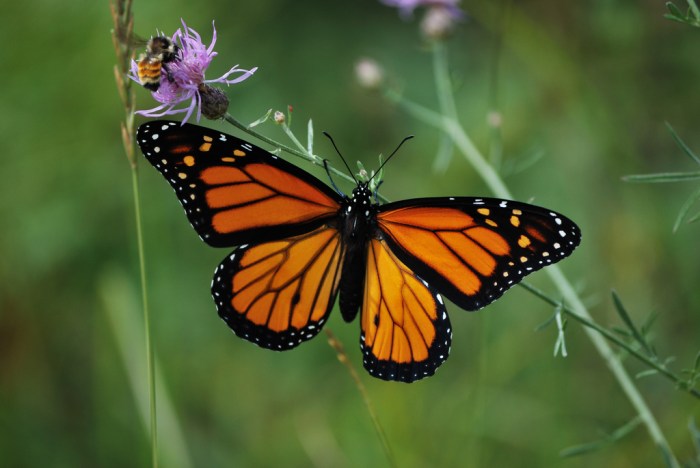
Kristin caught this bumblebee and a monarch butterfly sharing a snack at the National Wildlife Refuge in Seney. See her photo background big, view more in her Scenic Michigan slideshow, and visit her website at KristinaScarcelli.com.

Hammock with a view at P.J. Hoffmaster State Park

View from my hammock Hoffmaster State Park

View from my hammock, photo by Bailiwick Studios

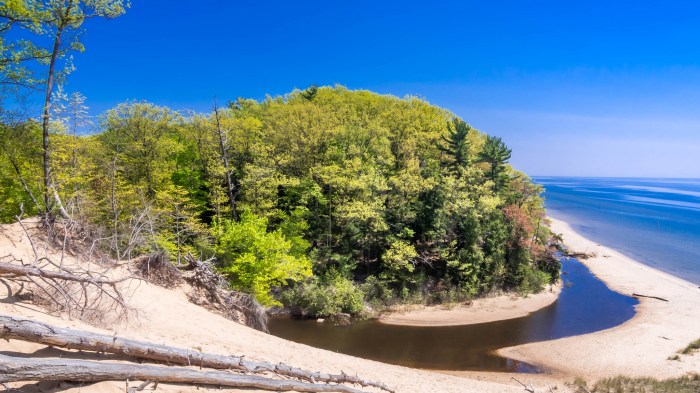
The photographer says that the outlet of Little Black Creek was the view from his hammock at Hoffmaster State Park near Muskegon. Not too shabby!

The Gillette Nature Center’s page on P.J. Hoffmaster State Park says (in part):

P.J. Hoffmaster State Park was established in the 1960s in honor of Percy James Hoffmaster, the longest acting Director of Conservation and the first chief of state parks in Michigan. The park encompasses 1200 acres, including 3 miles of Lake Michigan shoreline, and represents one of the finest examples of high relief, parabolic dunes and forested backdunes on the Great Lakes. The undisturbed quality of the habitat makes the park a refuge for 460 species of plants, nearly 90 species of birds and a rich array of mammals, reptiles, amphibians and insects. Hoffmaster is home to several listed species of plants, reptiles and birds.

The park’s pristine sandy beach is often described in magazines and travel guides as one of the wildest and most scenic beaches in Michigan.

…The park’s ten miles of trails and diversity of birds provides a birding experience unparalleled in the region, especially in the spring at the peak of migration. The park’s 293 site campground provides the opportunity for an overnight stay, and the surrounding landscape abounds with outdoor adventure for overnight or day visitors alike.

View the photo background bigtacular and see more in Bailwick Studios’ slideshow.

More summer wallpaper on Michigan in Pictures.

Red Mohawk: At Home with Michigan’s Pileated Woodpecker

Red Mohawk

Red Mohawk, photo by PK HyperFocal

The All About Birds entry for the Pileated Woodpecker (Dryocopus pileatus) says in part:

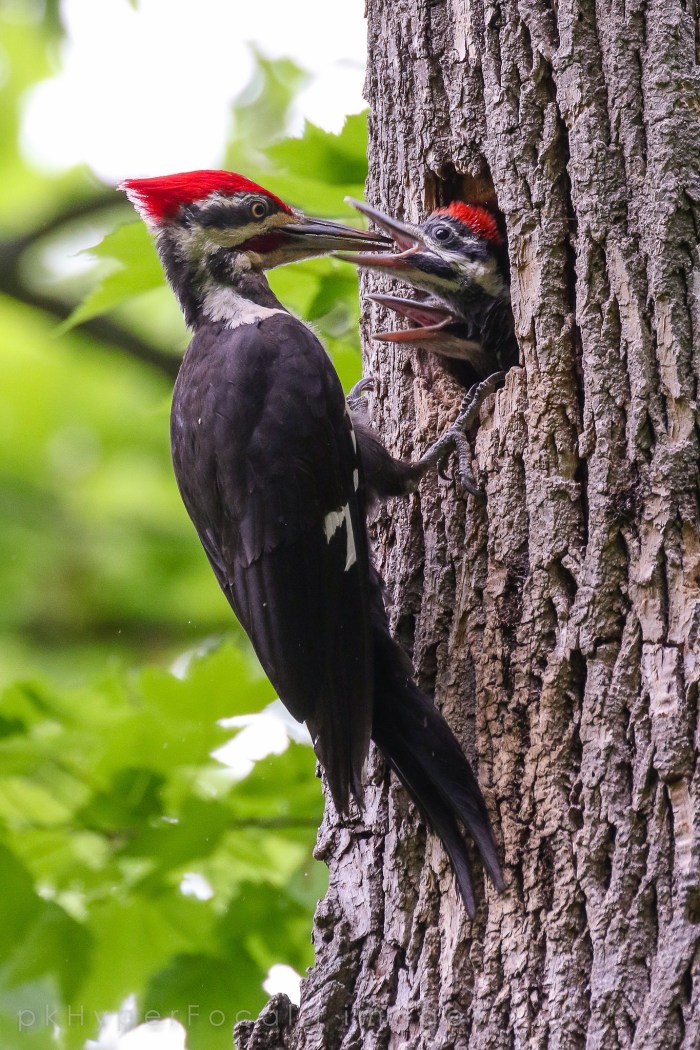
The Pileated Woodpecker is one of the biggest, most striking forest birds on the continent. It’s nearly the size of a crow, black with bold white stripes down the neck and a flaming-red crest. Look (and listen) for Pileated Woodpeckers whacking at dead trees and fallen logs in search of their main prey, carpenter ants, leaving unique rectangular holes in the wood. The nest holes these birds make offer crucial shelter to many species including swifts, owls, ducks, bats, and pine martens.

…The male begins excavating then nest cavity and does most of the work, but the female contributes, particularly as the hole nears completion. The entrance hole is oblong rather than the circular shape of most woodpecker holes. For the finishing touches, the bird climbs all the way into the hole and chips away at it from the inside. Periodically the adult picks up several chips at a time in its bill and tosses them from the cavity entrance. Pileated Woodpeckers don’t line their nests with any material except for leftover wood chips. The nest construction usually takes 3-6 weeks, and nests are rarely reused in later years. Cavity depth can range from 10-24 inches.

Nest trees are typically dead and within a mature or old stand of coniferous or deciduous trees, but may also be in dead trees in younger forests or even in cities. Dead trees are a valuable resource as nest sites or shelter for birds and other animals, and Pileated Woodpeckers battle for ownership with Wood Ducks, European Starlings, Red-bellied Woodpeckers, Red-headed Woodpeckers, Eastern Bluebirds, and Great Crested Flycatchers. Occasionally bats and swifts share roost cavities with Pileated Woodpeckers.

Click through for lots more including calls, Pileated facts, and video.

PK HyperFocal’s photo background big and see more in his Feathers slideshow.

Lots more Michigan birds on Michigan in Pictures.

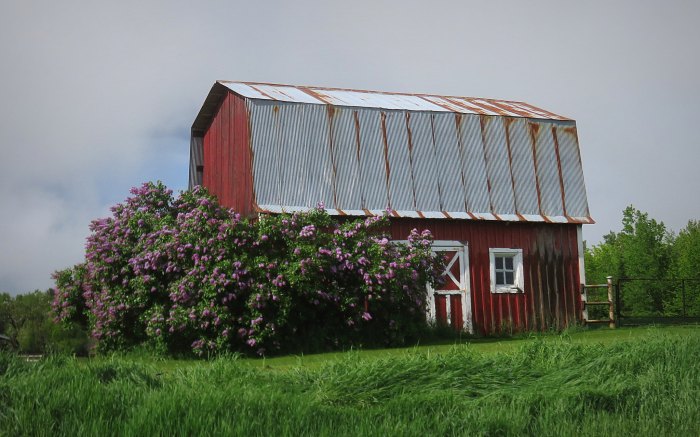
Red barn with Lilacs

Red barn with Lilacs

Red barn with Lilacs, photo by Ann Fisher

While lilacs are fading in much of the state, they’re just getting going in the Upper Peninsula!

View Ann’s photo background big and see more in her 2016 UP slideshow.

More barns on Michigan in Pictures.

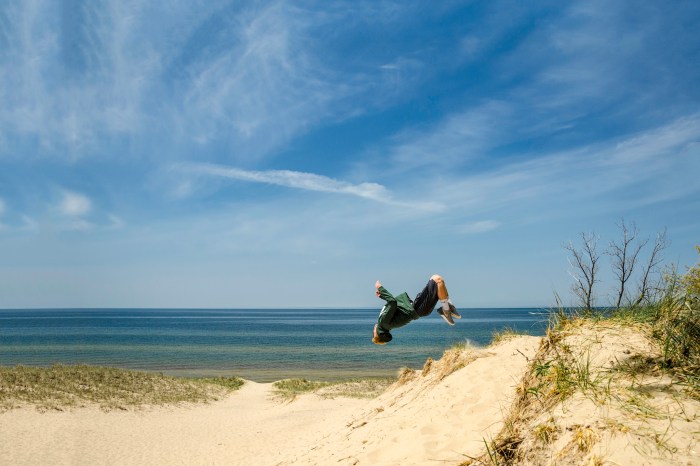
Flip out because Summer 2016 is here!!

Grand Haven Flip

Grand Haven MI, photo by Cyndie M

Summer 2016 is here, and as it’s the only Summer 2016 you’re ever gonna have – I recommend you get the most out of it!!

Cyndie took this last week at the sand dunes by Grand Haven. View it background bigtacular, see more in her slideshow, and check out more of her work on her website.

PS: More summer wallpaper on Michigan in Pictures!

Memorial Day in Michigan: 1907 Edition

via leelanau.com

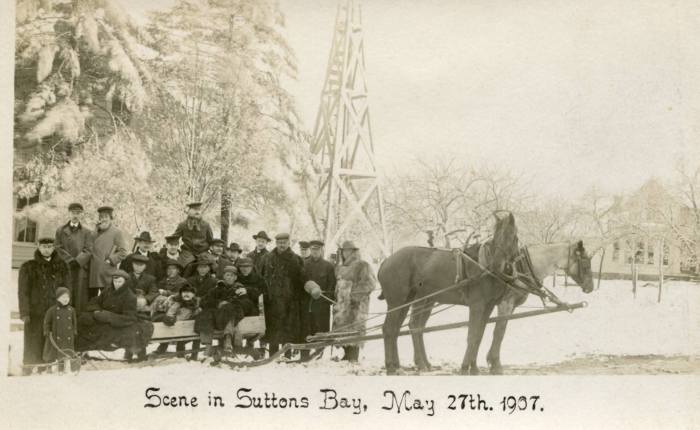
Suttons Bay May 27th 1907

Scene in Suttons Bay, May 27th. 1907, photo courtesy Leelanau Historical Society

Here’s the scene 110 years ago on Memorial Day in the village of Suttons Bay. Yikes!!

Hoping you have a safe and fun holiday weekend with the absolute minimum of snow!!

View the photo bigger, follow the Leelanau Historical Society on Facebook for more great photos, and check out their online photo archive for fun stuff like this search of Suttons Bay.

World War II Training on Lake Michigan

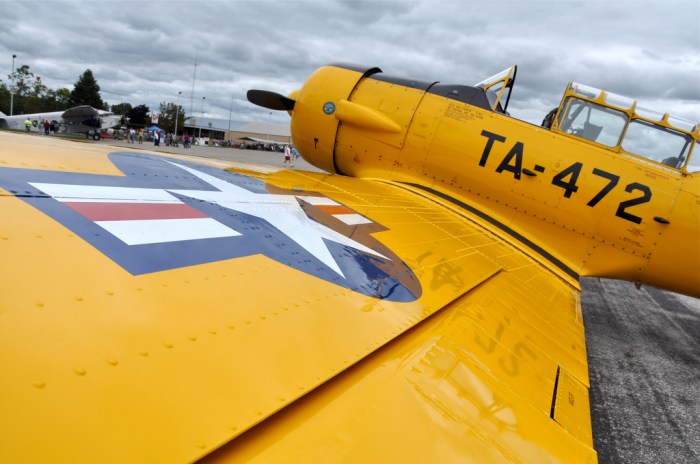
Wingspan

Wingspan, photo by Phil Squattrito

in advance of Memorial Day, the New York Times reviewed Heroes on Deck: World War II on Lake Michigan (trailer below) that tells the tale of how dozens of wrecked planes came to be on the bottom of that body of water. They write:

The film, by John Davies, recounts the training of pilots in how to land on aircraft carriers. Two passenger liners were stripped down and fitted with long decks (though not as long as the decks on actual aircraft carriers) and floated on Lake Michigan, where the training could take place without the threat posed by enemy submarines. Landing a plane on a floating airstrip was easier for some young men than others.

…Vintage footage shows crash after crash, though only a few fatalities resulted, in part because preflight training included how to escape if your plane were to go into the drink.

The film, showing on many public television outlets (including NJTV on Saturday and WLIW World on Sunday; check local listings), does more than just revisit an interesting tidbit of military history. It also chronicles present-day efforts to raise some of the planes from the lake bottom and restore them for display in museums and airports.

View Phil’s photo of this World War II fighter plane from the 2009 Gratiot County Airport open house background big and see more in his Transportation slideshow.

Here’s the trailer…