“Mackinac is a place largely visited by people from all parts of our country, and I take it from many foreign lands. A National Park is established on the island and I think the military post should be made not only comfortable but attractive.” -Quartermaster General Montgomery Meigs
It’s a birthday of sorts for Mackinac State Historic Parks which is a treasure trove of our colonial history. The page from Mackinac Parks on Fort Mackinac and the Mackinac National Park explains the birth of the park and how one forward thinking officer may very well have created the model for historical preservation in the park that holds so much of Michigan and the nation’s cultural history:
After Congress created Yellowstone in 1872, Senator Thomas Ferry introduced legislation to create a second park on Mackinac Island. In addition to the island’s attractive history and natural features, the U.S. government already owned much of the island as part of the Fort Mackinac military reservation and the soldiers stationed at Fort Mackinac could act as caretakers. As a result, the park would cost almost nothing, which Ferry knew appealed to the tight-fisted Congressmen of the 1870s. After two years of campaigning, President Ulysses Grant created the Mackinac National Park, the second park in the country, on March 3, 1875.
The park made Mackinac Island even more attractive to Midwestern visitors, and brought changes to Fort Mackinac, where the commanding officer became the park superintendent and a second company of soldiers joined the garrison. The Army finally performed some long-overdue repairs at the fort … Quartermaster General Montgomery Meigs believed that “the fort itself is to the public one of the greatest curiosities within the lands of the park,” and required the fort’s commanding officer, Major Alfred Hough, to repair the post’s aging blockhouses. Although the blockhouses served no military purpose, Meigs knew that they were “among the few relics of the older time which exist in this country,” and believed that “there would be a cry from tourists” if they were destroyed. Fort Mackinac thus became as much a part of the national park as the island’s natural curiosities.
…On September 16, 1895, the last soldiers formally transferred Fort Mackinac and the Mackinac National Park to the state. Although the national park ceased to exist with this transfer, the state immediately created the Mackinac Island State Park, which continues to welcome thousands of Mackinac Island visitors every year.
Mark took this photo back in the summer of 2017 from the cannon deck at Fort Mackinac on the Island. See more in his Mackinac, Michigan gallery on Flickr.
How would you like to wake up to this view?? Well, if you are a college student, the Isle Royale Wolf-Moose Research Project is seeking volunteers to assist with data collection for the 2022 summer field season. Students studying natural resources, conservation, ecology, or related fields will gain valuable field work experience working with distinguished researchers in Isle Royale National Park in the longest continuous study of any predator-prey system in the world.
The opportunity is for 4-5 weeks between early-May and mid-June, and requires students to have documented experience backpacking & camping for extended periods of time in remote settings, proficiency with orienteering, and the ability to get along with others in backcountry settings for 10-day periods of time are all critical. Get the full rundown of qualifications, activities & more on their website at IsleRoyaleWolf.org.
Carl is definitely Michigan in Pictures’s Isle Royale Bureau Chief! His photos feature prominently in our posts about Isle Royale & his photo of a Bull Moose Faceoff is one of the most popular photos of all time on Michigan in Pictures. He took this way back in the summer of 2009, and you can see hundreds more in his Isle Royale National Park gallery on Flickr. For sure head over to his Mackinaw Scenics website to view & purchase his work!
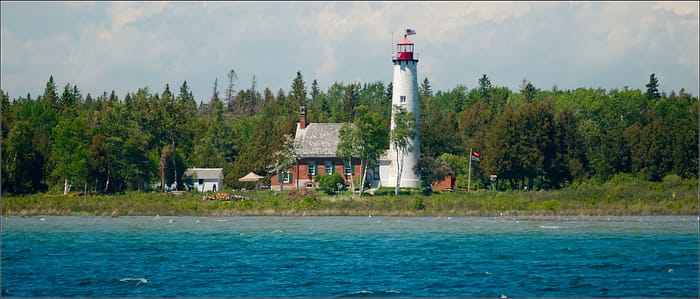
Because several ships had been wrecked on the dangerous shoals near the island of St. Helena in 1872, Congress authorized construction of a lighthouse at the southeast tip of the island. Since September 20, 1873, the beacon of the St. Helena Lighthouse has helped guide vessels safely through the Straits of Mackinac.
The light was first automated in 1922 and the modern lighthouse uses solar batteries to power the light.
In 1988, the lighthouse was added to the national Register of Historic Places. Recently restored to excellent condition by the Great Lakes Lighthouse Keepers Association, the St. Helena Island Lighthouse continues to light up the Straights and provide a glimpse of the golden age of the Great Lakes’ lights.
Joel took this photo back in 2014 on a Lighthouse Cruise with Shepler Ferry / Great Lakes Lighthouse Keepers Association. See more shots in his Lighthouse Cruise 6/16/2014 gallery.
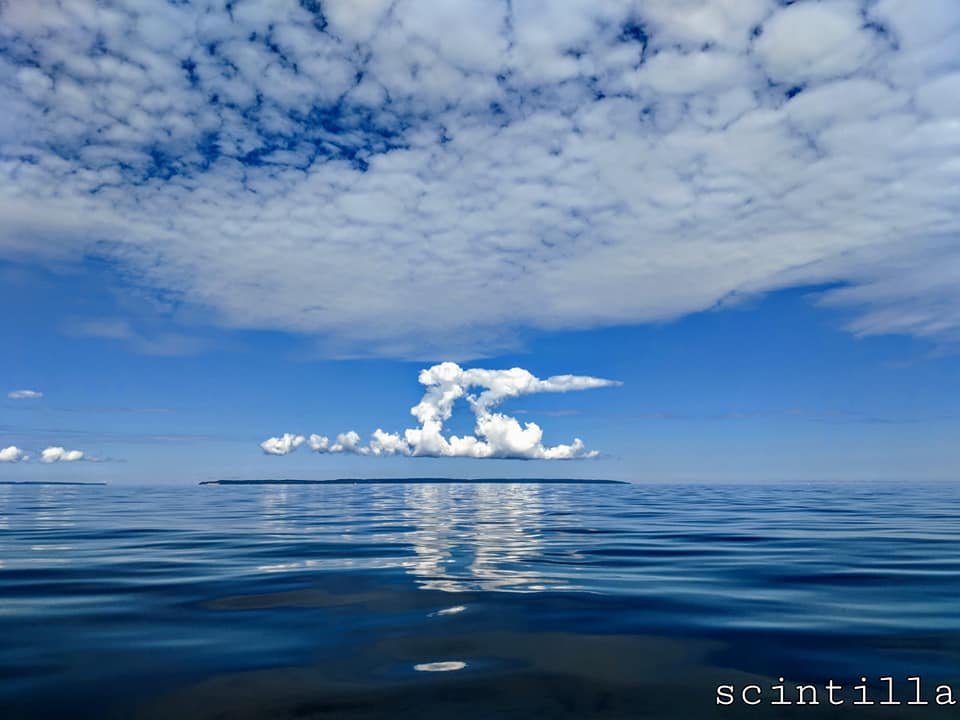
Back in May, James took this photo & shared: “Superior, for our 8 days along your shores, your waters have been so calm, belying your reputation as the angry instrument of so many shipwrecks. I get the wink, o’ great one. I won’t tell a soul.”
PS: Don’t trust the wink, James – Superior is wily!!! More from Michigan’s mighty Lake Superior (including another pic from James) on Michigan in Pictures.
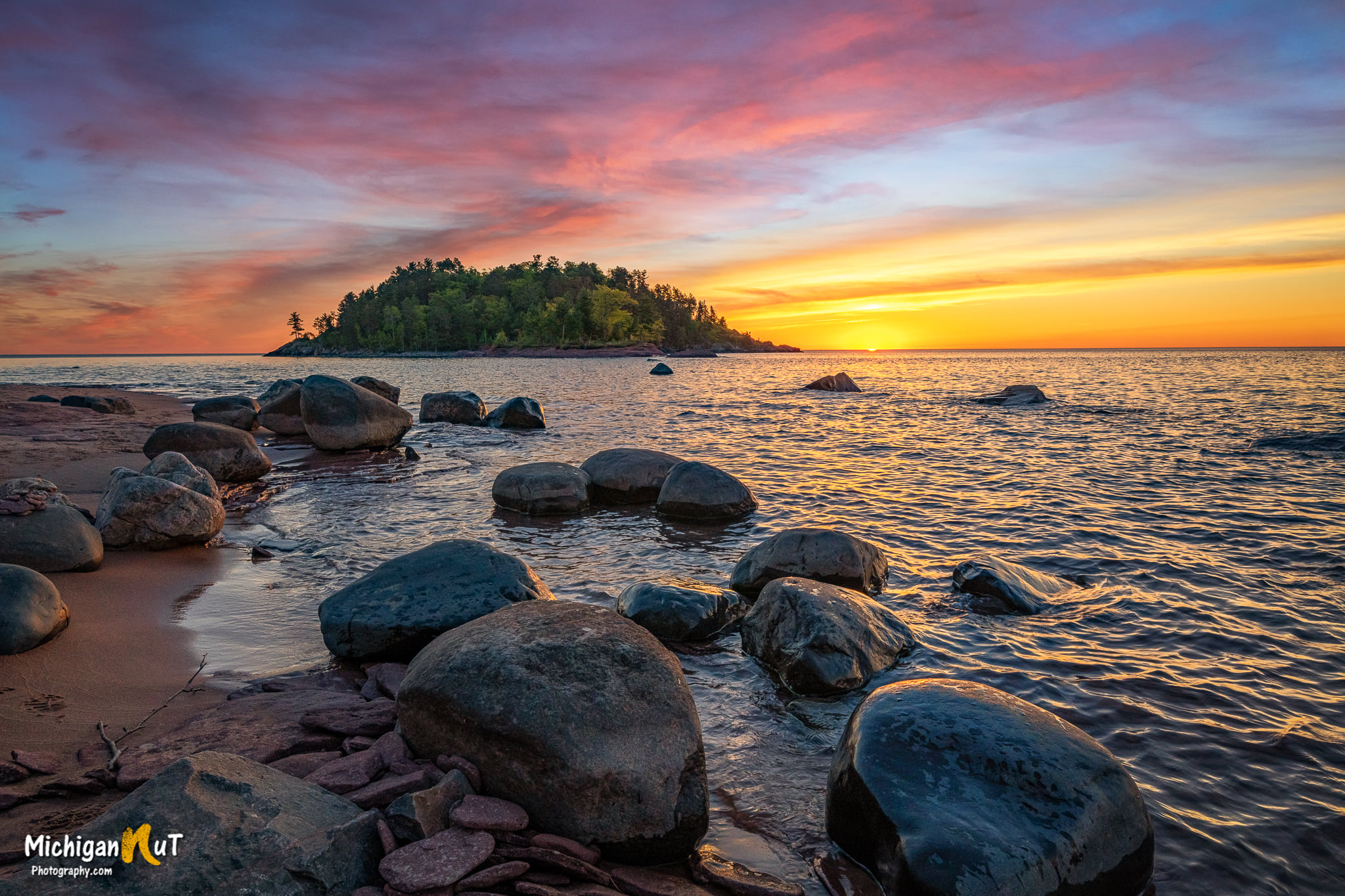
The Michigan Department of Natural resources says that the Little Presque Isle tract is often called the crown jewel of Lake Superior, with its beautiful sand beaches, rugged shoreline cliffs, heavily timbered forests, and unmatched public views:
The rock comprising the area represents some of the oldest exposed formations of its kind. More than a mile of bedrock lakeshore and cliffs adorns Little Presque Isle, including sandstone cliffs that reach nearly 60 feet high toward the base of Sugar Loaf Mountain. One kind of bedrock, granitic, that occurs here is the least common bedrock type along the Great Lakes shoreline, with less than eight miles occurring in total. This is one of three areas where the public can see these 2.3 billion year old formations in Michigan.
The proposed wilderness area is a local landmark, which has significant historical value. The island was reportedly connected to the mainland sometime prior to the 1930s and was a landing place for early explorers and native inhabitants.
Since 1959, a research team has spent most of the winter observing the interplay between wolves and moose at Isle Royale National Park in Lake Superior. But this year’s mission has been scrapped to protect the scientists and support personnel from possible exposure to the virus, Superintendent Denice Swanke said Friday.
Experts from several universities, the park service and the Grand Portage Band of Lake Superior Chippewa had planned to assess how an effort to rebuild the wolf population is affecting the ecosystem.
The remote park is closed from Nov. 1 to April 15. The winter researchers use a single cabin, which wouldn’t allow for social distancing. Also factoring into the decision to cancel the expedition were the border closure between the United States and Canada, and a shortage of flight resources to bring supplies, Swanke said.
The park service and partners will try to document wolf population changes this summer using remote cameras and other techniques, Swanke said. But they won’t have the benefit of aerial observations that can be done only during winter, when the animals are easier to spot.
“There will just be a hole in the data that nothing can be done about,” said John Vucetich of Michigan Technological University, one of the biologists who have produced annual reports about the wolves and moose that roam the island park, as well as its other wildlife and vegetation.
David writes: As we were hiking from West Chickenbone Lake campground to McCargoe Cove, I saw a fallen tree’s roots across the narrow arm of the lake. Then the roots turned and looked at me. Moooooose!! See more in his Isle Royale 2017 gallery on Flickr & for sure check out his blog posts about the trip in his excellent blog Cliffs & Ruins!
Here’s a simply stunning shot of North Manitou Island off the Leelanau Peninsula at the beginning of August. Leelanau.com says that North Manitou Island:
…is managed as wilderness with the exception of a 27 acre area around the Village. Visiting the island is a primitive experience emphasizing solitude, a feeling of self-reliance and a sense of exploration. The primary visitor activities are backpacking and camping. Travel in the wilderness area is by foot only. Power on the island is provided by a photovoltaic array located in the Village.
North Manitou Island is 7-3/4 miles long by 4-1/4 miles wide and has 20 miles of shoreline. The topography varies considerably on the island from low, sandy, open dune country on the southeast side grades to the high sand hills and blowout dunes on the southwest side of the island.
British General Brock of the Michigan Command ordered Captain Roberts, on St. Joseph Island, to attack the American Fort on Mackinac Island. That morning Captain Roberts embarked for Michilimackinac on the Northwestern Fur Company’s ship, Caledonia, with two six-pound guns, ten batteaux (flat-bottom boats), and seventy canoes. Captain Roberts’ force was composed of 42 regulars and 4 officers, 260 Canadians, 572 Chippewas and Ottawas, 56 Sioux, 48 Winnebagoes, and 39 Menomonies. The British arrived at Mackinac Island at 3:00 a.m. on July 17.
Fort Mackinaw’s American commander, Lieutenant Hanks, immediately prepared for action. However, around 9:00 in the morning he discovered that the British were in possession of the higher ground above the fort and that British artillery was already directed at the Americans’ most defenseless position. At 11:30 in the morning, the British sent in a flag of truce and the fifty-seven United States officers and enlisted men at the Fort surrendered.
After this victory, the British constructed Fort George (now known as Fort Holmes) about a half-mile behind the main Fort in order to protect it during future invasions. Great Britain retained control of Fort Mackinaw until the United States won it back in the Treaty of Ghent in 1815.
On July 8th, 1850, James Jesse Strang was crowned king of Beaver Island. Michigan History Magazine shared this article with me years ago:
Despite claiming to be “the perfect atheist,” Strang became a follower of Mormon leader Joseph Smith. When Smith was murdered in March 1844, Strang claimed to be the new Mormon leader, although most Mormons followed Brigham Young to Utah.
King James Strang (daguerreotype, 1856)
Strang’s followers settled on an uninhabited island in northern Lake Michigan they called Big Beaver. The island had everything Strang and his followers needed: virgin timber, tillable land, a deep and sheltered bay and exceptional offshore fishing. It also was twenty-five miles off the mainland-a perfect place to protect Strang’s followers from outside influences and beliefs.
By the mid-1850s, the Mormon colony on Beaver Island boasted more than 2,500 followers. Beaver Island replaced Mackinac Island as the principal refueling stop for steamers, and the annual value of the kingdom’s exports (fish, wood and potatoes) was considerable.
The growth of Strang’s kingdom was not without controversy. Non-Mormons, called Gentiles, took exception with the Mormon settlement. Driven from the area’s fishing spots, angry over the establishment of a kingdom and Strang’s adoption of the practice of polygamy, the Gentiles vowed revenge. At the bequest of President Millard Fillmore, the U.S. district attorney prosecuted Strang for an assortment of unfounded offenses that included murder and treason. However, Strang was acquitted on all charges, and a year later he was overwhelmingly elected to the state legislature.
Strang ruled Beaver Island as an autocrat; he even had himself crowned king. But regulating every aspect of his followers’ lives led to his downfall. Describing women’s clothes as impractical and unhealthy, Strang decreed female subjects needed to dress in loose, knee-length smocks worn over modest pantaloons. Most Beaver Island women accepted the change, but a few refused to comply. When two women refused to wear pantaloons, Strang had their husbands whipped. The two men sought revenge and on June 16, 1856, they ambushed and shot their king.
On July 9, 1856, James Jesse Strang died from his wounds. He was buried in Wisconsin.
With Strang gone, enraged Gentiles charged onto Beaver Island and evicted the Mormons. After taking control of the Mormon printing office, the attackers printed a manifesto that boasted, “The dominion of King Strang is at an end.”








.jpg)

