Happy 4th of July, Michigan!

Lan July 4th parade 127e

Lan July 4th parade 127e, photo by indefinitejourney.

Fourth of July, July 4th, the Fourth or Independence Day – call it what you will, this is our day. John Adams wrote to his wife Abigail:

The second day of July, 1776, will be the most memorable epoch in the history of America. I am apt to believe that it will be celebrated by succeeding generations as the great anniversary festival. It ought to be commemorated as the day of deliverance, by solemn acts of devotion to God Almighty. It ought to be solemnized with pomp and parade, with shows, games, sports, guns, bells, bonfires, and illuminations, from one end of this continent to the other, from this time forward forever more.

I doubt Adams envisioned the star-shaped sunglasses, but bring on the pomp, the parades (the picnics!), the sports and games (best leave the guns at home), the bells, bonfires and brilliant, booming illuminations. Somewhere amidst all of that if you can, think about the acts of devotion that could be made towards making this nation and state ever more worthy of celebration and love.

I should point out that this photo is part of an awesome set of Lansing 4th of July Parade photos (slideshow!!)
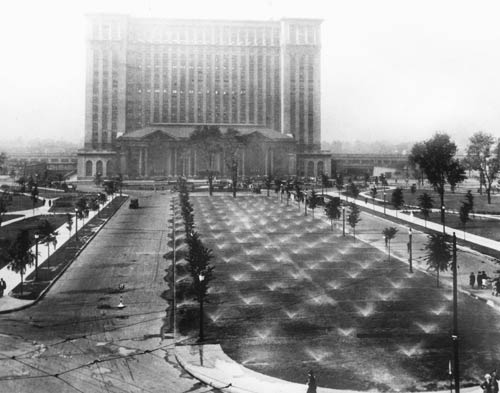
Detroit’s Michigan Central Station

Michigan Central Station, 1921

The introduction to Detroit’s Michigan Central Station says the Michigan Central Station was designed by Warren & Wetmore and Reed & Stem, the firms who were the architects of New York’s Grand Central Station. It opened in 1913, and by the time this 1921 photograph (above) was taken, the Beaux Art ideal had been reached. The unique road configuration leading up to the Michigan Central, as well as the fine ambiance Roosevelt Park contributed to the scene, reveals itself to be absolutely necessary to complete the designers’ vision. (Courtesy of Manning Brothers Historical Photographic Collection)

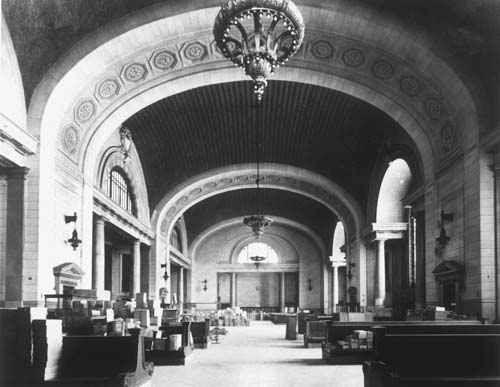
Michigan Central Station waiting room

By 1967 the main waiting room (right, click for larger view) was closed to travelers and used merely for storage; it is difficult to conceive of these splendid benches being relegated to use as a mere shelving system. Hanging on by a thread, the Michigan Central continued to operate without its restaurant or even the main park entrance. (Dave Jordano, Courtesy of the Burton Historical Collection)

In case you’re wondering, here’s a photo of the waiting room in its current state and here’s another.

The photos and captions are reprinted with permission from Detroit’s Michigan Central Station by Kelli B Kavanaugh. In addition to some history on Michigan Central Station and great old photos of the station and activity, the book includes some floorplans of MCS. It’s available from the publisher online at www.arcadiapublishing.com or by calling 888-313-2665.

View other excerpts from Arcadia Publishing’s Michigan books at Michigan in Pictures and also be sure to check out MCS 7.2.7: Transformers co-star Michigan Central Station on Absolute Michigan for more photos and some great videos too!!

Soo Locks Celebration, 1905 right up to tomorrow

Soo Locks Celebration - 1905

Soo Locks Celebration – 1905, photo by Detroit Publishing Co.

The fantastic American Memory feature of the the US Library of Congress had this picture titled Reviewing stand, Saint Marys [sic] Canal celebration. It was taken in 1905, the very first year of a celebration that continues today: the annual Soo Locks Celebration (also known as Engineer’s Day). It’s held every year on the last Friday of June between 10 AM and 4 PM. For those following along, that’s tomorrow, July 29, 2007.

You can click for a whole gallery of shots from the Soo Locks – Sault Ste. Marie Canal on the St Mary’s River from American Memory, see some photos of the Soo Locks and past celebrations from Joel Dinda and tune into the locks via the Soo Locks SkyCam.

Michigan Shoreline Tour: South Haven … and the Friends Good Will

Friends Good Will

Friends Good Will, photo by Doug Langham

Doug writes that the Michigan Maritime Museum’s historical replica of the famous sailing sloop Friends Good Will sails daily from the South Haven harbor. Follow that link for the tale of the original Friends Good Will and the building of this replica. (also check out Doug’s daytime photo of the sloop)

The Wikipedia entry for South Haven has all your facts and demographics and says that most of the city is in Van Buren County, with a the very north portion in Allegan County. Probably the best resource for South Haven history is the city of South Haven’s history page. It notes that the city was originally founded by J.R. Monroe, who was granted a land patent from the U. S. government in 1833 for 65 acres of land along Lake Michigan’s shore. The city didn’t get going until the 1850s when sawmills at the mouth of the Black River were established and fed the growth of the town (and the timber-hungry city of Chicago). South Haven’s “glory days” were probably when:

The resort business had its beginning in the mid-1800’s at the home of Mrs. H. M. Avery. It was to experience phenomenal growth and became South Haven’s most colorful era. By the turn of the century, thousands of visitors were arriving by steamer and train to enjoy a memorable vacation. Lodging was available in magnificent hotels, farm resorts, family homes, or picturesque little cottages along the river. Entertainment was unlimited. Choices included pavilions, several theaters, a casino, an opera house, an amusement park with a roller coaster, and much more.

Tourism remains the main business of South Haven and the South Haven Visitors Bureau and Great South Haven Chamber of Commerce can help you plan a visit. You can look in on the town with the South Haven web cam, view the Flickr photo map for South Haven and the Google map for South Haven.
Coincidentally, yesterday’s post was from South Haven too. View more South Haven area photos on Michigan in Pictures and also explore South Haven on Absolute Michigan.

Yesterday in Jackson, Michigan

main_street_looking_east_part2_9_27

main_street_looking_east_part2_9_27, photo by jacksonista.

Looking east, looking west, this set of old Jackson postcards is the best (you can also view the slideshow).

From the roller coaster at Hague Park to the casino at Wolf Lake to cell block 11 at the “new” state penitentiary to things that it’s hard to even describe, this set of over 150 old photos will take you way back.

Vintage Base Ball and the Kent Base Ball Club

2002 (213)

2002 (213), photo by xman12.

I think it’s pretty cool that just hours after Brian H got me interested in the Kent Base Ball Club, Detroit Tiger pitcher Justin Verlander hurled a no-hitter.

The Vintage Base Ball Association says that base ball (two words prior to the 1880s) is a re-creation of the game based on rules of the late 1850s, 1860s and 1880s. Michigan boasts 13 base ball teams – more than any state.

The Kent Base Ball Club of Grand Rapids is a founding member of the Vintage Base Ball Association.

Grand Rapids’ first team, the Kent Base Ball Club of Grand Rapids was formed on April 4, 1867, when a group of Civil War veterans formed a club to continue playing the game they had learned while in the army. Silas K. Pierce, who had recently moved to the city from Ionia, was elected as the club’s first president…

One hundred and twenty-three years later, in 1990, a group of local enthusiasts led by city historian, Gordon Olson, decided to reorganize the Kents and play the game of base ball as it had originally been done in the 1860s. Olson had found the original constitution and by-laws of the Kent Base Ball Club in the Grand Rapids History and Special Collections Center at the public library, and was curious to see how the old game compared to its modern counterpart. The newly reconstituted Kents now play an average of 12-15 games per summer, and have appeared in Columbus, Ohio; Fayette State Park, Greenfield Village, Old Kent Park (all in Michigan), and Doubleday Field at Cooperstown, New York. In period uniforms, they do their best to live up to the enthusiasm and dedication to sportsmanship and fair play that motivated the original Kents.

Every year in early June they play the Silas K. Pierce Cup (State of Michigan Championship) at John Ball Park in Grand Rapids and you can get a schedule, more history and links at their site.

xman12 has over 1200 photos of the Kent Base Ball Club in action.

The Shiawassee River

Shiawassee River

Shiawassee River, photo by naokomc.

Poked around the map of Michigan this morning, looking for a place I hadn’t been. That turned out to be the Shiawassee River. (Shiawassee River slideshow)

The very good (if staggeringly bright yellow) page on the Shiawassee River basin from Shiawassee History says:

The Shiawassee River Basin plays a major role in the mid-Michigan area. Its drainage area is approximately 1,200 square miles and portions of the river touch at least 7 counties.

The river is about 110 miles long and generally flows in a northerly direction, which is one of only two or three in the world. The Flint River, Cass River and Titabawassee River join the Shiawassee just southwest of the City of Saginaw and together form the Saginaw River which drains into the Saginaw Bay.

Shiawassee History also explains that Shiawassee may come from the Chippewa term for straight running river; Shiawassee (straight, or straight ahead) wassee. Then again, you can find other sources saying that the name means “river that twists about”.

The Nature Conservancy has a nice page on the Shiawassee River Watershed and the threats it faces from development pressures.

I’ll link to Wikipedia’s brief entry on the Shiawassee River because it had a link to Headwater Trails proposed Shiawassee River Water Heritage Trail (and in hopes that someone can go there and make the entry better).

Update (6/12/07): I just found the Saginaw Basin Land Conservancy who relate that the Saginaw Bay Watershed is the largest contiguous freshwater coastal wetlands system in the United States, featuring more than 175 inland lakes and about 7,000 miles of rivers and streams that are home to large populations of waterfowl, birds, snakes, turtles, amphibians, and more than 138 endangered or threatened species. They’re having a photo contest too – see the comments for details!

Arch Rock, Mackinac Island Michigan

Arch Rock, Mackinac Island Michigan, c. 1899

Indians.org tells the story of the creation of Mackinac Island’s Arch Rock and says that even now the bravest of the Ottawa people will not walk over it. My favorite Michigan history book, Lore of the Great Turtle by Dirk Gringhuis, says that Arch Rock was the bridge over which departed souls could find their final resting place and also tells another story of its formation due to an angry father, the Sky Person Evening Star and the tears of She-who-walks-like-mist. (seriously, if you have an 8-12 year olf on your gift list, buy them this book)

Wikipedia’s Arch Rock entry takes a more scientific bent, saying that this 149′ limestone arch formed during the Nipissing post-glacial period, characterized by high Lake Huron levels following the end of the Wisconsin glaciation. Arch Rock is one of several limestone formations in Mackinac Island State Park.

I believe that the boat so perfectly posed in the arch is a “mackinaw boat” (photo).

The photo is from the Detroit Publishing Company collection (c. 1899) at the Library of Congress (LC-USZC2-6399 DLC). You can get a larger view at Flickr and a massive 47 MB TIFF at the Library of Congress.

Michigan Shoreline Tour: Warren Dunes State Park

Warren Dunes State Park

Warren Dunes State Park, photo by mizjellybean

Heading up the shoreline from New Buffalo, we come to the Warren Dunes State Park. I think that the first thing you need to do is check out this slideshow of the Warren Dunes. Go ahead, we’ll wait.

Wikipedia’s entry for Warren Dunes State Park is a 1,952 acre state park, located along the shore of Lake Michigan in Berrien County, Michigan (near Sawyer). The park’s dunes include Mt. Fuller, Pikes Peak, Mt. Edwards and (the tallest) Tower Hill which rises 250′ above Lake Michigan. Warren Dunes was designated as a state park in 1930 and draws around one million visitors annually. The page on the village of Sawyer from the Harbor Country Chamber of Commerce adds that although most in the area saw the land as worthless, businessman Edward K. Warren had a vision to preserve them and bought the land at the turn of the century.

Speaking of Wikipedia – something we seem to do fairly often – they have a massive page of map data and hacks for Warren Dunes including a Flickr map of photos from the Warren Dunes area and the Google map to Warren Dunes State Park.

I should add that the DNR page for Warren Dunes State Park notes that due to an infestation of the Emerald Ash Borer beetle, over 4,000 ash trees have been removed from the modern campground unit, dramatically changing the appearance of that campground.

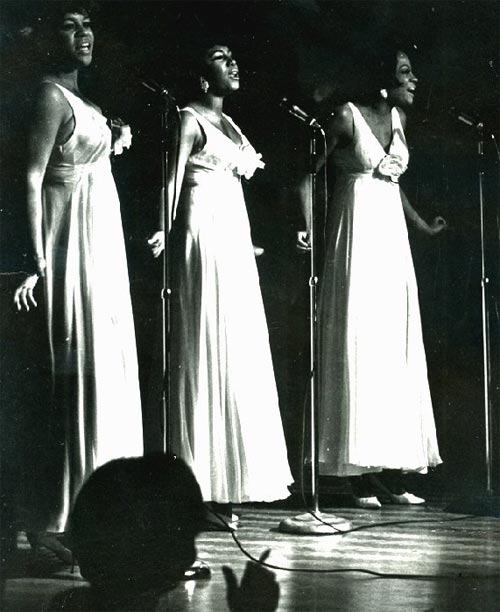
The Supremes at the Roostertail in Motown

The Supremes at the Roostertail in Detroit

The Supremes at the Roostertail, Detroit 1966, Archives of Michigan

Every month the Archives of Michigan post their Image of the Month. This month it’s the Supremes:

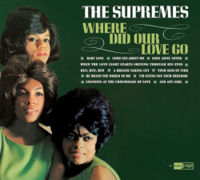
Where Did Our Love Go? (1964)As the most successful female singing group of all time, the Supremes are well known – not only for their music, but also their rise to stardom. Starting out in “the Projects” of Detroit, the group rose to become the most popular female group of the 1960’s. The recent film Dreamgirls, based loosely on their story, shows that Americans’ fascination with this successful African American singing trio has not waned.

The Supremes started as a quartet called “The Primettes” in 1959. After hearing the girls sing, the manager of the locally popular male group, “The Primes” (the future Temptations) decided to start a sister group. They were signed to Motown records in 1961. Soon after, the fourth member left the group, leaving the trio of Florence Ballard, Diana Ross, and Mary Wilson. In their negotiations with Berry Gordy, manager of Motown Records, they changed their name to “The Supremes.” Gordy decided to make Diana Ross the sole lead singer, a role the three had previously shared.

Read the rest of the article and see a larger photo of the Supremes at the Roostertail at the Archives of Michigan, explore The Supremes at Wikipedia, (and Billy’s Supremes web site),  check out the Roostertail’s history page and then turn up your speakers and click over to the Motown Historical Museum for more on the Supremes and other Motown greats.

And then – if you’re still looking for an “and then” – YouTube has The Supremes At Hollywood Palace “Stop In The Name Of Love”Baby Love on Top of the Pops and a whole lot more videos.