Lake St. Clair South Channel Lights

Lake St. Clair, Michigan by StormyRed_28

Lake St. Clair, Michigan, photo by StormyRed_28

Lakestclair.net’s page on the South Channel Lights off Harsens Island says:

Lake St. Clair has two lighthouse structures built before Abraham Lincoln was President of the United States. They still stand today just off the southeastern tip of Harsens Island.Construction of the Old South Channel Range Lights started in 1855 and finished in 1859. These lights guided ships into the fresh water delta once known as the Venice of America.

Save Our South Channel Lights is trying to save this endangered pair of lighthouses (also see this article in the Freep about them). There’s a map to their location from Lighthouse Friends.

History of the Michigan State Fair

State Fair, 1974

State Fair, 1974, photo courtesy Archives of Michigan

The Image of the Month for August 2007 from the Archives of Michigan:

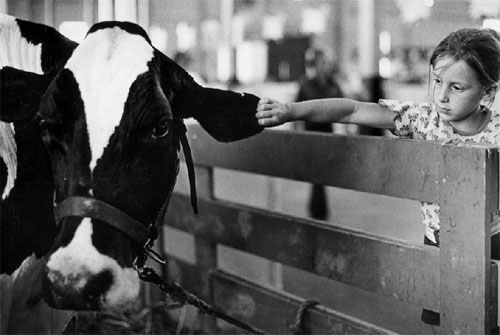
In this 1974 photo, six year-old Jennifer Weise tugs on a Holstein cow’s ear. The animal was one of 8,000 displayed at the Michigan State Fair that year.

Michigan’s first State Fair was held in Detroit in 1849. The Michigan Agricultural Society sponsored and organized the event. The fair moved to Ann Arbor in 1850 and then back to Detroit from 1851-1862. From 1863-1904, it rotated amongst different Michigan cities.

Read the rest of the history of the Michigan State Fairs (there’s also a UP fair) and click for the official sites for the Michigan State Fair (Wednesday, August 22nd through Labor Day, September 3rd, 2007) and the Upper Peninsula State Fair (held August 13th – 19, 2007).

Hotel Madison-Lenox Detroit :: 1900 – 2005

madlennox by humphreyphotography

madlennox by humphreyphotography

Scott Humphrey took this photo of the Hotel Madison-Lenox in Detroit shortly before its demolition. He has a whole lot of great photo to view at Scott Humphrey Photography, so get on over there and take a look!

We are featuring a short film with imagery of the demolition of this historic hotel called Vacancy by Brandon Walley on Absolute Michigan today.

Mighty Mac at 50

Mighty Mac at 50

Mighty Mac at 50, photo by smiles7.

Here’s a photo from last weekend’s 50th Anniversary Celebration for the Mackinac Bridge. She has another shot of the fireworks on both the Mackinac City and St. Ignace ends of the bridge.

Michphotog has a nice set of photos of the fireworks as well!

Did anyone else make it there? We’d love a report and some more photos.

The Mackinac Bridge

V8

V8

V8, photo by rckrawczykjr.

Ralph took this photo of the grille badging of a 1933 Cadillac V8 Series at the GM Heritage Center in Sterling Heights, Michigan.

It’s part of a great set of photos of GM’s archive of auto history.

Holland, Michigan: flippin’ sweet.

flippin' sweet.

flippin’ sweet., photo by jill d.

Of this very wallpaper-friendly photo, Jill writes:

i took this one of my friend phil last spring. we were at this place called the bowl, which is basically a huge sand dune on the coast of lake michigan in holland, michigan. phil was a diver in high school — the combo of his back flip and the amazing sunset combined to make one of my favorite photos i’ve ever taken.

The Holland CVB’s history page tells the story of religious opression and economic depression in the Netherlands leading Dr. Albertus Christiaan & Christine Van Raalte, their family and congregation to take ship to America. At Detroit:

Dr. Van Raalte left his flock to survey the area and determine the best location for his Dutch Kolonie. Of all the sites that he studied, the one that was made to order for his colonizing plans was at the mouth of the Black River where it flowed into Black Lake (now Lake Macatawa) which, in turn, led to Lake Michigan. As soon as Van Raalte had satisfied himself that he had found the most desirable location for his colony, he lost no time in leading his group to the spot. They reached their destination on February 9, 1847.

There’s a ton more information about the early trials of the city and modern day Holland at the excellent Holland Convention and Visitor’s Bureau web site. Every May the city hosts Tulip Time, a celebration of all things Dutch and Dutch Village is a major Michigan tourist attraction. I think that this photo was taken at Holland State Park (also known as Ottawa Beach).

Wikipedia’s entry for Holland, Michigan says that as of the 2000 census, there were 35,048 people residing in the city (112,000 people in the metro area). Wikipedia also notes that Holland is home to the world’s largest pickle factory, that it is the birthplace of Slashdot, one of the first (the first?) blogs created by Hope College student Rob “CmdrTaco” Malda & company and that L. Frank Baum wrote The Wonderful Wizard of Oz, while summering in the resort community of Macatawa.

We’ve added Holland to our Absolute Michigan map of Michigan. Someday we’ll figure out how to let other people add stuff too. You can find more pictures of Holland from Michigan in Pictures (including a nice bit of history and a Tulip Time extravaganza) and get business info and stories at Absolute Michigan keyword Holland.

Michigan History magazine needs your photos!

Untitled, photo by jacalynsnana.

Christine Schwerin is a photo editor looking for a good venue to find specific images from Michigan photographers on a regular basis to be used in Michigan History magazine. She’s hoping to find photographers interested in joining an email list to receive a monthly list of images they’re looking for. If you are, send her an email!

Christine says that the first photo they’re looking for is a nice scenic picture – river, meadow, whatever, so long as it is in the Huron National Forest. Do you have one? Let her know!

A quick review of the Huron National Forest (part of the Huron-Manistee National Forests) tells me that we’ll have to return for an extended visit another day.

The above photo is of one of the world’s premier trout streams, the Au Sable River – a large portion of which winds through the Huron National Forest.

Wilfred Sykes

Wilfred Sykes

Wilfred Sykes, photo by jowo.

I think that Joel can pretty much handle today’s post:

Pretty boat. Leaving the harbor at Muskegon, Michigan.

While I’ve seen, and photographed, most currently active lakes boats, this one had somehow escaped me until yesterday afternoon. We’d gone to Muskegon to walk the beach, and suddenly there she was, leaving the harbor.

Sykes was the first American lakes boat completed after World War II, and was launched shortly after I was born. In many ways she’s the prototype for a generation of lakers. And just plain gorgeous! Glad I finally found her.

You may enjoy Joel’s Lakers slideshow and you’ll probably also like the Wilfred Sykes photo gallery from boatnerd.com Joel links to above.

Reflections :: Saugatuck, Michigan

Reflections

Reflections, photo by chatursunil.

We get about 100 people a day who are searching for backgrounds for their computer. To them I say: this photo makes a great background!

Saugatuck (pop. 1065 in 2000) is the sister city to Douglas. This Saugatuck/Douglas history page says that unlike most Midwest frontier towns, neither town suffered the devastating fires nor the modernizing railroad. As a result, the villages provide a rare chance to see pre- and post-Civil Ware Greek Revival and Italianate architecture alongside later structures in the Arts & Crafts and Colonial Revival manner.

Like Douglas and many communities along Michigan’s western shore, Saugatuck was timbered out after the Great Chicago Fire of 1871. Still…

…Saugatuck and Douglas thrived, turning to shipping and fruit growing as a source of income in the latter part of the 1800s. Peaches from the area were called “Michigan Gold” and were shipped by large steamships to the Chicago market. Hundreds of ships of various types were built in Saugatuck shipyards and the town was a haven for ship captains.

A resort, tourist, and “cottage” culture emerged in the 1880s and took a propitious turn in 1910 when a group of Chicago artists established the Summer School of Paintings on Ox-Bow Lagoon, and when a huge dance hall, called the Big Pavilion, was built on the waterfront. The resulting influx of well-known artists and big name Chicago architects resulted in a wave of building in the Arts & Crafts and Colonial Revival manner. The seed planted at Ox-Bow has continued to flourish over the years, with the area is now known as the Art Coast of Michigan. Today, Ox-Bow continues to be affiliated with the Art Institute of Chicago.

The Saugatuck/Douglas Visitors Bureau has a huge pile of information and photos and links, including a link to a pretty informative video tour of Saugatuck/Douglas. There’s also the Saugatuck/Douglas Area Business Association with more events, news & listings. Wikipedia’s entry on Saugatuck says that attractions today include art galleries, the harbor, marinas, scenery, unusual stores, the view from atop Mount Baldhead, tourist attractions, the famous Oval Beach on Lake Michigan, Saugatuck Dunes State Park and Allegan State Game Area.

Cool new feature alert!

Here’s the Google Map for Saugatuck in our newly created Absolute Michigan map of Michigan. I’ll try and loop back and add maps for the other entries in our Michigan shoreline tour.

Postcard History of Sister Lakes, Michigan

Speedboat ‘King Tut’ on Indian Lake

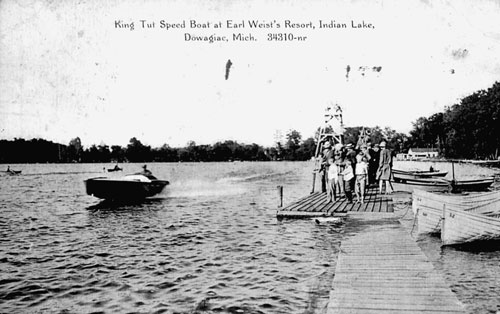
Speedboat ‘King Tut’ on Indian Lake The photographer taking a picture of the speedboat King Tut in 1929 had no idea of its significance. Earl Wiest Jr. and Ralph Tice, owners of Tice’s Beach at the north end of Indian Lake, were intense rivals. Who had the faster boat was an example. Tice won this round by building King Tut, the fastest boat on the lake, and racing it in front of Wiest’s Resort.
Happyland Resort on Magician Lake (Dowagiac)

The introduction to Sister Lakes by R.L. Rasmussen, a new book in Arcadia Publishing’s Postcard History Series, says that technically the two lakes that are called the Sister Lakes are Round Lake and Crooked Lake. In 1877 a post office for Sister Lakes was established in the area between the two lakes.

The book covers these two lakes and also the other nine lakes within a six-mile radius: Magician Lake, Indian Lake, Dewey Lake, Round Lake with 194 acres; Big and Little Crooked Lakes, Cable Lake and the four smaller lakes of Keeler, Pipestone, Priest, and Brush.

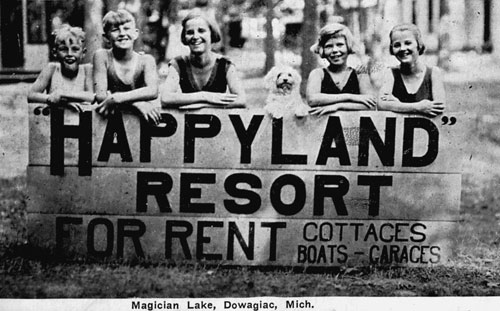
Happyland Resort on Magician Lake (above right, click for larger view) These young vacationers are from a 1923 postcard. This resort was originally started by Frederic E. Howe. He and his wife had a theatrical troupe that would spend their summers there writing plays and taking them out on the road. These actors would then be available to groups attempting to raise money for special causes.

You can learn more about Sister Lakes at the Sister Lakes, Michigan web site (nice map of the Sister Lakes area too) and also view the area on Google Maps.

The photos and captions reprinted with permission from Sister Lakes by R.L. Rasmussen. The book is available from the publisher online at www.arcadiapublishing.com or by calling 888-313-2665.

View other excerpts from Arcadia Publishing’s Michigan books at Michigan in Pictures!