
The Demolition of the J.L. Hudson building in Detroit

Hudson Implosion 2

Hudson Implosion 2, photo by ExcuseMySarcasm.

I had a post mapped out in my head that started out “When I was a little boy, my grandma used to take me down to Hudsons in Detroit on Saturday…”

I realized I couldn’t find the link to the site I found last year with all the photos of Hudson’s in its glory, so that post will have to wait for another day. Besides, this isn’t that kind of a photo…

With the press of a button at 5:47 PM on October 24, 1998, Detroit Mayor Dennis Archer dropped the J.L. Hudson Department Store from his city’s skyline and into the history books and record books.

The above from a detailed page on the demolition of J.L. Hudson Department Store CDI (the company that performed the demolition). It understandably touts their work, explaining that at 439 feet tall and 2.2 million square feet, Hudson was both the tallest and the largest single building ever imploded.

Hudson’s Implosion at the Fabulous Ruins of Detroit tells the tale the best (with photos). I know it’s cheating to skip to the end and post that, but after watching a video of the implosion and hearing the cheers, I was very moved by it, especially given what has happened in Detroit and Michigan in the decade since and appears to be continuing:

The cheering had stopped as the immense reality of the event sobered all who viewed it. An emptiness followed and the guilt of our cheers weighed upon us.

The choking clouds dissipated and a ghastly scene was revealed. An inch of dust covered everything for blocks around and there, in the midst of it all, lay the smoldering and shattered heart of 20th Century downtown Detroit.

For more photos (and to see the above larger) check out ExcuseMySarcasm’s Hudson Explosion slideshow and also the Hudson’s Detroit slideshow on Flickr which also contains some pics of the Hudson car and this photo by Paul Hitz of the space where Hudson’s used to be where he suggests that a park or something would be nice where the Hudsons building used to be.

Here’s a video with a good view of the charges going off (this person has a number more too!), another video from across the river in Windsor and a third titled “Detroit Hope” showing Hudson’s rising like a phoenix.
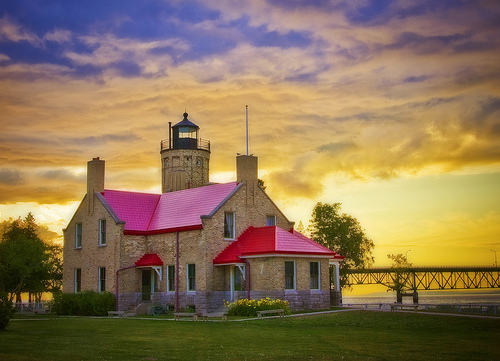
Old Mackinac Point Lighthouse – Mackinaw City

Mackinac Point Lighthouse at sunset

Mackinac Point Lighthouse at sunset, photo by the pentax hammer.

Gary asks that you please view this the way it should be viewed: Large On Black. See this photo (and many more) larger in his Junk on Explore slideshow.

On his Seeing the Light entry for Old Mackinac Point Lighthouse, Terry Pepper writes that as the connecting passage between Lake Michigan and Lake Huron, the Straits of Mackinac have always been critical to maritime commerce. As the Straits are frequently shrouded with fog, Mackinac Point was an ideal location for a fog signal building and lighthouse and an effort to build a facility began in 1888 and was completed with the installation of a red Fourth Order Fresnel lens in 1892:

As the use of automobiles became increasingly widespread in the early 1900’s, Midwesterners began to take increasing advantage of the newfound freedom that their automobiles provided, driving ever increasing distances to vacation. The unspoiled beauty of Michigan’s Upper Peninsula beckoned, and regular car ferry service began to ply the waters between Mackinaw and St. Ignace. With large amounts of vessel traffic now moving through and across the Straits, the Old Mackinac station became increasingly important as the light enabled the car ferries to operate throughout the night.

When the Mackinac Bridge opened in 1957, the car ferries were out of business, and with the brightly illuminated bridge serving as a navigation aid par excellence, the old light station was immediately rendered obsolete and was decommissioned.

The facility is now part of Mackinac Island State Historic Parks, and you can visit their Old Mackinac Point Lighthouse pages for history of the light and some great old photographs and educational resources for kids.

Port Sanilac might have been Bark Shanty Point

Port Sanilac life preserver

Port Sanilac life preserver, photo by Deep blue ocean.

Be sure to check this baby out bigger (and this one too)!

Wikipedia says that Port Sanilac is a village in Sanilac Township of Sanilac County, pop 658:

This village was originally a lumberjack settlement on the shore of Lake Huron named “Bark Shanty Point.” In the late 1840s and 1850s, the settlement gained its first sawmill, schoolhouse, and general store. In 1854, Bark Shanty Point’s first post office opened. In 1857 the village was renamed to Port Sanilac, as it is in Sanilac Township in Sanilac County. Local legend attributes the name to a Wyandotte Indian Chief named Sanilac.

This photos is from the Port Sanilac Marina (marina web cam). More about the town at the village at Port Sanilac web site.

Piquette Plant sunset … or is that a sunrise?

Piquette Plant sunset

Piquette Plant sunset, photo by LindaB..

Yesterday on Absolute Michigan we featured an article from Michigan History Magazine titled Where the Model T began and I found this photo while looking for a picture to pair with it. I decided to find another and feature this one here!

Jerald Mitchell calls the Ford Motor Company’s Piquette Avenue Plant in Detroit “a fulcrum point of human history [where] the balance of history shifted.” It was at this factory in Detroit that Henry Ford and his cohorts conceived the Model T automobile. For nine months, these men labored through fifteen-hour days, scrawled rough diagrams on the blackboards, fiddled with auto parts and patterns, argued and probably repeated the words “what if” a thousand times. When they were done, they had created the design for one of the most revolutionary automobiles ever built.

Read the rest on Absolute Michigan and learn much more about the museum that Jerald and others have created at tplex.org – the Model T Automotive Heritage Complex.

Linda writes she and her husband took a tour of the Ford Model T Piquette plant where restoration is underway. She says that the plant has special meaning for them as her husband’s great great grandfather was the winning bid for the plumbing of the building with a bid of $2,035! She also notes that these are the original windows to the plant.

You can see her other photos from the Piquette Plant, check out these Piquette photos from Miz Jelly Bean and dive into the Piquette slideshow on Flickr.

The Zilwaukee Bridge

The Zilwaukee Bridge

The Zilwaukee Bridge, photo by Mario.Q.

This photo is part of Mario’s Zilwaukee Bridge set (slideshow). He writes:

The Zilwaukee Bridge carries northbound and southbound I-75 125 feet over the Saginaw River at Zilwaukee, MI with a total length of just over 8,000 ft. This high level bridge replaced a drawbridge at the same location that caused major backups on I-75 with frequent openings for ship traffic going from Saginaw, MI to the Great Lakes. With a major and widely publicized construction mishap and huge budget overruns this is one of the more widely know bridges in the State of Michigan.

You can read much more about this star-crossed bridge in Wikipedia’s Zilwaukee Bridge entry, but the best resource is michiganhighways.org. There you can find The Zilwaukee Bridge: From the Beginning by MDOT. This details the whole story including “The Accident“. There’s also a bunch of photos of the bridge including an aerial view and an annotated aerial view.

A War Worth Waging and A Vote Worth Casting

A War Worth Waging – HFM, photo by MikeRyu

View it bigger on black and see more photos in Mike’s Henry Ford Museum set (slideshow).

Seeing this photo and realizing it’s been less than 100 years that women have enjoyed the right to vote made me think about how tirelessly they worked to secure the right to vote. Here’s a snapshot of women’s suffrage in Michigan courtesy the H-Net Chronology of Michigan Women’s History:

1849 A Senate committee, led by Senator Rix Robinson of Ada, proposes a universal suffrage amendment but it is not acted upon because of the “unusualness” and “needlessness” of the franchise for women.

1866 The state’s first bill on woman suffrage is defeated by one vote.

1867 The Michigan Legislature grants women taxpayers the right to vote for school trustees but rejects total woman suffrage.

1912 Governor Charles S. Osborn successfully urges the Michigan State Legislature to put the suffrage question before the all-male electorate in November. Clara B. Arthur of Detroit leads the campaign and the proposal appears to win. However, the opposition steals the election under suspicious circumstances.

1917 Governor Albert E. Sleeper signs a bill on May 8, granting Michigan women the right to vote in presidential elections.

1918 Michigan male voters approve a state constitutional amendment granting suffrage to Michigan women.

1919 Michigan women vote for statewide offices for the first time.

1920 The 19th Amendment to the Constitution, granting the vote to women, becomes law on August 26. Women vote for the first time in the presidential election on November 2.

It also made me wonder how something (each of our rights to vote) that has been bought and paid for time and again with far, far too much blood, sweat and tears can be treated with such disdain by many.

Your vote is your voice, please speak up today.

More about voting in Michigan from Absolute Michigan.

National Mine, old shed

fullshedinrain600

fullshedinrain600, photo by TheDailies.

This photo is part of Kim’s National Mine set (slideshow). She has posts about her place in National Mine on her blog. She took this shot in the rain, so it probably makes sense to share the Weather Underground page for National Mine.

Wikipedia’s National Mine, Michigan entry says that National Mine is an unincorporated community in Tilden Township (Marquette County), located just south of the city of Ishpeming.
Michigan Place Names by Walter Romig

The village was founded in 1878 as part of the estate of the Lake Superior Iron Company, in the Winthrop Range. It was given a post office on December 5, 1879, with Richard F. Ellis as its first postmaster.

For Paul Harvey, this is Andy McFarlane saying have a great weekend!

A Haunting at Historic Fort Wayne

A Haunting at Historic Fort Wayne

A Haunting at Historic Fort Wayne, photo by milminedesign.

On the last Wednesday of every month, Absolute Michigan has a “Weird Wednesday” – a day dedicated to sharing creepy tales and strange photos from all across Michigan. Today is no exception and you can click over to read the legend of Dog Lady Island, a special excerpt from the great book Weird Michigan by Linda S. Godfrey.

Linda doesn’t have a corner on the unexplained though – here’s a photo from the Absolute Michigan pool by Karen who writes:

I took this photo on a sunny spring day in early April. Late afternoon at Historic Fort Wayne in Detroit. No one was in front of me when the photo was taken, nor did I see this apparition until reviewing my photos. I am an investigator with Metro Paranormal Investigations here in Michigan and we were preparing for an investigation. Notice that the figure does not have a head. Pictures taken immediately before and after this one show normal lighting and look nothing like this one. This photo has been analyzed many times by several individuals and the current conclusion is that it is unexplained.

At the Metro Paranormal Investigations you can check out paranormal reports and more photos in their gallery.

The Wikipedia entry for Fort Wayne in Detroit doesn’t mention any hauntings, but you should probably go there to check! One thing I do know about Fort Wayne is that the whole facility is in peril due to a lack of funding for historic preservation. You can learn more about that from the Historic Fort Wayne Coalition and at Save Fort Wayne.

100 years of Lake Michigan at South Haven Pier Lighthouse

Late October on Lake Michigan

Late October on Lake Michigan, photo by micstolz.

Michael notes that even 100 years of Lake Michigan waves can’t put out the South Haven Light. He has several more in his South Haven Oct 26 2008 set (slideshow) – all uploaded “background big”. You might also want to check out the South Haven Light slideshow from the Absolute Michigan pool.

Terry Pepper’s Seeing the Light relates the history (with photos) of the South Haven Pier Lighthouse. He writes that a Fifth Order Fresnel lens from Parisian glass makers Barbier and Fenestre was installed in the lantern in 1902:

While the light was new, the old wooden beacon had withstood thirty years of Lake Michigan’s worst, and as a result of increasing deterioration, Eleventh District engineer James G. Warren laid-out plans to replace the venerable structure with a new cylindrical metal tower.

Contracts for the metalwork and required materials were awarded and delivered to the lighthouse depot in St. Joseph. On October 6, 1903, the tender Hyacinth delivered the prefabricated steel tower and a work crew on the pier, and erection of the new structure continued through the remainder of the month. The thirty-five foot structure was given a gleaming coat of white paint, and the district lampist carefully removed the Fifth-order lens from the old beacon and installed it in the new octagonal lantern. Captain Donahue proudly climbed the spiral stairs within the new tower to exhibit the South Haven light from atop the new tower for the first time on the evening of November 13.

Light and tower remain an active aid to navigation maintained by the Coast Guard and while you’re in South Haven, be sure to visit the Michigan Maritime Museum.

Autumn in Alberta, Michigan

DSC_6567

DSC_6567, photo by jsorbieus.

Jim took this photo in Alberta, Michigan, an unincorporated community in L’Anse Township of Baraga County:

The community was originally founded in 1936 after Henry Ford declared the banks of the Plumbago Creek to be an ideal spot for a sawmill. Ford named the town “Alberta” after the daughter of one of his top executives, Edward G. Kingsford.

At the time Ford established Alberta, wood was used extensively in automobiles. Mr. Ford envisioned the town as a model sawmill community; consisting of twelve houses, two schools, and a steam driven mill built to the most modern standards of the day. The Plumbago Creek was dammed to provide a reservoir to serve the town and mill’s water supply needs. The mill was a two-story white clapboard wood frame structure and still stands, now housing a portion of the Alberta Village Museum. The saw mill had a capacity of 14,000 board feet per day for hardwood and 20,000 board feet per day for softwood. This was a small capacity even by 1936 standards, with Mr. Ford’s other three mills in the Upper Peninsula of Michigan producing twenty to twenty-five times as much.

In 1954, Ford Motor Company donated the town of Alberta, Michigan and 1700 acres of land to what is now the School of Forest Resources and Environmental Science at Michigan Technological University.

Alberta buildings still standing on the property are used as a museum, support research and teaching programs for forestry and ecology majors, and are used by numerous universities from around the United States for forestry education.

Read more about The Ford Center from MTU.

Jim has a whole lot more big, background sized photos of fall’s glory in his U.P. set (slideshow). You can see more photos from the area on the Flickr map for Alberta.

More autumn wallpapery fresh in the Michigan in Picturesfall wallpaper collection!