Fall Color Tours: Marquette, Negaunee, Au Train

The Start of Autumn by Marjorie Obrien

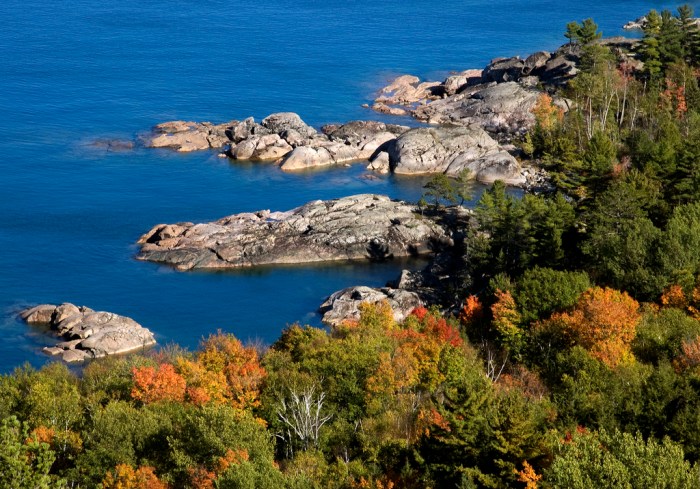
The start of Autumn, photo by I am Jacques Strappe

You can get 100+ more photos of the Upper Peninsula in autumn from Marjorie (slideshow).

Last fall through Absolute Michigan/Michigan in Pictures we started using the great information compiled in Travel Michigan’s Fall Color Tours as a starting point to point you to some great fall color touring (and fall color photos) around the state.  We’re trying to add to what they’ve put together – not rip them off! As always, if you have links to information or photos that we missed, comments or reports, post them in the comments below!

We’ll start with a driving tour of the Central Upper Peninsula that’s best from mid-September to early October and about 185 miles long. The tour starts in the UP’s largest city, Marquette. Marquette features some amazing architecture. You can read about and see pictures of it courtesy of Marjorie’s blog, Michigan Architecture, especially the beautiful red sandstone.

I recommend wandering around downtown for a while to check out the buildings and maybe grab a muffin from Babycakes and some coffee at Dead River Coffee. Travel Michigan (TM) recommends a visit the Marquette Harbor Lighthouse, home of the Marquette Maritime Museum. The lighthouse (pictured right by n. weaver, part of his UP slideshow) was constructed in 1866 and is the oldest significant structure in the city and more importantly, the lighthouse is one of the most historic navigation beacons on Lake Superior. There’s a nice little park behind it where you can swim if you are totally insensitive to temperature.

TM suggests that Presque Isle Park is also worth a visit and it is, offering a slow, brief jaunt along the rugged Superior shore and lots of nice little trails. It’s also a great bike ride along the shore on an excellent bike path from the lighthouse.
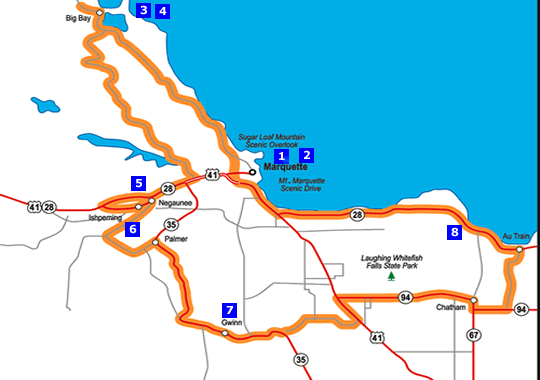
Now’s probably a good time for a map – click TM’s map to see larger. Heading north on County Road 550 to Big Bay takes you on a half hour cruise through some beautiful country rich in trees and views.  You can stop and do the 20 minute or so climb of Sugarloaf Mountain (see some pics from Lake Superior Photo). In Big Bay is the Thunder Bay Inn where you are required by travel writer code to mention  “Anatomy of a Murder” which was filmed there. Unfortunately the Thunder Bay Inn has been shuttered.  You can stop in at some of the other businesses and stay at the Big Bay Point Lighthouse Bed and Breakfast (if you call, they sometimes offer tours).

From Big Bay, head back on County Road 510 through the Huron Mountains and trees that arch over the roadway to form a tunnel of color. At US-41 head right and south into Negaunee (Chippewa word for pioneer) where you can visit the Michigan Iron Industry Museum, site of the first iron forge in the Lake Superior region. Negaunee’s Union Station Depot looks like a neat place to stay.  From Negaunee, continue to Ishpeming, home of the U.S. National Ski & Snowboarding Hall of Fame and the Cliff’s Shaft Mine Museum.

The route takes you down County Road 476 to Palmer and from there on M-35 south to Gwinn. You can enjoy hiking and mountain biking at Anderson Lake West State Forest Campground or continue south on M-35 to Little Lake where you take County Road 456 east to US-41. A left US-41 takes you north to M-94 where you turn right on M-94 to Chatham and can ask “Honey – are you sure we’re not lost?” 3 miles north off M-94 at Sundell are the about 100′ high Laughing Whitefish Falls (photo right by Church of One).

From there it’s east until you reach H-03 located between Chatham and Forest Lake, north on H-03 along the AuTrain River and past AuTrain Lake until you reach the junction of M-28. You can go east 12 miles along the Lake Superior shoreline on 28 to Tyoga Pathway or go west back to Marquette.

Check out more Michigan Fall Color Tours on Michigan in Pictures and also our fall wallpaper collection!

Seney National Wildlife Refuge

Seney, MI

Seney, MI, photo by lilrhgerl.

lilrhgerl took this Holga photo – do yourself a favor and check out her Holga slideshow. She writes that Seney is the most amazing place, and anyone who has spent time there would probably agree.

The Seney National Wildlife Refuge encompasses nearly 100,000 acres in the central Upper Peninsula. Seney was established in 1935 for the protection and production of migratory birds and other wildlife. It supports a variety of wildlife including a profusion of birds: bald eagles, common loons, trumpeter swans, Canada geese, hooded mergansers, mallards, black ducks, ring-necked ducks, wood ducks and sandhill cranes. Animals include black bear, white-tailed deer, coyote, river otter and beaver. There’s also black flies, deer flies, and mosquitoes during warmer months.

The wetlands, which are also known as the Great Manistique Swamp provide a great haven for all these animals and birds have their roots when:

…Over a century ago, lumbering operations altered the landscape of the Upper Peninsula’s great forests. The ring of the lumberman’s axe echoed through the forests as local mills depleted the region’s valuable supply of red and white pine. After the pine forests were cut, mill owners turned their axes and saws to the Refuge’s northern hardwood and swamp conifer communities.Following the lumbering operations, fires were often set to clear away the debris. These fires burned deep into the rich organic soil, damaging its quality and killing the seeds that would have produced a new forest. On many areas of the Refuge, the scars from these lumbering operations remain visible to this day.

After the fires, a land development company dug many miles of drainage ditches throughout Seney. This drained acreage was then sold using extravagant promises of agricultural productivity. But the new owners quickly learned that these promises were unfounded. One by one, the farms were abandoned, and the exploited lands reverted to state ownership.

In 1934, the Michigan Conservation Department recommended to the Federal Government that the Seney area be developed for wildlife. This proposal was accepted and Seney National Wildlife Refuge was established in 1935.

Check out Seney National Wildlife Refuge on the Absolute Michigan map and click for the Seney slideshow from the Absolute Michigan pool!

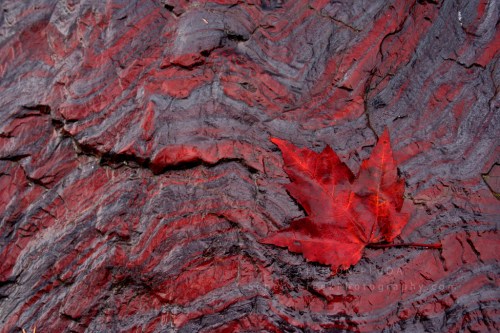
Banded Iron Formation at Jasper Knob in Michigan

Banded Iron Formation

Banded Iron Formation, photo by Allie.P.

Alison writes that this formation is billions of years old and is the main evidence of showing when photosynthetic life first arrived on earth. This photo is part of her Fall set (slideshow) and you can order a copy online from Seneca Creek Photography.

UPDATE! Alison emailed me some great information that makes this a lot clearer!

The Banded Iron Formations (BIFs) are about 2 billion years old and are made of alternating layers of Magenetie (Fe3O4) or Hematite (Fe2O3) which are the grey shiny layers, and red layers of iron stained chert (SiO2) often called jasperite. This photo is part of the Negaunee Iron Formation. Fe2+ is soluble in water, but when iron is oxidized to Fe3+, it is insoluble in water and will precipiate and become a solid. So, the alternating layers represent Iron being oxidized, and precipitation out to form a red layer, and then iron not being oxidized so that you dont get precipitation and get a hematite layer. It is this cycle of there being oxic (oxygen present) and anoxic (no oxygen) conditions in the ocean that has scientists wondering how that could happen.

There are many models that have been put together of how this could happen, but the most interesting one says that ancient bacteria used to use iron as a nutrient. The first bacteria that photosynthesized on our planet produced oxygen, which could explain how the iron was oxidized, precipitated and formed the red layers. Some have said the layers represent the death and birth of algal blooms. Eventually, bacteria produced so much oxygen that all the iron was oxidized, and thus we don’t get BIFs forming in our oceans today since it is impossible to dissolve any iron in it. They even found bacteria in some of the BIFs in Minnesota!

-90% of the world’s BIF (>1014 tons of ore) is located in Australia (~ 27 tons), South Africa, Brazil, and the Lake Superior Region in the US and Canada. The iron that is mined in the UP is extracted from BIFs by grinding them to a powder, taking the iron out through magnets, adding bentonite clay, and then rolling it up into pellets more commonly known as taconite pellets.

She adds that she has some journals about these she would be glad to send to anyone interested, as she have done some research on these as well. Contact her through her web site!

Read more about banded iron formations, fossils in the Negaunee Iron Formation, Jasper Knob and cool spots for rock collecting in the Eastern UP.

Here’s a link to more or less the location of Jasper Hill (Jasper Knob) on the Absolute Michigan map!

Victory Eagle, Marshall Fredericks

"Victory Eagle" at Former Veterans Memorial Building--Detroit MI

“Victory Eagle” at Former Veterans Memorial Building–Detroit MI, photo by pinehurst19475.

Anthony Lockhart writes:

This monumental sculptural relief (twenty-eight feet tall) by Marshall Fredericks is on the north wall of what was the Veterans Memorial Building. It symbolizes both sacrifice and victory. The building is now the UAW-Ford National Programs Center. It was designed by the firm of Harley, Ellington and Day and dedicated in 1951.

He has many more statues & sculptures from Detroit (view slideshow)

Editor’s note: I’m always surprised when I find that I’ve never featured a photo from a photographer whose work I follow closely. This is one of those times – if you’re looking for architectural photographs of Detroit and the surrounding area with informed commentary … look no further.

Menominee North Pier Light

Menominee Michigan Lighthouse

Menominee Michigan Lighthouse, photo by Lara Salonen.

You can see more photos of this cool pier light (and see them bigger) in Lara’s Menominee slideshow.

Terry Pepper’s page on the Menominee North Pier Light (at the mouth of the Menominee River on Green Bay) says that after harbor improvements were completed in 1927:

… a prefabricated octagonal cast iron tower was delivered by vessel, and lowered onto the pier.

Click to view enlarged imageThe thirty-four foot tower was painted white, and integrated with an attached fog signal building. An elevated wooden catwalk stretched along the wooden pier to provide the keepers with safe access to the light during periods when waves crashed across the surface of the pier. The octagonal cast iron lantern room was outfitted with a Fourth Order Fresnel lens of unknown manufacture.

At some point thereafter, the wooden pier was replaced by a concrete structure with a forty-foot diameter circular crib at its offshore end. At this time, the fog signal was eliminated with the inclusion of an automated electrically operated signal in the tower. With automation of the light in 1972, the need for daily maintenance of the light was also eliminated, and the iron catwalk was removed from the pier.

Dave Wobster’s page on the Menominee Light has some great photos and says that the 10-sided lantern no longer contains the original Fourth-Order lens, which has been moved to the restored Sand Point Lighthouse in Escanaba.

Under the Falling Leaves Moon

Hunter's Moon

Hunter’s Moon, photo by Kari Melissa.

This weekend (September 18-20) they celebrate the Festival of the Falling Leaves Moon, which honors the the heritage of Mackinac Island’s Native peoples and the fall bounty.

Binaakwe-giizis is Anishnaabe (Chippewa/Ojibwe) for falling leaves moon. This moon celebrates the time of year when the trees were told to stay awake for seven days and seven nights and only the cedar, pine and spruce obeyed. As a reward the are ‘ever-green’ and those that were unable to stay awake must shed their leaves each fall.

The Falling Leaves Moon illuminates the remnants of the harvested crops which provided cover for animals during the growing season.

During the founding days of America, European farmers used the bright moonlight to hunt game, fish and gather rice while the Anishnaabe tribes hunted, fished, gathered and prepared to move to their winter camps in order to protect and sustain themselves through the long, cold winters in the Upper Midwest and collect furs for trade value.

Moons of Harvest and Hunters

Wikipedia says that the Hunter’s Moon is also known as Blood Moon or Sanguine Moon. It’s the first full moon after the Harvest Moon, which is the moon closest to the autumnal equinox.

Gagetown – Michigan’s Thumb Octagon Barn

Gagetown - Michigan's Thumb Octagon Barn, photo by coloneljohnbritt

Gagetown – Michigan’s Thumb Octagon Barn, photo by coloneljohnbritt

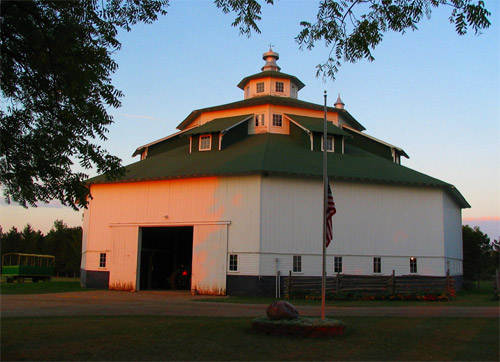
John writes that this enormous, eight-sided barn in Gagetown is an agricultural museum open to the public during the warmer months.

Check out thumboctagonbarn.org for details including the answer to a question: Why an octagon barn?

Besides the fact that Mr. Purdy (the owner of the barn) was taken up by the uniqueness of this shape of barn, it was during this period that the agricultural community was promoting an octagon or round barn as the building of the future for agriculture. It was felt that this shape of building would be handier to work out of and that it would replace three or four buildings on the farm, i.e. hog house, horse barn, grainery, etc.).

At this same time Sears Roebuck & Co. listed a number of different sized octagon barn packages in their catalogue. You could order a barn “kit” and it was loaded on a flat car in Chicago and shipped all over the country.

It is obvious that if an octagon barn was the building of the future for agriculture there would have been more of them dotting our landscape. In talking to men who worked on the Purdy Farm as boys, they said that it was not as handy to work in and it was a more costly building to build.

Their photos page has some neat images including a photo of the Purdy Farm and barn from 1924.

Clare Union Station

tracks pano

tracks pano, photo by scott.gosnell.

Click the photo to see this excellent panorama larger and to see it on a map. Michigan in Pictures often features stories of historical structures that are being preserved. As near as I can tell, this is not one of those.

The Michigan Passenger Stations page on Clare Union Station begins:

The Clare depot was built by the Pere Marquette and Ann Arbor Railroads in 1898 at a total cost of $6585. The Queen Ann style depot has wings paralleling each set of tracks. There are two bay windows, presumably for agents of both railroads. The door and window arrangement suggests waiting rooms and freight rooms for both roads also.

The Pere Marquette built through Clare around 1870. This was part of the original PM land grant railroad…

Passenger service on the Ann Arbor ended in 1950 and after being used for many years for storage, the building was abandoned. Click to read more and see some more views of the station, including historical photos.

For more photos of the station you can check out Clare, Michigan at Michigan’s Internet Railroad History Museum.

Big Sable Point Lighthouse in Ludington State Park

Big Sable Point Lighthouse

Big Sable Point Lighthouse, photo by photoshoparama.

Dan has a number of photos from Big Sable Point Lighthouse and you can see them bigger by checking out the slideshow.

Terry Pepper’s Seeing the Light is down (I fervently hope temporarily) so I can’t get the crunchy details on from his Big Sable Lighthouse page. Wikipedia’s Big Sable Point Lighthouse entry says that the historical marker reads:

Called Grande Pointe au Sable by French explorers and traders, Big Sable Point was an important landmark for mariners traveling a treacherous stretch of Lake Michigan shoreline between Big Sable Point and present-day Ludington. In 1855, twelve ships wrecked in that area. Commerce linked to the burgeoning lumber industry required that Big Sable Point be suitably lighted. State senator Charles Mears pressed the legislature to ask the federal government for a light station at Big Sable. In 1866 the U.S. Congress appropriated $35,000 for a lighthouse, which was built the following year. As the lumbering era waned, steamers carrying coal, foodstuffs, and tourists continued to rely on the lighthouse for navigation.

The Big Sable Point Lighthouse is one of the few Michigan lights with a tower reaching 100 feet. Completed in 1867, Big Sable’s tower measures 112 feet high. In 1902 the deteriorating brick tower was encased in steel. The keeper’s dwelling, which once housed a single family, has been enlarged over the years, resulting in the present three-family residence. Indoor plumbing and heating and a diesel electric generator were added in 1949. In 1953, power lines were extended to the Point. In 1968 the tradition of light-keeping begun in 1867 by Alonzo A. Hyde and his wife, Laura, ended when the station was fully automated. Big Sable Point Light Station is listed in the National Register of Historic Places.

The light is located in Ludington State Park (Wikipedia) and is open for tours May – October (see bigsablelighthouse.org for details). The Sable Points Lighthouse Keepers Association maintains several lighthouses on the east coast of Lake Michigan: Big Sable, Ludington North Breakwater, and Little Sable.

For more views of the lighthouse and the area, check out Big Sable Point on Flickr, some Big Sable Point Lighthouse panoramas (go to full screen!) and these rocking aerial photos of Big Sable Lighthouse at marinas.com – be sure to use the zoom!

You can check out Big Sable Point Lighthouse on the Absolute Michigan map (satellite view).

100 Years of the Model T

Assembling the Model T

Assembling the Model T, photo courtesy Archives of Michigan

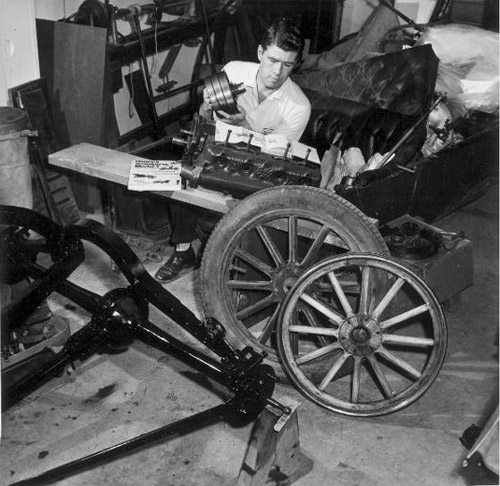
The September 2008 Image of the Month from the Archives of Michigan (click through for more pictures) says that the first production Model T was completed Sept. 27, 1908, at Ford’s Piquette Avenue plant in Detroit.

…Henry Ford wanted a car that the average American could afford. The Model T initially sold for $850. The price continued to drop as Ford’s assembly line technology improved production efficiency. According to Willis F. Dunbar and George S. May’s third revised edition of Michigan: A History of the Wolverine State, a Model T touring car cost only $360 by 1916.

The Model T also proved remarkably easy to maintain. Dunbar and May note, for example, that it “was so easy to repair that almost anyone could fix something … with a pair of pliers and a screwdriver.” Gasoline seldom proved an onerous expense, either. On page 45 of The Ford Century author Russ Bahnam notes that the Model T averaged twenty-five miles per gallon – with a gallon of gas typically costing only twenty cents!

The Ford Motor Company produced over 15 million Model Ts between 1908 and 1927. According to The Henry Ford of Dearborn, Mich., the Volkswagen Beetle is the only model with a greater production record!

For more in the Model T check out the Model T Automotive Heritage Complex, Inc. (aka the T-Plex) and the Model-T Centennial exhibit at The Henry Ford.