A Dream Realized

A Dream Realized, photo by lorainedicerbo

This photo by Loraine DiCerbo was taken at the Hiedelberg Project in Detroit. It’s part of her Detroit set (slideshow).

I thought it would be a fitting picture to pair with this excerpt from the text of Dr. Martin Luther King’s December 18, 1963 address at Western Michigan University:

The world in which we live is geographically one. Now we are challenged to make it one in terms of brotherhood. Now it is true that the geographical oneness of this age has come into being to a large extent through man’s scientific ingenuity. Man through his scientific genius has been able to dwarf distance and place, time and change. Our jet planes have compressed minutes into distances that once took months and weeks and days. I think Bob Hope has adequately described this new jet age in which we live. He said “It is an age in which it is possible to take a non-stop flight from Los Angeles, California to New York city–a distance of some three thousand miles–and if on taking off in Los Angeles you develop hiccups, you will ‘hic’ in Los Angeles and ‘cup’ in New York City.” You know it is possible because time difference to take a non-stop flight from Tokyo, Japan on Sunday morning and arrive in Seattle, Washington on the preceding Saturday night and when your friends meet you at the airport and ask when you left Tokyo, you will have to say, I left tomorrow.

Now this is a bit humorous but I’m trying to laugh a basic fact into all of us. It is simply this, that through our scientific genius, we have made of this world a neighborhood. Now through our ethical and moral commitment, we must make of it a brotherhood. We must all learn to live together as brothers or we will perish together as fools. This is the great challenge of the hour. This is true of individuals. It is true of nations. No individual can live alone. No nation can live alone.

…or state. We have a lot of work before us, and I hope that Michigan can be an active and engaged part of reshaping our naton and world for a changed future.
Underwater images from a Lake Michigan Stonehenge

If you’ve ever wondered what the most popular post on Michigan in Pictures was, you’ve arrived. Over 100,000 people followed a Reddit post here to learn about an underwater discovery.

September 29, 2011 Welcome everyone from Reddit. We don’t have any update to this story right now but I’ve emailed Mark and will post anything I learn. You might enjoy some of our Weird Michigan features from Absolute Michigan too!

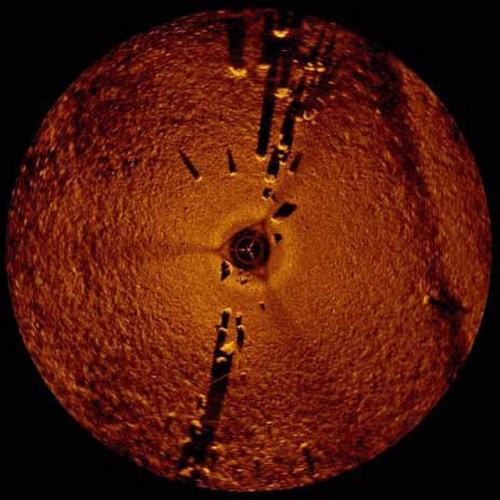
Lake Michigan Stones

Lake Michigan Stones, photo via bldgblog.

In Stonehenge Beneath the Waters of Lake Michigan, Geoff Manaugh of BLDGBLOG writes:

In a surprisingly under-reported story from 2007, Mark Holley, a professor of underwater archaeology at Northwestern Michigan University, discovered a series of stones – some of them arranged in a circle and one of which seemed to show carvings of a mastodon – 40-feet beneath the surface waters of Lake Michigan. If verified, the carvings could be as much as 10,000 years old – coincident with the post-Ice Age presence of both humans and mastodons in the upper midwest.

Regarding the slightly repurposed “sector scan sonar” device that Northwestern Michigan University College professor and underwater archaeologist Dr. Mark Holley & Brian Abbott were using to survey some old wrecks when they made their discovery, Geoff writes:

The circular images this thing produces are unreal; like some strange new art-historical branch of landscape representation, they form cryptic dioramas of long-lost wreckage on the lakebed. Shipwrecks (like the Tramp, which went down in 1974); a “junk pile” of old boats and cars; a Civil War-era pier; and even an old buggy are just some of the topographic features the divers discovered.

You’ll definitely want to click through to read the rest and see more pictures!

You can read a detailed feature about this in U.S. archeologists find possible mastodon carving on Lake Michigan rock at NowPublic and listen to some radio reports from the time of the discovery in August of 2007 that include an interview with Dr. Holley and another with Grand Traverse Bay Ottawa Indian tribal member and historian John Bailey in Mammoth discovery beneath Grand Traverse Bay? on Absolute Michigan.

Motown Records / Hitsville USA 50th Anniversary in 2009

FH040003

FH040003, photo by haycarrieanne.

If you check it out bigger you can read the historical marker … or check out the front and back at Mich Markers! Carrie has many more cool shots in her Capturing Detroit set (slideshow).

Wikipedia’s Motown Records page says that Motown Records (Tamla Motown outside of North America) was founded in Detroit, Michigan. by Berry Gordy as Tamla Records on January 12, 1959. That makes next Monday Motown’s 50th birthday!

Hitsville USA” is now the Motown Historical Museum. They write:

There were many many talented young artists, musicians, song writers, producers, engineers and staffers who contributed to the Motown Sound. They came to Hitsville because they loved making music. Hitsville became known as a hit factory. It was open 24 hours a day, seven days a week, cranking out hit after hit record from 1959 until 1972.

“My own dream for a hit factory was shaped by principles I learned on the Lincoln-Mercury assembly line. At the plant, cars started out as just a frame, pulled along on conveyor belts until they emerged at the end of the line – brand spanking new cars rolling off the line. I wanted the same concept for my company, only with artists and songs and records. I wanted a place where a kid off the street could walk in one door an unknown and come out another a recording artist…a star!”
~ Berry Gordy, (Founder, Motown Record Corporation)

Motown is just one of the Michigan businesses, organizations and municipalities celebrating an anniversary in 2009 – head over to Absolute Michigan and the 2009 Michigan Anniversaries page to see many more and add ones we might have missed!

Detroit Journal – Words and Pictures by buckshot.jones

gray

gray, photo by buckshot.jones.

Scott aka buckshot.jones has a tremendous set of photos titled Detroit Journal – Words and Pictures. Some are funny, some revisit the past and many more take a hard look at the state of the city.

If you love Detroit or simply wonder what happened and is happening in the city, I cannot recommend this collection highly enough. Here are the words that go with the photo above:

I’d look into the mirror every morning only to find the same guy staring back. Then, it seems suddenly, I find some 50 year old grump is staring back. Who is this guy? The changes happen so slowly with such steady force I failed to see the changes. I noticed the laugh lines around my eyes are now stubbornly etched into my face even in times of scorn. As I contemplate these changes I think of friends and family and how, in my mind’s eye, they are still 21, bolted down in time. Just like me, or so I thought. Now consider that old friend you haven’t seen in 10 or 15 years. Think of how you had to do a double take when you met after all those years. The face is familiar but the changes make you not quite sure. You hesitantly state their name with a question, “John?”

For me my home town is curiously like encountering that long lost friend. I have lived here my entire life yet over the last couple years the changes in Detroit have, at times, struck me as startling. For most of my early life, as a schoolboy and a young adult, I spent my time working throughout the city neighborhoods and business districts. During all that time these neighborhoods were in decline, I just never noticed the change. About 10 years ago I took a job that had me traveling a great deal in Canada and since that time my professional life has found me spending most of my time away from home traveling all over the Midwest.

As my body banned me from playing basketball and my lack of patience killed my golf game, photography filled the distraction void. Trading the links for a photo safari on my weekends, I started to wander around my old haunts mostly in search of connections to my memories. I was struck by what I found, or in some instances failed to find- my home town suddenly got old. “Detroit….right?”

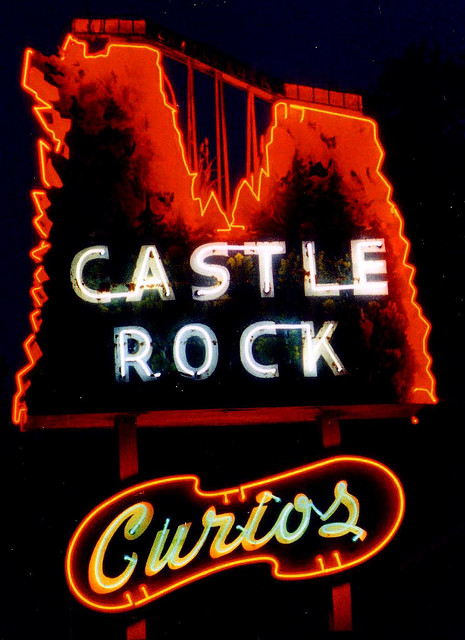
Castle Rock: Another (Michigan) Roadside Attraction

Castel Rock Curios

Castle Rock Curios, photos by Alan C of Marion,IN

This photo is just one of very many in Alan ‘s Roadside Finds set (slideshow) and you’ll also want to wander through his Michigan pics!

Michigan’s Roadside Tourist Attractions will be showcased in a special exhibit opening at the Michigan Historical Museum in Lansing on January 10, 2009.

Michigan’s Roadside Attractions, set to run through Sept. 14, 2009, features more than 50 roadside attractions that grew up as Michigan expanded its highway system from the 1930s through the 1970s. Many of these attractions still provide fun and excitement for millions of tourists each year.

“Deer parks and dinosaur gardens are just a couple travel experiences that take center stage again in this exhibit. Places like Castle Rock in St. Ignace, the Soo Locks Boat Tours and the multiple locations where Paul Bunyan has been spotted are also featured through photos, artifacts and souvenirs,” said Phillip C. Kwiatkowski, director of the Michigan Historical Museum System. ” Michigan’s Roadside Attractions is about treasured mementoes, from miniature Paul Bunyan statues and plastic purses to dinosaurs, seashells and even ceramic doll dish sets.”

Learn more about the exhibit from the Michigan Historical Museum.

I know you’re all wondering about Castle Rock – here’s what Roadside America has to say:

Castle Rock is an abrupt, geologic protuberance just north of the Mackinac Bridge on Michigan’s Upper Peninsula. The nearly 200-ft. column of rock was long ago augmented with a man-made ramp and walkway to provide tourists a climb for an unparalleled view of Lake Huron and distant Mackinac Island.

At the base of the Castle Rock lookout is an amusing Paul Bunyan statue accompanied by his mythical sidekick, Babe the Blue Ox. This Bunyan is rare. Instead of standing, ready to deforest Michigan, Paul sits, staring googly-eyed towards the lake. With a newspaper in his hands, we’d complete the visual that Paul is halfway through one of his mighty bowel movements.

OK, probably should have cut that one sentence earlier. Read more about Castle Rock from Hunt’s UP Guide (I learned that it only costs 50¢ to climb – definitely stopping next time!)

A Michigan December, Henderson Castle

A Michigan December, Henderson Castle

A Michigan December, Henderson Castle, photo by John Clement Howe.

Henderson Castle, constructed 1895 and now a bed & breakfast.

View this bigger along with more photos of Henderson Castle in John’s Historic Homes of Kalamazoo set (slideshow), read more about Henderson Castle on Michigan in Pictures and see a video tour of Henderson Castle on YouTube.

Coffee Tasting at Paramount Coffee of Lansing

Coffee Tasting, photo by WAXY.

John writes that this is from a coffee tasting session at Paramount Coffee in Lansing. The man on the right is his grandfather, Lawrence B. Weingarten, one of the founders of Paramount. He got this history from a previous version of the Paramount Coffee web site:

In 1935, during the height of the great depression, two established coffee salesmen decided to take a chance. They left their jobs in Chicago and ventured up I-94 to Lansing, Mich., to start their own company. They chose Lansing as they felt it was the ideal location for their new challenge. So on Aug. 14, 1935 the two friends scraped together every penny they had and went after their lifelong dream. What they lacked in money, they more than made up for in enthusiasm and energy. Paramount Coffee Company was born.
You can see this photo bigger in John’s slideshow and more of his work can be found at Waxy Photography.

Albion: History of The Forks

Destination, photo by Stephen K. Willi

In keeping with this blog’s tradition of “Well here I am, now where is that actually?” (as opposed to “Hey that looks cool, I wonder what’s up with that?”) I thought I’d take a look at the city of Albion. Although I come here once or twice a year, my knowledge has been confined to Albion College (which is always closed when I’m here), Albion’s world class sledding hill, the Bohm Theater, the “other” Cascarelli’s (cause Homer’s Cascarelli’s rocks), the Coca-Cola sign and one very cool bookstore. I suppose that could be enough to build a post on, but I have my reputation to think about. And so, with already far too much adieu…

Wikipedia’s entry for Albion, Michigan says that this city in Calhoun County had a population of 9,144 in 2000.

The first white settler, Tenney Peabody, arrived in 1833. As local legend goes, Peabody’s wife decided to name the city after Albion, Oswego County, New York where another prominent pioneer, Jesse Crowell, came from. The city was almost named Peabodyville, but Albion was the preferred choice.

….The forks of the Kalamazoo River provided power for mills and Albion quickly became a mill town as well as an agricultural market. A railroad line arrived in 1852, fostering the development of other industries.

From the time that the earliest English-speaking settlers arrived, the area has also been known as The Forks, because it is situated at the confluence of the north and south branches of the Kalamazoo River. The Festival of the Forks has been celebrated annually since 1967, celebrating Albion’s ethnic heritage.

If you want to really dive into the history, you’re in luck because the Albion Michigan website has an amazing amount of historical information courtesy of historian Frank Passic. The site is framed so it’s hard to link directly to stuff, but be sure to go to the Albion History section and click into the gallery of photographs.

See this photo larger in Stephen’s Black and White Photography slideshow (view set).

The Polar Express and Pere Marquette 1225

The Pere Marquette #1225 (Christmas train 12/25) One of the Last!!!

The Pere Marquette #1225 (Christmas train 12/25) One of the Last!!!, photo by David Sr. – Lapeer Photography.

A lot of times I think I’ve written about something on Michigan in Pictures and then when I look, it turns out I haven’t.

Such is the case with the Pere Marquette #1225 Christmas train. David writes that this train was used as the model for the train in the animated movie “The Polar Express” with Tom Hanks (view trailer on YouTube). Wikipedia explains:

The steam locomotive that pulls the Polar Express is modeled after an actual locomotive that is on display at the Steam Railroading Institute in Owosso, Michigan. The Pere Marquette 1225 Berkshire-type (2-8-4), built in 1941 at the Lima Locomotive Works in Lima, OH, was part of the Pere Marquette Railway system before being decommissioned in 1951. Slated for scrapping, it was acquired by Michigan State University (MSU) in 1957 and exhibited on campus.

In 1971, MSU steam enthusiasts commenced the formidable task of restoring the mighty locomotive to operating condition. Restoration was substantially completed in 1985, and in 1988, number 1225 started pulling excursion trains in the Owosso area and around Michigan. The locomotive has been listed on the United States National Register of Historical Places.

In the film, artistic liberty is taken with the appearance of the locomotive and its tender, both being made to seem even more massive than the 794,500 pound (361,136 kilogram) original. Many of the train’s sound effects, such as the whistle blowing and steam exhausting, were created from live sampling of number 1225 while in operation.

Learn more about the train and see it in action at The Steam Railroading Institute in Owosso. See it bigger along with other views of Michigan in David’s Michigan slideshow (view set) and see more photos of the Pere Marquette 1225 in the 1225 Michigan slideshow (really a treat!)

The movie was based on the Caldecott Medal winning book The Polar Express written and illustrated by Chris Van Allsburg. Like the movie, it’s set partially in Van Allsburg’s hometown, Grand Rapids.

Michigan road salt & the Detroit Salt Mine

Salt Mountain, photo by otisourcat

In the battle against snow and ice that is waged every winter day on Michigan’s roads, salt remains and essential ingredient. MDOT records for 1991 show that 442,223 tons of road salt were applied to 10,000 linear miles of trunk line maintained under MDOT’s jurisdiction. The Wayne County Road Commission notes that a single salt run for a truck can use up to 12 tons of salt, depending upon the truck size. That page has several more bits of trivia including the fact that at temperatures below 20 degrees, salt begins to lose its effectiveness. It becomes almost completely ineffective at 0 degrees or colder.

The Salt Institute’s page on Michigan salt says that estimated salt deposits in Michigan are astronomical. In the Detroit area alone, it is believed that there are over 71 trillion tons of unmined salt. Geological studies estimate that 55 counties of the Lower Peninsula cover 30,000 trillion tons of salt.

Our largest salt mine is actually the Detroit Salt Mine, operated by the Detroit Salt Company (closed for a time but now re-opened, comes with an annoying & loud Flash warning) and I suppose is makes sense that in 1940 Detroit became the first major city to use rock salt for snow and ice control. The Great Lakes Radio Consortium’s Ann Murray has a great report titled Exploring a Great Lakes Salt Mine that takes you inside the Cleveland salt mine that extends under Lake Erie. The best exploration of the mine is via The ghostly salt city beneath Detroit in the Detroit News:

In a 1925 Detroit News article, miner Joel Payton told about his salt mine job. “The only dirty part of this job is going down to work,” Mr. Payton explained.

“I have to wear this old outfit because the big buckets that take us down get smudgy from the action of the sulphur water on the iron of the buckets.

“The mine itself is dry and clean as pure rock salt in a solid vein 35 feet thick is bound to be. The high vaulted rooms that we have hollowed out have sparkling white floors, walls and ceilings.”

Payton continued, “One reason we don’t have any rats in our Detroit mine is because the rats would have nothing to eat except the leavings of our lunch pails. And by the way, not only are there no rats or cockroaches or other living creature in our mine, but also no remains of living things from past ages. The salt vein is, of course, a dried up sea that once covered this section for hundreds of miles. You’d naturally suppose that some fish or vegetation would have been pickled or fossilized in the brine as it hardened. But I’ve never seen a single fossil or sea shell or any remains of that kind”

The photo above was taken at the Verplank salt dock, Muskegon and you can see more photos of otisourcat has taken of Michigan road salt.