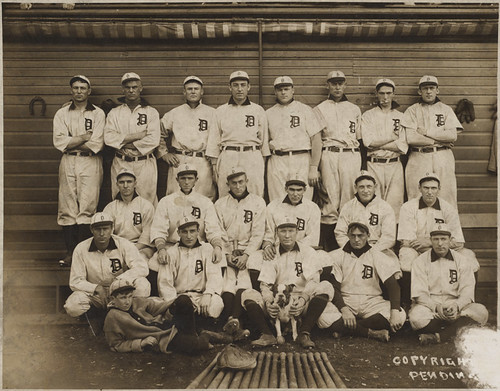
Detroit Tigers, Champions of the American League (in 1907)

Detroit Tigers, Champions of the American League in 1907

Detroit Tigers, Champions of the American League in 1907, photo by Boston Public Library.

We’re not going to be able to say the same thing 102 years later, but the 2009 Detroit Tigers certainly played well above preseason expectations.

The photo above shows the 1907 Detroit Tigers, who won the AL pennant but lost to the Chicago Cubs:

Top row, left to right: John Eubanks, Claude Rossman, Sam Crawford, Bill Donovan, George Mullin, Ed Willett, Fred Payne and Ed Killian. Center: Davy Jones, Red Downs, Ty Cobb, Bill Coughlin, Germany Schaefer, and Elijah Jones. Front: Ed Siever, Jimmy Archer, Hughie Jennings, Boss Schmidt and Charley O’Leary.

See this bigger in the ridiculously awesome McGreevey Collection slideshow (view collection) from the Boston Public Library.

The collection consists of early Boston baseball photographs dating from 1875 to 1916. Represented are many of the most important ballplayers of the 19th and early 20th century including Cy Young, Ty Cobb, Mike “King” Kelly, Kid Nichols and many others. Also included are panoramic photos of the ballparks of the era including the Huntington Avenue Grounds in Boston and the Polo Grounds in New York. The centerpiece of the collection is a series of photographs related to the first World Series in 1903 between Boston and Pittsburgh.

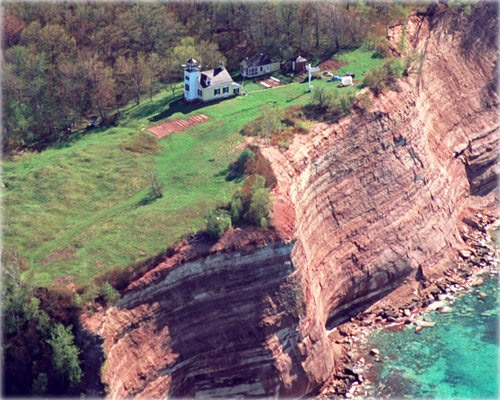
Grand Island North Lighthouse

Grand Island North Light 2

Grand Island North Light 2, photo by Shawn & Brian Malone

The page on Grand Island North Lighthouse from Terry Pepper’s Seeing the Light begins:

Eight miles in length, and three miles in width, Grand Island is the largest island on Superior’s south shore. Long known by fur traders for the natural harbor of refuge on the island’s southern lee, the North West Company established a post on the site of present day Munising in the late 1700’s, and subsequently the American Fur Company operated a post on the Island itself during the early decades of the nineteenth century. The hay days of “King Fur” were fading into memory when Abraham Williams, the island’s first permanent white settler arrived from Vermont in 1837 and set up homesteading in a couple of the old abandoned trading post buildings on the island’s south shore. As other settlers began arriving to eke an existence from the island’s shores, Williams established a trading post, blacksmith’s shop and sawmill on the island.

In 1853 Congress appropriated $5,000 for a new lighthouse at the top of a 175-foot cliff on the northern end of the island, but materials used were so inferior that the light had to be completely demolished and rebuilt in 1867. It served for almost 100 years before being decommissioned and sold to Dr. Loren Graham, author of “A Face in the Rock,” a chronicle of the rich native heritage of the island. There’s more great photos of the lighthouse including this one by Jeff Shook and a shot from 1905.

You can buy a copy of this photo right here and check out more of their Lake Superior lighthouses.

If you’re looking for some chilly reading on a warm fall day, The Surfer’s Journal is running a ten page story in their summer issue featuring photos that the Malones took at a Grand Sable Dunes surfing session in January of 2009.

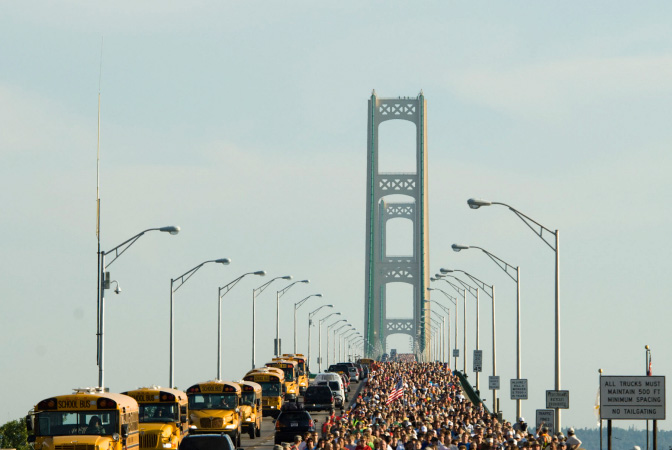
52nd Annual Mackinac Bridge Walk ~ September 7, 2009

2008 Mackinac Bridge Walk

2008 Mackinac Bridge Walk, photo courtesy Michigan Department of Transportation & Mackinac Bridge Authority

The annual Mackinac Bridge Walk is a Michigan tradition that has been held every year since the Bridge opened in 1957. This year is the 52nd annual and it takes place (as always) on Labor Day  (September 7) from 7-11 AM. The walk is free and you can get all the details from the official Mackinac Bridge web site.

There’s more info available on Wikipedia and you can learn all about the Mackinac Bridge over at Absolute Michigan.

The Mackinac Bridge

Theft of the Traverse City State Hospital Gate

Light of Day Falls on the Asylum

Light of Day Falls on the Asylum, photo by sunliner500.

We’ve been working all week on the first ever Traverse City Wine & Art Festival which takes place tonight. In a normal world, I’d be posting today only about how excited I am at how amazing this event will be.

The festival takes place at The Village at Grand Traverse Commons and the Minervini Group who owns and manages the of the former Traverse City State Hospital was gracious enough to let us use an office in their main headquarters. Yesterday morning, I was shocked to learn that someone had stolen the iconic gate from the back of Building 50. It’s likely that this metal gate was packed on a truck for Chicago or elsewhere. Check out some of the photos linked below to see the details, and if you ever come across it on a walk, know that there are a lot of people who would appreciate you letting the Minervinis know by email or calling 231.941.1900!

Have a look at Nick’s photo bigger and also check out Traverse City State Hospital set (slideshow). There’s more photos at traverse city state hospital gate on Flickr.

There’s also great information about the Traverse City State Hospital from Kirkbride Buildings and some cool old photos on this Building 50 page that might contain some shots of the gate.

Photos from the 2009 Woodward Dream Cruise

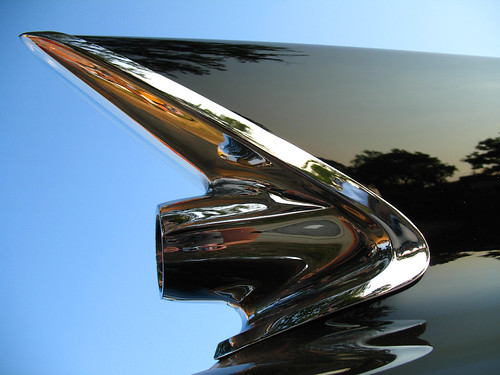
car abstract

car abstract, photo by *Alysa*.

The 2009 Woodward Dream Cruise is in the rearview mirror but even if you missed it, you can see some great photos in the Woodward Dream Cruise slideshow from the Absolute Michigan pool. See this bigger in Alysa’s slideshow.

There’s tons more in the Woodward Dream Cruise slideshow from all Flickr users and also the Woodward Dream Cruise group.

If you wonder where it all got started, check out Cruisin’ the Original: Woodward Avenue on Michigan in Pictures.

Electric Blues: Remembering Les Paul

courtesy Absolute Michigan

Electric Blues

Electric Blues, photo by Rudy Malmquist.

“Les Paul brought six strings to electricity and electricity to six strings. Les Paul was an innovator, a groundbreaker, a risk taker, a mentor and a friend. Try to imagine what we’d be doing if he hadn’t come along and changed the world. There will always be more Les to come. That’s certified.”
~ Billy Gibbons, one of many to praise Paul

Les Paul, designer of the Gibson Les Paul and an incredibly influential musician, passed away yesterday at the age of 94.

Wikipedia says that in addition to collaborting on the the guitar that bore his name, Paul is credited with recording innovations including overdubbing, tape delay, phasing effects, and multitrack recording. The “Wizard of Waukesha” was also one of the most influential guitarists ever, developing licks, trills, chording sequences, fretting techniques and timing that set him apart from his contemporaries and have carried through to the modern day.

There’s so much more to be said. Start with:

Les Paul Online is the artists official web site. Definitely go here to get a feel for the man. Paul’s good humor and amazing skills shine through.

The World Has Lost a Remarkable Innovator and Musician: Les Paul Passes Away at 94 from Gibson Guitar

What makes the Gibson Les Paul unique and The Man Behind the Guitar from the Les Paul Guide

You can (and should) watch Les Paul – Chasing Sound! on YouTube. Also see Les Paul Chasing Sound (IN MEMORIAM 1915-2009) at PBS to read some great history and a timeline of Paul’s career.

Legendary guitar-maker Les Paul left mark in Kalamazoo from mLive is just one of the articles they have about Paul.

Gibson Guitar in Kalamazoo, Michigan from Michigan in Pictures seems to be where people go to ask questions about Gibson guitars the have … and has some good information about the company.

Be sure to check out Rudy’s photo bigger.

Riverfront Redevelopment: Lansing’s Ottawa Street Power Station

Riverfront Redevelopment

Riverfront Redevelopment, photo by Mario.Q.

Mario has a great Ottawa Street Power Station set (slideshow) in which he’s documenting this redevelopment project.

Wikipedia’s entry for the Ottawa Street Power Station says:

The Ottawa Street station provided electricity and steam to the downtown Lansing area from 1939 through the late 1980’s. By 1971, improvements at the Board of Water and Light’s Eckert Station permitted the Ottawa Street Station to operate as a backup station for electric generation. It continued to provide steam service into the 1980s. In 1984, this Board of Water and Light’s Eckert Station began providing steam service, initially as a backup to the Ottawa Street Station, but eventually as the primary steam service source. As equipment became obsolete, it was removed from the Ottawa Street Station, and ultimately it was decommissioned in 1992 for electric and steam.

…In 2007 it was sold to be redeveloped as corporate headquarters for the Accident Fund Insurance Company of America. Massive renovations to convert the plant to an office building are currently underway by The Christman Company, with completion of the entire 7-acre office campus scheduled for the first quarter of 2011.

Lansing City Pulse article about the Ottawa Power Station redevelopment and this great thread on the project from SkyscraperPage (complete with 3D renderings).

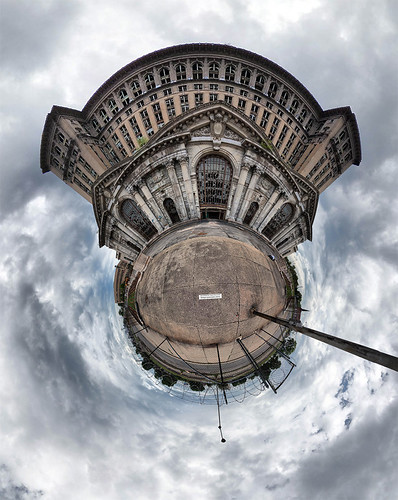
Michigan Central Station panoramic tour

Michigan Central Station

Michigan Central Station, photo by jeanpierrelavoie.

Let’s go for a ride, shall we?

Chris Sebok sent me a link to this amazing panoramic walkthrough of Detroit’s Michigan Central Station by Montreal photographer Jean-Pierre Lavoie (part of his Detroit set). It’s an extremely cool walkthrough that you have to see to believe!

NOTE: There is sound on this so turn it down if you’re surfing on the sly!

Check out more on MCS from Michigan in Pictures.

Farming in Michigan in the 1880s


Antrim County Farm, 1889, photo courtesy Seeking Michigan

The good folks at Seeking Michigan dug this gem for me and it’s one of those that you just have to check out bigger.

Teaching Michigan History is just one of many of great online features from the apparently soon-to-disappear Michigan Department of History, Arts & Libraries. Read about how this freaks out historians that this incredible cultural resource is being scrapped to save 2 million dollars and see Facebook for efforts to save HAL. They published this cool Excerpt from Charles Estep’s Farm Diary, August 1884 that gives a look at the difficult life of a farmer at the turn of the century in Michigan. It begins:

Nineteenth century farmers often kept hand-written diaries of their farming activities: planting, raising and harvesting crops. The following is an August 1884 excerpt from Charles Estep’s “Farm Diary 1883-1886.” His farm on Musgrove Highway later became the Fred Bulling Farm in Sebewa Township, Ionia County, Michigan. Today, farmers often keep track of their crops on computers. Historians and scientists use diaries and computer print-outs to study farming practices and trends over time.

Since I have no idea how long these materials will stay online if HAL is dissolved, here’s a few excerpts from the excerpt:

Friday, August 1st, 1884. Perry cut some oats yesterday. He came over this morning. I went out and found they were too green and got him to wait until next week. I worked in the corn a little and bound up some oats.

Tuesday, 5th. A little showery this forenoon. I handled over some manure. Perry helped me part of the forenoon. Afternoon he cut and I bound oats.

Friday, 8th. Perry finished cradling the oats today. I went to Portland to take my teeth to have them fixed over. They are worse than ever they were. He is going to reset them again. Ella Estep rode out to Father’s with me.

Friday, 15th. I did but little today. I finished the oat stack, marked out a headland, set a stump on fire and the fire ran all over the piece. In the afternoon my head ached, so I did not work.

Tuesday, 19th. Today I plowed and picked up stone. I am plowing my oat stubble. The weather is very warm and very dry.

Thursday, 21st. I went down home and helped thresh part of the day. The rest I picked stone and plowed. Father and Bion had 971 bushels of wheat.

Friday, 22nd. I picked up a load of stone and plowed today.

Saturday, 23rd. Foe was sick all night last night. After breakfast I went down and got Mrs. VanHouten to come and see her. She said we had better send for a doctor right away, so I went down home and started Bion after the doctor and got Mother. Then I went and got Mrs. D. Leak. In the meantime Mrs. Olry came. Dr. Smith came at two o’clock. At about four o’clock our baby was born, a bouncing healthy boy of 8 and 3/4 pounds. Foe was very sick, indeed. Mother stays all night.

Thursday, 28th. I was down to Mr. Ralstons and borrowed a baby crib. I borrowed a drag down home. I went out and dragged a while. It commenced to rain too hard to work most of the time. I went and got Mrs. D. Leak to come and dress the baby.

Click to read more entries.

Grand Haven Coast Guard Festival and Coast Guard Cutters Mackinaw

Old USCG MackinawNew USCG Cutter Mackinaw
Old USCG Mackinaw and New USCG Cutter Mackinaw, photos by Bass Dude

On an average day, the Coast Guard will conduct 109 search & rescue operations, saving 10 lives and assisting 192 people in distress. The Grand Haven Coast Guard Festival is the nation’s largest festival that honors the men and women of the US Coast Guard. It takes place July 24 – August 2 in Grand Haven and features nightly entertainment at Waterfront Stadium, arts & crafts, downtown carnival, parades, ship tours and the world’s largest musical fountain with spectacular fireworks. This year is the 85th annual occurrence of the festival which unofficially began in 1924 as a Coast Guard personnel only picnic and has grown to attract over 350,000 people including the nation’s highest ranking Coast Guard dignitaries.

The Coast Guard Cutters Bristol Bay and Mackinaw will be in Grand Haven for the festival and offering tours. The 290 feet long old Mackinaw (WAGB 83) was built in Toledo, Ohio and commissioned in December 1944 and decommissioned June 10, 2006. It is now the Icebreaker Mackinaw Maritime Museum in Mackinaw City (here’s a tour of the Mackinaw).

The new US Coast Guard Cutter Mackinaw (WLBB 30) is the only heavy icebreaker assigned to the Great Lakes. It was commissioned June 10, 2006 and is powered by 3 Caterpillar 3612 Turbocharged V-12 engines – 3360 KW each. Prolusion comes from 2 ABB azimuthing electric propulsion drives where the propulsion motor is installed inside a submerged azimuthing (unlimited 360 degrees) pod and coupled directly to an extremely short propeller shaft. In addition to heavy icebreaking, the Mackinaw has state of the art systems and multi-mission capabilities that include servicing buoys, search & rescue, law enforcement and the ability to deploy an oil skimming system to respond to oil spill situations.

Check out this 360° tour of the Coast Guard Cutter Mackinaw and these photos from the Mackinaw’s launch via Boatnerd.

Be sure to check these photos out bigger (old and new) or in Skip’s Boats set (slideshow).