The Book Tower, Detroit

The Book

The Book, photo by gatsbyj.

Wikipedia’s Book Tower entry says that:

The Book Tower is an Italian Renaissance styled tower in Detroit, Michigan. Construction began in 1916 as an addition to the original Book Building and finished a decade later. Designed in the Academic Classicism style, it is 475 feet (145 m) and 38 stories tall (not including two basement levels), with two mechanical floors at the top encasing the green copper roof, a roofing style shared by the nearby Westin Book-Cadillac Hotel. Retail and gallery floors used to reside on the first and second floors, with businesses previously occupying the rest. Sadly, as of 2009, the building is unoccupied.

Named after the famous Book Brothers of Detroit, it was briefly the tallest building in the city until the completion of the Penobscot Building in 1928. A taller Book Tower of 81 stories was to be built at the opposite end of the Book Building, but the Great Depression cancelled those plans.

The Book Building and Book Tower are now completely vacant. You can get a map to the Book Tower from Wikimapia. Emporis has more about the Book Tower and also more of the buildings designed by architect Louis Kamper. If you’re wondering about the Penobscot Building, Michigan in Pictures has that covered.

See it bigger in Christian’s About Detroit set (slideshow).

The Portage Lake Lift Bridge & Houghton Bridgefest

The Portage Lift Bridge I

The Portage Lift Bridge I, photo by We Are CS.

There are those who believe that the Portage Lift Bridge in Houghton, Michigan looks like two grasshoppers eating spaghetti. There are also those who believe this structure is worthy of celebration. That annual event happens this weekend (June 19-21) and it’s called Bridgefest. It looks like they pack a lot of fun into this weekend long celebration.

Wikipedia’s Portage Lake Lift Bridge entry says:

The Portage Lake Lift Bridge connects the cities of Hancock and Houghton, Michigan, USA, across Portage Lake, a portion of the waterway which cuts across the Keweenaw Peninsula with a canal linking the final several miles to Lake Superior to the northwest. US 41 and M-26 are both routed across the bridge.

The original bridge on this site was a wooden swing-bridge built in 1875. This was replaced by a steel swing-bridge built by the King Bridge Company in 1901. This bridge was damaged when a ship collided with it in 1905. The center swinging section of the bridge was replaced and a similar incident almost occurred again in 1920, but the ship was able to stop by dropping its anchor, which snagged on the bottom of the lake. In 1959, this bridge was replaced, at a cost of about 11-13 million US dollars (sources vary), by the current bridge which was built by the American Bridge Company.

As its name states, the bridge is a lift bridge with the middle section capable of being lifted from its low point of four feet clearance over the water to a clearance of 100 feet (30 m) to allow boats to pass underneath. The Bridge is the world’s heaviest and widest double-decked vertical lift bridge.Its center span “lifts” to provide 100 feet (30 m) of clearance for ships. The bridge is a crucial lifeline, since it is the only land based link between the north (so-called Copper Island) and south sections of the Keweenaw peninsula.

Be sure to check this out bigger and also have a look at Kyle’s Portage Lift Bridge set (slideshow). More photos of the Portage Lift Bridge on Flickr.

Grand Island East Channel Light

Picture Rock Light House

Picture Rock Light House, photo by wlmgram.

The Grand Island East Channel Light entry at Terry Pepper’s Seeing the Light begins:

Grand Island stands at the entrance to Munising Bay, with its south shore long serving as a natural harbor of refuge to vessels seeking shelter from the fury of Superior’s late season storms. So critical was the area considered by mariners that one of the big lakes’ first lighthouses was built on the north tip of Grand Island in 1856, to both warn coasting captains of the northern point of the island and to indicate the safe harbor located to the south. While the lighthouse served both purposes well, it did little to provide assistance to captains making their way through the harbor passages one the east and west sides of the island, through which entry was difficult under conditions of good visibility, and next to impossible under the cover of darkness.

To this end on February 27, 1860, Senator Chandler presented a petition signed by masters, pilots and owners of vessels sailing through the area “praying the erection of two light-houses upon the entrance to Grand Island bay and harbor.”

In addition to being one of the first lights on Lake Superior, it was also one of the first to be decommissioned. Click through to Terry’s site to read on and to see more pictures. He notes that you pass this light if you take the Pictured Rocks Boat Cruise. You can also see a Map to Grand Island light at Lighthouse Friends.

Be sure to check this out bigger and also see Wendy’s slideshow for a few more lighthouse photos.

Hunting trails under Lake Huron

Great lake

Great lake, photo by jpwbee.

Earlier this week mLive reported (thanks Michitwitter) that University of Michigan researchers found evidence of ancient hunters at the bottom of Lake Huron:

Using detailed government data on lake floor topography, a research vessel and a remote mini-rover equipped with a camera, scientists found what they believe are hunting pits, camps and rock structures called caribou “drive lines” on the bottom of Lake Huron.

Drive lines, also called drive lanes, are walls built of rocks that hunters used to lure caribou into ambush. A peculiarity of the deer species is that it readily follows linear cues, even though the rock walls are short enough to step over.

The structures were found on an underwater ridge that – about 9,000 years ago – was a land bridge above water. The 10-mile-wide Alpena-Amberley ridge stretches more than 100 miles from near Point Clark, Ontario, to Presque Isle.

The 1,148-foot “drive line” structure found by U-M researchers closely resembles one previously discovered on Victoria Island in the Canadian subarctic.

Click the link above for an underwater photo and be sure to check it out bigger.

Chelsea Michigan turns 175 … but where is all the history?

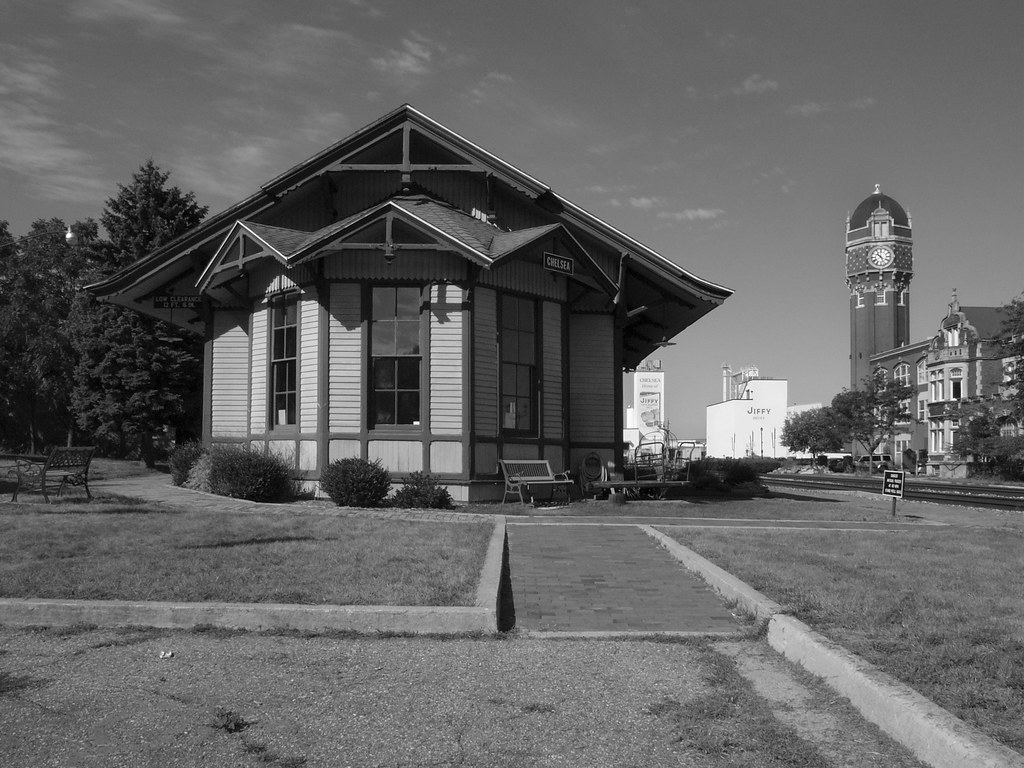
Chelsea Train Station by Jeff & Leyla

Chelsea Train Station by Jeff & Leyla

Chelsea, Michigan holds its 175th Anniversary Celebration June 25-28 with 4 days of events including a parade, youth activities, contests, music and folks in period costumes – family oriented fun.

This is the space where I would normally tell you something about the history of the town, but even the Wikipedia entry for Chelsea, Michigan has almost nothing. The city of Chelsea has little to say. They did have a link to the Washtenaw County guide entry for Chelsea where I learned:

Chelsea was first settled in 1820 by Cyrus Beckwith, along with Elisha and James Congdon.

Elisha Congdon named the community after his hometown of Chelsea, Massachusetts.

The town was literally “put on the map” when the Michigan Central Railroad built a station here in 1850. UPDATE: Searched for the railroad and found a great Chelsea history page.

Today Chelsea is best known as the home of the DaimlerChrysler Proving Ground and of Chelsea Milling Company’s “Jiffy Mix” brand.

Any other facts or links about Chelsea? Share them in the comments!

Jeff says that left to right you’re seeing the Chelsea Train depot (for rent), Jiffy, the Chelsea Clocktower and the Glazier Stove Co. It’s part of his Chelsea & Dexter set (slideshow). Speaking of slideshows, here’s the Chelsea slideshow from the Absolute Michigan pool.

You can check out some photos of the Glazier Stove Company from the Library of Congress.

R.I.P. Tiger Stadium

R.I.P.

R.I.P., photo by Ralph Krawczyk Jr.

Ralph writes:

Supporters of renovating what remained of Tiger Stadium surrendered Monday in a failed court effort to postpone the final demolition, sparking the end of a legacy that began in 1896…

You can read about the demolition in the Freep, watch it on YouTube, check out other Tiger Stadium pictures on Michigan in in Pictures and read Tiger Stadium stories on Absolute Michigan). You can also see more photos of this iconic park in Raph’s Tiger Stadium set (slideshow).

I’m not sure, however, that you can explain to me why Detroit seems hell-bent on demolishing its most prominent pieces of heritage.

Michigan Schooner Festival – September 11-13, 2009

Last light of day...

Last light of day…, photo by Doug Langham.

The inaugural Michigan Schooner Festival will take place September 11-13, 2009 in Traverse City. It will bring together six tall ships in West Grand Traverse Bay for rides aboard the ships, evening cruises, kids activities and more. “Song of the Lakes” will headline the entertainment with a performance on Saturday evening during a progressive-style party on the ships. Get all the details from MichiganSchoonerFestival.org.

The Friends Good Will out of South Haven won’t be there (at least this year) but the image was just too tasty to pass up! Be sure to check this photo out background bigalicious and also in Doug’s Friends Good Will slideshow.

Strawberry Season, 1940

Migrant girl, strawberry picker, Berrien County, Mich.
Migrant girl, strawberry picker, Berrien County, Mich., photo by John Vachon

Today’s photo from summer of 1940 is courtesy the Library of Congress. Be sure to check it out bigger and try a search for Michigan Strawberries to see more shots from Berrien County’s strawberry farms.

Ann Arbor blogger (and certified Michiganhead) Edward Vielmetti notes that strawberry season in underway in southern Michigan. He’ll post a field report when he goes! You can get all kinds of information and recipes about these tasty treats at Michigan Strawberries Are Ready to Pick on Absolute Michigan.

Ernest Hemingway fishing and a river of Michigan postcards

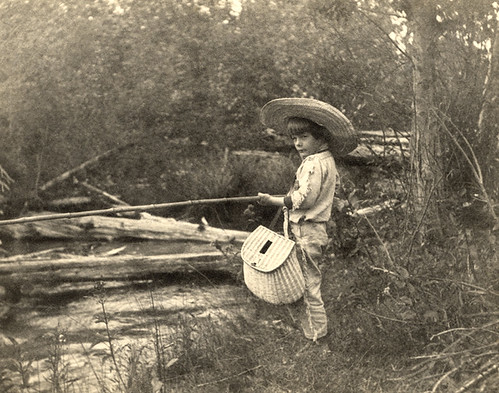
Young Ernest Hemingway fishing in Horton's Creek, near Walloon Lake, Michigan

Young Ernest Hemingway fishing in Horton’s Creek, near Walloon Lake, Michigan, photo by UpNorth Memories – Donald (Don) Harrison.

I thought about titling this post “Why Ernest Hemingway Became Such a Tough Guy” – this is the kind a photo your mom pulls out and shows your girlfriend when you’re 16. Check out
this Hemingway fishing slideshow and also this feature on Hemingway’s youth on Absolute Michigan.

If you love Michigan history, you will love Don Harrison’s Up North Memories. Don has nearly 10,000 postcards scanned in and available for viewing and (in some cases) for sale in his eBay store. One way to explore them is through Flickriver.

Enjoy the weekend!!

When Octopi Fly

Octopi

Octopi, photo by GH Patriot.

Last night the Red Wings managed to beat the Blackhawks 2-1 in an overtime thriller and return to the Stanley Cup. For those unfamiliar with the traditions of Hockeytown, I give you The Legend of the Octopus:

The Legend of the Octopus is a sports tradition during Detroit Red Wings home playoff games in which an octopus is thrown onto the ice surface for good luck. The origins of the activity go back to the 1952 playoffs, when a National Hockey League team played two best-of-seven series to capture the Stanley Cup. The octopus, having eight arms, symbolized the number of playoff wins necessary for the Red Wings to win the Stanley Cup. The tradition was first started on April 15, 1952 by Pete and Jerry Cusimano, brothers and storeowners in Detroit’s Eastern Market. The team swept the Toronto Maple Leafs and Montreal Canadiens en route to winning the championship, as well as winning two of the next three championships.

Since 1952, because the tossing of octopuses is generally viewed as a successful symbol of good luck, the practice has persisted each year; in one 1995 game, fans threw 36 octopuses, including a 30-pounder. The Red Wings’ unofficial mascot is a purple octopus named Al, and during playoff runs two of these mascots are also hung from the rafters of the Joe Louis Arena, symbolizing the 16 wins now needed to win the Stanley Cup. It has become such an accepted part of the team’s lore, that fans have developed what is considered proper etiquette and technique for throwing an octopus onto the ice.

Those octopi also flew a few weeks ago at the Grand Haven Kite Festival (click that link for a slideshow from the Absolute Michigan pool).

See this photo bigger in GH Patriot’s Other slideshow.