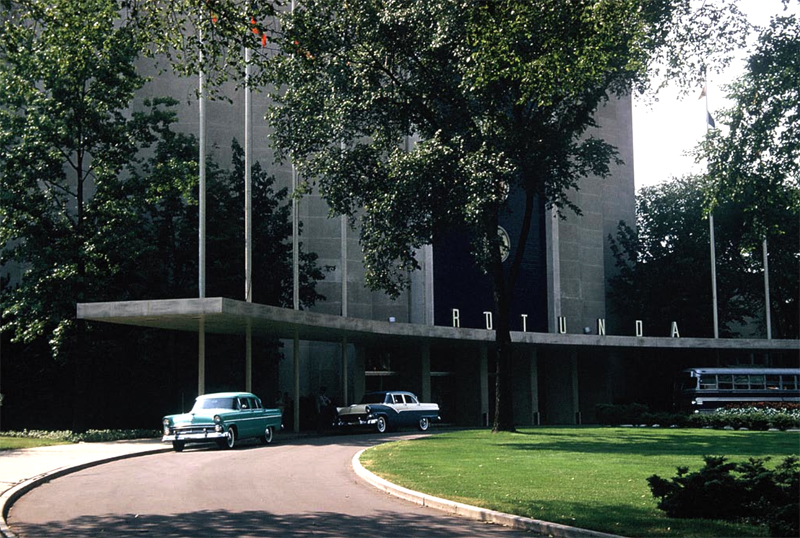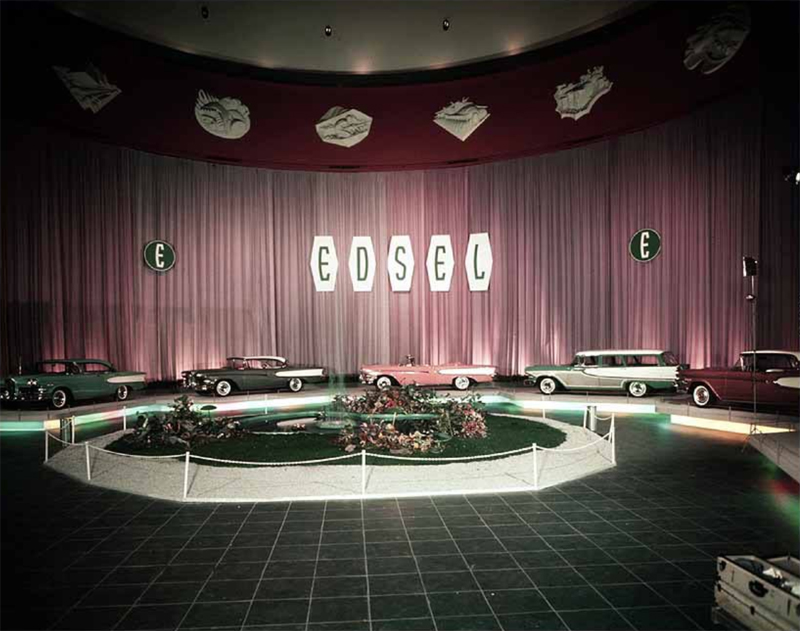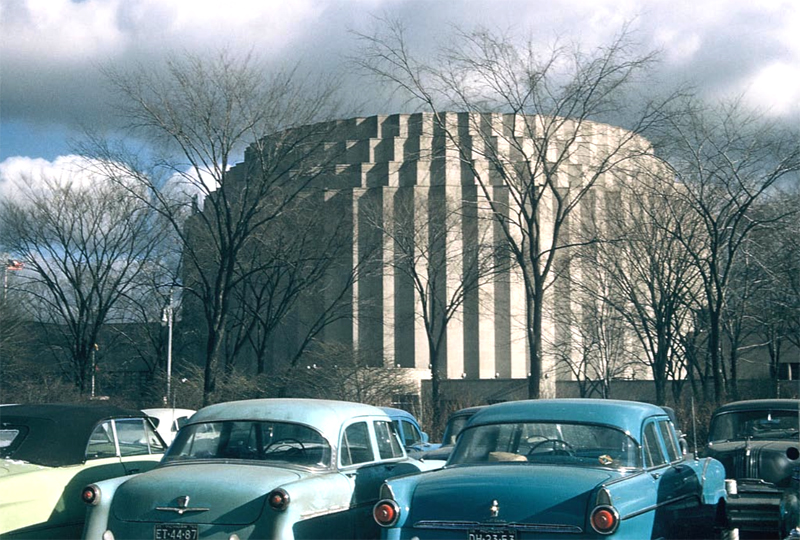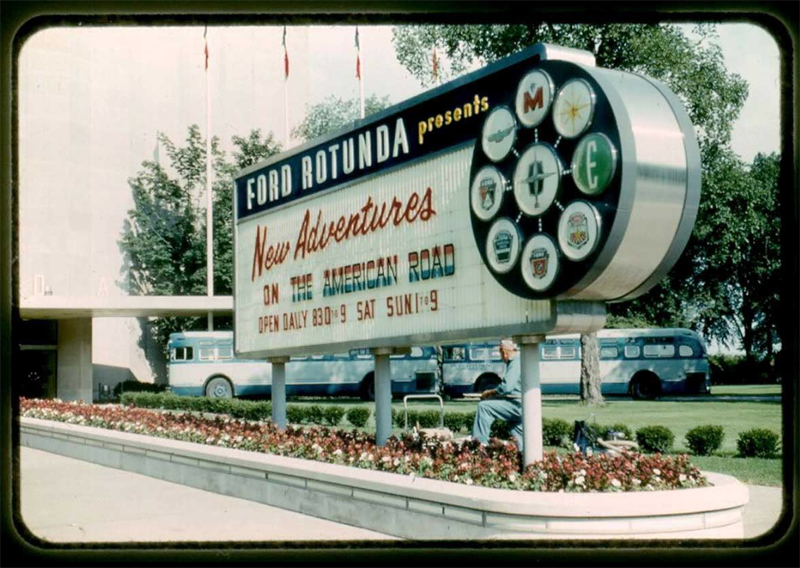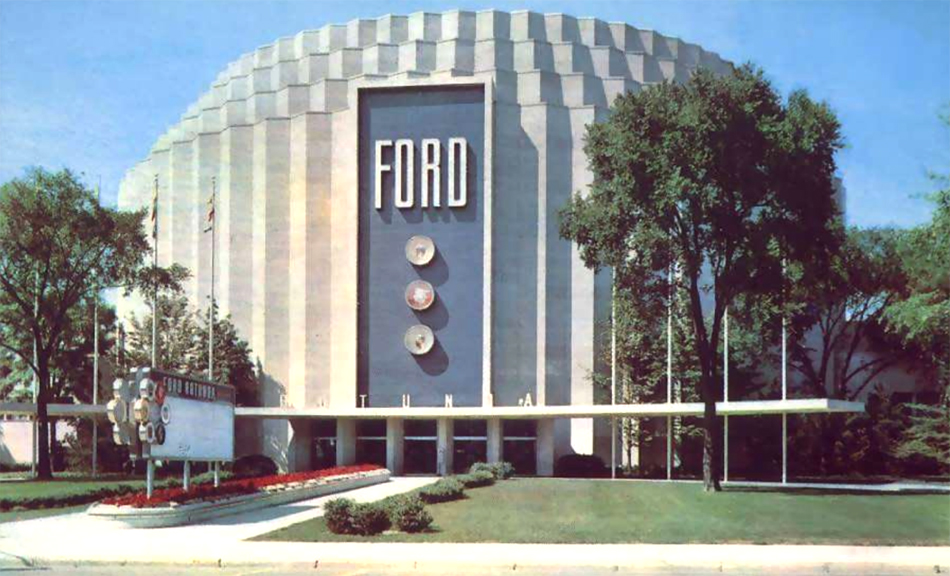
The Ford Rotunda

The Ford Rotunda – Dearborn, Michigan, photographer unknown

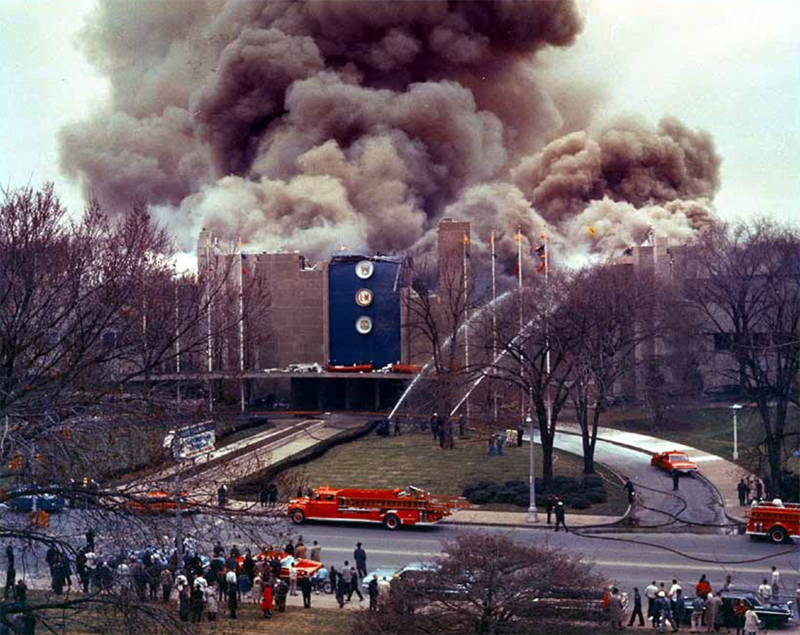
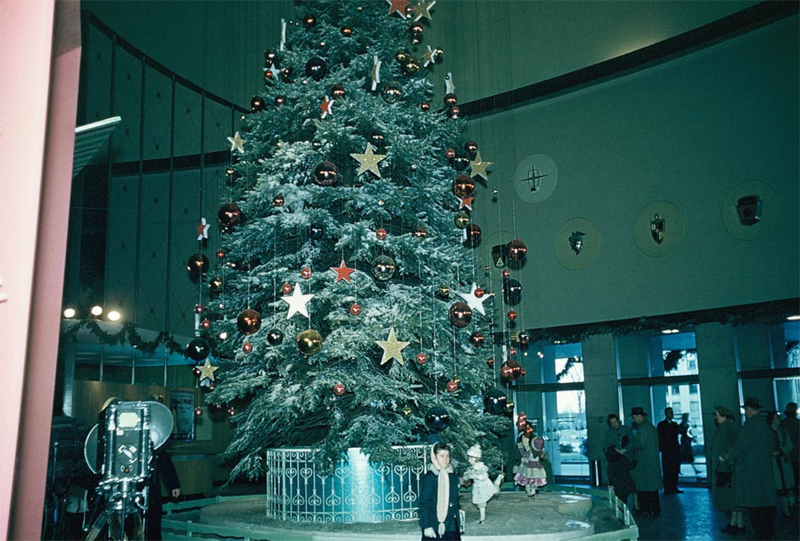
Michigan in Pictures regular Matt passed an email about the Ford Rotunda along that had some cool pictures I thought folks would like to see. When flames consumed a Christmas fantasy from the Detroit News Rearview Mirror begins:

From 1936 to 1962, the gear-shaped Ford Rotunda attracted visitors from around the world. It was the fifth most popular tourist destination in the United States in the 1950s.

The building had its roots in the 1933 Chicago World’s Fair, known as the Century of Progress Exposition, which opened in May of 1933 and attracted more than 40 million visitors over its two-year run. One of the major attractions at the fair was Ford Motor Company’s Rotunda, which was disassembled after the fair and brought back to Dearborn, where it was reconstructed using more permanent materials. Designed to be the showcase of the auto industry, the Ford Rotunda was opened to the public on May 14, 1936.

…In 1960, the Rotunda ranked behind only Niagara Falls, the Great Smoky Mountains National Park, The Smithsonian Institution and the Lincoln Memorial as a national tourist destination. It was more popular than Yellowstone, Mount Vernon, the Washington Monument and the Statue of Liberty.

Read on for the sad tale of how it burned to the ground on November 9, 1962.

Television History – The First 75 Years might be the photographer – there’s some of the same shots there and they write about their parents taking them to see Santa during the Christmas Season at the Rotunda. They also have a nice aerial of how the Ford Rotunda was located in relation to the Rouge Plant.
Before the Mackinac Bridge: City of Munising

Mackinac MI UP Great Lakes Passenger and Auto Ferry City of Munising connecting Mackinaw City and St Ignace before the Mackinaw Bridge was build

Mackinac MI UP Great Lakes Passenger and Auto Ferry City of Munising connecting Mackinaw City and St Ignace before the Mackinaw Bridge was built, photo by UpNorth Memories – Donald (Don) Harrison.

Before the Mackinac Bridge was built (check Absolute Michigan for lots more on that), going to or from the UP was by ferry. The City of Munising was the last of the breed:

Built by the American Ship Building Company of Cleveland in 1903 for the Pere Marquette Railway Company, the “Pere Marquette 20” became the “City of Munising” in 1937. The Michigan Department of Highways used the ship to ferry autos across the Straits of Mackinac until 1959. The ship was used for potato storage by a Washington Island, Wisconsin firm until 1973.

Michigan State Ferry Album has some photos of the City of Munising and other ships that plied the Straits.

Check this out bigger and see some shots of the old ferry docks in Don’s slideshow of old Mackinac photos

The Pontiac Silverdome

Abandoned Pontiac Silverdome - Pontiac Mi

Abandoned Pontiac Silverdome – Pontiac Mi, photo by Derek Farr ( DetroitDerek ).

Crain’s Detroit reported yesterday afternoon that an as yet unnamed Canadian company has purchased the Pontiac Silverdome for $583,000.

Ballparks.com’s page on the Pontiac Silverdome notes that at 80,368, the massive Silverdome long had the largest seating capacity in the NFL. The air-supported and cable-restrained facility was the largest of its kind in the world and is the first successful example of a fiberglass fabric roof system. From Wikipedia’s entry on the Pontiac Silverdome, I found this site dedicated to Silverdome architect C. Don Davidson. The site explains:

After working in the south as a prominent architect for several government and city projects, Davidson returned home in 1965 to a city that was slowly dying and stated in his own words, *”It looked as if someone had dropped a bomb on the city”. In 1966 he was hired at the University of Detroit to teach architecture and urban planning.

It was then when Davidson and his U.of D. class embarked upon an urban renewal project for Pontiac under the direction of Bruno Leon, Dean of Architecture.

You’ll definitely want to click through for drawings, press clippings and more about the Pontiac Silverdome.

Curiously enough, Derek’s photo appears on that site! See it bigger in his Detroit Ruins (and other cities) slideshow.

If you’d like a video look, you can check out the auction preview video (go to about 1:20 to get past the auction promo). If you’d rather just see what it looks like with laser lights and a rave going on, how about this video of Project Hardcore @ Silverdome in 2009?

The Game: University of Michigan Wolverines vs Ohio State Buckeyes

Michigan vs Penn State Wide-Angle

Michigan vs Penn State Wide-Angle, photo by AdamJacobsPhotos.

One week from today on Saturday, November 21, 2009 UM and Ohio State square off at the Big House in Ann Arbor at 12 noon.

The Game: Michigan Wolverines vs. Ohio State Buckeyes on Absolute Michigan has all kinds of information about this historic rivalry.

Michigan won the first meeting in 1897 (sweet photo of the teams!) and Ohio State didn’t notch a victory until 1919. At the Official Opening of Michigan Stadium in 1927 (click through for a photo) Michigan blanked the Buckeyes 21-0. While Michigan leads 57-42-6, OSU has won the last 5 meetings and is the favorite this year as well.

Be sure to check this out bigger in Adam’s slideshow!

2009 Leonid Meteor Shower & the Great Meteor Storm of 1833

My God...
My God…, photo by Muvv

It’s Friday the 13th and while we should probably have a photo of a black cat breaking a mirror or something, we’re going to look ahead to next week when the Leonid meteor shower peaks on Tuesday, November 17th. According to NASA:

If forecasters are correct, the shower should produce a mild but pretty sprinkling of meteors over North America followed by a more intense outburst over Asia. The phase of the Moon will be new, setting the stage for what could be one of the best Leonid showers in years.

“We’re predicting 20 to 30 meteors per hour over the Americas, and as many as 200 to 300 per hour over Asia,” says Bill Cooke of NASA’s Meteoroid Environment Office. “Our forecast is in good accord with independent theoretical work by other astronomers.”

Leonids are bits of debris from Comet Tempel-Tuttle. Every 33 years the comet visits the inner solar system and leaves a stream of dusty debris in its wake. Many of these streams have drifted across the November portion of Earth’s orbit. Whenever we hit one, meteors come flying out of the constellation Leo.

While it will probably be a pretty good meteor shower, it will have nothing on 1833, as this first-hand account of Great Leonid Meteor Storm of 1833 by Elder Samuel Rogers explains:

We had but little rest that night, for, before three o’clock in the morning, we were all aroused from our slumbers, making preparation for an early start. Some one, on looking out of the window, observed that it was almost broad daylight. “That can not be,” another answered, “For it is scarcely three o’clock.” “I can’t help what the clock says,” replied the first speaker, “my eyes can not deceive me; it is almost broad daylight –look for yourselves.”

After this little altercation, some one went to the door for the purpose of settling the question. Fortunately, there was not a cloud in the heavens; so by a glance, all was settled. I heard one of the children cry out, in a voice expressive of alarm: “Come to the door, father, the world is surely coming to an end.” Another exclaimed: “See! The whole heavens are on fire! All the stars are falling!” These cries brought us all into the open yard, to gaze upon the grandest and most beautiful scene my eyes have ever beheld. It did appear as if every star had left its moorings, and was drifting rapidly in a westerly direction, leaving behind a track of light which remained visible for several seconds.

Some of those wandering stars seemed as large as the full moon, or nearly so, and in some cases they appeared to dash at a rapid rate across the general course of the main body of meteors, leaving in their track a bluish light, which gathered into a thin cloud not unlike a puff of smoke from a tobacco-pipe. Some of the meteors were so bright that they were visible for some time after day had fairly dawned. Imagine large snowflakes drifting over your head, so near you that you can distinguish them, one from the other, and yet so thick in the air as to almost obscure the sky; then imagine each snowflake to be a meteor, leaving behind it a tail like a little comet; these meteors of all sizes, from that of a drop of water to that of a great star, having the size of the full moon in appearance: and you may then have some faint idea of this wonderful scene.

Be sure to check this out bigger or in Matthew’s My Photographic Love Affair slideshow (view the set). You might also enjoy on meteoric: 2009 Leonid Shower & the sound of meteors from Michigan in Pictures.

When The Gales Of November Came Early

When The Gales Of November Came Early

When The Gales Of November Came Early, photo by siskokid.

The legend lives on from the Chippewa on down
of the big lake they called “Gitche Gumee.”
The lake, it is said, never gives up her dead
when the skies of November turn gloomy.
With a load of iron ore twenty-six thousand tons more
than the Edmund Fitzgerald weighed empty,
that good ship and true was a bone to be chewed
when the “Gales of November” came early.

If you’re from Michigan … or Wisconsin … or Minnesota or Ontario or any place that touches the Great Lakes you probably grew up hearing Gordon Lightfoot’s commemorative ballad played (and overplayed) every November. While looking for lyrics to the song, I came across this page about the Wreck of the Edmund Fitzgerald on Gordon Lightfoot’s web site.

“According to a legend of the Chippewa tribe, the lake they once called Gitche Gumee ‘never gives up her dead.'”
~Great Lakes: The Cruelest Month, James R. Gaines with Jon Lowell in Detroit, Newsweek Magazine

Thus began the Newsweek article in the issue of November 24, 1975. That lead and the news magazine’s dry story inspired Gordon Lightfoot to write one of the greatest “story songs” ever…

Lightfoot wrote Wreck Of The Edmund Fitzgerald as a tribute to the ship, the sea, and the men who lost their lives that night. When asked recently what he thought his most significant contribution to music was, he said it was this song, which he often refers to as “The Wreck”. In spite of its unlikely subject matter, the song climbed to #2 on the Billboard pop charts and Wreck of the Edmund Fitzgerald remains one the most stirring topical ballads ever written and a highlight of every Lightfoot concert.

More Edmund Fitzgerald and more shipwrecks on Michigan in Pictures.

Check this out bigger and see Jim’s whole Lake Superior set (slideshow).

There’s not way I’m not going to link over to include* Joseph Fulton’s amazing tribute video to the 29 men who died November 10, 1975 aboard the Edmund Fitzgerald. If you haven’t watched this, do it. It’s one of the best videos on the internet and shows the power of the Fitz and of Superior.

featured-wordpress

*And break my own rule of “just photos” – sorry about that if it bothers you.

Freshwater Fury: The Great Lakes Storm of 1913

Charles S Price upside down, 1913

Charles S Price upside down, 1913,  Wikipedia

Dear wife and Children. We were left up here in Lake Michigan by McKinnon, captain James H. Martin tug, at anchor. He went away and never said goodbye or anything to us. Lost one man yesterday. We have been out in storm forty hours. Goodbye dear ones, I might see you in Heaven. Pray for me. / Chris K. / P.S. I felt so bad I had another man write for me. Goodbye forever.

~A message found in a bottle 11 days after Plymouth disappeared, dictated by Chris Keenan, federal marshal in charge of the barge

Wikipedia says that the Great Lakes Storm of 1913, also known as the “Freshwater Fury” or the “White Hurricane”, was a blizzard with hurricane-force winds that ravaged the Great Lakes November 7-10, 1913. With the sinking of 19 ships, the stranding of another 19 and a death toll of at least 250, it remains the deadliest and most destructive natural disaster in Great Lakes history.

detroit-news-great-lakes-stormMajor shipwrecks occurred on all but Lake Ontario, with most happening on southern and western Lake Huron. Lake masters recounted that waves reached at least 35 feet (11 m) in height. Being shorter in length than waves ordinarily formed by gales, they occurred in rapid succession, with three waves frequently striking in succession. Masters also stated that the wind often blew in directions opposite to the waves below. This was the result of the storm’s cyclonic motion, a phenomenon rarely seen on the Great Lakes.

In the late afternoon of November 10, an unknown vessel was spotted floating upside-down in about 60 feet (18 m) of water on the eastern coast of Michigan, within sight of Huronia Beach and the mouth of the St. Clair River. Determining the identity of this “mystery ship” became of regional interest, resulting in daily front-page newspaper articles. The ship eventually sank, and it was not until early Saturday morning, November 15, that it was finally identified as the Charles S. Price. The front page of that day’s Port Huron Times-Herald extra edition read, “BOAT IS PRICE — DIVER IS BAKER — SECRET KNOWN”. Milton Smith, the assistant engineer who decided at the last moment not to join his crew on premonition of disaster, aided in identifying any bodies that were found.

You can get a map to the wreck of the Charles S Price, and here’s a list of shipwrecks of the 1913 storm and an account of the weather. You can see more photos from Wikipedia and also in Lakeland Boating’s great slideshow of some of the on and offshore damage from the Freshwater Fury.

More at absolutemichigan.com/Shipwreck and even Michigan shipwrecks on Michigan in Pictures.

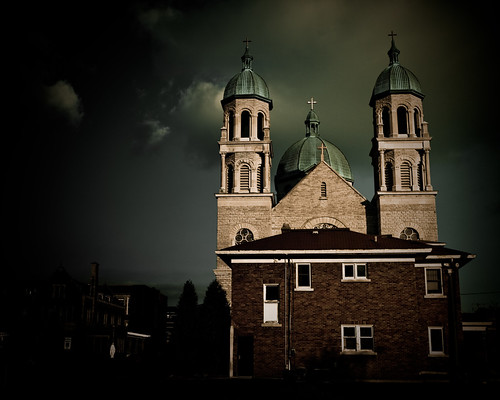
Dark Mood: Basilica of St. Adalbert

Dark Mood

Dark Mood, photo by Rudy Malmquist.

The web site for Basilica of St. Adalbert (of the Roman Catholic Diocese of Grand Rapids) tells a little of the history of this ornate church that has always fascinated me as I’ve driven past it on the freeway going west out of Grand Rapids.

The Saint Adalbert Aid Society was formed in 1872. At that time the purpose of the fraternal aid societies that sprang up in the primarily ethnic areas of the city, was to assist new immigrants in settling in the area, finding housing, and employment. With the help of the Saint Adalbert Aid Society, and on the initiative of the many Polish people of this area, two lots were purchased in 1880 at the corner of Fourth Street and Davis Avenue, NW, and in June of 1881 construction of a small wooden church was begun. Thus, St. Adalbert Parish was soon established. In 1891 the original church was enlarged to accommodate the every growing Polish population.

In early July of 1907, work began on the present church building. The cornerstone was laid on August 18, 1907, and the building was completed in late spring of 1913 for a total cost of about $150,000, including all of its furnishings.

The basilica is one of a few Minor Basilica in the US and the only church of this rank in Michigan. Wikipedia has more about Polish Cathedrals in America and says that these ornate churches were built by Polish Catholics in rememberance of the glory days of the Polish Commonwealth in the sixteenth and seventeenth centuries.

Be sure to check Rudy’s shot out background bigalicious and see more pics in the Roman Catholic Diocese of Grand Rapids, Michigan group on Flickr.

Fort Gratiot Lighthouse – Michigan’s Oldest Lighthouse

Everywhere is walking distance if you have the time.~Stephen Wright

Everywhere is walking distance if you have the time.~Stephen Wright, photo by mjo62000.

The official Fort Gratiot Lighthouse site relates that:

The Fort Gratiot Lighthouse is the oldest lighthouse in Michigan and the second oldest on the Great Lakes. The first lighthouse in this area was built in 1825 and was located approximately where the first Blue Water Bridge stands. De to poor construction and a storm, it collapsed in 1828. In 1829, a new lighthouse was built north of the military fort by Lucius Lyon, who later became one of Michigan’s first U.S. Senators. The new location made it easier for ships to spot as they entered the rapids at the head of the St. Clair River.

Originally seventy-four feet high, the white painted brick tower was extended to its present height of eighty-six feet in the early 1860s…

The green flashing light that was automated in 1933 may be seen for seventeen miles. The two-story brick lighthouse keeper’s house, with its hipped gable roof and pointed gothic porch, was built in 1874.

Today, a Coast Guard station and the lighthouse watch over one of the busiest waterways in the world.

You can see some historical photos at the link above and get lots more information at Fort Gratiot Lighthouse on Terry Pepper’s Seeing the Light.

See this bigger in Mary Jo’s Lighthouses slideshow or check out the whole set!

Check out many more Michigan Lighthouse on Michigan in Pictures.

Detroit Beer … and Detroit Beer Week

What was Detroit known for besides cars?

What was Detroit known for besides cars?, photo by Derek Farr ( DetroitDerek ).

Derek asks (and answers):

What was Detroit known for besides cars?

Goebel, Strohs, Pfeiffer, Altes, Tivoli, and a whole host of other breweries used to be here.

Among those companies, Stroh’s was certainly the leader and the Stroh’s History page says:

A name as important to the success of Detroit as Ford or Chrysler, the Stroh family began with humble roots, brewing beer in a family-owned inn during the 18th century in Kirn, Germany. In 1848, during the German Revolution, Bernhard Stroh, having apprenticed at his father side, immigrated to the United States. He established his own brewery in Detroit in 1850. Stroh named his new company Lion’s Head Brewery, adopting the Lion’s Crest logo from the Kyrburg Castle in Germany – the same crest that adorns Stroh beers today

After establishing the brewery, Bernhard’s son, Bernhard Jr., continued its expansion. A firm proponent of tradition and quality, he introduced the European method of fire-brewing to America. The fire-brewing process uses a direct flame rather than steam to heat beer-filled copper kettles. The resulting higher temperatures intensify the aroma and body of beer, resulting in a more flavorful brew.

The Stroh’s Beer site neglects to mention the final chapter of the Stroh Brewery Company that is detailed on Wikipedia. In 1999 the company sold off its brands. The Pabst Brewing Company acquired the most Stroh/Heilman brands. They currently produce Colt 45 malt liquor, Lone Star, Schaefer, Schlitz, Schmidt’s, Old Milwaukee, Old Style, Stroh’s, and St. Ides while Miller Brewing got Mickey’s Malt Liquor and Henry Weinhard’s. On Wikipedia you can also get a photo of the original Stroh Brewery.

Over the next week (October 16-24, 2009) the city of Detroit will host the first-ever Detroit Beer Week. From Absolute Michigan:

The week-long series of beer-centric events will be held at participating venues in Detroit, with satellite events at Metro-Detroit brewpubs. These events will consist of brewery tours, tasting flights, meet-the-brewer sessions, food pairings, and a wide array of other unique activities. Events will be hosted by Detroit Beer Week staff and the Detroit Beer Barons, a group of Metro-area brewery personalities…

The grand finale of Beer Week is the Inaugural Harvest Festival, hosted by the Michigan Brewers’ Guild and Metrotimes on Saturday, October 24, in Eastern Market.

This photo is part of Derek’s Detroit set (slideshow).