Cooler by the Lake

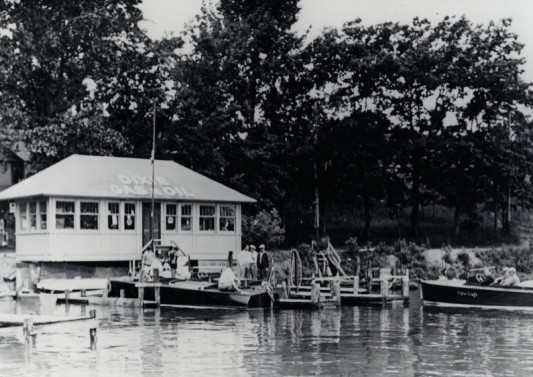
Gull Lake, Michigan, Circa 1930, photo courtesy Archives of Michigan

On Cooler by the Lake at seekingmichigan.org – the Library of Michigan and the Archives of Michigan’s very cool Michigan history site – Mary Zimmeth writes:

I am an urban child. During the summer, I rode my bike everywhere and took in a matinee at least once a week. I went to Tigers baseball games, enjoyed bittersweet hot fudge sundaes at Sanders, and watched the Scott Fountain change colors on Belle Isle. It was a great childhood, yet I envied people who owned cottages and boats. It did not matter that I could not swim. Each summer I desired a vacation near a lake with a boat in the dock. Boats in the water or being towed on the road equal summer.

This first image comes from the Charles R. Childs Collection of photograph prints and negatives dating 1922-1951. (Childs was a photographer from Illinois who specialized in tourist shots.) Taken at Gull Lake, this photograph (c. 1930) centers on Chris-Craft boats filling up at Dixie Gas and Oil. Builders of the standard “runabout,” the company marketed to the middle class by introducing payment plans in the mid-1920s. Boats were no longer just for the wealthy.

Read the rest and see lots more of Michigan’s photographic history at Seeking Michigan!
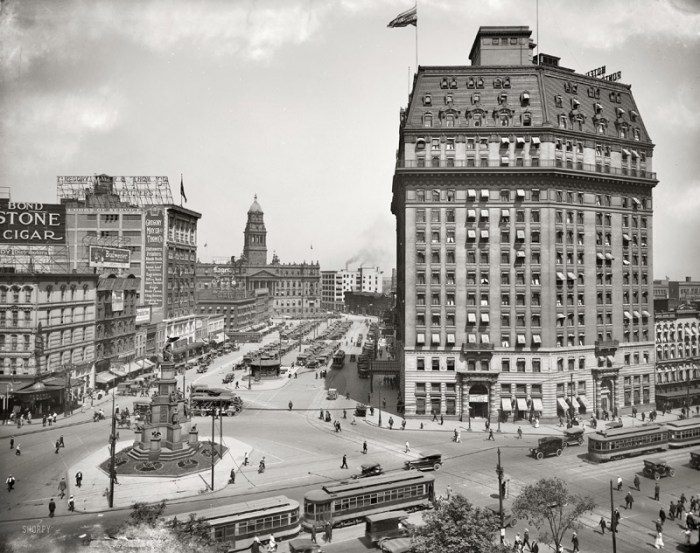
It’s your birthday Detroit, how about a history lesson?


Hotel Pontchartrain and Cadillac Square from City Hall, 1916, photo by Detroit Publishing Co, via Shorpy

Hello Detroit, it’s your birthday!*

History Detroit tells the story of Cadillac and the founding of Detroit on July 24, 1701. They explain how Antoine de la Mothe, Sieur de Cadillac made a plan with his mentor and Governor General of New France, Louis de Buade, Comte de Frontenac, to found a new settlement at the south of Lake Huron to increase security of French interests on the Great Lakes. Frontenac died, and his successor was not fond of Cadillac so:

Cadillac set sail for France in 1698 in order to convince King Louis to allow him to found a new settlement lower in the Great Lakes. Specifically, he was interested in the area south of Lake Huron known as le détroit, or the straits.

The area known as le détroit was ideal for a new settlement because the land was fertile, the location on the river was felt to be easily defended against the British and the climate was more hospitable than that in the more northern settlements like Michilimackinac.

Cadillac returned to Quebec, then travelled to Montreal where he gathered canoes, farmers, traders, artisans, soldiers, and Native Americans to accompany him on his quest. The men set sail on June 4, 1701.

Cadillac and his men reached the Detroit River on July 23, 1701. The following day, July 24, 1701, the group traveled north on the Detroit River and chose a place to build the settlement. Cadillac named the settlement Fort Ponchartrain du Detroit in honor of King Louis’s Minister of Marine.

Read More About Fort Ponchartrain and Cadillac.

You have to check this photo from Shorpy (a great blog where you can also buy these old prints) background bigtacular to see the amazing detail and activity captured including the Soldiers and Sailors Monument in the bottom left corner. Here are earlier views of the hotel circa 1907, minus the upper floors, and 1910, minus most of the cars, and here’s Shorpy’s entire Detroit Michigan historic archive.

Need more? There’s a whole lot more Detroit on Michigan in Pictures and at absolutemichigan.com/Detroit.

* I feel a little weird giving a history lesson as a birthday present.

Why are most barns red?

Why are most barns red?

Why are most barns red?, photo by whitepuffycloud.

Shannon dug up the answer to the question: Why are barns usually painted red?:

Centuries ago, European farmers would seal the wood on their barns with a linseed oil mixture, often consisting of additions such as milk and lime. The combination produced a long-lasting paint that dried and hardened quickly. Now, where does the red come from?

Wealthy farmers added blood from a recent slaughter to the oil mixture. As the paint dried, it turned from a bright red to a darker, burnt red.

Farmers added ferrous oxide, otherwise known as rust, to the oil mixture. Rust was plentiful on farms and is a poison to many fungi, including mold and moss, which were known to grown on barns. These fungi would trap moisture in the wood, increasing decay.

Regardless of how the farmer tinted his paint, having a red barn became a fashionable thing. They were a sharp contrast to the traditional white farmhouse. As European settlers crossed over to America, they brought with them the tradition of red barns. In the mid to late 1800s, as paints began to be produced with chemical pigments, red paint was the most inexpensive to buy. Red was the color of favor until whitewash became cheaper, at which point white barns began to spring up.”

You may also wonder why barns have lightning rods – we’ve got that covered too!

Check this out bigger in Shannon’s Lansing, MI slideshow!

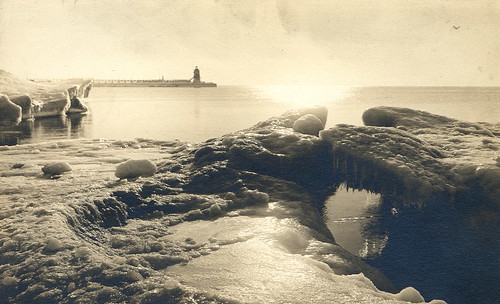
Frankfort Beach & North Breakwater Light in Winter

Benzie Vintage Winter Frankfort Beach Card looking South to the pod Pier and Lighthouse

Benzie Vintage Winter Frankfort Beach Card looking South to the pod Pier and Lighthouse, photo by UpNorth Memories – Donald (Don) Harrison.

The Frankfort North Breakwater Light in the picture is one of three Michigan lighthouses that the Coast Guard is offloading.

Be sure to check this out background bigtacular Don’s Benzie vintage winter slideshow has more wintertime views from Northern Michigan.

Everyone OK with a little more summer?

Michigan by Rail: How will we get from here to there?

Untitled, photo by Brooke Pennington.

There’s a great post over on Absolute Michigan about a series of Michigan Rail Forums that are seeking to develop a statewide vision for freight, passenger and commuter rail – click over and check it out! There’s also a great video about the history of railroads in Michigan.

I for one love rail travel and I hope that Michigan can pull together a modern rail system that allows us all to sit back and enjoy the scenery as we ride the rails!

Check this out bigger in Brooke’s slideshow

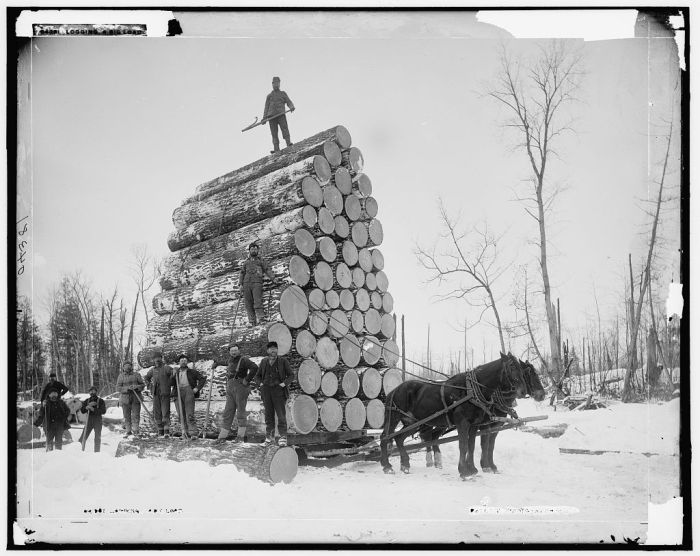
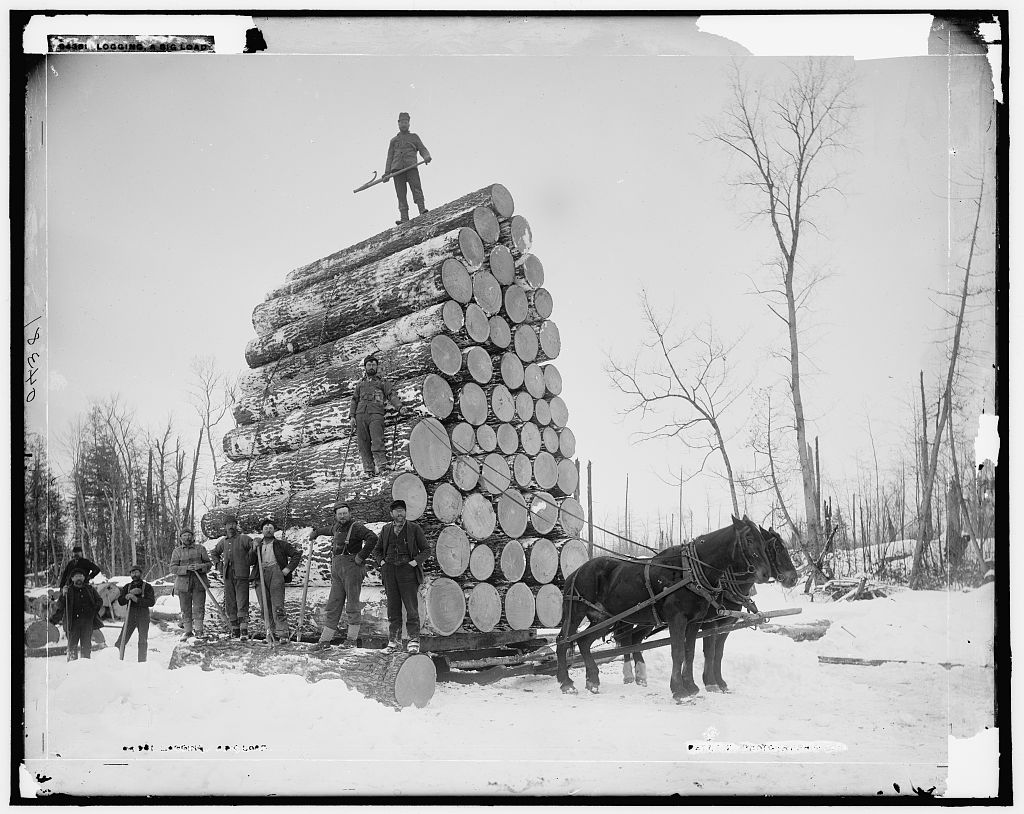
Logging Michigan’s White Pines


Logging a big load, photo courtesy Library of Congress/Detroit Publishing Co

The above photo was taken somewhere in Michigan in the late 1800s. Click to view it bigger.

Once upon a time, much of the state of Michigan was covered by a vast, white pine forest.  If you want to get a taste of what old growth pines were like, and also a very cool logging camp, consider a trip to Hartwick Pines.

Seeking Michigan has a great feature about Life in a Logging Camp that includes some cool photos. It begins:

Michigan’s Lumber Boom

In the 1840s, Eastern states were beginning to exhaust their timber resources, and information about Michigan pine began to spread. Lumbermen began flocking to the Great Lakes State. According to George S. May’s revised edition of Willis Dunbar’s Michigan: A History of the Wolverine State, Michigan’s lumber boom peaked around 1880. Dunbar and May also note that lower peninsula forests were “virtually all cutover” by 1900 and that Upper Peninsula lumber production began to decline a few years after that. Conservation techniques and selective cutting increased productivity later in the twentieth century. By then, however, the “hey day” of the lumber industry was unquestionably over.

The Nature of a Logging Camp

For much of its history, logging was a winter activity. In winter, logs could be easily transported to river banks via bob sleds (or, in later years, by railroad.). In spring, when the ice melted, logs were floated down the river to saw mills. Log marks (the logging equivalent of “cattle brands”) determined ownership. Due to the seasonal nature of the business, logging camps tended to be temporary.

In “Michigan’s White Pine Era, 1840-1900” (Michigan History vol. 43, December 1959), Rolland H. Maybee describes a typical Michigan lumber camp, circa 1875-1900. Many camps of this era accommodated sixty to one hundred men. Typically, there would be five or six main buildings, all made of logs. A bunkhouse, a cookshanty, a barn, a blacksmith shop, and a camp office and store would be among the buildings. The camp office and store typically included living quarters for the foreman and log scaler.

Read on at Seeking Michigan!

The Dime Building in Detroit

Inside the Dime Building Dime Building
Inside the Dime Building and Dime Building, photos by Adore707

Detroit 1701’s page on The Dime Building relates how Daniel Hudson Burnham found fame as a city planner and was influential in the founding of the City Beautiful Movement. His architectural firm, Root and Burnham, designed the 20-story Masonic Temple Building in Chicago in 1893, one of the nation’s first skyscrapers, and they were tapped by Dime Bank:

The Dime Bank wanted an appropriate building for their facilities. The first floor was to serve as a banking floor where patrons would make their deposits and withdrawals. The higher levels in this 23-story building provided the many offices the bank needed for business, undoubtedly growing as the vehicle industry boomed in Detroit. Burnham designed the attractive lobby that you see with its skylight and numerous decorations. Electric elevators for tall buildings were first successfully installed in the 1890s, so they were still a new invention when Burnham designed this Dime Building…

Air conditioning was unavailable in 1910 and electric lights were, apparently, less efficient than the ones we have today. This motivated Burnham to incorporate a design that provided a window for ventilation and light in every office. You will notice the light well as soon as you enter the lobby of the Dime Building. This one faces Griswold and clearly illustrates this typical feature of Burnham’s Chicago style skyscrapers. Just to the east on Griswold, you will see the Ford Building that Burnham designed for its 1909 opening. In that one, Burnham’s light well is invisible from Griswold.

The Dime Building has its own web site and there’s a little more about the Dime Building on Wikipedia. You can see an old photo of the Dime Building from Wikipedia and another of the Dime from the early 20th Century at Shorpy.

See these other other photos bigger in his Detroit MI slideshow.

How about a little independence for Independence Day?

elevator watching

elevator watching, photo by gsgeorge.

Geoff writes: Renaissance Center elevator, holding at the 72nd floor for fireworks spectators. They passed out 3D glasses for whatever reason. Maybe the future was so bright it needed to be in 3D? See this bigger in his Detroit slideshow and also check out the Independence Day slideshow from the Absolute Michigan pool.

Wikipedia says that Independence Day alias Fourth of July alias The Glorious Fourth alias The Fourth is a federal holiday commemorating the adoption of the Declaration of Independence on July 4, 1776. Of the signing of the Declaration, John Adams wrote to Abigail:

I am apt to believe that it will be celebrated by succeeding generations as the great anniversary festival. It ought to be commemorated as the day of deliverance, by solemn acts of devotion to God Almighty. It ought to be solemnized with pomp and parade, with shows, games, sports, guns, bells, bonfires, and illuminations, from one end of this continent to the other, from this time forward forever more.

Thomas Jefferson, served with Adams on the Committee of Five that drafted the Declaration of Independence and observed that a groups of people from great nations to town councils will always have disagreements. He nonetheless spent much of his life serving the cause of creating an enduring nation. He made a point that I think could serve governments who are locked in petty disagreements while our country and citizenry face serious threats at home and abroad, economically and environmentally that require action immediately:

Do you want to know who you are? Don’t ask. Act! Action will delineate and define you.

Hope you all get out and have fun, and if you have a chance to talk to an elected official at a parade, let them know what you’re looking for. And whether you have that chance or not, take some time to work to make the world become what you think it should.

The Quincy Dredges

164/365 - Dredge

164/365 – Dredge, photo by dcclark (catching up again!).

Brenden Balliod’s Great Lakes Shipwreck Research (a fantastic resource for divers & historians) has this to say about the Quincy Dredges #1 & #2:

For almost 100 years, the copper mines of the Keweenaw extracted copper from mined rock with the use of stamp mills. The mined rock was smashed by large stamp heads and the brittle non metallic rock broke off leaving the metallic copper. The broken poor rock was ground into “stamp sand” and simply dumped into the lake. Subsequently, large fields of stamp sand now line the Keweenaw Waterway and Lake Superior. Portions of Torch Lake by Lake Linden and Hubbell were almost completely filled in. After WWII it was found that the stamp sand still contained a great deal of copper which could be extracted at a profit by regrinding it. Because of this, in 1947 the Calumet and Hecla Mining Company built a suction dredge capable of vacuuming stamp sand off the lake bottom to a depth of 110 ft. The dredge was operated by the Quincy Mining Co. and was a common sight on Torch Lake throughout the summer months, where it could be seen “mining” the discarded tailings from Torch Lake.

The dredge was usually laid up during the winter months by anchoring it out in the lake, and it carried onboard pumps to combat the slow leakage of water through its hull. Apparently, at 9:00 AM on Sunday January 15, 1956, the pumps stopped working, and before they could be restarted, the dredge plunged to the bottom, leaving only her roof exposed. Raising the dredge was thought to be uneconomical and only limited salvage was conducted. Gradually, the dredge settled into the lake bottom leaving only the peak of her roof above water.

Today, the Quincy Dredge #1 is barely visible above the surface and can be seen from Hwy. M26 by Hubbell. Her sister dredge, the Quincy Dredge #2 lies near her, up on the beach at Mason. The Dredge #1 is a truly creepy dive and offers low visibility, especially near the lake bottom. Her steel superstructure is all that remains, and it rises over 40 ft. off the lake bottom. A good deal of machinery has been left at the site, but low visibility and general creepiness hampers most exploration. Divers who want to explore the Dredge should do so in early Spring or late Fall with a good dive light. Ice diving the Dredge in the Winter may also be a good option for divers with ice diving experience.

Click through to see old photos & maps. There’s a lot more shipwrecks and other diving opportunities in the Keweenaw Underwater Preserve. About the photo, David adds:

This photo has a fun story behind it. The dredge is beached at the shore of Torch Lake, not too far from the highway. I parked near it and walked in, where I met two kayakers who had just come to shore after looking around the water side of the dredge. We chatted, and not five minutes after I’d met them, they offered to let me take a kayak out and see it for myself! — Which I did, of course. I love the UP!

Check it out bigger and in his slideshow.

The Place of the Torches: Torch Lake

Untitled, photo by ( Jennifer ).

Wikipedia’s Torch Lake (Antrim County, Michigan) entry says:

Torch Lake at 19 miles (31 km) long is Michigan’s longest inland lake and at approximately 18,770 acres (76 km²) is Michigan’s second largest inland lake … It has a maximum depth of 330 feet (100 m) just off the east end of Campbell Rd. (Milton Twp.) and an average depth of 111 feet (34 m), making it Michigan’s deepest inland lake. It is a popular lake for fishing, featuring lake trout, rock bass, yellow perch, smallmouth bass, muskellunge, ciscoes, brown trout, rainbow trout, and whitefish.

The name of the lake is not due to its shape, rather, is derived from translation from the Ojibwa name Was-wa-gon-ong meaning “Place of the Torches”, referring to the practice of the local native American population who once used torches at night to attract fish for harvesting with spears and nets. For a time it was referred to by local European settlers as “Torch Light Lake”, which eventually was shortened to its current name.

You can see Torch Lake on the Absolute Michigan Map of Michigan and fly around it in Google Earth!

See this bigger in Jennifer’s Torch Lake Spring slideshow and see many more pics in the Torch Lake group on Flickr!