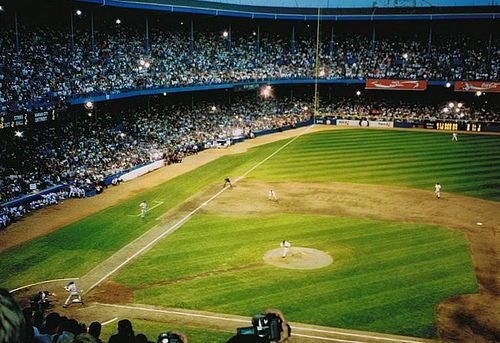
The Last Pitch: Farewell to Ernie Harwell

The Last Pitch
The Last Pitch, photo by baklein62

“I’d like to be remembered as someone who showed up for the job. I consider myself a worker. I love what I do. If I had my time over again, I’d probably do it for nothing.”
~Ernie Harwell

Like thousands of other people, whenever I see a picture like this of my beloved Detroit Tigers, the voice that narrates it in my head is the voice of William Earnest “Ernie” Harwell, who passed away last night at the age of 92.

Probably the best thing that I’ve seen about Harwell is this video. The Detroit Tigers tribute page to Ernie Harwell lists his accomplishments:

He also called the pitch from Todd Jones in the photo above that ended the last game ever at Detroit’s Tiger Stadium on September 27, 1999.

Struck him out.

I’m thinking Ernie would have liked this photo from Barney even more, but I already blogged it. More in his terrific Baseball as Art set (slideshow) and more about Ernie Harwell and the Detroit Tigers on Michigan in Pictures.

Step back in time at Greenfield Village

Greenfield Village
Greenfield Village, photo by Michael Lavander

“I am collecting the history of our people as written into things their hands made and used…. When we are through, we shall have reproduced American life as lived, and that, I think, is the best way of preserving at least a part of our history and tradition.”
~Henry Ford on his museum

Greenfield Village in Dearborn (satellite map) is part of The Henry Ford, dubbed America’s Greatest History Attraction. If you’ve ever been to either, you know that’s not just a marketing slogan. Greenfield Village has seven historic districts that are jam packed with historical buildings & artifacts from all over:

Entering Greenfield Village is like stepping into an 80-acre time machine. It takes you back to the sights, sounds and sensations of America’s past. There are 83 authentic, historic structures, from Noah Webster’s home, where he wrote the first American dictionary, to Thomas Edison’s Menlo Park laboratory, to the courthouse where Abraham Lincoln practiced law. The buildings and the things to see are only the beginning. There’s the fun stuff, too. In Greenfield Village, you can ride in a genuine Model T or “pull” glass with world-class artisans; you can watch 1867 baseball or ride a train with a 19th-century steam engine. It’s a place where you can choose your lunch from an 1850s menu or spend a quiet moment pondering the home and workshop where the Wright brothers invented the airplane. Greenfield Village is a celebration of people — people whose unbridled optimism came to define modern-day America.

Michael took this photo at the museum’s opening day and you can see it bigger in his Greenfield Village 041510 slideshow.

Need more? Check out the Greenfield Village slideshow from the Absolute Michigan pool and more posts about Greenfield Village on Michigan in Pictures.

Enjoy your weekend and remember that Michigan’s museums need your patronage more than ever!

Comerica Park, Home of the Detroit Tigers

Extra! Extra!

Extra! Extra!, photo by RLHyde.

The page on Comerica Park at ballparksofbaseball.com says that in the mid 90s:

…Tigers President John McHale said that Tiger Stadium had 10,000 of the best seats in baseball, but was supported by 40,000 of the worst. It was clear that Tiger Stadium lacked many of the amenities of newer parks being constructed at the time. In 1995 the city agreed to help fund a new stadium and in March 1996 voters approved a plan to build a new ballpark in downtown Detroit. Following other ballparks that were built during that decade, the Tigers new ballpark was built mainly of steel and concrete, with a brick exterior. Constructed in downtown Detroit, construction began October 29, 1997.

For the first time in over 100 years, opening day baseball was played at a different location other than at the corner of Michigan and Trumbull. Nearly 40,120 fans filled Comerica Park on opening day, April 11, 2000.

The $300 million ballpark is 345′ down the leftfield line, 330′ down right and 420′ in straightaway center. For the name, Comerica Bank pays the Detroit/Wayne County Stadium Authority $2.2 million per year. Here’s a satellite map of Comerica Park at 2100 Woodward Avenue in Detroit.

Whatever you feel about the Tigers’ move from Michigan & Trumbull, it’s hard to deny that Comerica is a beautiful ballpark. The Detroit Tigers section for Comerica Park has some sweet panoramas of Comerica Park and past ballparks that the Tigers have called home.

Ryan says that this looks better the bigger it gets, and he’s right. Check it out on black or background bigtastic.

Need more? Here’s the Comerica Park slideshow from the Absolute Michigan pool on Flickr!

Earth Day at 40, Earth Day in Michigan

Untitled, photo by Brooke Pennington.

Many folks may not know that Earth Day has deep roots in Michigan, at the University of Michigan to be precise. James Tobin at Michigan Today has the story of the Teach-In on the Environment that UM held in March of 1970 because Earth Day fell right in the middle of exams. Students and teachers formed a group called Environmental Action for Survival (ENACT) and booked Democratic front-runner Senator Edmund Muskie, Ralph Nader and biologist Dr. Barry Commoner.

Over four days, an estimated 50,000 people took part in ENACT’s teach-in—an astonishing success that fueled enthusiasm for Senator Nelson’s national Earth Day, which drew some 20 million participants four weeks later and transformed environmentalism into a movement of historic importance. (A number of ENACT’s leaders went on to influential careers in the field, including Doug Scott, a longtime executive at the Sierra Club who is now policy director at the Campaign for America’s Wilderness; David Allan, who became a professor and associate dean of U-M’s School of Natural Resources and Environment; and John Turner, who served as director of the U.S. Fish and Wildlife Service under the first President Bush.)

“The Michigan event was by far the biggest, best, and most influential of the pre-Earth Day teach-ins,” Adam Rome, a historian and authority on the environmental movement told the Ann Arbor Chronicle. “It was the first sign that Earth Day would be a big deal.”

Read the rest and see photos and even a documentary from The 40th Anniversary of Earth Day at Michigan.

The Michigan Department of Environmental Quality can point you to Earth Day events all across Michigan, from the Get Clean/ Go Green Earth Day Celebration in Twin Lakes to the Michigan Earth Day Fest in Rochester held this weekend (Apr 23-25) where they expect 100,000 people to learn about green and healthy living through earth-friendly alternatives in food, energy, transportation, clothing, wellness, career, home, garden, finances and more.

Brooke took this photo on Earth Day last year. Check it out bigger in his Spring slideshow and view more of his work on Michigan in Pictures.

There’s a whole lot more in the Earth Day slideshow from the Absolute Michigan pool!

Detroit, Old & New

This post is technically for Saturday and Sunday, so I’ll use two photos. Happy weekend, Michigan.

the book cadillc 1960s
the book cadillac 1960s, photo by detroitmi97

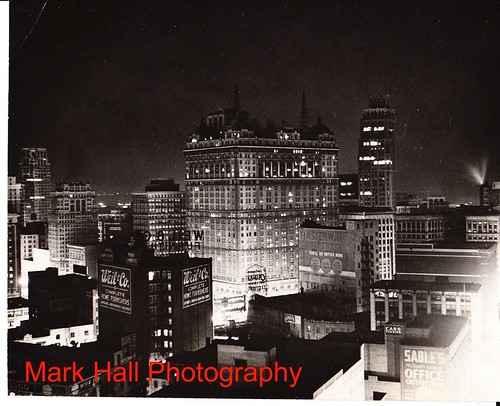
This photo must be seen bachground bigtacular, preferably as part of Mark’s old detroit slideshow.

The star of the photo is best met through the awesomely awesome Buildings of Detroit. Their page on the Book Cadillac Hotel begins:

The Book brothers sought to make Washington Boulevard the most opulent, most successful retail destination in Detroit. By 1923, the siblings had built the Washington Boulevard Building and the Book Building and had already cornered much of the real estate on the boulevard. But the Statler Hotel, which opened Feb. 6, 1915, anchored their boulevard on the north and was drawing their tourists. The brothers decided they needed a hotel of their own.

On the south end of the boulevard, bound my Michigan Avenue, stood the venerable Cadillac Hotel. The Book brothers – Herbert, Frank and J. Burgess Book Jr. – were born within its walls and played along the landscaped mall that stood outside it…

Read on to go from the razing of the Cadillac Hotel through many owners to shuttering to the present day when it is once again open as the Westin Book Cadillac Detroit.

I could stop there, but when I read the first post in Noah’s The People of Detroit Photo Documentary, I really felt I had to share it. Head over to The People of Detroit: Outlier on Flickr for a good read (PG for brief language and sexual reference).

The People of Detroit: Outlier
The People of Detroit: Outlier, photo by Noah Stephens

Grand Rapids Founding Day Parade, May 1, 2010

NOTE: This event has been CANCELLED!


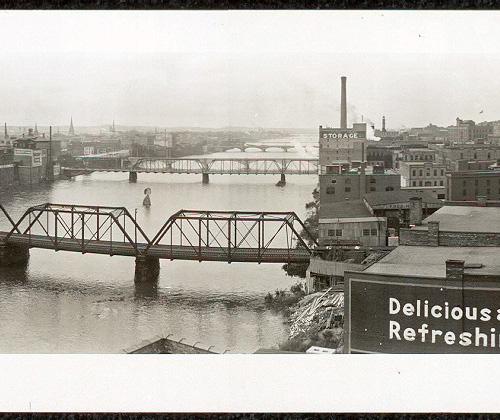
Grand Rapids, 1915, photo by Kenneth Spencer

Grand Rapids cruise director Rob Bliss has launched the latest in a series of events, the Grand Rapids Founding Day Parade (view poster). The first annual of this event happens May 1, 2010 and he writes:

May 1st will be the 160th Anniversary of the Founding of Grand Rapids, and to mark that day I am putting on a large scale parade and celebration. Floats, marching bands, and retro cars will all be involved in making this day great.

$5,000 Float Competition: $5,000 will be given away to the best float, decided by a public vote. Anyone can enter a float and be in the parade and possibly win this prize, and there is no entry fee. All floats must have some connection to the greater Grand Rapids area (includes lowell, caledonia, etc.) but are very open ended. A local band playing local music on a float stage would apply! Dance party on the blue pedestrian bridge as a float would work. Whatever idea you have will most likely work.

…This parade is decided by a public vote, with paper voting taking place at the end of the parade, near the Grand Rapids Library and Veterans Memorial. Mayor Heartwell will be speaking to the crowd following the event.

This exciting new community event works to celebrate and to continue to push our city forward. Very few citizens know when their hometown was founded; come downtown and help celebrate our community.

This photo from the Library of Congress is available as a stunning panorama which I hope you get a chance to see. You may also want to explore the photographic history of Grand Rapids through the photographs from the Grand Rapids Historical Commission’s online archive!

Happy Ernie Harwell Day!

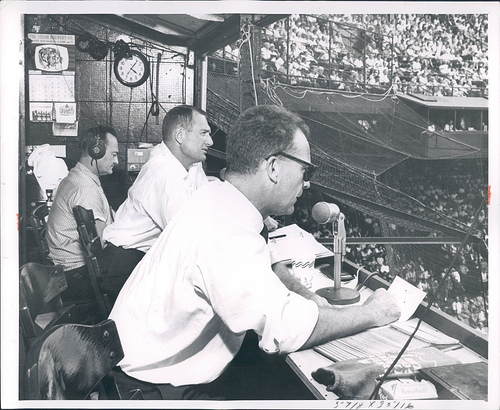
Ernie Harwell & George Kell broadcasting for the Detroit Tigers
George Kell Ernie Harwell 1961, photo by doctor_gogol.

For, lo, the winter is past,
the rain is over and gone;
The flowers appear on the earth;
the time of the singing of birds is come,
and the voice of the turtle is heard in our land
~Ernie Harwell quoting the Song of Solomon (listen)

The Detroit Free Press notes that today is not just the Detroit Tigers home opener against the Cleveland Indians, but also that April 9 is now Ernie Harwell Day by decree of the Michigan Senate.

The Detroit News Rearview Mirror on Ernie Harwell writes that the Baseball Hall of Fame and longtime Detroit Tigers announcer was born on January 25, 1918 in Washington, Georgia, was so tongue-tied as a youngster that kids made fun of him and became the only broadcaster ever traded when the minor league Atlanta Crackers traded him to the Brooklyn Dodgers for farmhand Cliff Draper.

In 1950 Harwell was lured to the rival New York Giants, where one year later he broadcast the debut of Willie Mays. From 1954 to 1959, Harwell was the voice of the Baltimore Orioles.

George Kell was finishing his Hall of Fame career as a player with the Orioles, and one day Ernie invited him into the radio booth. Kell later landed a job with the Detroit Tigers and in 1960 the Detroit club signed Harwell to become Kell’s partner. “It’s the best move I ever made,” Ernie said. “I’ve been very happy in Detroit.”

…Baseball author Bruce Shlain reflects: “Somehow he brings the proper pitch and phrasing to a whole season, with a rhythm and pacing that only a select few have ever commanded. In many ways a Harwell broadcast is profoundly musical, as befits a man who has published 55 songs with composers such as Johnny Mercer. Many an announcer has aspired to sounding as if talking to a friend in his living room, but Harwell effortlessly establishes the same rapport on the air as he does in person.”

Be sure to check out this shot of Ernie & George Kell out bigger and see more in Doctor Gogol’s Stadium Workers set. In honor of Ernie and the home opener, I suggest you settle back and watch the Tiger Briggs Stadium Detroit slideshow.

Check out more Detroit Tiger features on Michigan in Pictures and play ball!

Hand-building automobile bodies: Michigan’s Automobile Factories, 1900-1961

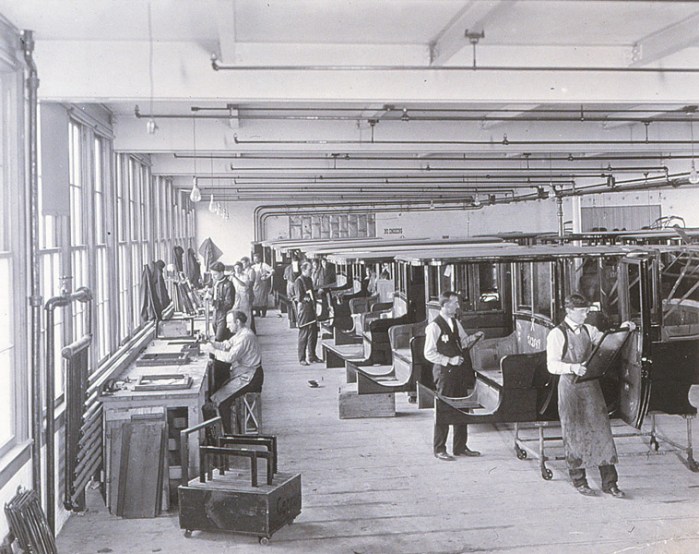
Packard Factory, Detroit, 1910, courtesy of the National Automotive History Collection, Detroit Public Library

The Michigan Radio Picture Project has a new feature titled Michigan’s Automobile Factories, 1900-1961 edited by Doug Aikenhea. It’s a fantastic tour through Michigan’s automobile heritage, that takes you from hand-built wooden auto bodies to sheet metal & assembly lines. It features well known factories in Detroit, Flint & Lansing like Ford, Buick and Chrysler along with lesser known ones such as Durant-Dort, Fisher, Chalmers & Maxwell. They write:

The industrial adventurers and entrepreneurs who launched Michigan’s automobile industry came from various backgrounds. Some of them began as carriage makers, like William C. Durant who would go on to found General Motors in 1908. The earliest automobiles, like their horse-drawn predecessors, were constructed largely from wood and were built individually until the assembly line evolved to accelerate production and incorporate standardized, mass-produced parts. As automobile manufacturing progressed, the role of the worker changed from traditional craftsman to skilled assembly line specialist. This series of historical photographs traces the evolution of Michigan automobile factories from 1900 until 1961.

Click through for more!

Play Ball! Detroit Tigers Opening Day 2010

have a seat in my time machine

have a seat in my time machine, photo by 1ManWithACamera.

The Detroit Tigers open the 2010 baseball season in Kansas City at 4:10 PM today. The Baseball Almanac says that since 1901, the Detroit Tigers are 58-50 on Opening Day. On April 26, 1992 when Larry took his nephew Aaron to his first Tiger game, the Bengals came up short to the Blue Jays, 2-4. Here’s hoping that the boxscore in 2010 looks more like the 15-2 crushdown that the Tigers laid on the Texas Rangers last year.

Over on Absolute Michigan we have our Detroit Tigers Opening Day 2010 Blog Roundup. More at absolutemichigan.com/Tigers and from Michigan in Pictures.

Check this out big as a ballpark and see more in Larry’s Detroit Tigers and their ballparks set (slideshow).

A Belated Happy Birthday to Michigan Governor William G. Milliken

Untitled, photo by BryantDIGITAL

Yesterday (March 26th), former Michigan Governor William G. Milliken turned 88. I bumped into him a few weeks ago and he seemed in great health, so hopefully he has many more coming.

Several years ago, in The Very Best People in the Northern Express, Robert Downes wrote:

Raised on Washington Street in Traverse City, Bill Milliken was the longest-serving governor in the state’s history, occupying the office from 1969 to 1983.

Gov. Milliken is an honest-to-gosh war hero: He flew 50 combat missions in WWII as a waist-gunner in a B-24. He survived two crash landings; received a flak stomach wound on one mission; and once had to bail out in Italy when his plane ran out of fuel 50 miles from its base. He received seven medals for his service, according to “The Milliken Years” by Joyce Braithwaite and George Weeks.

Still considered one of the leaders of the moderate wing of the Republican Party, Governor Milliken’s administration saw many advancements in civil rights and environmental protections. The governor signed Michigan’s landmark bottle deposit law into effect in 1976 and it was during his tenure that the Sleeping Bear National Lakeshore was created by an act of Congress in 1970. Although he hailed from Northern Michigan, Gov. Milliken recognized the importance of preserving the viability of the City of Detroit and refused to play into the “us vs. them” mentality of outstate politicians. As governor, he lobbied against members of his own party in the late ’70s for the Detroit People Mover, which was ultimately approved in a drastically limited form.

…Little known fact: The governor’s middle initial stands for Grawn, the family namesake of the crossroads between TC and Interlochen.

More in the William G. Milliken entry from Wikipedia.

Check this out bigger in Bryant’s slideshow.