A little trip up north… and Thomas Story Kirkbride

2 Doors Down by Carolyn Gallo

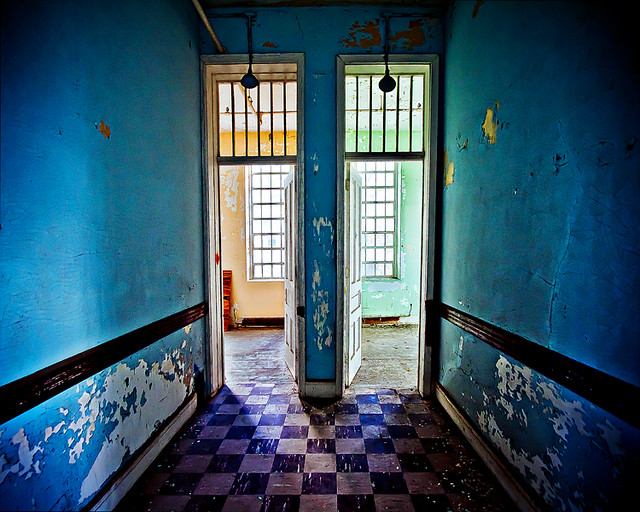
Last weekend, I had the good fortune to lead a photo walk for a group of Michigan photographers at the place where I work, the The Village at Grand Traverse Commons in Traverse City. We were touring the as yet un-renovated parts of what was known as Building 50 when it was the Traverse City State Hospital. Also known as the Northern Michigan Asylum for the Insane and the Traverse City Regional Psychiatric Hospital, the building was a Kirkbride Institution, designed by Dr. Thomas Story Kirkbride.

Kirkbride was a Pennsylvania Quaker and founding member of the Association of Medical Superintendents of American Institutions for the Insane who developed a concept of treatment known as the Kirkbride Plan. This plan proposed a particular way of housing patients that included segregating by severity of mental illness and fresh air and natural light where possible:

It was believed crucial to place patients in a more natural environment away from the pollutants and hectic energy of urban centers. Abundant fresh air and natural light not only contributed to a healthy environment, but also served to promote a more cheerful atmosphere. Extensive grounds with cultivated parks and farmland were also beneficial to the success of an asylum. Landscaped parks served to both stimulate and calm patients’ minds with natural beauty (enhanced by rational order) while improving the overall aspect of the asylum. Farmland served to make the asylum more self-sufficient by providing readily available food and other farm products at a minimal cost to the state.

Patients were encouraged to help work the farms and keep the grounds, as well as participate in other chores. Such structured occupation was meant to provide a sense of purpose and responsibility which, it was believed, would help regulate the mind as well as improve physical fitness. Patients were also encouraged to take part in recreations, games, and entertainments which would also engage their minds, make their stay more pleasant, and perhaps help foster and maintain social skills.

There’s lots more from Kirkbride Buildings where the author has done some spectacular scholarship and created an excellent resource for these amazing structures. The Kirkbride System produced a photographic environment of uncommon richness that is evident in the slideshow from the group A little trip up north…, the Flick slideshow for the “atripupnorth2010” tag and in the streams of the photographers in the group. They also visited some wineries and other spots in the area.

As an added bonus, and unlike many of Michigan’s ruins, the Village at Grand Traverse Commons is actively being redeveloped. In fact, this week a crew began work to restore much of the North Wing where we toured!

See this photo bigger in Carolyn’s Photogs Up North slideshow.

Search Kirkbride on Michigan in Pictures for more about the history of this remarkable place.
Happy Birthday, Greenfield Village and The Henry Ford!


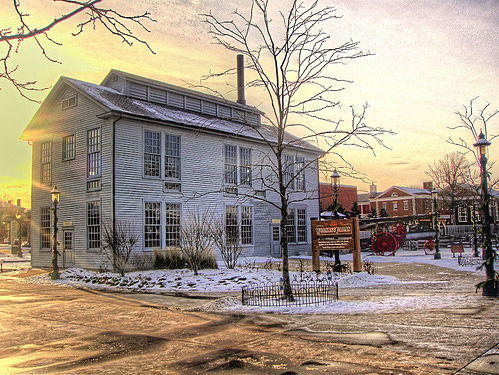
Soybean Lab Agricultural Gallery – Greenfield Village, Dearborn, Michigan, photo by cmulou

You don’t really think about “light” having an anniversary, but today is the 131st anniversary of Thomas Edison’s invention of the electric light. Light’s Golden Jubilee Honors Thomas Edison and Dedicates a Museum from The Henry Ford Museum relates that today features another birthday:

On October 21, 1929, Henry Ford hosted an elaborate celebration in Dearborn, Michigan, in honor of his friend Thomas A. Edison. Known as Light’s Golden Jubilee, the date marked the 50th anniversary of Edison’s invention of the electric light. Ford also planned his event as a dedication of his own lasting tribute to Thomas Edison and to American innovation, the Edison Institute of Technology (later renamed Henry Ford Museum) and Greenfield Village. Here, Henry Ford had moved the Menlo Park, New Jersey, laboratory where the inventor made his discovery so many years before.

The RSVPs for Light’s Golden Jubilee began pouring in to Ford Motor Company by early October 1929. Prominent businessmen like John D. Rockefeller, Jr. and J.P. Morgan, scientist Marie Curie, inventor Orville Wright, and humorist Will Rogers were among those who enthusiastically accepted Ford’s invitation to be part of the landmark event.

A t 10 o’clock that morning, President Herbert Hoover, Henry Ford and Thomas Edison arrived at Smiths Creek depot at Greenfield Village on a steam- powered locomotive, much like the one on which Edison had sold papers as a youth. They were met by invited guests that numbered more than 500. The crowd roared their approval and congratulations as Edison , Hoover and Ford stepped from the train to begin the day’s festivities…

Read on and also see some photos from the opening gala at the Henry Ford.

Check this photo out bigger in cmulou’s Winter at Greenfield Village slideshow and Happy Birthday to one of Michigan’s coolest museums!!


Why is it called Indian Summer anyway?

indian summer

indian summer, photo by paulh192.

“The air is perfectly quiescent and all is stillness, as if Nature, after her exertions during the Summer, were now at rest.”
~John Bradbury, 1817

We’ve had a spectacular October, and that had me wondering about the term “Indian summer.” Wikipedia has some thoughts on Indian summer, but I thought the best work was done by William R. Deedler, Weather Historian for the National Weather Service Detroit/Pontiac in Just what is Indian summer and did Indians really have anything to do with it?. He writes:

It can be defined as “any spell of warm, quiet, hazy weather that may occur in October or even early November.” Basically, autumn is a transition season as the thunderstorms and severe weather of the summer give way to a tamer, calmer weather period before the turbulence of the winter commences.

The term “Indian Summer” is generally associated with a period of considerably above normal temperatures, accompanied by dry and hazy conditions ushered in on a south or southwesterly breeze. Several references make note of the fact that a true Indian Summer can not occur until there has been a killing frost/freeze.

The earliest known use of the term was in 1778 by Frenchman St. John de Crevecoeur who wrote:

Sometimes the rain is followed by an interval of calm and warmth which is called the Indian Summer, its characteristics are a tranquil atmosphere and general smokiness. Up to this epoch the approaches of winter are doubtful; it arrives about the middle of November, although snows and brief freezes often occur long before that date.”

But does it have anything to do with Native Americans? Some thoughts Deedler shares are that Native Americans chose that time of year as their hunting season, that natives made use of the dry, hazy weather to attack settlers before winter set in, and the prejudicial notion that immigrants equated Indian Summer to “fools” Summer, given the reliability of the weather. One curious idea is:

…not at all in the American Indian “camp” of theories, was put forward by an author by the name of H. E. Ware, who noted that ships at that time traversing the Indian Ocean loaded up their cargo the most during the “Indian Summer”, or fair weather season. Several ships actually had an “I.S.” on their hull at the load level thought safe during the Indian Summer.

In any case, this is a welcome phenomenon, and one of the best reasons I know to live in Michigan!

Check this out background big and in Paul’s slideshow.

More Michigan Fall Wallpaper from Michigan in Pictures.

legends stood here: Exploring Detroit with Absolute Michigan

legends stood here

legends stood here, photo by buckshot.jones

All week on Absolute Michigan we’ve been featuring Detroit with fresh looks at Michigan’s largest city from a wide range of folks including Johnny Knoxville and David Byrne and topics that include Detroit’s art resurgence and movie-making in the Motor City.

About the photo, Scott writes:

At this very spot, some of the greatest to ever play the game, played right here. Under a blue Michigan sky they crafted their legend. From the deadball era of Ty Cobb to the steriod era of “My head didn’t get bigger, my hat shrunk” Barry Bonds, the greats of the game played.

I figure most of us folks in Detroit have a fond memory, or two, of this place. I saw Ron Leflore in the midst of a 30 game hitting streak, sitting down the first base line. Out in the left field stands I watched the Bird win a game sitting next to my brothers and our old man. I took my daughter to her first game in 1982. She was still an infant, it was early June and the old park was still as cold as a meat locker. In the last year of the park, my son and I attended a game. We moved all around the stadium, finishing up in my favorite part, the upper deck bleachers, right to the left of the flag.

I truly loved that place.

Check this out bigger and in his excellent Detroit Journal: Words & Pictures series (view slideshow).

Lots more Detroit Tigers and Detroit photos from Michigan in Pictures.

Job Shadowing: Glen Haven Canning Company

Job Shadowing

Job Shadowing, photo by Happyhiker4.

Looks like the old cannery at the Sleeping Bear Dunes National Lakeshore is getting a fresh coat of paint as part of a renovation this fall. The Cannery Boathouse Museum is the largest public exhibit of Great Lakes small craft and features all kinds of historic boats used around Glen Haven and the Manitou Islands.

360 Michigan has a cool 360 degree panorama of the cannery and the beach at Glen Haven that you’ll want to check out.

Check this out bigger in Mark’s slideshow which features some outstanding fall photos!!

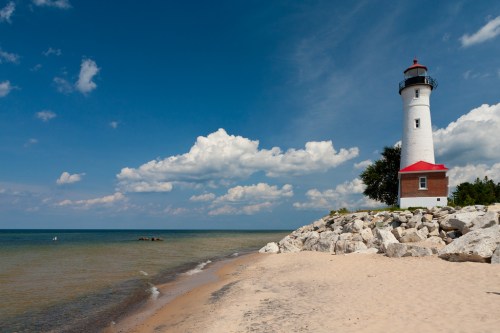
Crisp Point Lighthouse on Lake Superior

Crisp Point Lighthouse
Crisp Point Lighthouse, photo by Mario.Q

Terry Pepper says that a visit to Crisp Point is a “must” for any lighthouse fans, as it remains one of the most desolate and beautiful locations in all of the Great Lakes. He should know, as he’s the last word in Great Lakes Lighthouses. On his Crisp Point Lighthouse entry he writes:

The Lake Superior coastline between Whitefish Point and Grand Island stands as one of the most beautiful stretches of shoreline in all of the Midwest. With pleasure boaters, tour boats and kayakers making their leisurely way along the coast to soak up the natural beauty. It is difficult to imagine that during the 1800’s this stretch of seemingly bucolic coastline was known to mariners as “The Shipwreck Coast,” with the hulks of innumerable vessels pushed onto the shore by violent storms out of the north, or lost in the pea soup fogs which frequently enveloped the area.

…Congress approved the establishment of four life saving stations between Vermilion and Deer Park on June 20, 1874, one of which was designated as Station Ten, and built at an unnamed point approximately fifteen miles west of Whitefish Point. Although David Grummond was appointed as the first keeper at life saving station 10, it would be Christopher Crisp who served as keeper from 1878 until 1890 who would have the most lasting impact on the area, as Crisp became so well known that the point on which the station was established would become forever known as “Crisp’s Point.”

Much more about the lighthouse at the link above and also from the Crisp Point Historical Society.

Check it out bigger and in Mario’s Great Outdoors slideshow.

Many more Michigan Lighthouses on Michigan in Pictures.

Have a wonderful Labor Day Weekend!

Have a wonderful Labor Day weekend

Have a wonderful Labor Day weekend, photo by Kevin Povenz.

I always love it when the perfect photo for Michigan in Pictures is waiting in the Absolute Michigan pool on Flickr. I echo Kevin’s sentiments and wish everyone a very happy & safe Labor Day Weekend filled with all the family, friends & fun that you desire!!

Check this out background boomtacular and in Kevin’s Fun/Interesting slideshow.

Here’s some Michigan Labor Day gems from Absolute Michigan & Michigan in Pictures:

Carp Lake or Lake of the Clouds?

IMG_0060

IMG_0060, photo by JimSchoensee.

I was looking for the legend of why the Lake of the Clouds got its name. It turns out that this signature scenic site in the Porcupine Mountains Wilderness State Park got its romantic name in the 1930s or 1940s depending on the source you believe. The later source has some more detailed information, so I’ll relate it here:

The name “Lake of the Clouds” makes me chuckle. The lake was originally named “Carp Lake” by the settlers of these parts in the 1840s. In this usage “carp” is short for “scarp,” or “escarpment,” the rocky basalt-and-conglomerate ridge you see to the left, and has nothing to do with the ugly bottom-feeding fish. When the area became the Porcupine Mountains Wilderness State Park in 1945, some marketer thought “Carp Lake” wouldn’t fly with city-slicker tourists and insisted the name be changed.

Whatever name it goes by, it is indeed a beautiful vista – get information about Lake of the Clouds trails from Hunts Guide to the UP.

Check this out bigger and in Jim’s slideshow.

More Porcupine Mountains on Michigan in Pictures.

Burt Lake & William Austin Burt

Burt Lake Shoreline ~ Indian River, Michigan

Burt Lake Shoreline ~ Indian River, Michigan, photo by peterlfrench.

Wikipedia says that Burt Lake is a 17,120 acre lake in Cheboygan County. It was named after William Austin Burt, who, together with John Mullett, made a federal survey of the area from 1840 to 1843. I know that you want to know more about William Austin Burt, and Wikipedia has it covered again:

William Austin Burt (June 13, 1792 – August 18, 1858) was an American inventor, legislator, surveyor, and millwright.

Burt was born in Worcester, Massachusetts, and lived in Michigan from 1822 until his death in 1858. He was a member of the Michigan Territorial Legislature, 1826-1827. He served as Mount Vernon’s first postmaster from 1832 to 1856. He was a Macomb County Circuit Court judge in 1833, a state legislator in 1853, and a deputy U.S. surveyor from 1833 to 1853. While surveying, he won acclaim for his accurate work on public land surveys. In 1857, Burt moved to Detroit, where he died a year later.

Among Burt’s numerous inventions were the typographer in 1829, which was a predecessor to the typewriter. He also invented the solar compass, a surveying tool used in the Michigan Survey, employed in regions that had an abundance of minerals, which would interfere with accurate readings when using ordinary instruments. While out surveying on September 19, 1844, in what is today Marquette County, Michigan, Burt discovered one of the largest iron ore deposits in the United States. A historical plaque commemorates William Austin Burt at Stony Creek, near his home in Mt. Vernon, Michigan.

See this bigger and in Peter’s Northern Michigan slideshow and check out more Michigan lakes on Michigan in Pictures!

On a personal note, when I was a kid my family had a cottage not far from here.

Michael Moore to help restore Michigan’s downtown movie theaters

Bohm Theatre, Albion

Bohm Theatre, Albion, photo by I am Jacques Strappe.

One of the cool things that came out at this year’s Traverse City Film Festival was Michael Moore’s plan to to bring back downtown movie theaters. John Flesher And Mike Householder of the AP write in USA Today:

For generations, Americans viewed films in stately, single-screen theaters that were pillars of city business districts — an experience that faded with the rise of suburban multiplexes and the decline of downtowns.

Michael Moore wants to bring those theaters back. The Academy Award-winning documentary filmmaker has a plan to refurbish or prop up downtown movie houses in his home state of Michigan— and eventually nationwide.

Such efforts have been made before. But Moore’s approach has a twist, modeled on the successful resurrection of the State Theatre in Traverse City, his adopted hometown in northern Michigan.

The way to rescue downtown movie houses, Moore says, is to run them as nonprofit ventures staffed mostly with volunteers. That slashes costs and gives the community a stake in the theater’s survival, he says.

Moore plans to provide grants and training to theater operators who use those methods. The money would come from a fund he’s creating with his rebate from a state film tax credit earned by producing his documentary, Capitalism: A Love Story, in Michigan. He expects the refund to total about $1 million.

“One of our goals is to create an economic boost, particularly in struggling downtown areas,” he told The Associated Press this week during the annual Traverse City Film Festival, which he and others established six years ago. “Another is to save the art of cinema and encourage great films to be made.”

The Flint native moved to the Traverse City area in 2003 and took an interest in the State Theatre on the resort town’s main street. Opened in 1916, it had become a shuttered relic.

As someone who lives in Traverse City and has seen the amazing impact that the re-opening of the State Theatre has had on downtown Traverse City by driving traffic to restaurants and shops, I have to say that this is an economic development idea that communities should take a good look at!

If you want to see these theaters, there’s no better place than Marjorie O’Brien’s amazing Theaters of Michigan set. The theaters are organized alphabetically by city name. She hopes to do a book and writes that although it’s probably an obsession:

This project is, however, the least I can do to raise public awareness about the plight of historic movie theaters.

Each theater featured in this set is unique and different from the next. Each theater has had very different stages in its life; each has its own storied history.

Check them out, beginning with Albion’s shuttered Bohm Theatre, in her Theaters of Michigan slideshow.

PS: If you want to learn more about Marjorie, check out our Michigan in Pictures photographer profile of Marjorie O’Brien.