Seul Choix Point Lighthouse

Seul Choix Lighthouse

Seul Choix Lighthouse, photo by DanielBrinks.

The Seul Choix Point Lighthouse (map) is operated by the Gulliver Historical Society and DNR as a park & museum. Terry Pepper’s Seeing the Light’s page for Seul Choix Pointe Light explains:

At the dawn of the 1880’s, the volume of maritime traffic passing between harbors on the western shore of Lake Michigan and Green Bay and the Straits of Mackinac exploded. While the St. Helena Island light station lighted the eastern entry into the Straits, mariners were forced to navigate blind along 100 miles of unlighted upper peninsula coastline before the Poverty Island light came into view at the western end of the passage. With treacherous storms frequent at both ends of the navigation season, mariners frequently chose to ride out such storms in the lee of points protruding into the lake along this 100-mile stretch of unlighted shoreline.

Seeking to both make identification of such a refuge easier, and to mark the shore at an interim point between the two existing lights, the Lighthouse Board recommended that establishment of a light station on the end of Point Patterson, approximately midway between St. Helena Island and Manistique.

It took nearly 20 years to complete – read on for more about what was apparently the Cadillac of lighthouses. The light is also reputed to be haunted, and you can read a lot more about that in The Haunting of Seul Choix Point Lighthouse on Michigan in Pictures.

Check this out bigger and see more in Daniel’s 2020110700 Vacation slideshow.
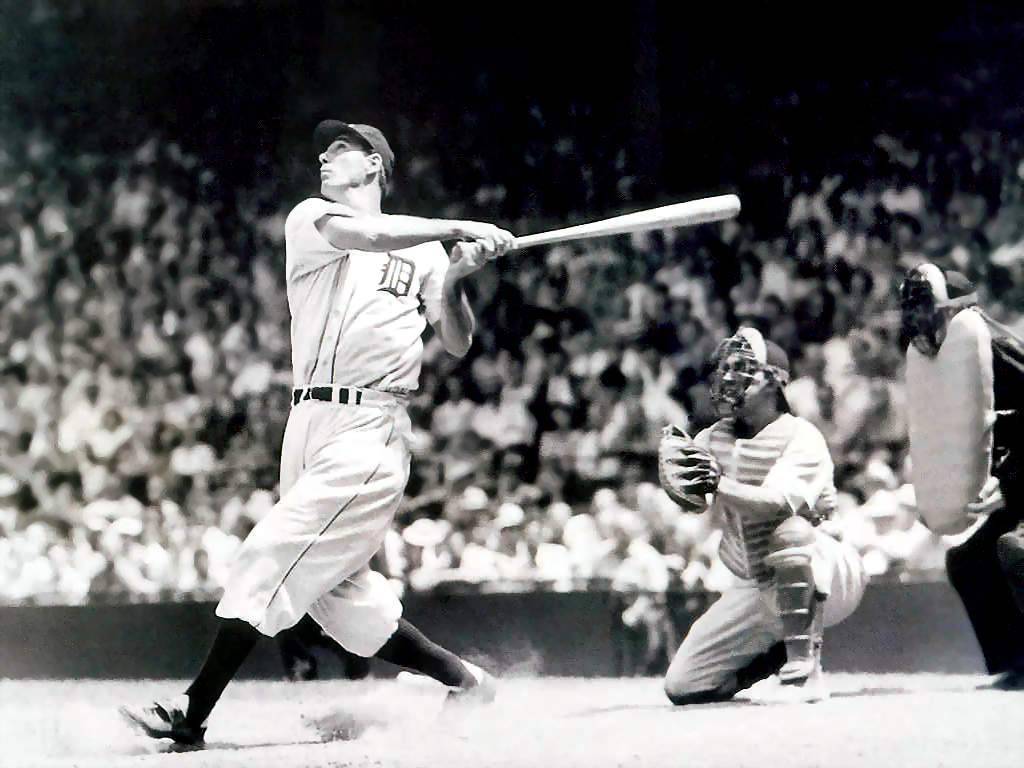
Yom Kippur and Hall of Famer Hammerin’ Hank Greenberg

Detroit Tiger Hank Greenberg, source unknown

“When I was playing, I used to resent being singled out as a Jewish ballplayer. I wanted to be known as a great ballplayer, period. I’m not sure why or when I changed, because I’m still not a particularly religious person. Lately, though, I find myself wanting to be remembered not only as a great ballplayer, but even more as a great Jewish ballplayer.”
~Hank Greenberg, after his career

Tonight the Tigers continue their drive toward the World Series. Wikipedia’s entry for Hank Greenberg begins:

Henry Benjamin “Hank” Greenberg (January 1, 1911 – September 4, 1986), nicknamed “Hammerin’ Hank” or “The Hebrew Hammer,” was an American professional baseball player in the 1930s and 1940s. A first baseman primarily for the Detroit Tigers, Greenberg was one of the premier power hitters of his generation. He hit 58 home runs in 1938, equaling Jimmie Foxx’s 1932 mark for the most home runs in one season by any player between 1927 (when Babe Ruth set a record of 60) and 1961 (when Roger Maris surpassed it).

The Jewish holiday Yom Kipper started last night, and this article on Greenberg’s career from the Baseball Almanac tells how rabbis got involved in the decision as to whether or not he would play on Rosh Hashanah in 1934, explaining that:

Rosh Hashanah was not the only major religious holiday that momentarily got in the way of the Tigers’ march to the 1934 World Series while simultaneously adding to the legend of Hank Greenberg. Nine days after the win over Boston, Detroit played the second place New York Yankees. Despite the fact that the pennant was not officially decided, Greenberg was not in the lineup. He was not injured, or suspended, or being benched for poor play. He had simply come up against Yom Kippur, the one day he could never hope to overcome.

Yom Kippur is the Jewish Day of Atonement, the holiest day on the calendar, when all the sins of the past year are “wiped away” through fasting and prayer. Devout Jews would never think of working on such a day. The 1934 Greenberg was not particularly devout; for his entire life, in fact, he would harbor deep doubts and questions about all organized religion. He was, however, still influenced by his father, who “put his foot down” (Greenberg 57). So he sat.

Also check out this great article on Hank Greenberg’s World War II service from Baseball Reference and his induction speech for the Baseball Hall of Fame.

Tons more Detroit Tigers history & photos on Michigan in Pictures!

An opening at the Argus Museum

Argus Factory
Argus Factory, photo by Voxphoto

The Argus Museum has an exhibition opening Friday, October 21st entitled Sunday Afternoon on the Porch: Reflections of a Small Town in Iowa, 1939-1942, photographs by Everett W. Kuntz. The exhibition runs from October 21st through November 18th, 2011. However, as the exhibit really has nothing at all to do with Michigan, and as this blog is called Michigan in Pictures, we’ll press on and tell you that the museum is located on the second floor of the Argus l building in Ann Arbor, one of the buildings that housed the Argus Camera Co.

Several years ago, Michigan in Pictures had a piece telling the story of the Argus Camera Company, whose cameras had a big role in the explosion in consumer photography. The post has become an internet phenom of sorts, gathering nearly 100 comments from folks buying, selling or wondering about Argus cameras. The article said little, however, about the museum itself. Fortunately, the email that the museum sent me shares a bit more, adding that:

Also on display will be artifacts from the Argus Museum collections. Products manufactured by the Argus Camera Company, including rare objects and prototypes, are featured, as well as military items and employees’ personal effects. Many of the artifacts on display were manufactured in the same building which now houses the Museum.

Former Argus employees and their families will be invited to the opening, giving those interested a chance to speak with them. Argus-related presentations are planned for Saturday, October 22nd, with an afternoon field trip to the Yankee Air Museum which will include a private tour and photography opportunities. (A $2.50 admission fee per person will be charged.) The Argus Museum Archives will open for research on Sunday, October 23rd. Reservations are required for Saturday and Sunday events. If you are interested in giving a presentation (it can be an informal one), please contact Cheryl Chidester…

So it sounds like all you Argus & old camera fans out there will want to check this weekend out. Cheryl is the museum curator and her number is 734-759-0770 (or email) – contact her for questions about the weekend and reservations for Saturday & Sunday.

Ross took this shot of the former Argus camera factory with an Argus 75 pinhole conversion. See it bigger and see more in his arghole slideshow.

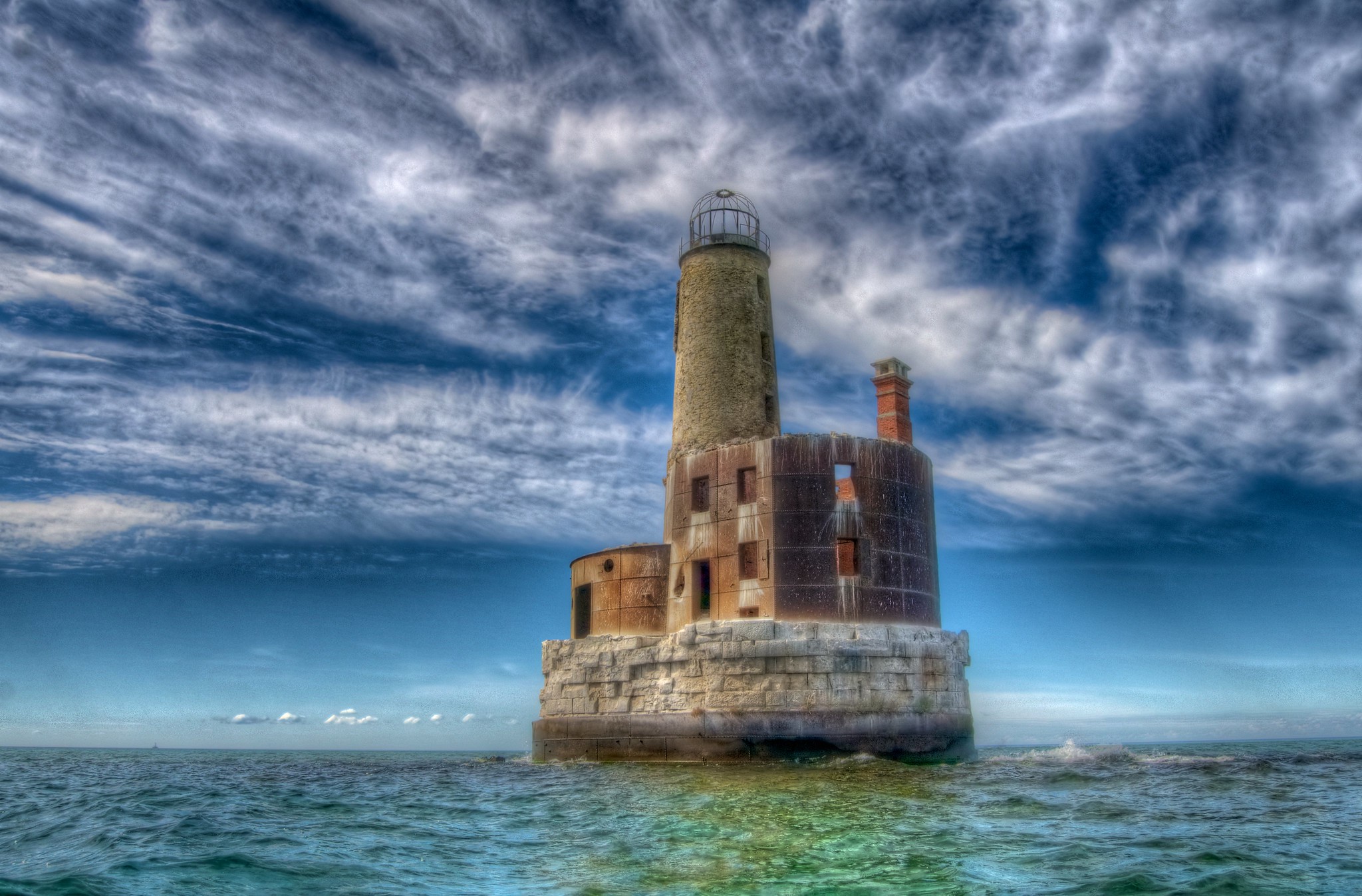
Waugoshance Shoal Lighthouse, Revisited

Waugoshance Lighthouse - Revision 1 by Jason Lome

Waugoshance Lighthouse – Revision 1, photo by lomeranger

I thought that Jason’s incredible HDR – plus the fact that he paddled 14 miles to get this shot – was more than reason enough to revisit one of the most storied lights in the Great Lakes, Waugoshance Shoal Lighthouse.

The Waugoshance Lighthouse Preservation Society explains:

This treacherous area of Lake Michigan was the location of the first Lightship, stationed on Waugoshance Shoal in 1832. It was used to help guide the many ships through the area, now known as Wilderness State Park. In 1851, the Lighthouse Board decided to replace the Lightship with Waugoshance Lighthouse.

Waugoshance Lighthouse served until 1912, when it’s services were replaced by White Shoals Lighthouse. In it’s glory the Waugoshance sported red and white horizontal strips on a steel encased tower and stone walls that are five and one half feet thick. Also, it has one of only three remaining “birdcage” lanterns left on the lakes and is considered one of the most endangered lighthouses in the world.

Learn much more – including how the light was used for WW II training – at Waugoshance Shoal Lighthouse at Terry Perrper’s Seeing the Light and another photo of Waugoshance on Michigan in Pictures. Also don’t miss The Joker’s Ghost, a story from this lighthouse on Absolute Michigan.

You have to check this photo out bigger and in Jason’s slideshow.

Support Michigan in Pictures with Patreon

What Was There, Michigan Edition

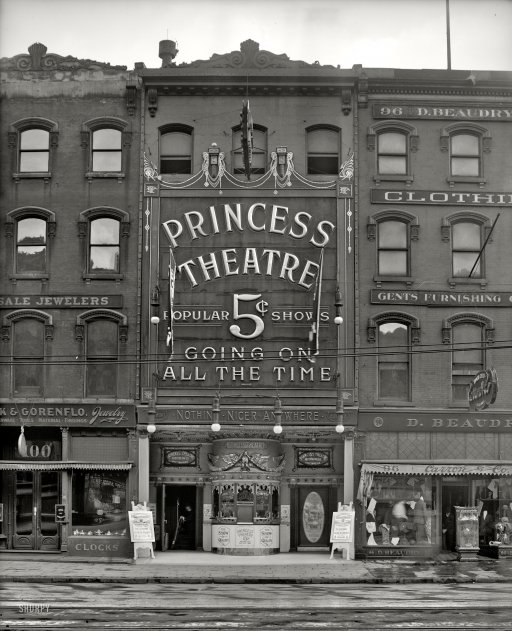
Princess Theatre, Detroit photo courtesy WhatWasThere

The other day I came across a new website called WhatWasThere. This innovative project ties historical photos to Google Maps and Google street views so you can see what was there. You can browse around a map, zooming in and out and then click on photos. The site lays them over the Google street view and lets you fade the old photo to reveal what’s there now!

Unsurprisingly, Detroit has the best coverage so far, and it’s pretty cool to see how sites like Woodward Ave looking north at Jefferson (location of the Spirit of Detroit) or Griswold Street have changed. Water Winter Wonderland (a cool site in its own right) has a sweet shot of the interior of the Princess and says that the Princess Theatre was shuttered in 1922 and located at 520 Woodward. That’s the present site of the old Comerica Bank HQ. At another of my favorite sites for old photos, Shorpy, you can get this photo bigger and even buy a print!

Here’s the link to WhatWasThere for Michigan.  There’s not a whole lot of photos to be found (yet) outside Detroit, but one of the coolest things is that you can add your own historical photos, so the site is only going to get better. There are some definite gems though – be sure to check out Grand Rapids City Hall, the seriously cool looking Lansing Masonic Temple at the site of Cooley Law School and the not very much changed Front St in Marquette. A surprising hot spot is Port Huron – check out Sperry’s Department Store to get going.

Mickey Cochrane and the 1934 Detroit Tigers

Detroit Tiger

Detroit Tiger Manager Mickey Cochrane, photo courtesy Boston Public Library

There were few things as exciting as watching somebody trying to get in there on a close play with Cochrane. Home plate was his, you see. You had to take it away from him. Tough? Just the same as a piece of flint.
~Doc Cramer regarding Mickey Cochrane

Yesterday the Detroit Tigers came from behind to beat the White Sox 6-5 in extra innings. It was their 12th in a row and a feat that only 3 Tiger squads have matched. Tiger Tales has the list with 13 in a row in 1927 and 14 from 1909 and 1934.

Speaking of 12 and 1934, the Bleacher Report (which I’m finding to be a really cool sports site) ranks the ’34 Tigers as the 12th best offense in baseball history. While the team ultimately fell to the Gas House Gang in the World Series, they won 101 games and dominated the AL for several years with a lineup was ridiculous, as Motown Sports explains:

The addition of outfielder (Goose) Goslin to a lineup that already featured stars Hank Greenberg and Charlie Gehringer, earned the Tigers’ offense the nickname “G-Men” after the legendary FBI officers of the day. While G-Men were known to get into shootouts with gangsters, the Tigers’ G-Men formed the nucleus of an offense that helped the club roar through the American League in 1934 posting a 101-53 record.

Four Tigers, Greenberg (139), Gehringer (127), shortstop Billy Rogell (100) and Goslin (100), each had 100 RBI campaigns. Gerhinger paced the league in hits, as well, with 214. However, the Tigers of ’34 not only could hit, but they could run, too. JoJo White (28), Pete Fox (25) and Gee Walker (20) finished amongst the top five in the American League steals leaders. The G-Men led the AL in runs, batting average (an incredible .300), doubles and stolen bases in 1934.

Click through for the ’34 Series program and much more about one of the greatest Tiger teams.

The manager of this team was Hall of Fame catcher Mickey Cochrane. He appeared on a 1935 cover of TIME Magazine, won the AL MVP for the Tigers in ’34 and led the Tigers to 2 pennants and the 1935 World Championship. Wikipedia notes that the fiercely competitive “Black Mike” was one of the greatest catchers in baseball history with a .320 batting average over a 13 year playing career, the highest until Joe Mauer surpassed it in 2009!

The photo of Mickey Cochrane on the dugout steps at Fenway Park is from 1934-38. You can view it background big and see more in the Boston Public Library’s Mickey Cochrane slideshow.

More Detroit Tigers photos on Michigan in Pictures including a post about another member of this legendary squad, 2nd baseman Charlie Gheringer.

Big Bay Point Lighthouse

Big Bay Point Lighthouse - Big Bay ,  Michigan

Big Bay Point Lighthouse – Big Bay , Michigan, photo by Michigan Nut.

Probably the most unique thing about Big Bay Point Lighthouse is that it’s a bed & breakfast! A friend of mine ran it for a while, and take it from me: there’s few better places to stay on the shore of Lake Superior!

As always, Terry Pepper’s Seeing the Light has great information & photos on the history of Big Bay Point Lighthouse:

The lighthouse was built as a two-story brick duplex dwelling, 52 feet by 52 feet with 18 rooms. The light tower rose from the center of the house 105 feet above Lake Superior. There were also two small brick outhouses, a brick oil storage building, and a 20 foot by 15 foot brick fog signal building. The first fog signal consisted of two steam operated ten-inch train whistles that protruded from the roof of the building.

…The duplex dwelling housed the Head Keeper and his family on one side, and the Assistant Keeper and family on the other. There was an office on the lower level of the tower; accessible only from the head keeper’s side of the building. Each dwelling had six rooms consisting of kitchen, parlor and dining room on the first floor, and three bedrooms on the second.

Read on for more including its peripheral role in the film Anatomy of a Murder.

Check this out bigger and in Johns’ spectacular Michigan lighthouses slideshow.

Many (many) more Michigan lighthouses on Michigan in Pictures!

Restoring the Irish Hills Towers

2 towers

2 towers, photo by riot jane

The newly formed Irish Hills Historical Society has launched a campaign to restore and reopen the Irish Hills towers and to open an Irish Hills museum. You can learn more at that link and read about the history of the Irish Hills towers on Michigan in Pictures.

See this photo bigger and in Bethany’s Irish Hills slideshow.


Pride and Joy at the Woodward Dream Cruise

Pride and Joy

Pride and Joy, photo by country_boy_shane.

The annual Woodward Dream Cruise is the is the world’s largest one-day automotive event, drawing 1.5 million people and 40,000 classic cars. It takes place this Saturday (August 20, 2011) and has come a long way since August 1995, Nelson House and a group of volunteers looked to relive and recreate the cruisin’ heydays of the 50s and 60s.

The one day cruise is paired with the Ferndale Woodward Dream Cruise which happens August 18-20 and has many special exhibitions and musical performances.

More about the Woodward Dream Cruise on Michigan in Pictures.

Check this out background big and in Shane’s Woodward Dream Cruise 2008 slideshow. You can also get your own copy from Shane Gorski Photography!

Want more? Have a look at the Woodward Dream Cruise Group on Flickr!

Into the Big Sky in the Huron National Forest

Into the Big Sky
Into the Big Sky, photo by Neil Weaver

The Huron-Manistee National Forest is actually two separate and non-contiguous national forests, the Huron National Forest (established in 1909) and the Manistee National Forest (established 1938). They were combined in 1945 for administrative purposes. Wikipedia says:

The Huron National Forest portion is in northeast lower Michigan. Its southern boundary is approximately at the latitude of Manistee’s northern boundary. It has a total area of 438,538 acres (685.22 sq mi, or 1,774.70 km²). It lies in parts of Oscoda, Alcona, Iosco, Crawford, and Ogemaw counties. There are local ranger district offices in Mio and Oscoda.

The threatened Kirtland’s Warbler nests in the area, and tours are available, subject to time restrictions.

Check this out bigger and see more in Neil’s Huron National Forest slideshow. You can purchase Neil’s photos from his website and also keep up with his travels around Michigan on Facebook!

Michigan in Pictures has more about Kirtland’s Warbler.