Remembering Michigan’s legendary architect Albert Kahn

Albert Kahn's legacy

Albert Kahn’s legacy, photo by .brianday.

“Architecture is 90 percent business and 10 percent art.”
~Albert Kahn

Legendary Detroit architect Albert Kahn died on December 8, 1942. The Albert Kahn entry at Wikipedia begins:

Kahn was born on March 21, 1869 in Rhaunen, Rhineland-Palatinate, Germany. Kahn came to Detroit in 1880 at the age of 11. His father Joseph was trained as a rabbi. His mother Rosalie had a talent for the visual arts and music. As a teenager, he got a job at the architectural firm of Mason and Rice. Kahn won a year’s scholarship to study abroad in Europe, where he toured with another young architecture student, Henry Bacon, who would later design the Lincoln Memorial in Washington, D.C.

The architectural firm Albert Kahn Associates was founded in 1895. He developed a new style of construction where reinforced concrete replaced wood in factory walls, roofs, and supports. This gave better fire protection and allowed large volumes of unobstructed interior. Packard Motor Car Company’s factory built in 1907 was the first development of this principle.
The success of the Packard plant interested Henry Ford in Kahn’s designs. Kahn designed Ford Motor Company’s Highland Park plant, begun in 1909, where Ford consolidated production of the Ford Model T and perfected the assembly line. On Bob-Lo Island, Henry Ford had a dance hall designed and built by Albert Kahn, which was billed as the second largest in the world in a 1903 account…

Ten Albert Kahn designed buildings are recognized with Michigan historical markers:

    • Battle Creek Post Office
    • The Dearborn Inn
    • Detroit Arsenal Tank Plant in Warren, Michigan
    • Edsel and Eleanor Ford House in Grosse Pointe Shores, Michigan
    • Fisher Building
    • Delta Upsilon Fraternity, 1331 Hill St., Ann Arbor
    • Packard Motor Car Company factory
    • The Detroit News
    • The Detroit Free Press
    • Willow Run

Get the complete list of his firm’s buildings (including the Russell Industrial Center) at Wikipedia. The company that Kahn founded in 1895 is still in the business. There’s an interesting biography of Albert Kahn from Ford that notes that a Detroit sculptor recognized Albert’s artistic talent and allowed him to attend his art school free. However, after discovering that Kahn was color blind, the artist encouraged him to become an architect and secured him a job as an office boy.

Check this photo out bigger and see more in Brian’s Detroit Flavor slideshow. Coincidentally enough, Brian just let me know that this photo is being hung in a gallery today along with 10 other prints from Brian (and another 10 from two other michpics regulars,  Jon DeBoer and Jeff Gaydash) at Studio Couture gallery, 1433 Woodward Avenue. Opening night for the exhibition will be this Saturday from 6pm-9pm. Details right here!

More Michigan architects & architecture from Michigan in Pictures.

A long shot in Vehicle City

A long shot

A long shot, photo by flintstoner.

Editor’s note: Midway through writing this post, I realized that I had blogged about the Vehicle City arches four years ago. I figured that if I had forgotten, most of you probably would have forgotten too or never seen it, so here you go.

Last week Governor Rick Snyder appointed Michael Brown as Emergency Manager for Flint. You can read all about that (including some interviews) on Absolute Michigan.

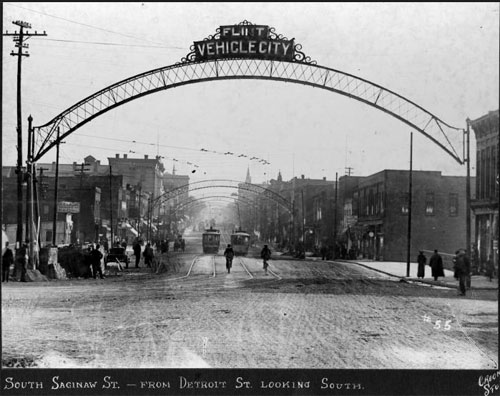
When I was looking at photos for that feature, this one with all the arches on Saginaw street caught my eye so I decided to learn a little more about them. Flinn’s Journal (which is a really cool site by the way that has a dynamic Facebook page) has a column on the Flint Arches that explains:

On November 29, 2003, a part of downtown Flint’s past officially returned to become part of Flint’s present and future when the replicated Flint Vehicle City arches were dedicated and lit for the first time. The arches are reminders of Flint’s glorious past as “The Vehicle City” as the city faces an uncertain future.

The vehicles which were made in Flint when the original arches were built were horse-drawn carriages. The leading maker of horse-drawn carriages in Flint was the Durant-Dort Carriage Company which was co-founded by William C. Durant and J. Dallas Dort and was in business from 1886 to 1917. Both men would also start companies which made horseless carriages. Dort founded the Dort Motor Car Company which was in business from 1915 to 1923. Dort Highway was named in his honor. Durant took over the then-small Buick Motor Company in 1904 and made it the leading motorcar company in 1908, the year that Durant founded Buick’s parent company General Motors Corporation. The first arches were erected in 1899 and built by Genesee Iron Works.

The arches were each fitted with 50 light bulbs which were illuminated at night. The arches replaced gas lighting. To celebrate Flint’s Golden Jubilee in 1905, an additional arch was erected near the point where Saginaw Street and Detroit Street (now M.L. King Ave.) split off north of the bridge over the Flint River. This arch was topped off by an illuminated sign saying “FLINT VEHICLE CITY”. For the Christmas holiday season, the regular light bulbs were replaced by multicolored light bulbs.

Click above to read more and see some photos. The arches were fabricated by Bristol Steel of Davison Michigan – check their site for photos and video of the installation. You can see some cool old photos at the Flint Vehicle City Arches site too.

Check this out background bigtacular and in flintstoner’s Flickriver.

Below is a photo by Arthur Crooks from the excellent Making of Modern Michigan gallery showing the Vehicle City Arch erected in 1905 as part of the City’s 50th anniversary. The caption of the photo says “South Saginaw St from Detroit Street looking South” while the description says it’s on Saginaw Street looking north. Can anyone clarify this?

Eastern Black Walnut and Thousand Cankers Disease

Walnut Tree, Looking Up (Michigan)

Walnut Tree, Looking Up (Michigan), photo by Philosopher Queen.

Just a little Editor’s note rant to say that I grew up with a simply gorgeous black walnut tree in my yard, and it really upsets me when I have to write about yet another species that I love under threat of destruction by our out-of-control ecology. Some days it feels like all we’ll have left is squirrels, asian carp, emerald ash borers and kudzu. Also, sorry this is so long … I just kept learning stuff.

The Great Lakes Echo has a feature on Thousand Cankers Disease that attacks black walnut trees. The disease is caused by the walnut twig beetle and a newly identified fungus, geosmithia morbida, that act together to destroy walnut trees and is especially deadly to eastern black walnut. Both beetle and fungus prefer warm weather, and the theory is that it could be spreading north because of temperature. It has already been found in Pennsylvania, and Michigan and other states have a quarantine. (we know how well that worked for ash trees though)

Wikipedia’s entry for Juglans nigra aka Eastern Black walnut says that black walnut is a deciduous, flowering tree in the hickory family that is native to eastern North America. It can reach heights over 100 feet, growing tall and straight in the forest or spreading with a large crown in the open. The history of black walnut at the Walnut Council says that:

The tree once grew abundantly in the eastern bottomland forests, where the soil was deep and rich. Trees 150 feet tall with 50-foot clear stems and 6-foot diameters were not uncommon. Black walnut was the number one prized fine hardwood in America at a time before the use of veneers. Early colonists exported the wood to England from Virginia as early as 1610. Solid walnut wood was used in every sort of homemade furniture imaginable, during the Colonial and Federal periods, but rarely was the fine grain appreciated. Most pieces were covered with a coat of paint. The rage for walnut as a fine furniture wood occurred in a period from 1830-1860, during the popularity of the Empire, Victorian, and Revival styles. Unfortunately by this time, black walnut wood was already becoming scarce.

During pioneer times in the Midwest states, black walnut was still very abundant, although the extremely large trees were already gone. The tree was often cut for rudimentary things as split rail fences. Millions of railroad ties were made from walnut, since it resisted rot when in contact with the soil…

Black walnut never faltered in its use as gunstock material. It is unsurpassed, since no other wood has less jar or recoil, it doesn’t warp, shrink or splinter, and it is light in proportion to its strength. The smooth, satiny surface makes it easy to handle. The U.S. Government used black walnut gunstocks for generations and it is still the favored wood for shotguns and rifles used by hunters and sportsmen.

In a 1993 Michigan forest inventory, it was estimated that there are about 8.5 million walnut trees in Michigan’s forests. Mike has a nice detail of walnuts on the tree, Julie has a cool shot of a cardinal in a walnut tree, and you can see a gorgeous photo of a walnut tree in France on Wikipedia that really shows the spread of the tree and is big enough to make a great background! There are also some photos and drawings in the USDA Plant Profile for black walnut. If you have a wheelbarrow full of walnuts, you might want to read about growing & harvesting walnuts or watch this video. And finally, if you’re looking to plant some walnut trees, click that link!

View Cynthia’s photo on black and in her Trees slideshow.

Central Lake, Then & Now

Central Lake Then and Now [Explored]

Central Lake Then and Now [Explored], photo by Beccah79

Beccah took this shot of downtown Central Lake, and says the B&W version shows the town as her grandpa would have seen it when he came downtown to do his shopping.

Be sure to check it out bigger and see more in her Flickriver.

That old chestnut: American Chestnuts in Michigan

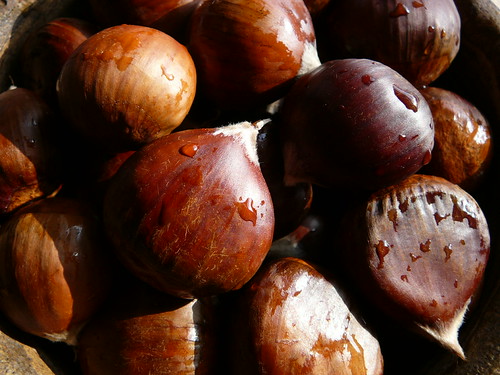
Beautiful Chestnuts

Beautiful Chestnuts, photo by jpwbee.

Happy Thanksgiving everyone!

Wikipedia’s entry for the American Chestnut (Castanea dentata) explains that this large, deciduous tree of the beech family was once one of the eastern United States dominant hardwoods before it was nearly wiped out by chestnut blight. Curiously enough, one of the few pockets to survive were some 600 to 800 large trees in northern lower Michigan. I couldn’t find much about these trees other than that reference, so if anyone knows something about that, post it in the comments!

I do know that Chestnut Growers, Inc. is a 37 member cooperative based in Michigan with members in Lower Michigan and Washington state. Their page on sweet chestnuts says that:

In Europe, chestnuts are consumed in a wide variety of dishes, from soups, stews, and stuffing to fancy deserts. Matter of fact, chestnut flour is the secret to many of the fancy French pastries. In other parts of the world, such as China, the chestnut is a staple food in the peoples’ diet. Chestnuts have about half the calories of other nuts and have the lowest fat content of all the main edible nuts. Chestnuts have only four to five percent fat as compared to sixty-two percent for the hazelnut and seventy-one percent for the pecan. In composition and food value, the chestnut, with its high carbohydrate content of about seventy-eight percent, is more akin to cereal grains, such as wheat, than to nuts with a low carbohydrate content. Since chestnuts are starchy rather than oily, they are readily digestible when roasted or boiled.

Read on for more and suggestions on cooking. They take orders for fresh chestnuts and ship beginning in October, and are at farm markets through the fall. You can also but them online through Michigan-based Earthy Delights. I found a recipe for Michigan chestnut pie that looks tasty too.

Julie bought these Michigan-grown beauties at Zingermans. Check them out background bigalicious and see more in Julie’s Food slideshow.

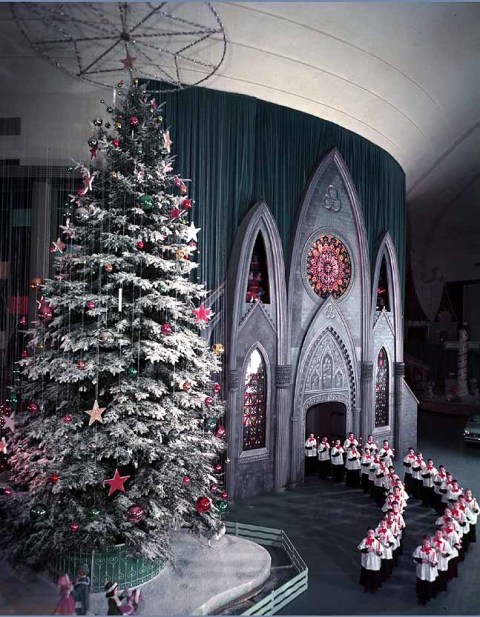
Ford Rotunda Building at Christmas 1961

Ford Rotunda Building at Christmas 1961

Ford Rotunda Building at Christmas 1961, photo by kbreenbo.

Today on Absolute Michigan, we’re featuring the Ford Rotunda and the annual Christmas Fantasy. The feature on the Rotunda in the Detroit News tells how it burned in 1962 and explains:

Over the nine years the Christmas Fantasy was held, almost 6 million people visited it. Thousands of Detroiters had their first visit with Santa at the Rotunda, and memories of Story Book Land and the miniature circus mingle with childhood memories of stockings by the fireplace and cookies for Santa.

Check this out on black and see more in Karen’s Ford Historic Archives slideshow.

Remembering the Carl D. Bradley

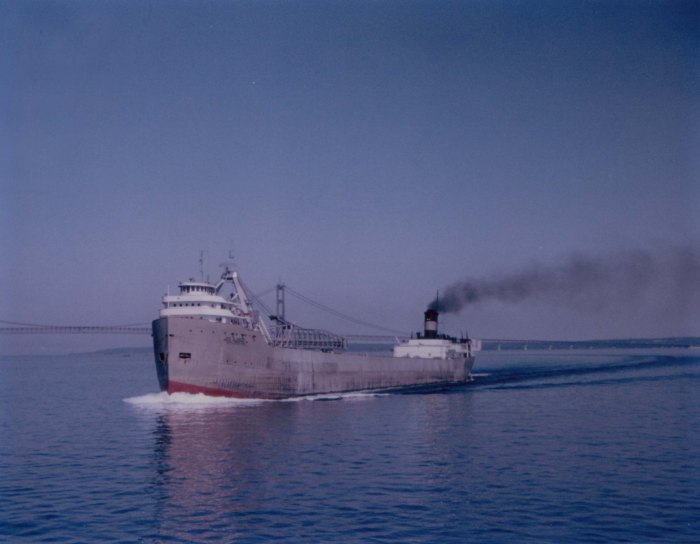
Carl D Bradley on the Great Lakes

Bradley – Color – 300 dpi, photo by Presque Isle County Historical Museum.

23 women became widows in that instant and 53 children lost their fathers.
~Rogers City resident on the sinking of the Bradley

The Edmund Fitzgerald gets the majority of the attention when Michigan shipwrecks are discussed, but it can be argued (very convincingly) that the wreck of the Carl D Bradley on November 18, 1958 was the greatest of Great Lakes tragedies. 33 of 35 crewmen – most from her home port of Rogers City – perished, leaving the small city in northeastern lower Michigan stunned by grief.

Over on Absolute Michigan today we have an excellent feature from the Archives of Michigan on the Wreck of the Carl D. Bradley that includes a riveting video from the documentary November Requiem. An article by Warren J. Toussaint about the sinking begins:

Tuesday, Nov. 18, 1958, at 5:31 p.m., the limestone carrier, Carl D. Bradley, was up bound on Lake Michigan, having delivered her last limestone cargo of the year to Indiana on November 17,1958. She stayed close to the Illinois and Wisconsin shores because of reports of severe weather conditions rapidly developing from the west. As it reached the area of Sturgeon Bay, Wis., it had to turn to the northeast in order to cross the upper area of Lake Michigan on its way to the homeport of Rogers City, Mich., on Lake Huron. Suddenly, the Bradley’s steering wheel went slack, as if the gears had suddenly disconnected. On the course it was on, the winds and waves were striking the ship on the aft quarter of the port side causing the ship to rock severely. First Mate, Elmer Fleming, knew the ship was in trouble. He jerked the radio telephone from its cradle and shouted a desperate call “Mayday, Mayday, – Mayday. This is the Carl D. Bradley. Mayday Mayday Mayday.”

Read on and see much more at carldbradley.org!

The photo is one of the last known photos of the Steamer Carl D. Bradley, taken after she passed under the Mackinac Bridge and was making the turn to the southeast to set a course for Rogers City. Check it out background big and in their great Bradley Transportation Fleet slideshow. Definitely have a look at the Presque Isle County Historical Museum website for more on the Bradley and the history of the region and to order the Bradley DVD!

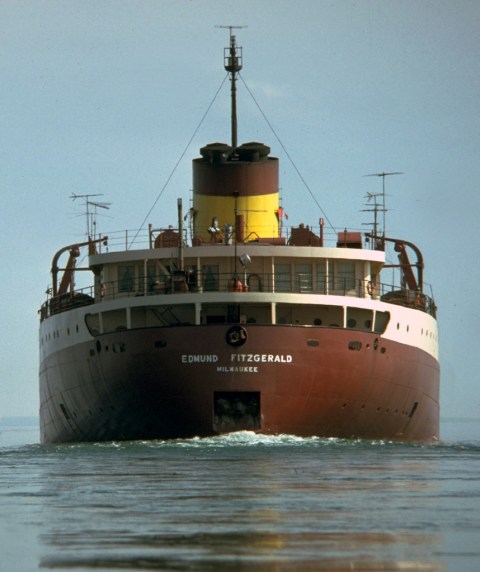
Edmund Fitzgerald, 1975

Edmund Fitzgerald 1975

Edmund Fitzgerald 1975, photo by The Open Lake Group LLC

Wade writes that this photo by Roger LeLievre of the Fitzgerald as she passes downbound in the St. Mary’s River off Six Mile Point is one of his all time favorite views the Fitz. See it on black and in his Edmund Fitzgerald slideshow. Wade works the lakes and has some really cool photos of all kinds of ships in his photostream. He had this to say about the Fitz:

The 729 foot Str. Edmund Fitzgerald was launched into the Detroit River in 1958. Over the next 17 years she was considered to be the ‘best among the best” as the flagship of the Columbia Transportation Line. Sailors that worked on her took immense pride in their opportunity and she was a favorite of sailors and people ashore as well.

Lots more Edmund Fitgerald on Michigan in Pictures and definitely check out The Wreck of the Edmund Fitzgerald by Joseph Fulton on Absolute Michigan – a masterful video that accompanies Gordon Lightfoot’s tribute with great footage.

George Romney, 43rd Governor of Michigan

Gov. George Romney of Michigan

Gov. George Romney of Michigan, photo by seekingmichigan.

Tonight at 8 PM, eight Republican candidates take the stage at Oakland University in CNBC’s “Your Money, Your Vote” Republican Presidential Debate (also see this Freep article).

One of the candidates is Massachusetts Gov. Mitt Romney, who grew up in Bloomfield Hills the son of George Wilcken Romney (July 8, 1907 – July 26, 1995). George Romney was chairman and CEO of American Motors Corporation from 1954-1962, the 43rd Governor of Michigan from 1963-1969, an unsuccessful candidate for President in 1968 (see campaign brochure), and the US Secretary of Housing and Urban Development from 1969 -1973. Wikipedia says:

His position as the leader of the moderate Republicans at the constitutional convention helped gain him the Republican nomination for Governor of Michigan. He ran against incumbent Democratic Governor John B. Swainson in the general election. Romney campaigned on revising the state’s tax structure, increasing its appeal to businesses and the general public, and getting it “rolling again”. Romney decried both the large influence of labor unions within the Democratic Party and the similarly large influence of big business within the Republican Party. His campaign was among the first to exploit the capabilities of electronic data processing. Romney won by some 80,000 votes and ended a fourteen-year stretch of Democratic rule in the state executive spot. Romney’s win was attributed to his appeal to independent voters and to the increasingly influential suburban Detroit voters, who by 1962 were more likely to vote Republican than the heavily Democratic residents of the city itself. Additionally, Romney had appeal to labor union members that was unusual for a Republican.

Here’s a video of Romney announcing his candidacy for Governor and another video of Romney’s inauguration on January 1, 1963. You can also see a photo of George Romney from 1980 that looks amazingly like Mitt, and the Boston Globe has a nice presentation titled The Romneys: Lessons of the Father that includes some pictures of George & Mitt.

This photo from 1963 shows Gov. George Romney releasing the first Atlantic Salmon in the Great Lakes. See it on black and see more photos of Michigan’s history in seekingmichigan’s slideshow!

The Haunting of White River Light Station

White River Light Station

White River Light Station, photo by CJSmithChicago.

It’s Halloween week on Michigan in Pictures and we’ll try and feature as much Michigan spookyness as possible. Today’s story appears courtesy Still on Duty at White River Light on Absolute Michigan:

When Karen McDonnell is alone she sometimes hears footsteps on the stairway of the former White River Light. But she isn’t afraid. She says, “I like the comfort it gives me. It’s like a watchman, just making sure everything is okay before it’s too late at night.”

McDonnell is the curator of an old lighthouse that has been turned into a museum. She takes care of the light and gives tours to visitors. Sometimes early in the morning or late at night she hears what sounds like somebody climbing the stairs and walking around on the upper level. She wonders if it might be the spirit of the light’s first keeper.

When the White River Light opened in the mid-1870s, William Robinson and his wife Sarah moved in. Over the years, the English couple raised their family at Whitehall. Sarah died at a young age, but William remained the lightkeeper for 47 years. When the government forced the 87-year-old keeper to retire in 1915, William’s grandson became the next lightkeeper at White River. William helped his grandson run the light, but the rules said that only the lightkeeper and his “immediate” family could live at the lighthouse. William would have to leave. But he refused, telling his grandson, “I am not going to leave this building.” He was right. The day before he had to move out, he died. His grandson buried him in a small nearby cemetery…

Read more over on Absolute Michigan and learn more about the lighthouse at White River Light on Terry Pepper’s Seeing the Light.

Check this out background bigtacular and in Chris’s slideshow.