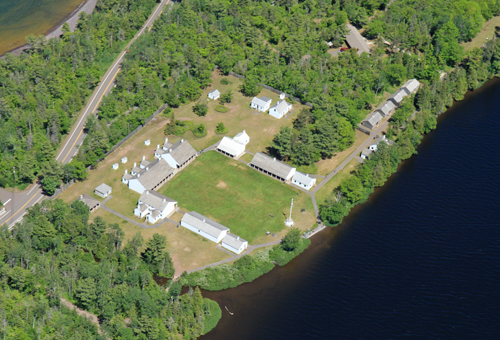
Fort Wilkins State Park on Lake Fanny Hooe


Fort Wilkins, photo by Neil Harri Aerial Photography

A number of years ago, I camped at Fort Wilkins State Park on Lake Fanny Hooe on the Keweenaw Peninsula. Hunts Guide to the UP says that Fort Wilkins was a typical 19th-century frontier garrison, the most northern in the U.S.:

The 1843 Keweenaw copper rush in this distant area, way beyond the frontier of settlement, led to building this small fort. From 1844 to 1846 the fort was the area’s only source of law and order. The government’s greatest concern was friction between native Indians and unruly miners. But little hostility actually broke out. By 1846 most of the small-time prospectors had left. Large mining companies had stabilized the region, so the fort was abandoned. It reopened after the Civil War, from 1867 to 1870, due to inadequate barracks facilities elsewhere in Michigan.

The army abandoned Fort Wilkins for good in the 1870s. Within two decades it had become a favorite picnic and camping destination. Local people appreciated its beautiful, forested location on Lake Fanny Hooe.

Today you can camp on the shores of the lake, which is still beautiful and forested and offers great fishing. They do some interpretive demonstrations at the park as well.

I couldn’t find a photo that I liked for the fort until I found these aerial shots in the photo gallery at the Fort Wilkins Natural History Association, a nonprofit that raises money to support and sponsor programs and special events at the park. They have some cool videos about the history of Fort Wilkins that are worth your time.

Neil Harri is a professional aerial photographer who also has some great Upper Peninsula photos, books and DVDs for sale through his website.  The DVD aerial tours look especially cool and there are several from the Keweenaw including a historical aerial tour of Keweenaw’s Copper Ridge!

More Michigan aerial photography on Michigan in Pictures!

USCGC Mackinaw at the Grand Haven Coast Guard Festival

USCGC Mackinaw

USCGC Mackinaw, photo by loomisman.

The Grand Haven Coast Guard Festival (July 29 – August 7, 2011) has been held every year in Grand Haven. It features a parade of ships and a couple street parades, music, carnival, fireworks and all kinds of events and exhibits about the history of the United States Coast Guard. They explain:

The festival unofficially began in 1924 as a Coast Guard personnel only picnic when the local Coast Guard station held rowing competitions for those service members stationed in Grand Haven. Today the Grand Haven Coast Guard Festival has become a premier event with attendance of over 350,000 people including the nations highest ranking Coast Guard dignitaries from Washington, D.C.

The focus of the annual Grand Haven Coast Guard Festival is the National Coast Guard Memorial Service honoring those who sacrificed their lives in the service of their country while fulfilling their motto “SEMPER PARATUS” (“Always Ready”). Each year since the first picnic in 1924 and the first festival in 1937, we have celebrated our heroes, the men and women of the United States Coast Guard with fun filled family events at the annual Grand Haven Coast Guard Festival. Grand Haven is honored by its designation as “Coast Guard City, USA” by an Act of Congress and signed by the President of the United States on November 13th, 1998.

Check this out bigger in in Drew’s Grand Haven Coast Guard Festival slideshow.

Michigan in Pictures has more about the US Coast Guard Cutter Mackinaw.

Super A, Model A

Farmall
Farmall, photo by PepOmint

Wikipedia says that the “letter series” from Farmall was introduced in 1939 by International Harvester. Reading about these affordable vehicles that put tractors within reach of small farmers all across the nation put me in mind of another vehicle series that catered to the mass market, Henry Ford’s Model T, Model A and Model B.

That in turn reminded me of a recent feature on Absolute Michigan about a Michigan man who is driving a Model A for 365 days and blogging about it.

Check it out bigger and in her Super A slideshow.

Remembering First Lady Betty Ford

President Gerald Ford and First Lady Betty Ford

President Gerald Ford and First Lady Betty Ford, photo by Marion S. Trikosko

First Lady Betty Ford (Elizabeth Ann Bloomer Warren Ford) passed away on July 8, 2011. She was born in Chicago on  April 8, 1918. After a brief stint in Colorado, she moved with her family to Grand Rapids and graduated from Central High School. In 1948, she married Gerald Ford, who was campaigning for what would be his first of thirteen terms as a member of the U.S. House of Representatives. They were married fifty-eight years until his death in 2006. Despite the fact that she had one of the shortest terms as First Lady, she was definitely one of the most influental women to have held the position:

In the opinion of The New York Times and several presidential historians, “Mrs. Ford’s impact on American culture may be far wider and more lasting than that of her husband, who served a mere 896 days, much of it spent trying to restore the dignity of the office of the president.”

The paper went on to describe her as “a product and symbol of the cultural and political times—doing the Bump along the corridors of the White House, donning a mood ring, chatting on her CB radio with the handle First Mama—a housewife who argued passionately for equal rights for women, a mother of four who mused about drugs, abortion and premarital sex aloud and without regret.” In 1975, in an interview with McCall’s magazine, Ford said that she was asked just about everything, except for how often she and the president had sex. “And if they’d asked me that I would have told them,” she said, adding that her response would be, “As often as possible.”

Ford was also instrumental in raising awareness of breast cancer and founded the Betty Ford Center after a battle with alcoholism. You definitely have to watch this PBS feature on Betty Ford – it’s one of the best and there are also some interviews with her children as well. Also see President Gerald R. Ford – 1913 – 2006 on Absolute Michigan.

The Detroit News reports that  public viewing of her casket will be held in the atrium of the Gerald R. Ford Presidential Museum today from 7-11 PM and Thursday from 7-10 AM. Following a 2 PM service tomorrow, Ford will be buried beside President Ford on the Museum grounds.

You can see more photos by Marion S. Trikosko at the Library of Congress. This has always been one of my favorite pictures of a couple who obviously loved each other very deeply and were among the most real politicians we’ve had in modern times.

Library of Congress Call Number: LC-U9- 30765B-6A

Neptune Rounds the Sun

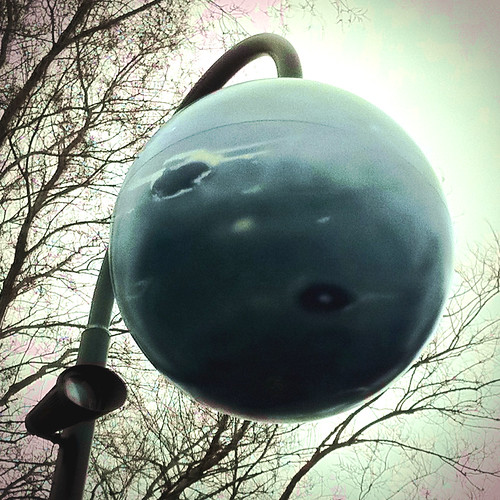
Neptune Jr.

Neptune Jr., photo by farlane.

The planet Neptune was discovered in 1846, and at 4.5 billion km from the Sun, it completes an orbit every 164.79 years. Today – July 12, 2011 – Neptune completes the first full orbit since its discovery!

And you thought it took you a long time to get the garage cleaned out…

I took this photo early this Spring along the TART Trail in Traverse City. While I had just learned this little fact about Neptune, I actually rode out that day all the way to Pluto, a distance of about 6 miles. You can see the Sun and inner planets right at the TC Library. In their list of fun weekend things for families to do, MyNorth.com writes:

Bike through a six-mile long interactive model of the solar system on a portion of the TART trail in Traverse City. Hand-crafted sculptures of each planet and plaques sharing details about each planet dot the trail according to an accurate scale of the solar system. Beginning at the Sun directly outside the Traverse Area District Library, bikers of all ages can travel to the far reaches of Pluto and back again on wide paved trail that make the trip smooth and simple. Traverse Area District Library is located at 610 Woodmere Ave Traverse City.

Check it out on black and in my Traverse City, Michigan slideshow.

Detroit Tiger All Stars, Now & Then

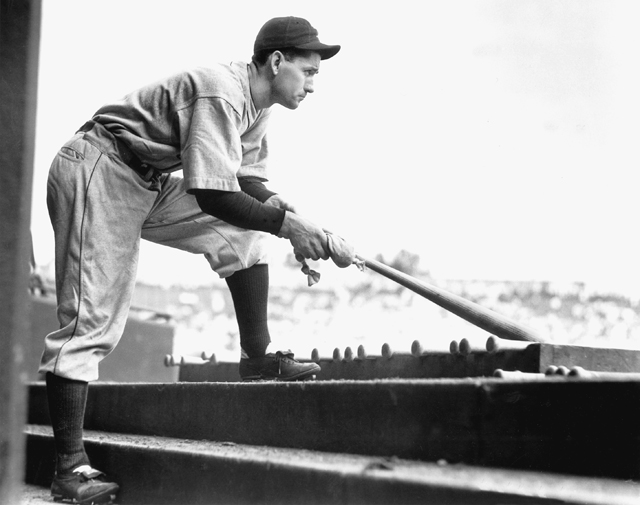
Charlie Gheringer

In 2011, the Detroit Tigers are rolling into the All Star break leading the AL Central. Their sizzling play is reflected in the lineup for tomorrow night’s All Star Game with 5 All Stars. In addition to the starting catcher Alex Avila, the Bengals are also sending pitcher Justin Verlander, first baseman Miguel Cabrera, pitcher Jose Valverde and newly acquired shortstop Jhonny Peralta. That’s one short of the most All-Stars they’ve had (in 1984 and 1985).

You can check out the complete list of Detroit Tiger All-Stars from MLB.com. It dates back to the first All Star game in 1933. Tigers’ Hall of Fame second basemen Charlie Gheringer played played every inning of the first six All-Star Games as the starting second baseman for the American League, and played a pivotal role in the very first All Star game:

The novel idea of a single game made up of the most exciting assemblage of ball-playing talent ever brought together on the diamond at one time, seemed too good to be true. In 1933 and 1934, All-Star teams were selected by the managers and the fans. The National League’s manager John McGraw and American League’s Connie Mack were chosen to lead a line-up of big hitters including Lou Gehrig, Jimmie Foxx, Al Simmons and the one and only Babe Ruth. “We wanted to see the Babe,” said Bill Hallahan, the National League starter. “Sure, he was old and had a big waistline, but that didn’t make any difference. We were on the same field as Babe Ruth.”

With fellow All-Star, Charlie Gehringer on first in the bottom of the third, The Babe drove one into the right-field stands, the first homer in All-Star history. The crowd, according to one account, “roared in acclamation” and the first All-Star Game, won by the American League on the strength of Ruth’s homer, was a resounding success.

I’m not sure who took this photo, but I found it through Brian DeWagner’s blog where he posted it with What’s in a Name?.

Charles Leonard Gehringer was born in Fowlerville, Michigan. Nicknamed “The Mechanical Man” for his astonishing consistancy, he batted over .300 13 times  and was one of the greatest 2nd basemen ever to play the game. Learn more about his career at the Baseball Hall of Fame and via Wikipedia!

Update! Just found a great account of Charlie Gehringer’s 1934 All-Star game at Bless You Boys – check it out!

St. Joseph Lighthouse

St. Joseph Lighthouses

St. Joseph Lighthouses, photo by KentV999.

The page on the St. Joseph Pier Lights from Terry Pepper’s Seeing the Light says that while the first lighthouse in St. Joseph is thought to be in the home of Captain Pickering in 1832, where the family put lanterns in their windows so ships would know where the entrance to the St. Joseph River was located:

St. Joseph’s first Federal lighthouse was constructed in 1859 on the hill above the harbor, and served the area until 1906 when the north pier was extended 1,000 feet, and the cast iron pier head light installed.

…The inner pier light was built in 1907, to serve as a rear range for the existing pierhead tower, allowing vessels to line up accurately on the channel from far out in the Lake. Over a a steel frame, the structure was encased in 3/8 inch steel plates. Twenty-six feet square, the building was capped by an octagonal cast iron lantern room, and equipped with a Fourth Order lens manufactured by Chance Brothers of Birmingham, England. At some point thereafter, this lens was removed from the tower, to be replaced by a Fourth Order Fresnel lens manufactured by Sautter & Cie, of Paris, the lens that remains in the tower to this day.

Check it out on black and in Kent’s St. Joseph MI slideshow.

To beat the heat, check out the St. Joseph Lighthouse slideshow from the Absolute Michigan group on Flickr which features a lot of wintertime shots!

U2 360 @ MSU x2


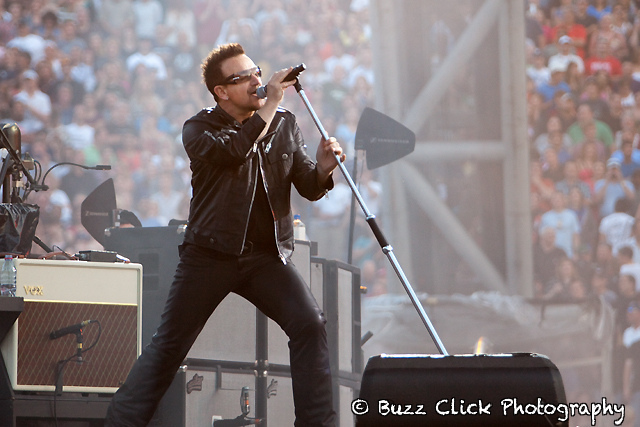
Bono U2, photo by Buzz Click Photography

Along with 65,000 of his closest friends, Spike attended Sunday night’s U2 show in Spartan Stadium. What many people didn’t know was that it wasn’t the legendary Irish rockers first visit to East Lansing. As the Lansing State Journal reports, the campus pub Dooley’s hosted the band way back in 1981:

George Scofes, now 82, booked the up-and-coming Irish band to play Dooley’s bar (now Harper’s Restaurant and Brewpub) in East Lansing in December 1981.

Another Dooley’s owner asked George to give U2’s debut album “Boy” a listen and decide if the band should be booked for the Irish pub.

George said he didn’t know much about music, but the band sounded good to him.

You can see the 1981 Dooley’s set right here.

Spike seems to have had great seats – heh. View his shots from the concert in his U2 Live slideshow. Click through to the photo for his observations of the show which begin:

On Sunday night, June 26, the biggest rock band in the world brought the massive rock show to Southeast Michigan. The stadium-sized spectacle of U2’s “360 Tour” may very well be the biggest show on Earth. It’s certainly the largest stage with its 167-foot-high, 29,000-square-foot, four-legged superstructure known as The Claw, which could be seen for miles, peeking out from atop the stadium walls. The stage that was too big to fit in any Detroit venue, proved to be too big for even Lansing as several concrete walls had to be knocked out to accommodate the stage once it arrived last week. (Read more)

The Fisher Building in Detroit

iPhone Fisher

iPhone Fisher, photo by Trovarsi

The Detroit News Rearview Mirror feature on the Fisher Building in Detroit begins:

When the seven Fisher Brothers of Fisher Body fame hired architect Albert Kahn in 1927 to design a building that would bear their name, they gave him a blank check and the instructions to build “the most beautiful building in the world.” Plans for a $35 million three-phase project were announced by the brothers in January of 1927. The original program called for three units to be built over a period of several years, but due to the onset of the Great Depression in 1929, only phase one, the Fisher Building, was completed at a cost of $10 million.

The site the brothers had selected for the structure was bounded by West Grand Boulevard, Lothrop Avenue, Third Avenue and Second Boulevard, across from the General Motors building. They originally wanted to build downtown but were unable to put together a suitable parcel of land. They turned to the General Motors area where the idea for a New Center was born.

Read on and see some cool photos at the Detroit News. You can also check out the Fisher Building on Emporis and the Fisher Building on Wikipedia, which notes that the building contains the 2,089 seat Fisher Theatre, a National Historic Landmark, and it is also the location of the headquarters for the Detroit Public Schools. More about Albert Kahn on Michigan in Pictures.

Check this out bigger and in Ryan’s Detroit slideshow.

More architecture from Michigan in Pictures.

Emancipation Proclamation at the Henry Ford

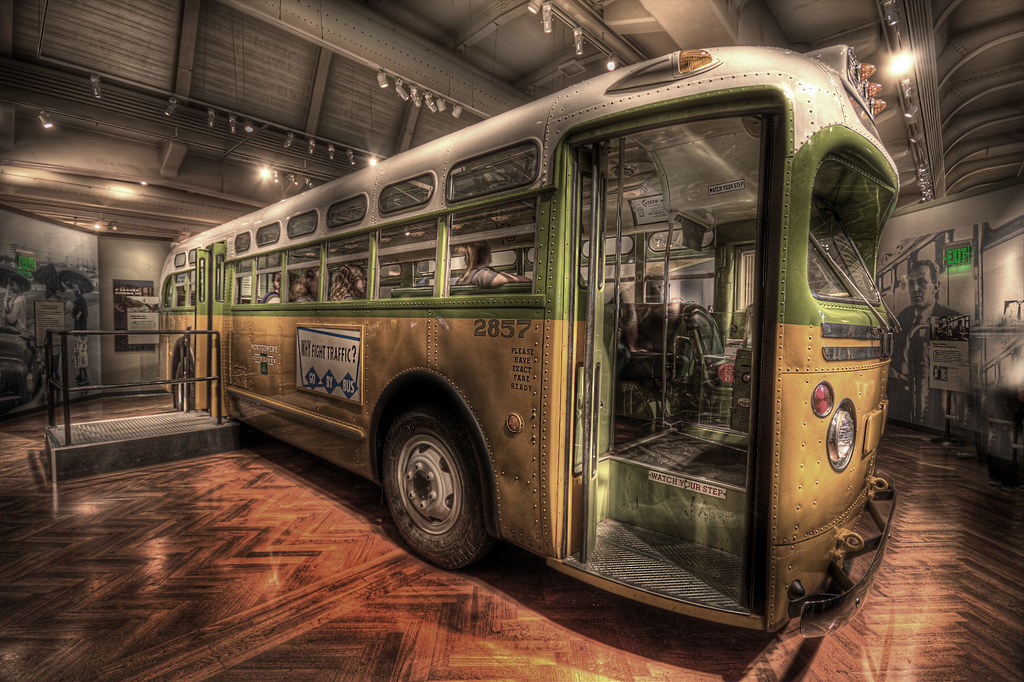
The Rosa Parks Bus by Rafael Peixoto Ferreira

The Rosa Parks Bus by Rafael Peixoto Ferreira

One of our nation’s most significant documents, the Emancipation Proclamation, will be on display at the Henry Ford Museum in Dearborn.

Following a brief opening ceremony, the original document will be on display around-the-clock, straight through early Wednesday morning, June 22, when it will return to Washington DC. More info and related events at the Emancipation Proclamation at the Hentry Ford.

I couldn’t think of a more fitting image for this than the Rosa Parks bus, just one of many amazing relics of American history that are displayed at the Henry Ford (see their exhibits). See more in Rafael’s great Detroit gallery.

Here’s a whole bunch of photos from the Henry Ford Museum from the Absolute Michigan group on Flickr!

Support Michigan in Pictures with Patreon