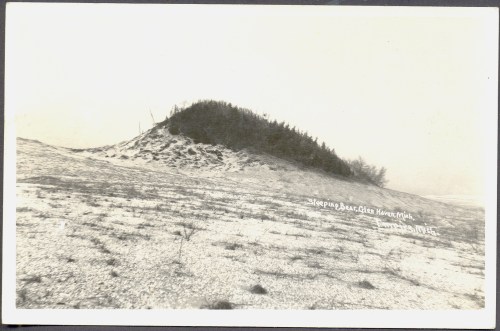
#TBT: The Bear of Sleeping Bear Dunes

Glen Haven MI Sleeping Bear Dunes Empire and Glen Haven Marked RPPC Kodak Stampbox Unsent what looks like a hump of low scrub bushes is actually a forest hill buried in sand

Glen Haven MI Sleeping Bear Dunes, photo by Don…The UpNorth Memories Guy… Harrison

Tuesday was the 44th anniversary of the founding of the Sleeping Bear Dunes National Lakeshore. You may have heard the Chippewa tale that inspired the name of the park:

“Long ago, along the Wisconsin shoreline, a mother bear and her two cubs were driven into Lake Michigan by a raging forest fire. The bears swam for many hours, but eventually the cubs tried and lagged behind. Mother bear reached the shore and climbed to the top of a high bluff to watch and wait for her cubs. Too tired to continue, the cubs drowned within sight of the shore. The Great Spirit Manitou created two islands to mark the spot where the cubs disappeared and then created a solitary dune to represent the faithful mother bear”.

You might not be aware, however, that “the Bear” was also an actual formation atop a dune about a mile north of the Pierce Stocking Overlook. The Lakeshore says that the formation pictured above…

…hardly looks like a bear now, for it has been changing rapidly in recent years. At the turn of the century, it was a round knob completely covered with trees and shrubs. You can still see some of the thick vegetation that gave it a dark shaggy appearance.

…For a long time, the Sleeping Bear Dune stood at about 234 feet high with a dense plant cover. However, through most of the twentieth century, erosion has prevailed. By 1961, the dune was only 132 feet high, and by 1980, it was down to 103 feet. The process is a continuing one. The major cause of the dune’s erosion was wave action wearing away the base of the plateau on which the dune rests. As the west side of the dune loses its support, it cascades down the hill. The wind, too, is a major agent of erosion, removing sand and destroying the dune’s plant cover.

You can see what the area looks like now and read more right here.

View Don’s photo background bigtacular and get daily blasts from the past in his Northern Michigan Photo Postcards – Our History and Heritage group on Facebook!
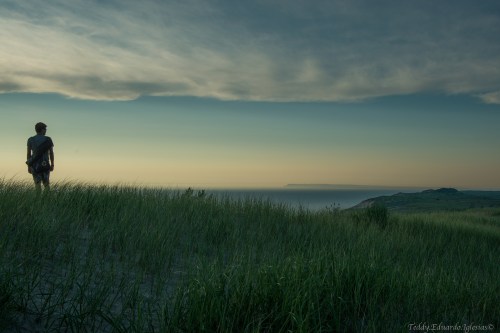
 

Adventurer

Sleeping Bear Dunes National Lakeshore

Sleeping Bear Dunes National Lakeshore, photo by teddy eduardo iglesias

I’ve stood in this spot, and it felt almost as amazing as this picture.

View Teddy’s photo background bigtacular and see more in his Michigan Outdoors slideshow.

Lots more from the Sleeping Bear Dunes National Lakeshore on Michigan in Pictures!

Bye Bye Summer

Summer ... bye bye

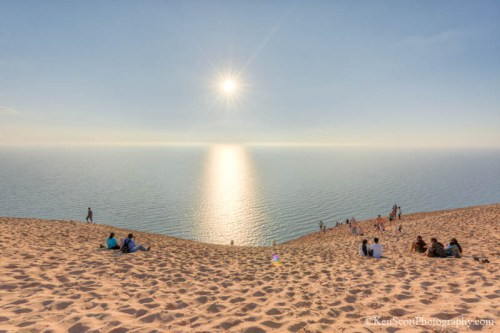
Summer … bye bye, photo by Ken Scott

Probably the best thing I’ve heard about “Summer 2014” being over is that it really wasn’t much of one anyway.

I hope everyone enjoys their last weekend of summer, and that we have a warm & long fall!

View Ken’s photo bigger, see more in his massive Sleeping Bear Dunes slideshow and definitely follow him on Facebook.

2014 Perseid Meteor Shower

Sleeping Bear Persied

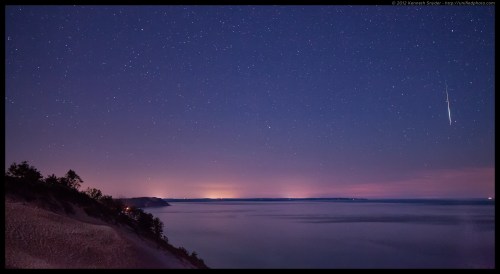
Sleeping Bear Perseids, photo by Kenneth Snyder

Without question the best meteor shower of the summer in Michigan is the Perseids, EarthSky’s Everything you need to know about the Perseid Meteor Shower has (predictably) all kinds of details and diagrams to help you get the most out of this annual display. The most important thing is to start watching now as the August supermoon is full this weekend.

Every year, from around July 17 to August 24, our planet Earth crosses the orbital path of Comet Swift-Tuttle, the parent of the Perseid meteor shower. Debris from this comet litters the comet’s orbit, but we don’t really get into the thick of the comet rubble until after the first week of August. The bits and pieces from Comet Swift-Tuttle slam into the Earth’s upper atmosphere at some 210,000 kilometers (130,000 miles) per hour, lighting up the nighttime with fast-moving Perseid meteors. If our planet happens to pass through an unusually dense clump of meteoroids – comet rubble – we’ll see an elevated number of meteors.

…The swift-moving and often bright Perseid meteors frequently leave persistent trains – ionized gas trails lasting for a few moments after the meteor has already gone. Watch for these meteors to streak the nighttime in front of the age-old, lore-laden constellations from late night until dawn as we approach the second weekend in August. The Perseids should put out a few dozen meteors per hour in the wee hours of the mornings of August 11, 12 and 13.

Read on for lots more.

View his photo big as the sky and see more in his Sleeping Bear Dunes slideshow.

More meteors on Michigan in Pictures!

The Dunesmobiles by Phil Balyeat

The Dunesmobiles

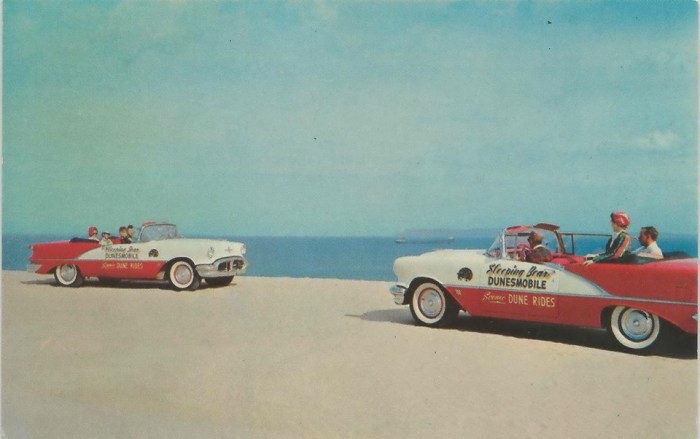
The Dunesmobiles, by  Phil Balyeat

Don Harrison operates UpNorth Memories and shares many of the historical post card photos I feature on Michigan in Pictures. Yesterday in honor of photographer Phil Balyeat’s 99th birthday he posted an incredible collection of photos Phil had taken over the years from the Traverse City area including this one.

View Phil’s photo bigger on Facebook and see LOTS more via UpNorth Memories  here, here and here!

More about the Dunesmobiles at Leelanau.com!

Life’s a Beach in Michigan

Glen Haven Dune Hike

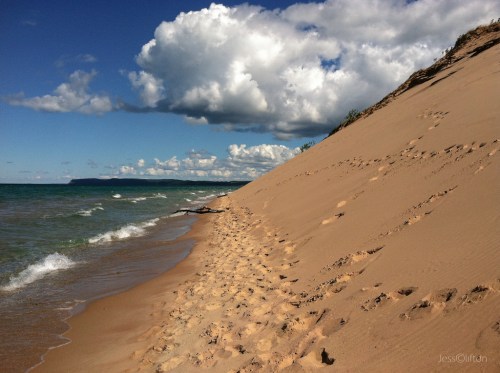
Glen Haven Dune Hike, photo by Jess Clifton

I don’t think that enough is made of the fact that as long as you’re in Michigan, you are never more than 85 miles from one of the Great Lakes. To make matters better, Michigan law permits you to freely walk the entire Great Lakes shoreline so get out and have some adventures this weekend!

About this photo, Jess writes: These images were taken on a hike on the Lake Michigan shoreline in Glen Haven MI roughly two years ago. Can’t recommend this hike enough! (I’m curious if any shipwreck remnants are still explorable with this year’s higher waterline.)

I’m curious too and will try to find out!

View Jess’ photo background bigtacular and see more in her Glen Haven Shipwreck Hike slideshow.

Lots more Michigan beaches and more Michigan summer wallpaper on Michigan in Pictures.

Michigan’s Blue Economy

Where Two Waters Meet

Where Two Waters Meet, photo by Robby Ryke

Michigan State University, the University of Michigan and Wayne State University, the three universities that make up Michigan’s University Research Corridor (URC), have released a report titled “Innovating for the Blue Economy“. The report cites nearly $300 million in awards for water-related research and outreach from 2009 to 2013 that have led to innovations from dealing with invasive species and monitoring water quality to finding ways to optimize water use in agriculture. Their news release on the report prepared by the Anderson Economic Group (AEG) says in part:

AEG’s analysis showed that Michigan ranked fourth in the nation in the percentage of jobs associated with industries related to water, at 718,700.

“One in five Michigan jobs is tied to having good and plentiful water,” said AEG founder and CEO Patrick Anderson. “It is an important economic driver in Michigan, and extends to Great Lakes shipping, advanced manufacturing, agriculture and fishing, and over 80 other industry subsectors where Michigan workers are employed today.”

While most of Michigan’s water-related jobs are in water-enabled industries such as agriculture, mining and manufacturing, about 138,000 are in core water products and services producing water treatment facilities and solving water quality and quantity issues.

“Water isn’t just Michigan’s defining characteristic but the foundation of life on earth,” said Michigan State University President Lou Anna K. Simon. “Our three universities make significant commitments to support water-related research and programs. These not only support Michigan’s economy and quality of life, but position the state as a knowledge wellspring for the world’s most precious natural resource.”

Read on and read the full report right here. The report is chock full of interesting facts including that those 718,700 jobs represent 21.3% of Michigan’s total employment (4th in the nation) and details many of the accomplishments of Michigan’s investment in our “Big Three” university research programs. Also note that “downstream” industries like tourism that rely on healthy water resources aren’t included in the numbers.

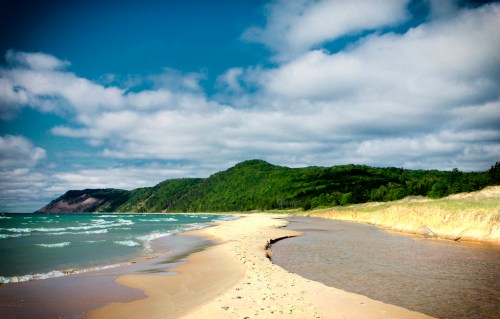
Robby writes that Otter Creek Beach has to be the reason why Sleeping Bear Dunes was Voted “Most Beautiful Place in America” by Good Morning America. View his photo bigger and see more in his slideshow.

Michigan in Pictures has over 40 pages of water-related photos – drink deep!

Lunar Eclipse Tonight!

Inside the Ghost Forest

Inside the Ghost Forest, photo by jimflix!

There’s an eclipse of the full moon tonight! It begins at 2 AM Eastern time with the total eclipse lasting 78 minutes and starting about 3 AM. While the forecast is not great, it looks like there’s a chance that those brave souls who trade sleep for a shot at viewing the eclipse won’t be disappointed.

Eastern Daylight Time (April 15, 2014)
Partial umbral eclipse begins: 1:58 a.m. EDT on April 15
Total eclipse begins: 3:07 a.m. EDT
Greatest eclipse: 3:46 a.m. EDT
Total eclipse ends: 4:25 a.m. EDT
Partial eclipse ends: 5:33 a.m. EDT

If you’re up in the Sleeping Bear Dunes area, they are having a star party tonight. If anyone knows of other viewing gatherings, post them in the comments! If the eclipse ends up getting clouded out locally, you can always take to the net and watch via the live stream from the Griffith Observatory. As I wrote about last week, this eclipse is the first of four total eclipses without a partial in between known as a Lunar Tetrad.

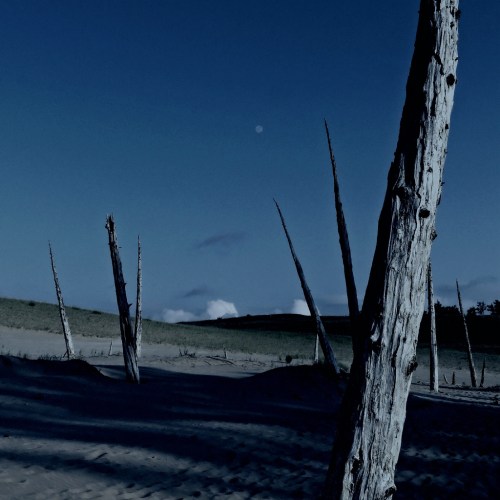
This photo is of the ghost forest on Sleeping Bear Point created when sand of the world’s largest shifting sand dune covered living trees.

View Jim’s photo background bigtacular and see more in his Sleeping Bear Dunes slideshow.

More of the moon and more dunes on Michigan in Pictures!

In between the dark and the light on Empire Bluffs

Sun Spill, Empire Beach

Sun Spill, Empire Beach, photo by jess_clifton

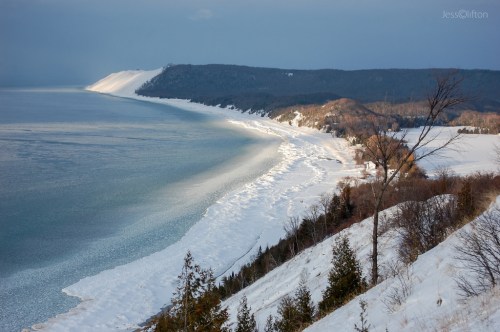
Recently Michigan in Pictures regular Jess Clifton and her family made a wintertime excursion to Empire in the heart of the Sleeping Bear Dunes National Lakeshore. She writes (in part):

At Empire, the beach was already sprinkled with about 10-15 other folks and the scene was surreal. Kids were crawling in and out of caves carved into the thick, massive ice formations built up along the water’s edge. Clouds intermittently descended and receded, offering up dramatic skies that beckoned you out.

…Once I finally convinced myself the beach was “safe” to venture out onto after watching about 14 other people successfully make the trek, I was off cresting mini ice mountains at a snails pace until I could finally peer into the water.

It was there that I finally got a sense of just how still the water was. Pancake ice floated gently on the barely breathing lake. The revelation of something so calm in such a harsh environment was almost jarring. (In a really good way.)

Read on for more and lots of stunning photos in her Why Michigan? blog.

View Jess’s photo background bigtacular and see more in her Winter in Northern Michigan slideshow. She also has a comparison photo from last year.

Lots more winter wallpaper on Michigan in Pictures.

View of Manitou Islands from Sleeping Bear Dunes

View of Manitou Islands from Sleeping Bear Dunes

View of Manitou Islands from Sleeping Bear Dunes, photo by jess_clifton

Last week’s Leelanau Enterprise is reporting that October 2013 had the lowest number of Sleeping Bear Dunes visitors in a decade – an impressive testimony to the impact of our recent government shutdown. You’ll be able to read the article in a month … when it’s no longer news I guess.

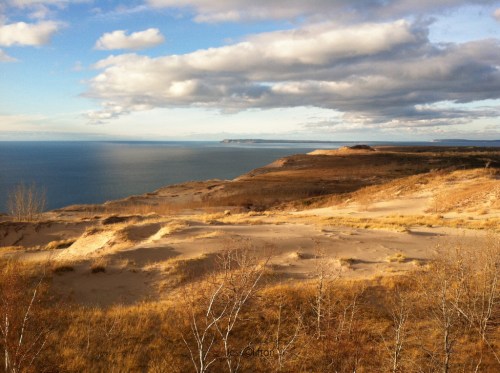
Jess took this from the Pierce Stocking Drive a week ago. Check it out background bigtacular and see more in her Sleeping Bear Dunes slideshow.

More dunes on Michigan in Pictures.