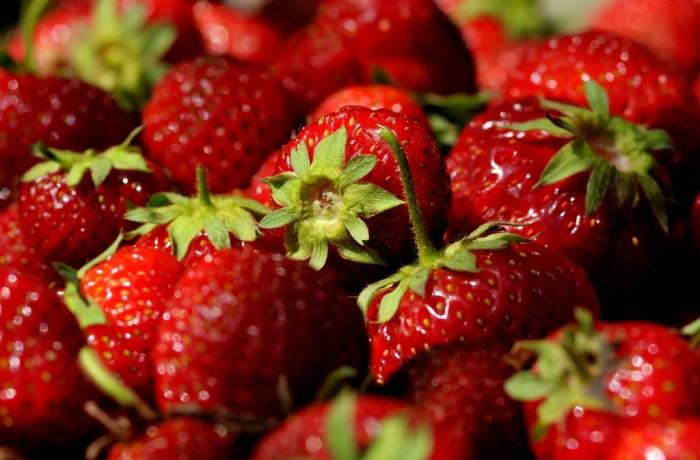
June’s moon is full on full on June 20 at 7:02 AM. It was known as the Strawberry Moon by Algonquin tribes, and it’s looking like Michigan’s strawberry season will be ramping up right on schedule. Here’s a couple of strawberry tidbits via Michigan Strawberries are Ready to Pick on Absolute Michigan:
Strawberries are grown in every county of Michigan and your fun fact of the day is that 53% of seven to nine year olds say strawberries are their favorite fruit. Strawberries are high in iron and Vitamin C – Eight strawberries will provide 14% of the recommended daily intake of Vitamin C for kids – and have less than 60 calories per cup.
Strawberries were a symbol of perfection and righteousness that medieval stone masons carved on altars and around the tops of pillars in churches and cathedrals. In parts of Bavaria, country folk still practice the annual rite each spring of tying small baskets of wild strawberries to the horns of their cattle as an offering to elves. They believe that the elves, who are passionately fond of strawberries, will help to produce healthy calves and abundance of milk in return.
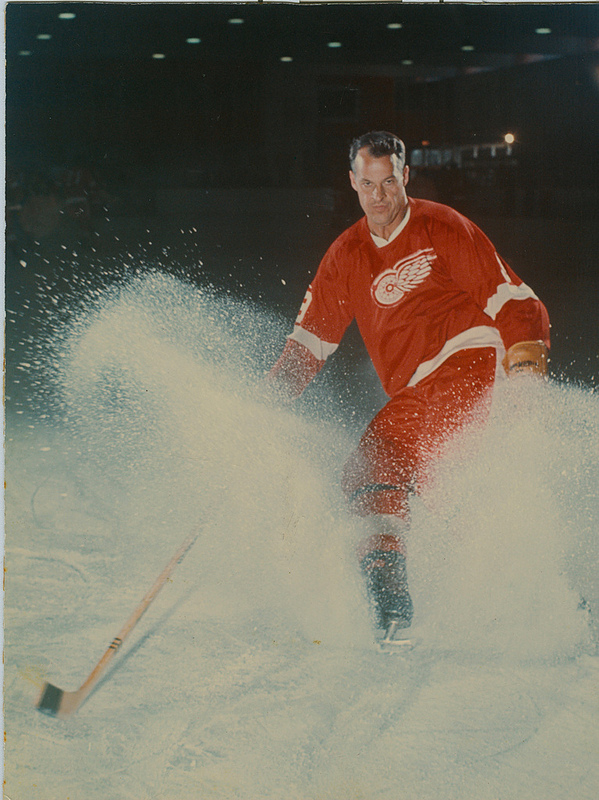
Gordie Howe is referred to as simply “Mr. Hockey”. World War II had just ended when he first entered the National Hockey League, and when he played his final NHL season 33 years later, Wayne Gretzky was playing his first. Over those five decades, Howe didn’t just survive, he was dominant – on the scoring lists, in battles in the corners, on game-winning goals and when the year-end awards were handed out. He was a big man, though by modern standards no behemoth, but what set him apart was his incredible strength.
Though other superstars could be deemed somewhat better scorers, tougher fighters or faster skaters, no player has approached Gordie Howe’s sustained level of excellence. Incredibly, Gordie finished in the top 5 in NHL scoring for 20 straight seasons. To endure and excel, Howe needed a unique set of qualities, both physical and mental, and the foundations for his astonishing career were laid in him from an early age.
Howe grew and matured quickly, and when he was 15 he made a bid to play with the New York Rangers, attending the team’s training camp in Winnipeg. He was homesick, however, and before the end of the camp he returned to Saskatchewan. He made a better impression with the Detroit Red Wings the next year, joining a group of Red Wing veterans and untried youngsters to work out in front of Detroit boss Jack Adams. The ambidextrous Howe drew Adams’ attention from the start with a sizzling rush down the left wing and a sharp shot. The next minute he escaped down the right wing, switched his stick to the other side and still with a forehand zipped another shot at the goal.
Howe made his professional debut when he was 18, taking up the right wing for Detroit at the beginning of the 1946-47 season. He was 6′ tall and just over 200 pounds, making him one of the heavier players in the league…
…Apart from his forbidding temperament, Howe’s athletic and savvy playing style also contributed to his longevity. He never wasted energy if he didn’t need to, especially after he cut down on the number of fights he’d take part in early in his career. He was economical with his movements, anticipating when and where the play would intersect with his effortless progress around the ice. He often played 45 minutes of a game when the average total was 25. Observers noticed that when his exhausted line returned to the bench, Howe was the first to recover and raise his head, ready for another shift.
In all, Howe was selected to 21 NHL All-Star squads, 12 times to the First Team. Six times he led the NHL in scoring to capture the Art Ross Trophy and six times he won the Hart as the league’s most valuable player. His Detroit teams won the Stanley Cup four times.
Howe had been in his prime during a defensive era, the 1940s and 1950s, when scoring was difficult and checking was tight. When he was 40, in 1967, the league expanded from six to 12 teams and the number of offensive opportunities grew with it. Howe played the 1968-69 season on a line with Alex Delvecchio and Frank Mahovlich, the mercurial but talented star who had moved to Detroit from Toronto. Mahovlich was big, fast and skilled and Delvecchio was a gifted playmaker. The three were dubbed “the Production Line 3” and Howe’s scoring returned to the levels of his youth and then beyond. He topped 100 points for the first time, scoring 44 goals and adding a career-high 59 assists.
Read on for much more and watch the Legends of Hockey profile of Gordie Howe below.
Wayne T. ‘Tom’ Helfrich shared this photo by longtime Michigan news photographer Ed Noble, then of the Pontiac Press and later of the Oakland Press. Tom writes that Ed had a photo shoot with Gordie and knew he was a big fan and brought him this print. View the photo bigger and see more great old shots in his Detroit Red Wings slideshow.
I sincerely hope that everyone who reads today’s post remembers that three-quarters of all bicycle fatalities are caused by driver error. It’s your duty as a driver to PAY ATTENTION as you pilot a several thousand pound machine that can become a deadly weapon if you are not vigilant. I would also add that I am in no mood today to hear about the cases where cyclists violate the rules of the road. That does not happen in 3/4 of car/bike fatalities including this one…
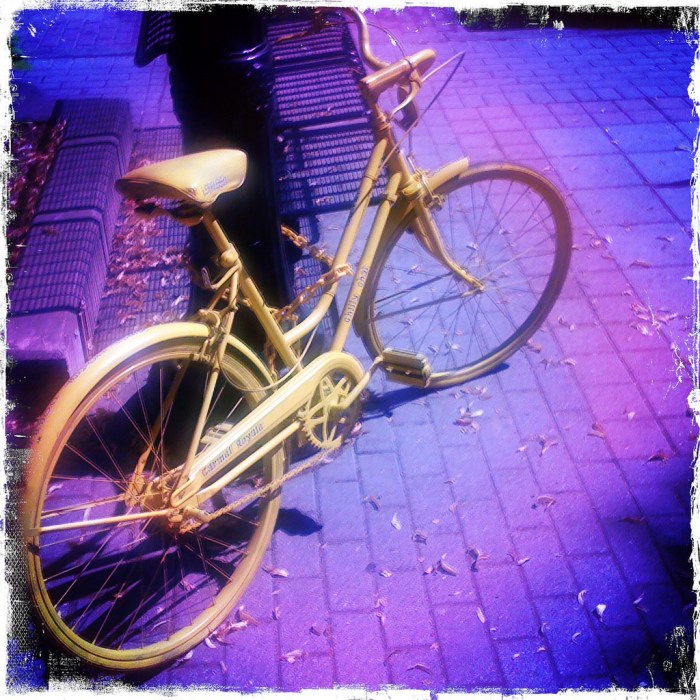
Today’s picture shows a ghost bike, a white-painted memorial for a bicyclists who was killed or struck while riding on the street. Accompanied by a small plaque, they serve as reminders of the tragedy that took place at their location and as enduring statements in support of cyclists’ right to safe travel.
The city of Kalamazoo now has need for a host of ghost bikes after the deadly bicycle crash on Tuesday, June 7, 2016 where five bicyclists died when a pickup truck hit them on Westnedge Avenue. Four more cyclists were seriously injured. That link has photos from last night’s Ride of Silence and also the horrible damage to the bikes.
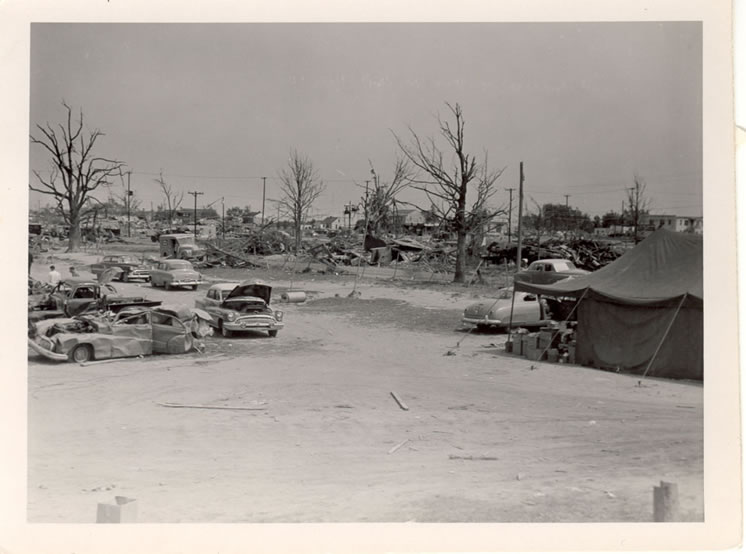
“The noise sounded like two freight trains going over a trestle right over your head; it was an ugly roar. My wife said the noise when the house went was like a giant pencil sharpener working.” -Tornado Survivor Robert Blue
This was the last tornado to kill over 100 people in a single tornado event anywhere in the United States. On June 8th, 1953, 116 people lost their lives in the Flint-Beecher community, and 844 people suffered injuries. The Flint-Beecher Tornado was just one of eight tornadoes that occurred that horrible evening across the eastern portion of the Lower Peninsula. Those other seven tornadoes resulted in an additional 9 deaths, 52 injures, and damage stretching from Alpena to Erie.
The Flint-Beecher tornado was rated as an F5, the highest rating on the Fujita scale of damage. Winds were likely in excess of 200 mph as the 800 yard wide tornado moved on its 27 mile path through Genesee and Lapeer counties. Approximately 340 homes were destroyed, 107 homes had “major damage”, and 153 homes had “minor damage”. In addition farms, businesses and other buildings were destroyed and had damage. These totaled another 50 buildings destroyed and 16 with damage. The damage was estimated around $19 million (about $125 million adjusted for inflation).
So great a number were killed by the monstrous tornado that the National Guard Armory building, along with other shelters, was turned into a temporary morgue. The scene of bodies pouring into the Armory (as an intermittent light rain poured outside) was incredibly bleak and horrifying, especially for the families and friends of the victims. At least 100 people waited outside into the rainy night before they could move inside to try and identify the bodies.
Atmospheric Optics from the UK is far and away the best website for rainbow science as well as other atmospheric optical phenomena. Regarding primary rainbows as seen in Noah’s photo from Frankfort, they say:
To see a rainbow we need sunshine and falling rain. Rainbows are rarer than might be thought … Halos occur much more frequently.
Early morning and late afternoon are the best times to see them because the sun must not be too high. Rainbows are always opposite the sun and their centres are below the horizon at the the antisolar point. The lower the sun the higher is the bow.
Red is always outermost in the primary bow with orange, yellow, green and blue within. Occasionally, when the raindrops are small, fainter supernumerary arcs of electric greens, pinks and purples lie just inside the main bow.
A rainbow is not just a set of coloured rings. The sky inside is bright because raindrops direct light there too. The primary bow is a shining disk brightening very strongly towards its rim.
Float like a butterfly, sting like a bee.
His hand can’t hit what his eyes can’t see.
Now you see me, now you don’t.
George thinks he will, but I know he won’t.
-Muhammad Ali
Let there be no argument. The man who just died was the most famous face on Earth. I contend he still is. Name a rock star, athlete or politician whose visage is instantly as recognizable in a New York boardroom, an African village or a Bedouin tent. We’ll save you time. There is no one. And remember, Ali achieved such worldwide fame without computers, without Internet, without DVRs or YouTube.
He did it through the magnificence of his boxing, the magnitude of his personality, and the causes he championed at a time when sitting down was more common than standing up.
…High-profile athletes rarely took such stances and certainly not with such consequences. It was a mark of Ali’s sense of principle and perspective (he famously claimed that the Vietnamese never called him the N-word, never put dogs on him, never lynched him, etc.) that while many Americans — and understandably, Vietnam vets who did go and fight — reviled him during those years, most have come around on him in time. I believe it is because he never wavered. He took his punishment. And he showed, in his later years, that his anti-Vietnam stance wasn’t a singular moment. He did things on principle for decades. He stood up for poor people. He was a civil rights advocate and champion. He gave a voice to young African-Americans in the 1960s and a hero to their children in all the years that followed. He also raised tens of millions to fight disease.
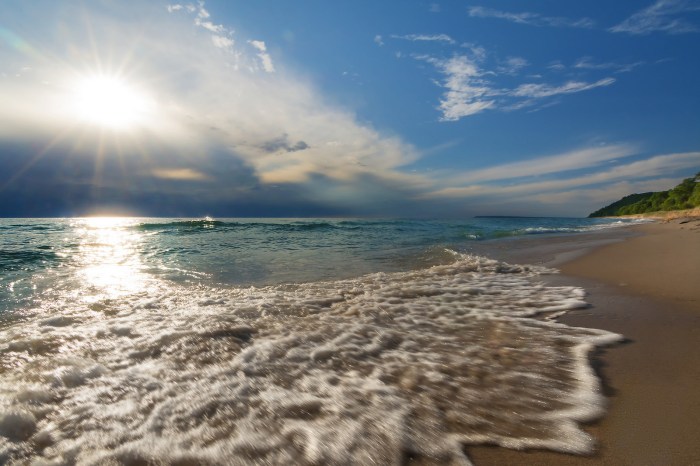
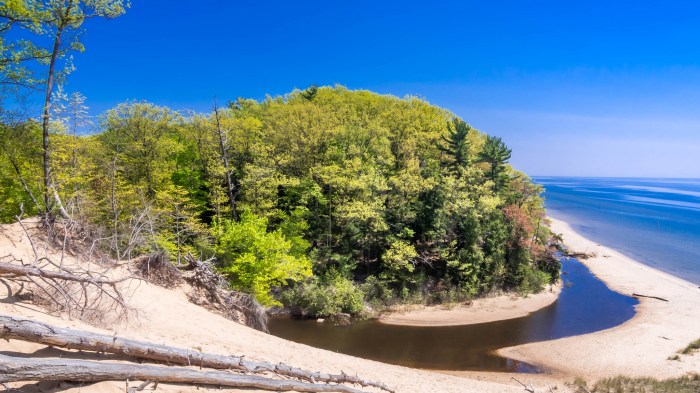
P.J. Hoffmaster State Park was established in the 1960s in honor of Percy James Hoffmaster, the longest acting Director of Conservation and the first chief of state parks in Michigan. The park encompasses 1200 acres, including 3 miles of Lake Michigan shoreline, and represents one of the finest examples of high relief, parabolic dunes and forested backdunes on the Great Lakes. The undisturbed quality of the habitat makes the park a refuge for 460 species of plants, nearly 90 species of birds and a rich array of mammals, reptiles, amphibians and insects. Hoffmaster is home to several listed species of plants, reptiles and birds.
The park’s pristine sandy beach is often described in magazines and travel guides as one of the wildest and most scenic beaches in Michigan.
…The park’s ten miles of trails and diversity of birds provides a birding experience unparalleled in the region, especially in the spring at the peak of migration. The park’s 293 site campground provides the opportunity for an overnight stay, and the surrounding landscape abounds with outdoor adventure for overnight or day visitors alike.
The Michigan DNR relates that Michigan’s state wildflower, the Dwarf Lake Iris (Iris lacustris): grows nowhere else but in the Great Lakes region, and most within Michigan’s boundaries:
In Michigan, Dwarf Lake Iris is especially concentrated along certain stretches of the northern Great Lakes shoreline, where it may occur for miles, interrupted only by habitat destruction, degradation, or unsuitable habitat such as rocky points or marshy bays.
Dwarf Lake Iris usually occurs close to the Great Lakes shores on sand or in thin soil over limestone rich gravel or bedrock. It tolerates full sun to near complete shade, but flowers mostly in semi open habitats. These areas can be very long and narrow strips bordering the high water line, or large flat expanses located behind the open dunes of the Great Lakes shoreline. Many iris locations are on old beach ridges of former shores of the Great Lakes. Fluctuating water levels of the Great Lakes play a vital role in opening up new habitat for Dwarf Lake Iris. During high water years, trees and shrubs along the shoreline may be flooded out. This flooding may open up patches within the forest where the Dwarf Lake Iris may spread. It is usually found growing under White Cedar, although White Spruce, Balsam Fir, and Aspen are also frequently present.
…”Lacustris” translates literally to mean “of lakes” and refers to where this beautiful iris grows. Dwarf Lake Iris was first found on Mackinac Island in 1810 by Thomas Nuttall, a renowned naturalist and explorer. Nuttall reached Mackinac Island after travelling from Detroit by canoe with French Canadian voyagers and the surveyor for the Michigan Territory. At least 1/3 of the species that Nuttall reported from the Great Lakes were new to science.
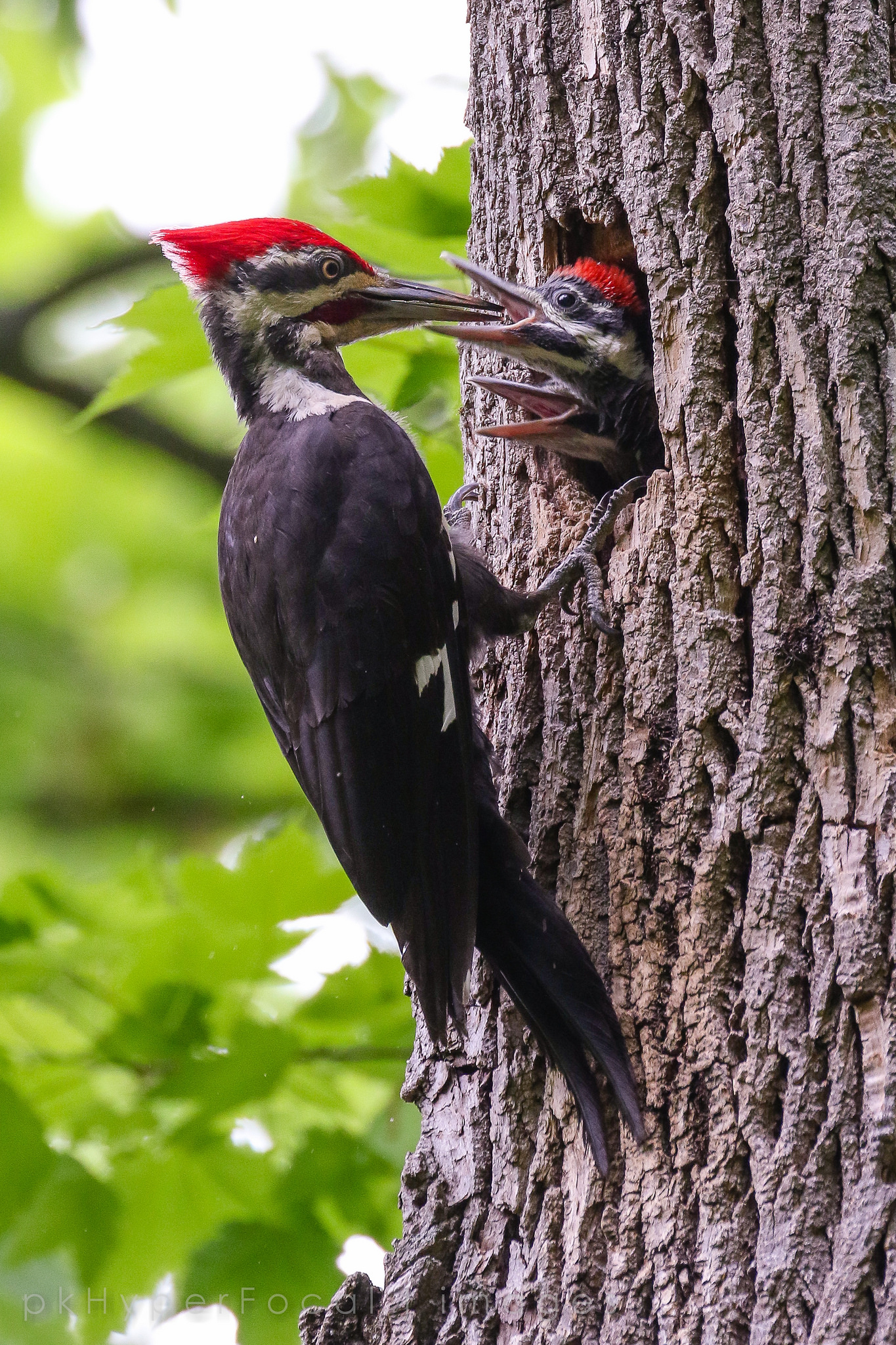
The Pileated Woodpecker is one of the biggest, most striking forest birds on the continent. It’s nearly the size of a crow, black with bold white stripes down the neck and a flaming-red crest. Look (and listen) for Pileated Woodpeckers whacking at dead trees and fallen logs in search of their main prey, carpenter ants, leaving unique rectangular holes in the wood. The nest holes these birds make offer crucial shelter to many species including swifts, owls, ducks, bats, and pine martens.
…The male begins excavating then nest cavity and does most of the work, but the female contributes, particularly as the hole nears completion. The entrance hole is oblong rather than the circular shape of most woodpecker holes. For the finishing touches, the bird climbs all the way into the hole and chips away at it from the inside. Periodically the adult picks up several chips at a time in its bill and tosses them from the cavity entrance. Pileated Woodpeckers don’t line their nests with any material except for leftover wood chips. The nest construction usually takes 3-6 weeks, and nests are rarely reused in later years. Cavity depth can range from 10-24 inches.
Nest trees are typically dead and within a mature or old stand of coniferous or deciduous trees, but may also be in dead trees in younger forests or even in cities. Dead trees are a valuable resource as nest sites or shelter for birds and other animals, and Pileated Woodpeckers battle for ownership with Wood Ducks, European Starlings, Red-bellied Woodpeckers, Red-headed Woodpeckers, Eastern Bluebirds, and Great Crested Flycatchers. Occasionally bats and swifts share roost cavities with Pileated Woodpeckers.
Click through for lots more including calls, Pileated facts, and video.





 Michigan in Pictures