Behind O-Kun-de-Kun Falls

Behind O-Kun-de-Kun Falls

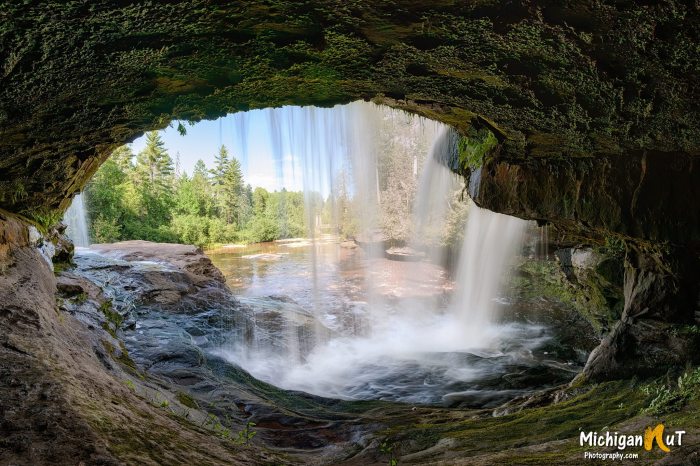
Behind O-Kun-de-Kun Falls, photo by Michigan Nut Photography

See a view from the front and get directions in Don’t Lose Your Bowl at O-Kun-de-Kun FallsThe waterfall is in Ontonagon which came to be named in a pretty hilarious story:

The name “Ontonagon” is derived from the Ojibway word “nontounagon,” which means “I lost my bowl.” Local legend surrounding the name stems from the story that a member of Chief O-Kun-De-Kun’s band was washing bowls near the mouth of the river when she was startled by an unkempt stranger in a canoe. The woman inadvertently dropped one of the bowls into the river and exclaimed “nontounagon”. The white man took her declaration to be a reply to his question about the name of the area.

John writes that a few years ago, he didn’t see a way to get behind the wild and scenic O-Kun-de-Kun Falls, but he found a way this time … and got a nice shower in the process!

See his photo bigger and view & purchase photos at Michigan Nut Photography.

More Michigan waterfalls on Michigan in Pictures.

North Bar Lake in Sleeping Bear Dunes

North Bar Lake Sleeping Bear Dunes

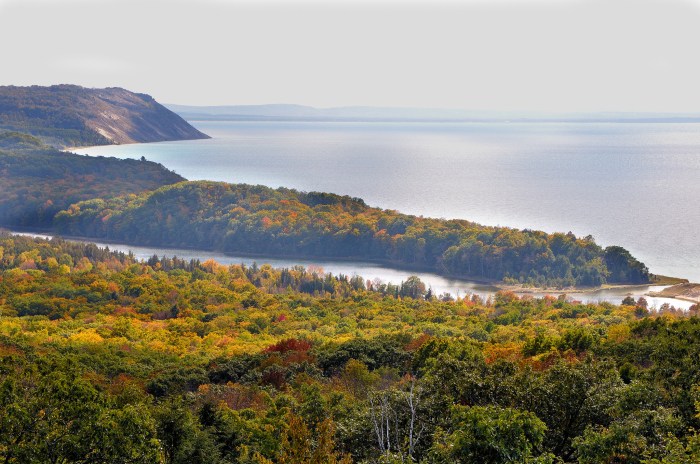
North Bar Lake, Sleeping Bear Dunes, photo by jdehmel

The Sleeping Bear Dunes National Lakeshore pages on North Bar Lake and the North Bar Lake Overlook say (in part):

The small lake below is North Bar Lake. The name describes how the lake formed: it is ponded behind a sand bar. At times, the sand bar builds up and separates North Bar Lake from Lake Michigan. At other times, a small connecting channel exists between the two lakes. North Bar Lake occupies part of a former bay on Lake Michigan. This ancient bay was flanked by headlands on both sides: Empire Bluffs on the south and Sleeping Bear Bluffs on the north. Shorelines have a natural tendency to become straighter with time. Wave action focuses on the headlands and wears them back, while shoreline currents carry sediment to the quiet bays and fill them in. Deeper parts of the bay are often left as lakes when sand fills in the shallower parts. The same process that formed North Bar Lake also formed many of the other lakes in northern Michigan: Glen, Crystal, Elk and Torch Lakes, for example.

…North Bar Lake is one of the most popular beaches in the Lakeshore because it has shallow, clear water over a sandy bottom makes for warmer swim than in Lake Michigan. But for those who like the refreshing cool water and wave action of the big lake, you can walk across the low dunes that separate the two lakes in just a couple of minutes. The beaches of pure sand and the small outlet to Lake Michigan is ideal for the kids to play.

View jdehmel’s photo background bigilicious and see more in his Sleeping Bear Dunes slideshow.

More dunes and more summer wallpaper on Michigan in Pictures.

See for miles & miles at Pictured Rocks

Pictured Rocks National Lakeshore by supernova9

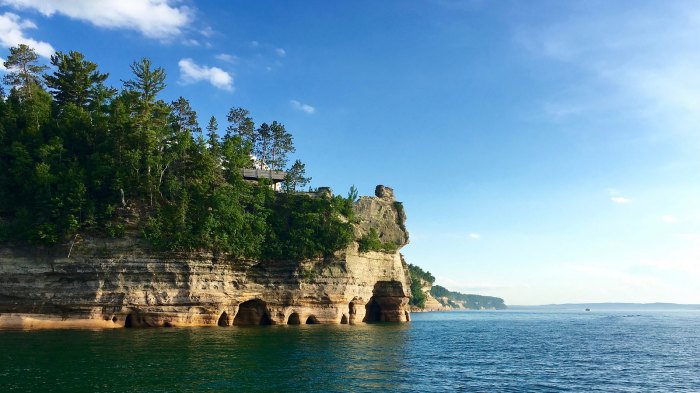
Pictured Rocks National Lakeshore, photo by supernova9

Maybe if I looked at this view every day for 50 years I would get tired of the Pictured Rocks National Lakeshore.

Maybe.

View supernova9’s photo bigger and see more in his Michigan’s Upper Peninsula slideshow.

More Pictured Rocks on Michigan in Pictures.

Fury Approaches

Fury Approaches

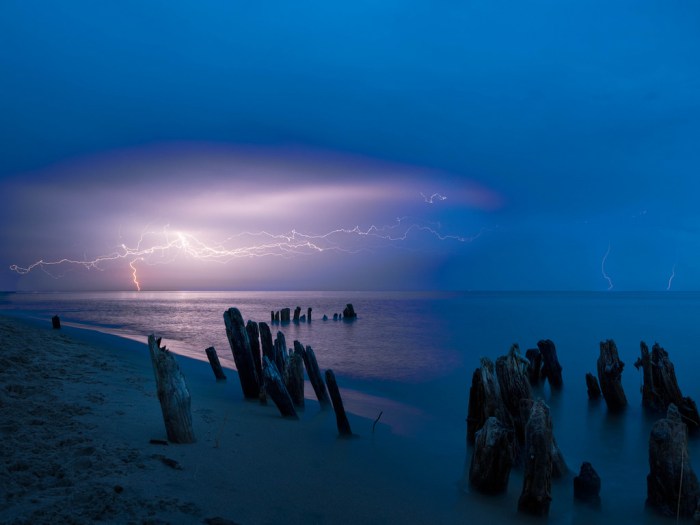
Fury Approaches, photo by Jamie MacDonald

Pow!

View Jamie’s photo from Kirk Park Beach in West Olive bigger, see more in his Stormy Weather slideshow, and visit jmacdonaldphoto.com for more of his work.

Agate Beach in Grand Marais … and Lake Superior Agates

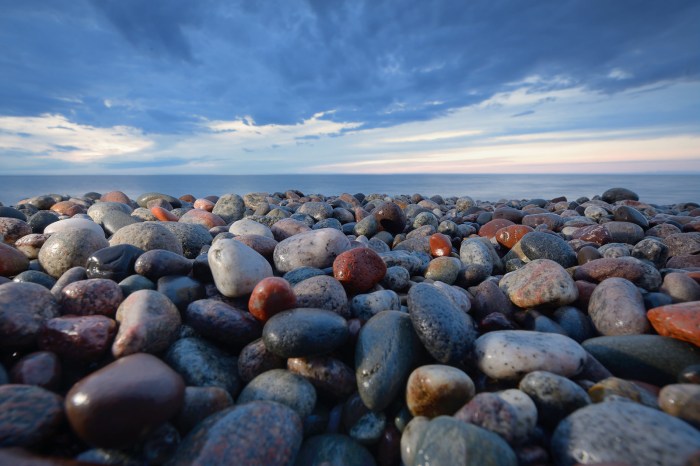
Agate Beach Treasures Neil Weaver Photography

Agate Beach Treasures, photo by Neil Weaver Photography

Karen “Agatelady” Bryzs of the Gitchee Gumee Museum in Grand Marais shares a ton of information about Lake Superior Agates, part of a worldwide family of semi-precious gemstones that naturally develop when an empty pocket inside a host rock fills in with microcrystals, forming a totally unique pattern:

Most Lake Superior agates formed in a rift zone approximately 1.2 billion years ago. Rift zones are cracks in the Earth’s surface out of which molten lava flowed. Today, there are still rift zones at the bottom of the Pacific and Atlantic oceans. The rift zone that created Lake Superior agates started in what is now northeast Kansas and continued northeast into what is now the western end of Lake Superior. This hot spot domed up lava several miles high and eventually choked itself off. If it would have continued, it could have split the North American continent in half.

She offers some tips from her book “Understanding and Finding Agates“:

  • Scan the beach and look for the Iron oxide red color.
  • Look for rocks that show evident concentric banding.
  • Check for possible entrance and/or escape channels that allowed gases or originally escape from the cavity, silica-rich water to enter, and pressure formed during the agate precipitation process to escape.
  • Search for rocks with conchoidal fractures that give the specimen a more angular, irregular shape.
  • When the angle of sun is low on the horizon, walk toward the sun and look a distance in front of you to look for the extremely translucent red carnelian agates.

Read on for lots more and definitely stop in the Gitchee Gumee Museum if you make it to Grand Marais! (done it, loved it!)

View Neil’s photo of agates near Grand Marais bigger, see more in his slideshow, and view and purchase his photos at neilweaverphotography.com.

Fourteen Foot Shoal Lighthouse in Lake Huron

14 foot shoal lighthouse by David Juckett

14 foot shoal lighthouse, photo by David Juckett

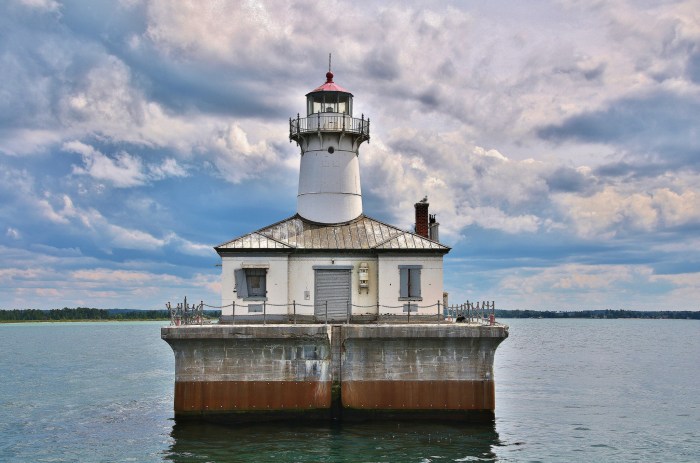
Terry Pepper’s Seeing the Light remains the gold standard for information about the lighthouses of the Great Lakes. Terry writes (in part) of the process of constructing Fourteen Foot Shoal Light near the entry into Cheboygan Harbor:

With completion of the work at Poe Reef in 1929, the work crew turned their attention to work at Fourteen Foot Shoal. While the new light was of a totally different design, and considerably smaller than the twin lights built at Martin and Poe Reefs, the construction of the crib proceeded in much the same manner, with the construction of a wooden crib at the shore station on the Cheboygan Pier. After an area on the shoal was leveled, the crib was eased down wooden ways into the water, and towed to the shoal by the Lighthouse Tender Aspen. Once over the leveled area, the crib was sunk to the bottom by filling its empty pockets with rocks and gravel.

This timber foundation then served as a core, upon and around which wooden forms were constructed and filled with concrete loaded from the Lighthouse Service scow. As was the case with both the Martin and Poe stations, the upper edge of the crib was formed into a graceful flare, designed to deflect waves away from the pier, in order to help protect the structures which would be erected on the deck. With the completion of the concrete work, the pier stood fifty feet square, and its deck level fifteen feet above the water.

The steel framework for the single story equipment building was erected at the center of the deck. Standing thirty-four feet by twenty-eight feet in plan, on completion, the entire exterior of the building was sheathed with 1/4-quarter inch steel plates, each riveted to the steel framework beneath. Centered on the roof ridge, a cylindrical steel tower was integrated into the roof, standing six feet in diameter and twenty-four feet above the ridge line. The tower was capped with an octagonal cast iron lantern and outfitted with a flashing white Fourth Order Fresnel lens.

Read on for lots more and photos!

View David’s photo background bigtacular and see more in his slideshow.

Many more Michigan lighthouses on Michigan in Pictures!

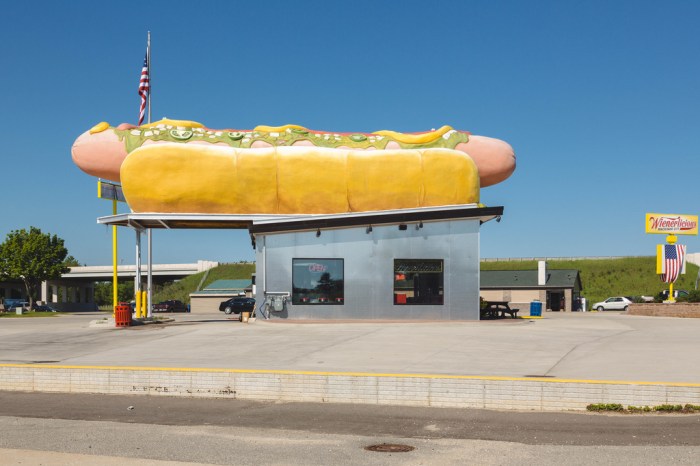
Wienerlicious

Wienerlicious, Mackinaw City

Wienerlicious, Mackinaw City, June, 2016, photo by Norm Powell

Remember folks: I don’t take the photos, choose the titles … or name businesses Wienerlicious. That said, have a Wienerlicious Wednesday Friday!

View Norm’s photo bigger, click for more of his Pure Michigan photos, and view & purchase photos at normpowellphotography.com.

More Roadside awesomeness on Michigan in Pictures.

Top Dog: Detroit Michigan’s Coney Island Hot Dog

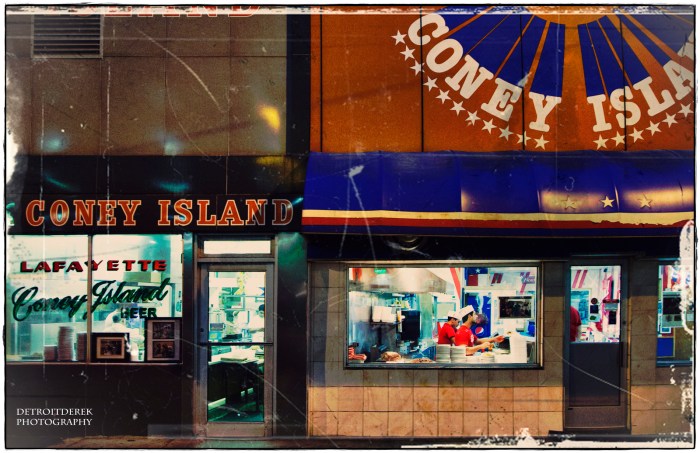
On Any Given Night Lafayette Coney Island

On Any Given Night, photo by Derek Farr

When mLive writer Emily Bingham realized that Michigan didn’t have an official state food, she set out to determine what their readers thought. The winner was the coney island hot dog which squeaked by my personal favorite, the pasty. Share what you think Michigan’s signature food is in the comments!

The Encyclopedia of Detroit entry for the Coney Dog says:

Many people think that the Coney dog, also called the Coney Island hot dog, got its start on Coney Island, NY where the hot dog was created. In actuality, this popular food got its start in Michigan, although the exact location is still disputed. Three locations in Michigan all claim to be the birthplace of Coney dogs: American Coney Island in Detroit, Lafayette Coney Island in Detroit and Todoroff’s Original Coney Island in Jackson.

In 1917, Gust Keros opened American Coney Island. A few years later Keros’s brother opened Lafayette Coney Island next door. Both of these Detroit Coney Islands are incredibly popular to this day, where there is an on-going argument over which establishment serves the best Coney dog. The dispute has been featured on several food television shows, including Food Wars and Man v. Food.

A Coney dog is a beef hotdog, topped with an all meat, beanless chili, diced white onions, and yellow mustard. A true Coney dog uses made-in-Michigan products.

Lots more about the coney dog on Absolute Michigan.

View Derek’s photo bigger where you can also read about the history of friendly competitors Lafayette Coney Island & American Coney Island. See more in his massive Signs & Billboards slideshow.

Michigan food on Michigan in Pictures!

2016 Chicago to Mackinac Sailing Race

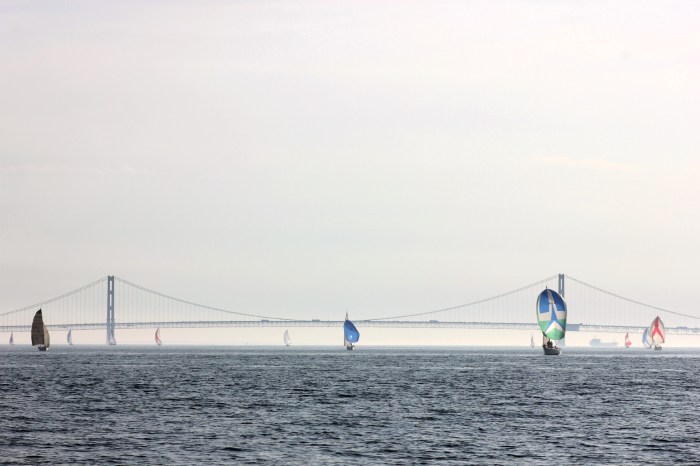
Chicago to Mac Sailboats & Mackinac Bridge

Sailboats and Mackinac, photo by Alex Duncan

On July 23, 2016, over 350 sailboats will leave the Chicago Yacht club for the longest annual freshwater race in the world. 2016 marks the 108th annual Chicago Yacht Club Race to Mackinac aka the Chicago to Mac. On their Race History page the CYC shares that:

Starting in 1898 with a mere five boats, The Mac has evolved into a world-class sporting event. After the first race in 1898, the Race to Mackinac was not held for five years until the second race in 1904. By 1906, the race had developed a healthy following and, in that year, the original Mackinac trophy was purchased. The race has seen occasional sustained violent weather in the blows of 1911, 1937 and 1970. After gale force winds took down most of the fleet in the Mac of 1911, the finish in the 1912 and 1913 races was changed to Harbor Springs on Little Traverse Bay instead of Mackinac Island. Race organizers felt the shorter distance was safer.

From 1914 until 1916 the Mac was back to its full distance until WWI. From 1917-1920 there were no Mac races due to the strains of the War, which took away yachtsmen and put many boats out of commission. Since 1921, the Race to Mackinac has run consecutively every year, remains the longest annual freshwater distance race, and is recognized as one of the most prestigious sailing races in the world.

Read on for lots more including an account of the first race. If you’re wondering when to catch a glimpse of them, Pyewacket set the monohull record in 2002 with a time of 23 hours, 30 minutes and 34 seconds. The race starts at noon on Saturday and usually takes between 40-60 hours to finish.

View Alex’s photo from 2011 background bigtacular and see more in his Pure Michigan slideshow.

More summer wallpaper on Michigan in Pictures!

Come Sail Away

Come Sail Away

Come Sail Away…, photo by Mike Millspaugh

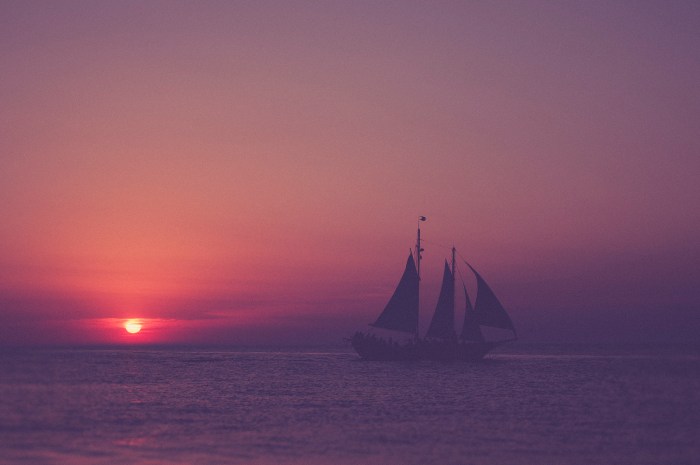
What a gorgeous photo of a tall ship under sail off Grand Haven. I looked around for a while trying to figure out what ship this is until I remembered that I can just ask all of you. Let me know in the comments!

View Mike’s photo bigger, see more in his slideshow, and view more of his work on his website.

You know I can’t resist…