
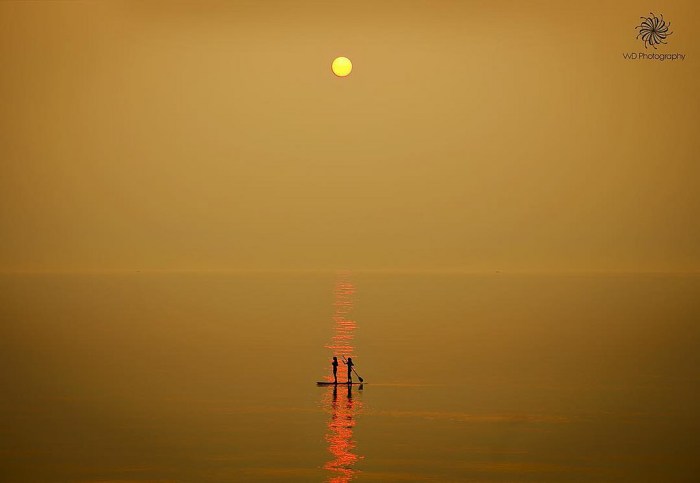
Stroll thru Michigan Lake, photo by Vesy Valcheva
View Vesy’s photo bigger and see more in her slideshow.
Stroll thru Michigan Lake, photo by Vesy Valcheva
View Vesy’s photo bigger and see more in her slideshow.
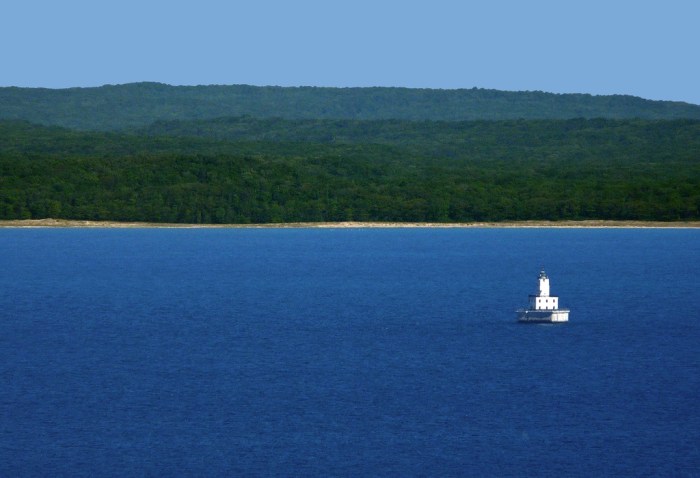
Tales of the Crib, photo by Jim
“To pass time, the men watched television, read books and magazines, played board games, and chatted with passing ship captains by radio. One coastguardsman perfected his rappelling skills by using ropes to descend from the gallery outside the lantern room to the concrete deck below.”
~Life on North Manitou Shoal
The last Coast Guard crew left the North Manitou Shoal Light in 1980. It’s located 8 miles off the the Lake Michigan shore from Leland, and growing up I could hear the station’s fog horn from my bedroom. When I was a kid, my parents and their friends would take steaks and beer out to the light and have dinner with the guardsmen.
Now mLive reports that the light is one of four Michigan lighthouses are up for sale to the public: North Manitou Shoal Light, White Shoal Lighthouse, Gray’s Reef Light, and Minneapolis Shoal Light. The auction page explains that proceeds from the public sales go back into the US Coast Guard’s aid to navigation fund for equipment, maintenance, and resources to continue preservation and maintenance of lighthouses that are still active. On Tuesday, August 30, registered bidders who have paid the $10K deposit can tour the light along with their contractor and they haven’t yet set a closing date for the auction.
Lighthouse Friends notes that the North Manitou Shoal Light was built in 1933 to replace the North Manitou Shoal Lightship:
…anchored two miles off Dimmick’s Point. In 1909, the Lighthouse Board noted that a shoal had developed southeast of Manitou Island in recent years and requested a lightship be placed on the easterly end of the shoal to help mark the six-mile-wide channel between Dimmick’s Point and Pyramid Point on the mainland.
This light station replaces the North Manitou Lightship No. 103 and North Manitou Island Light Station, and serves as an improved mark for the outer end of the shoal projecting southerly from the south end of North Manitou Islands. A substantial saving in annual maintenance cost will be effected. The crib on which the structure is built stands in 22 feet of water, on a hard sand and coarse stone bottom. The crib is 65 feet square by 22 feet deep, and is filled with conveyor stone. The voids around the stone in the 20 outer pockets were pumped full of Portland cement grout. Arch web steel sheet piling driven 24 feet into lake bottom encloses and protects the crib.
The crib supports a hollow pier of reinforced concrete 62 feet square and 20 feet above water, with deck overhanging 2 feet on all sides. This hollow space is occupied by the steam heating plant, coal and oil storage, laundry, etc. Above the pier rises the steel building 37 feet square, two stories high, surmounted by a square tower of three stories additional height. On the top of the tower is a third-order lantern, with its focal plane 79 feet above water. The building and tower are constructed of steel channels 12 and 15 inches wide, standing vertically with flanges turned in and bolted together on the inside.
View Jim’s photo background big and see more in his slideshow.
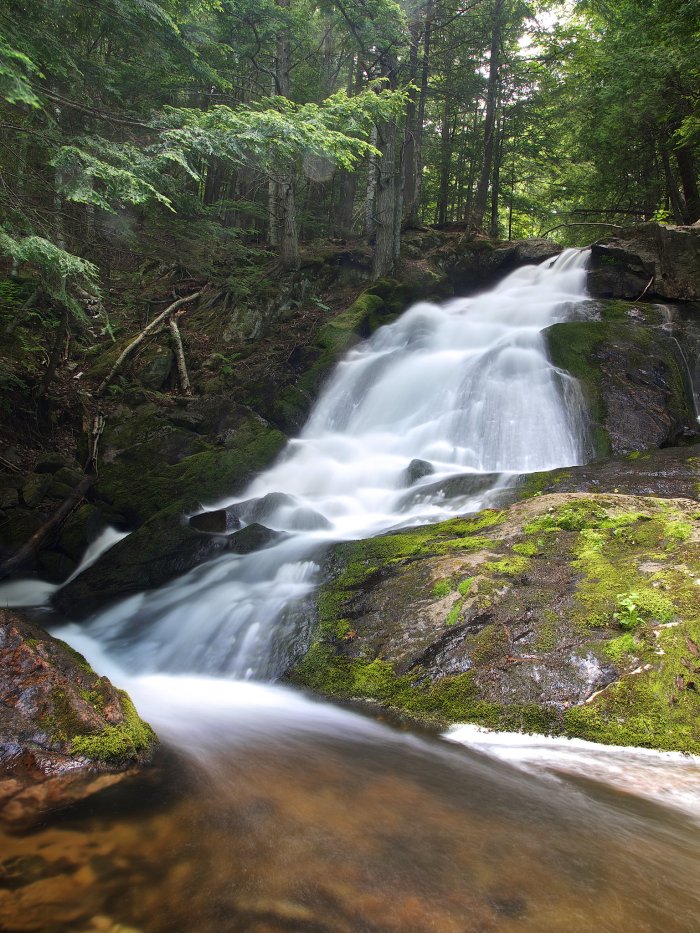
Alder Falls, photo by David Marvin
GoWaterfalling’s page on Alder Falls says this waterfall:
…is located about 20 miles north of Marquette on County Road 550. This is Canadian Shield country and the falls is typical of the falls found there. The falls is a slide about 30 feet high cascading down at a 45 degree angle. It falls into a deep, secluded and well shaded gorge. The gorge adds to the sense of wildness and isolation of the falls, even though it is only a mile from the main road.
Finding this waterfall is not trivial because Marquette does not seem big on marking their waterfalls or their rivers and creeks…
Upstream of the main falls are three more drops each around 5 feet high. The first of these is a short distance above the main falls and easy to reach from the north side of the creek. Upstream of that the creek has carved its way through an enormous rock, creating a narrow gorge. A second, not easily seen, drop is in the gorge. A third drop is beyond that.
Read more including detailed directions to what appears to be one of the more difficult waterfalls to get to at Go Waterfalling.
View David’s photo background bigtacular and see a bunch more shots from Alder Falls in his slideshow.
More Michigan waterfalls on Michigan in Pictures!
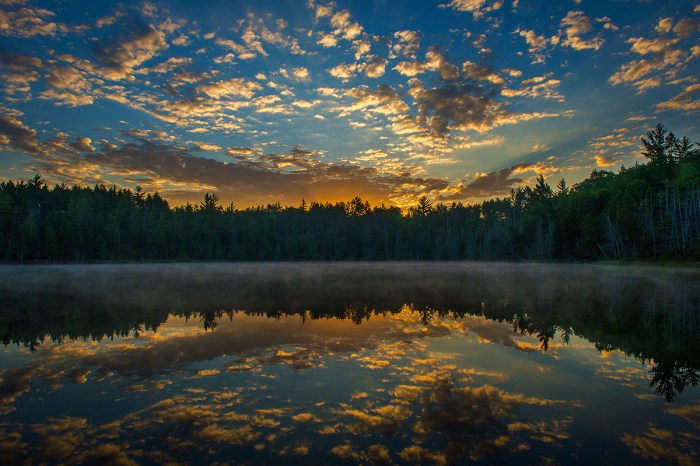
wGlory sunrise 1, photo by Jeff Caverly
The Michigan DNR’s page on Bright and Glory Lakes near Grayling includes maps. They say that both lakes have floating piers & boat launches for fishing – species include largemouth bass, rainbow trout, smallmouth bass, sucker, sunfish, yellow perch:
These lakes are called Kettle Lakes as they are shaped like tea kettles. They are roundish and deep in the center (more than 40 feet). The lake bottom is marl, so wading and swimming are prohibited as people would sink in the marl.
Here’s more about Kettle Lakes from MSU’s Geology department:
Kettles are depressions left behind after partially-buried ice blocks melt. Many are filled with water, and are then called “kettle lakes”. Most lakes in Michigan could be described as kettle lakes, and the term “kettle lake” describes the way the lake basin was formed. Kettle lake basins were formed as the glaciers receded. While this was happening, a block of ice broke off the glacier, and just sat there. As the glacier continued to melt, the debris from the glacier (soil, rocks, stones, gravel, etc.) filled in around the block of ice. When the block of ice finally melted, all the debris surrounding it fell into the hole, creating the kettle type basin, which when filled with water, became a lake as we know it.
Many of our small, deep lakes in Michigan are kettle lakes. Some have since been infilled with vegetation and plant matter, to form bogs. Even some of our larger, deep lakes, like Higgins Lake and Walled Lake, are kettles.
View Jeff’s photo background big, see more including another view of the sunrise in his slideshow, and follow Jeff Caverly Photography on Facebook.

Sunflowers, photo by Sharon
Sharon caught these beautiful sunflowers at the Petoskey Farmer’s Market. View the photo background bigilicious and see more in her Michigan slideshow.
More summer wallpaper on Michigan in Pictures.
Definitely watch Ken’s Perseid video at the end!
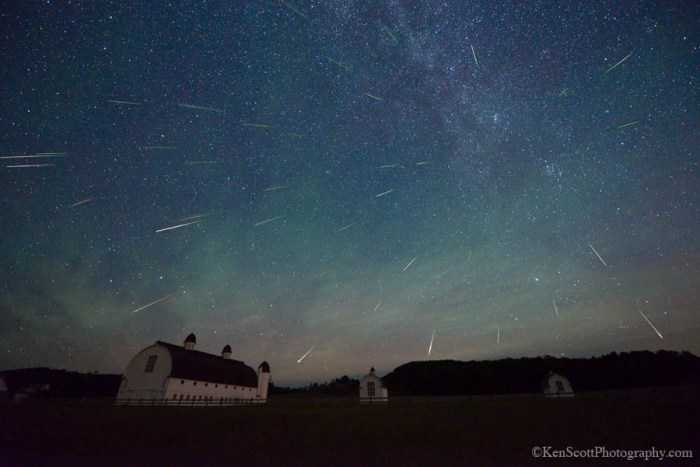
D H Day Farm … perseid meteor shower, photo by Ken Scott
I’ve shared this before, but Space.com has an interesting story about how the upcoming Perseid Meteor shower (peak August 11-13) came to be known as “The Tears of St. Lawrence” and also some of the science behind this annual August sky show:
Laurentius, a Christian deacon, is said to have been martyred by the Romans in 258 AD on an iron outdoor stove. It was in the midst of this torture that Laurentius cried out: “I am already roasted on one side and, if thou wouldst have me well cooked, it is time to turn me on the other.”
The saint’s death was commemorated on his feast day, Aug. 10. King Phillip II of Spain built his monastery place the “Escorial,” on the plan of the holy gridiron. And the abundance of shooting stars seen annually between approximately Aug. 8 and 14 have come to be known as St. Lawrence’s “fiery tears.”
…We know today that these meteors are actually the dross of the Swift-Tuttle comet. Discovered back in 1862, this comet takes approximately 130 years to circle the Sun. With each pass, it leaves fresh debris — mostly the size of sand grains with a few peas and marbles tossed in.
Every year during mid-August, when the Earth passes close to the orbit of Swift-Tuttle, the bits and pieces ram into our atmosphere at approximately 37 miles per second (60 kps) and create bright streaks of light.
Read on for more including diagrams and viewing tips.
Ken Scott captured these Perseid meteors last August over a 2 1/2 hour period at the D.H. Day Farm in the Sleeping Bear Dunes National Lakeshore. He says that the barn is lit by rogue lightning and that this is a composite of many meteor images, where each photo is rotated around the north star so that the ‘point of origin’ of the shower can be seen better. He understands it visually but not scientifically – anyone have a simple explanation for him?
View his photo bigger, see more in his Skies Above slideshow, and view and purchase his work at kenscottphotography.com.

Can’t Wait, photo by Jiafan(John) Xu
Osprey Watch of Southeast Michigan shares some information about Michigan Osprey:
An Osprey is a large bird with a length of 22-25 inches, a wingspan of 4.5-6 feet, and a weight of approximately four pounds. The Osprey has a dark brown back and a white belly, as well as a white head, which features a dark stripe running from its yellow eyes to the back of its head. Female Ospreys are slightly larger than males and may sport a dark speckled necklace
..The Osprey dines almost exclusively on live fish, often catching its meals by hovering over the water at an altitude of 50 to 200 feet, then diving feet first into the water to catch its prey. The Osprey’s feet are uniquely adapted to “air fishing.” Each Osprey foot has a reversible front toe, as well as barbs, called spicules, which help it hold onto a slippery fish in flight. Normally, an Osprey will aerodynamically position a fish headfirst in its talons before it returns to the nest.
These talons definitely look like fish hooks – read on for more!
View Jiafan’s photo bigger and see more in his slideshow where you can also see shots from a trip out west.
More Michigan birds on Michigan in Pictures.
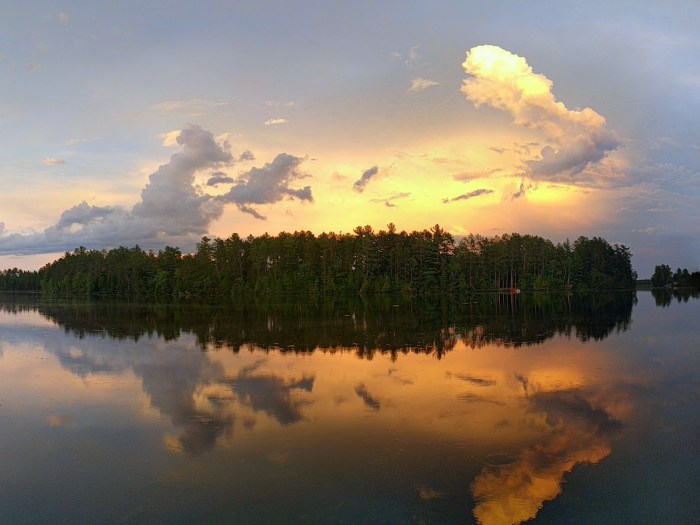
Evening clouds after rain, photo by Anne Fisher
Ann says she never tires of Bass Lake in the Upper Peninsula near Gwinn. I can see why! View her photo background big and see more in her 2016 UP slideshow.
More summer wallpaper on Michigan in Pictures and here’s a link to a map of Bass Lake.
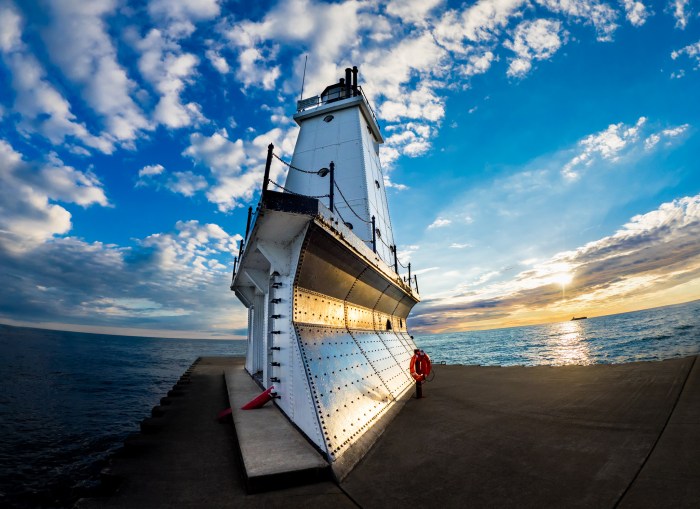
North Breakwater Light, photo by Mark Miller
The entry for Ludington North Breakwater Light at Terry Pepper’s Seeing the Light details a ton of the history of this lighthouse including the reason for its interesting appearance:
Over the summer of 1924, a unique structure took shape at the end of the North Breakwater. The main tower, fabricated of steel plates over an internal steel skeleton, took the form of a four-sided pyramidal tower with four round porthole windows on each of the three decks within. With plans calling for the installation of an air diaphragm fog signal operated by an electrically powered compressor, there was no need for a large fog signal building, and thus the signal building took the form of a relatively small structure integrated into the base of the landward side of the main tower. In order to help protect the structure from the force of waves crashing across the breakwater, the concrete foundation at the base of the structure was formed with angled surfaces designed to deflect the force of wave action up and away from the building.
The white painted tower was capped by a square gallery and an octagonal iron lantern installed at its center. Since the standard lantern design being used by the Lighthouse Service in new construction at this time was of circular conformation with diagonal astragals, it is likely (but unconfirmed) that the lantern used on this new light was transferred from the South Pierhead beacon which the new light was designed to replace.
Click through for more including a number of old photos.
View Mark’s photo background bigtacular and see more in his slideshow.
More lighthouses and more summer wallpaper on Michigan in Pictures.
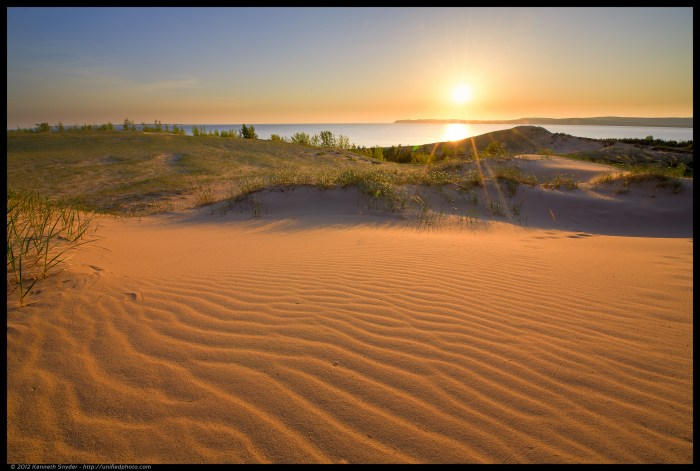
Steps of the Sun, photo by Kenneth Snyder
Here’s a shot from high atop one of the many dunes in the Sleeping Bear Dunes National Lakeshore from August 1, 2012.
View Kenneth’s photo background bigilicious and see more in his Sleeping Bear Dunes slideshow that includes some awesome northern lights pics!
More dunes and more summer wallpaper on Michigan in Pictures.
 Michigan in Pictures