Waterlife … and Miners Beach Falls

Miners Beach Falls , Pictured Rocks National Lakeshore, Michigans upper  peninsula  (explore # 61 Oct 14, 2010)

Miners Beach Falls , Pictured Rocks National Lakeshore, Michigans upper peninsula (explore # 61 Oct 14, 2010), photo by Michigan Nut.

Yesterday I had to take a little detour from the Pictured Rocks theme to acknowledge the Chevy Volt. An article in this morning’s Detroit News on my 2nd favorite film ever* about the Great Lakes had me tempted to take another detour, but since Kevin McMahon’s beautiful film Waterlife makes its way through all the Great Lakes, this gorgeous shot from Miner’s Beach in the Pictured Rocks National Lakeshore works perfectly. Kevin says:

“What I tell audiences who live among the Great Lakes is: This is literally your autobiography. Your drinking water all comes from the Great Lakes, and when you see the journey of your water, starting from that pristine environment up by Lake Superior and deteriorating continually until it gets to Toronto, well that’s our life story. Whatever goes into that water not only goes into us, but actually becomes a part of us.

One thing that I love about Kevin’s film that is missing from too many environmental films is that through stunning high-definition videography, he has captured the soul of the Lakes, those qualities that so many of us treasure. Waterlife group on Facebook and definitely try and see Waterlife if you can!!

John says that this little waterfall is hidden on the far east end of Miners Beach. See it background bigtacular and in his Michigan Waterfalls slideshow.

See over 800 more Pictured Rocks photos in the Absolute Michigan pool on Flickr and a whole lot more Pictured Rocks National Lakeshore on Michigan in Pictures!

*My favorite is of course Paddle to the Sea.

Chevrolet Volt: Motor Trend 2011 Car of the Year

2011 Chevrolet Volt in Production
2011 Chevrolet Volt in Production, photo by ibmphoto24

A a lot of the sound and fury that has surrounded the Volt’s launch has tended to obscure a simple truth: This automobile is a game-changer.
~Motor Trend Magazine

Motor Trend magazine has named the Chevrolet Volt its 2011 Car of the Year. The criteria for Car of the Year are design advancement, engineering excellence, intended function, efficiency, safety and value. After reading passages like the one below, you get the sense that when the Motor Trend Editor in Chief Angus MacKenzie says that the Chevy Volt is one of the most groundbreaking vehicles they’ve tested in 60 years, he means it:

The Volt’s unique powertrain not only defies established labels; it also defies established methods of determining fuel economy. After all, this is a vehicle that will complete the standard EPA fuel economy test in full EV mode, making conventional mileage calculations impossible.

Read more at Motor Trend, visit the official Chevrolet Volt web site and see a video, more about the award and GM’s IPO this week on Absolute Michigan.

The photo above is the first pre-production Chevrolet Volt on the assembly line at the Detroit-Hamtramck manufacturing plant. It was posted by IBM. Check it out bigger and read about how IBM software played a role in the development of the vehicle.

Here’s the Chevy Volt slideshow on Flickr.

Michigan’s Tallest: The Renaissance Center in Detroit

renaissance center detroit

renaissance center detroit, photo by Detroitmi97.

The list of the tallest buildings in Michigan says that the title of tallest building in Michigan belongs to the Renaissance Center at 77 stories and 722 feet tall. It also has the distinction of being the tallest all-hotel skyscraper in the Western Hemisphere.

The RenCen is owned by General Motors and Wikipedia says that the Ren Cen was conceived as a catalyst for Detroit’s economy by Henery Ford II and investors, and that it generated in excess of $1 billion in economic growth for downtown Detroit in its first year of operation.

John Portman was the principal architect for the original design. The first phase constructed a five tower rosette rising from a common base. Four 39-story office towers surround the 73-story hotel rising from a square-shaped podium which includes a shopping center, restaurants, brokerage firms, banks, a four-screen movie theatre, private clubs.The first phase officially opened in March 1977. Portman’s design renewed attention to city architecture, constructing the world’s tallest hotel at the time. Two additional 21-story office towers (known as Tower 500 and Tower 600) opened in 1981. This type of complex has been termed a city within a city.

…The architects’ initial design for the Renaissance Center focused on creating secure interior spaces, while its design later expanded and improved to connect with the exterior spaces and waterfront through a reconfigured interior, open glass entryways, and a Wintergarden.

While it might be a little over-photographed, it’s an amazing space for photographers to explore, inside and out.

Mark says he can see the whole world from here – can you? Check it out background boomtacular and see some other shots from high up in the RenCen in his detroit top slideshow.

More Renaissance Center and don’t miss the RenCen slideshow from the Absolute Michigan pool!

More of Michigan’s tallest on Michigan in Pictures.

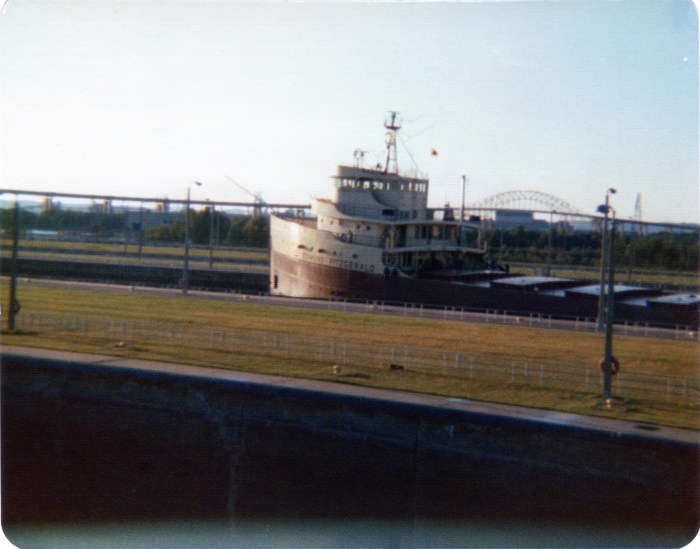
The Edmund Fitzgerald in the Soo Locks

Never before published photo of the Edmund Fitzgerald, taken only months before it was lost with all hands in Lake Superior. Remember, you saw if first on Flickr! My father-in-law took this shot. He told my wife that he wasn't taking a picture of the Big Fitz; he just wanted a photo of the locks, and this happened to be in the photo. Unfortunately, the negative is long gone and this photo was printed on some sort of rough-coated matte paper so that it could be mailed as a postcard. My father-in-law didn't realize until months after the sinking that he had a picture of this vessel. The photo was taken in August 1975; the Edmund Fitgerald sank in November of that year. It was, ironically, the sinking that made this ship famous. After it was built it was the largest ship on the Great Lakes, but other than that, it was just another anonymous working vessel plying the waters between Wisconsin and Michigan.

The Edmund Fitzgerald in the Soo Locks, photo by bill.d.

Through Gordon Lightfoot’s song, the Edmund Fitzgerald has become an icon for the power of the Great Lakes. Nowhere can you see it better than Joseph Fulton’s video of The Wreck of the Edmund Fitzgerald, a fantastic piece of film-making that you need to see if you haven’t already.

What I suspect that a lot of people forget (because I know I do) is that the S.S. Edmund Fitzgerald was just one of many ships plying the Great Lakes. About the photo above, Bill writes:

My father-in-law took this shot. He told my wife that he wasn’t taking a picture of the Big Fitz; he just wanted a photo of the locks, and this happened to be in the photo. Unfortunately, the negative is long gone and this photo was printed on some sort of rough-coated matte paper so that it could be mailed as a postcard.

My father-in-law didn’t realize until months after the sinking that he had a picture of this vessel.

The photo was taken in August 1975; the Edmund Fitzgerald sank November 10th of that year. It was, ironically, the sinking that made this ship famous. After it was built in 1958, until 1971, it was the largest ship on the Great Lakes, but other than that, it was just another anonymous working vessel plying the waters between Wisconsin and Michigan.

Check it out background big and see the back of the postcard. Visit the links below for more about the SS Edmund Fitzgerald:

More shipwrecks on Absolute Michigan and Michigan in Pictures.

Fury: The White Hurricane of 1913

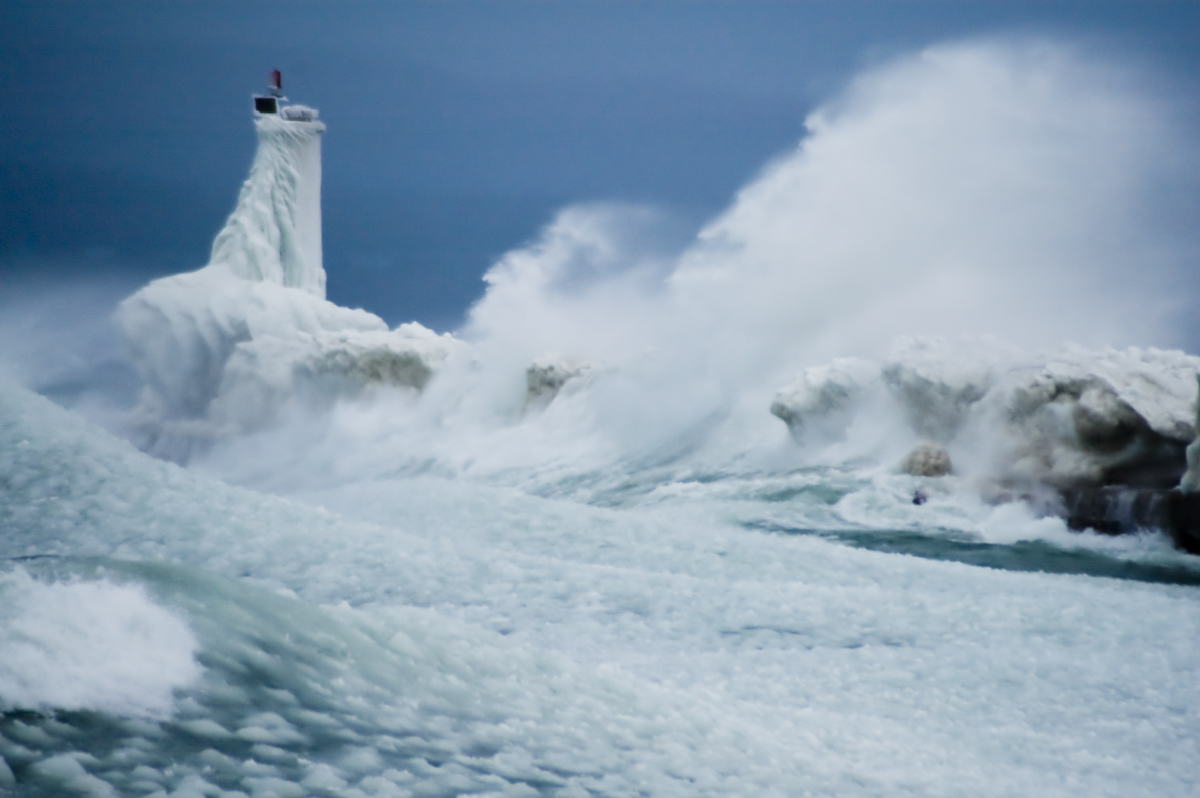
Furious Lake Michigan

Furious Lake Michigan Petoskey, photo by Odalaigh.

“No lake master can recall in all his experience a storm of such unprecedented violence with such rapid changes in the direction of the wind and its gusts of such fearful speed! Storms ordinarily of that velocity do not last over four or five hours, but this storm raged for sixteen hours continuously at an average velocity of sixty miles per hour, with frequent spurts of seventy and over.

Obviously, with a wind of such long duration, the seas that were made were such that the lakes are not ordinarily acquainted with. The testimony of masters is that the waves were at least 35 feet high and followed each other in quick succession, three waves ordinarily coming one right after the other.

~Report from the Lake Carriers Association in the wake of the Great Lakes “White Hurricane”

97 years ago the Great Lakes region reeled under the deadliest storm in its history. Known as the “Big Blow” and the “Freshwater Fury”, was a blizzard with hurricane-force winds that devastated the Great Lakes Basin in the Midwestern United States and the Canadian province of Ontario from November 7 through November 10, 1913. Read on for more!

Check this out bigger and in Charles’ Petoskey Storm Photos slideshow. He also has video of this storm.

Freshwater Fury: The Great Storm of 1913

Dear wife and Children. We were left up here in Lake Michigan by McKinnon, captain James H. Martin tug, at anchor. He went away and never said goodbye or anything to us. Lost one man yesterday. We have been out in storm forty hours. Goodbye dear ones, I might see you in Heaven. Pray for me. / Chris K. / P.S. I felt so bad I had another man write for me. Goodbye forever.

~A message found in a bottle 11 days after Plymouth disappeared, dictated by Chris Keenan, federal marshal in charge of the barge.

Wikipedia says that the Great Lakes Storm of 1913, also known as the “Freshwater Fury“or the “White Hurricane”, was a blizzard with hurricane-force winds that ravaged the Great Lakes November 7-10, 1913. With the sinking of 19 ships, the stranding of another 19 and a death toll of at least 250, it remains the deadliest and most destructive natural disaster in Great Lakes history.

Major shipwrecks occurred on all but Lake Ontario, with most happening on southern and western Lake Huron. Lake masters recounted that waves reached at least 35 feet (11 m) in height. Being shorter in length than waves ordinarily formed by gales, they occurred in rapid succession, with three waves frequently striking in succession. Masters also stated that the wind often blew in directions opposite to the waves below. This was the result of the storm’s cyclonic motion*, a phenomenon rarely seen on the Great Lakes.

In the late afternoon of November 10, an unknown vessel was spotted floating upside-down in about 60 feet (18 m) of water on the eastern coast of Michigan, within sight of Huronia Beach and the mouth of the St. Clair River. Determining the identity of this “mystery ship” became of regional interest, resulting in daily front-page newspaper articles. The ship eventually sank, and it was not until early Saturday morning, November 15, that it was finally identified as the Charles S. Price. The front page of that day’s Port Huron Times-Herald extra edition read, “BOAT IS PRICE” DIVER IS BAKER “SECRET KNOWN”. Milton Smith, the assistant engineer who decided at the last moment not to join his crew on premonition of disaster, aided in identifying any bodies that were found.

More shipwrecks on Michigan in Pictures!

Support Michigan in Pictures with Patreon

Wind, Water & Light: Turn your photos into energy

Wind on the Water

Wind on the Water, photo by jimflix!.

GE has an interesting project under their $10 billion dollar Ecoimagination initiative. The Ecoimagination Photo Project lets you upload photos to Flickr tagged with “Wind,” “Water,” or “Light”. For each photo, they donate a certain amount to three related charities to help build fresh water wells, donate solar powered lanterns, and build small-scale wind turbines for communities in need.

Click the photo project link above to see the photos and click for the ecomagination photo project group on Flickr.

Jim took this photo at the Sleeping Bear Dunes National Lakeshore in October. He writes:

Late evening light on the bluffs of the Sleeping Bear Sand Dunes. About 30 minutes after a storm, and there’s still lots of wind coming in. At over 400 feet above Lake Michigan, it takes 30 seconds to run down this bluff, but often takes 30 minutes or more to climb back up! Those are the Empire Bluffs down the coast on the left. And the distant point on the right is Point Betsie.

A complement to this photo, and here’s a photo in the middle.

Check it out background bigtacular and in his Sleeping Bear Dunes slideshow.

Michigan Windstorm of October 2010

NSPier10262010

NSPier10262010, photo by Twinz8.

Over the last 24 hours winds have roared through Michigan. While closed schools, downed trees and lost power are a problem for some, to some photographers & weather lovers (and of course surfers), the wild wind is a boon.

mLive has a report with some video from Grand Haven, a surfing hot spot (surfgrandhaven.com). More about Michigan surfing from Absolute Michigan.

Be sure to check this out bigger and check out more shots from the Grand Haven North Pier in Paul’s slideshow.

More Michigan weather from Michigan in Pictures!

Why is it called Indian Summer anyway?

indian summer

indian summer, photo by paulh192.

“The air is perfectly quiescent and all is stillness, as if Nature, after her exertions during the Summer, were now at rest.”
~John Bradbury, 1817

We’ve had a spectacular October, and that had me wondering about the term “Indian summer.” Wikipedia has some thoughts on Indian summer, but I thought the best work was done by William R. Deedler, Weather Historian for the National Weather Service Detroit/Pontiac in Just what is Indian summer and did Indians really have anything to do with it?. He writes:

It can be defined as “any spell of warm, quiet, hazy weather that may occur in October or even early November.” Basically, autumn is a transition season as the thunderstorms and severe weather of the summer give way to a tamer, calmer weather period before the turbulence of the winter commences.

The term “Indian Summer” is generally associated with a period of considerably above normal temperatures, accompanied by dry and hazy conditions ushered in on a south or southwesterly breeze. Several references make note of the fact that a true Indian Summer can not occur until there has been a killing frost/freeze.

The earliest known use of the term was in 1778 by Frenchman St. John de Crevecoeur who wrote:

Sometimes the rain is followed by an interval of calm and warmth which is called the Indian Summer, its characteristics are a tranquil atmosphere and general smokiness. Up to this epoch the approaches of winter are doubtful; it arrives about the middle of November, although snows and brief freezes often occur long before that date.”

But does it have anything to do with Native Americans? Some thoughts Deedler shares are that Native Americans chose that time of year as their hunting season, that natives made use of the dry, hazy weather to attack settlers before winter set in, and the prejudicial notion that immigrants equated Indian Summer to “fools” Summer, given the reliability of the weather. One curious idea is:

…not at all in the American Indian “camp” of theories, was put forward by an author by the name of H. E. Ware, who noted that ships at that time traversing the Indian Ocean loaded up their cargo the most during the “Indian Summer”, or fair weather season. Several ships actually had an “I.S.” on their hull at the load level thought safe during the Indian Summer.

In any case, this is a welcome phenomenon, and one of the best reasons I know to live in Michigan!

Check this out background big and in Paul’s slideshow.

More Michigan Fall Wallpaper from Michigan in Pictures.

Stairway to Heaven

Stairway to Heaven

Stairway to Heaven, photo by sl33stak.

Check this out big as a barn and in Jamie’s Buildings & Structures slideshow.

More Michigan barns on Michigan in Pictures!

October the 13th: Michigan Haunted Houses, Corn Mazes & Scary Attractions

Jason Voorhees

Jason Voorhees, photo by hardyc.

Hold on, man. We don’t go anywhere with “scary,” “spooky,” “haunted,” or “forbidden” in the title.
~Shaggy from Scooby-Doo

Over on Absolute Michigan, our Fearsome Finder of Frights has once again compiled his annual list of Michigan haunted houses, corn mazes and scary attractions. There’s a bunch of cool Halloween facts as well, so click over … if you dare.

Check this out bigger and in Chris’s super spooky Halloween/Horror slideshow.

More Halloween fun on Michigan in Pictures!