Banished Words: Epic Viral Fail

Face Plant

Face Plant photo by Rudy Malmquist

Every year, Lake Superior State University puts together their list of Banished Words. Before we get to the current list, here’s a little back story:

In 1977, one year after Lake Superior State University Public Relations Director W.T. (Bill) Rabe released the first “banished words list,” he said that the international reaction from news media and the public told him “it would go on forever.”

Forever may be stretching it, but the annual List of Words Banished from the Queen’s English for Mis-Use, Over-Use and General Uselessness has been going strong since New Year’s Day 1976 and shows no signs of stopping. People from around the world have nominated hundreds of words and phrases such as “you know,” “user friendly,” “at this point in time,” and “have a nice day,” to be purged from the language.

Here’s a few choice words from their 2011 Banished Words List:

“Standards for using ‘epic’ are so low, even ‘awesome’ is embarrassed.” Mike of Kettering, Ohio.

It may have been word of the year in some wheelhouses, but “refudiate” wasn’t looked upon favorably by many who sent in nominations.

“Aren’t all Americans people? Every political speech refers to the ‘American’ people as if simply saying ‘Americans’ (or ‘people’) is not enough.” Deb of Sault Ste. Marie, Mich.

But words and phrases related to technology and the way we communicate dominated the list for 2011, including “viral,” “epic,” “fail,” and the use of websites “Facebook” and “Google” as verbs. “Viral” received the most nominations.

“Facebook is a great, addicting website. Google is a great search engine. However, their use as verbs causes some deep problems. As bad as they are, the trend can only get worse, i.e. ‘I’m going to Twitter a few people, then Yahoo the movie listings and maybe Amazon a book or two.” Jordan of Waterloo, Ont.

Lake Superior State University accepts nominations all year, and you can post comments about this year’s words (or any other words that you wish to refudiate) on the LSSU Banished Words Facebook.

Check this photo out too big to fail or in Rudy’s slideshow.
New Year’s Eve Magic


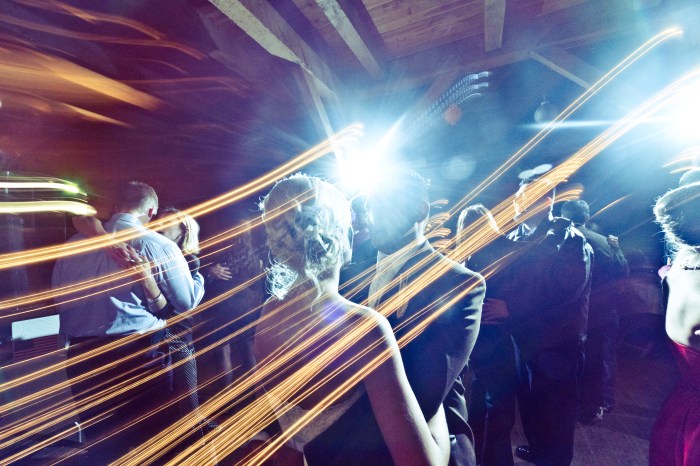
Dance Magic Dance.jpg

Dance Magic Dance, photo by MightyBoyBrian.

“To leave the old with a burst of song,
To recall the right and forgive the wrong;
To forget the thing that blinds you fast
To the vain regrets of the year that’s past.”
~Robert B. Beattie

Please accept the warmest wishes of the crew at Absolute Michigan for a safe, happy and magical New Years Eve! Here’s our listing of Michigan New Year’s Eve Happenings!

Brian writes that he kept the shutter open for 1.3 seconds after the two flashes fired so that he could get a streaking of ambient light. The final effect blew his mind (and mine). Check it out background bigalicious and in his People slideshow.

3-2-1…

Tri-Centennial State Park Lighthouse, Detroit Michigan: Velvia Version

Tri-Centennial State Park Lighthouse, Detroit Michigan: Velvia Version

Tri-Centennial State Park Lighthouse, Detroit Michigan: Velvia Version, photo by friday1970.

Tri-Centennial State Park is now known as the William G. Milliken State Park and Harbor. It was the first urban park in Michigan, and covers 31 acres on the banks of the Detroit River.

This 63-foot lighthouse is a scaled down replica of the Tawas Point Lighthouse, the only true Victorian-era style station on the Great Lakes.

Be sure to check this out background boomtacular and in his slideshow.

Many more Michigan lighthouses on Michigan in Pictures!

Rough-legged Hawk (Light Morph)

rough-legged hawk light morph

rough-legged hawk light morph, photo by Sherri & Dan.

Bird Web’s entry on Rough-legged Hawks (Buteo lagopus) says these birds:

…are variable in plumage, with light and dark color phases and variations in between. Dark phases account for only ten percent of western Rough-legged Hawks. Adults are generally mottled light-and-dark underneath, with dark patches at the wrists. Seen from below, the tails of both phases appear light with a dark terminal band. Seen from above, both phases appear mostly dark, but the light phase shows a light tail with a dark terminal band, and the tail of the dark phase appears dark all over. The adult male can have several dark bands at the tip of its tail as compared to the female, which only has one band. The light phase has a distinctive light-colored head, in contrast to its dark upperside. The Rough-legged Hawk’s bill and feet are relatively small.

Read more about these hawks at Rough-legged Hawk (Dark Morph) on Michigan in Pictures.

Check this out background big and in Sherri & Dan’s Animals slideshow.

Many more Michigan birds on Michigan in Pictures!

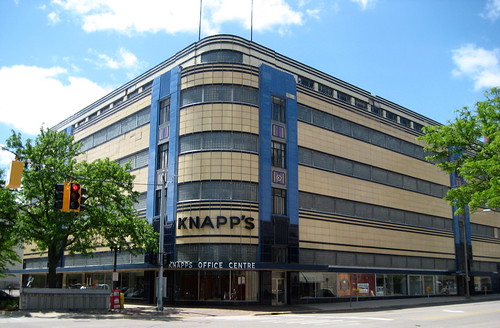
The Knapp Building says “Lansing has next”

Knapp's Office Centre

Knapp’s Office Centre, photo by Eridony.

Last week on Absolute Michigan we had a story about Lansing being named the Next American City. The article by Ivy Hughes in Next American City is titled Lansing: There’s No Place We’d Rather Be and might change your view of Michigan’s changing capital city. I had selected this photo for a quick link over to the article because I have always thought the building is neat. I soon learned that the long vacant Knapp’s Office Centre building is being renovated, another tangible sign of the new energy that is rising in Lansing.

Wikipedia’s J.W. Knapp Company Building entry says:

The J.W. Knapp Company Building is a historic five-story, 190,000-square-foot (18,000 m2) Streamline Moderne building in Lansing, Michigan, United States. Designed by Orlie Munson of the Bowd–Munson Company, which also designed several other Art Deco landmarks in Lansing, including the Ottawa Street Power Station, it was constructed by the Christman Company in 1937 through 1938. The curvilinear look of the streamlined structure comes from huge plates of concrete faced with enamel, called “Maul Macotta”, a copyrighted product of the Maul Macotta Company and prismatic glass brick windows. Alternating horizontal bands of yellow macotta and glass block are interrupted by vertical blue macotta pylons, rising from the building’s four principal entrances. The pylons are pierced by windows. The entrance portals, display window aprons, and decorative banding are dark blue macotta. Red, yellow and blue spandrels, incorporating the letter “K” as a design element, decorate the entrance portals

The building housed the main department store of the Lansing-based J.W. Knapp Company. When completed in 1939, it was hailed in the contemporary press as “the most modern building in the Midwest”. Today, it is considered to be one of the finest intact examples of Streamline Art Moderne commercial buildings in the Midwest, notable for its size, clarity of design and brilliant colors.

Don’t miss this great set of Historic photos of J.W. Knapps Building in the Lansing State Journal.

See this photo big as a building and see this and other shots of the building in Brandon’s massive Downtown Lansing slideshow.

Mackinac Bridge Sunset

Mackinac Bridge  Sunset

Mackinac Bridge Sunset, photo by GLASman1.

From high above the Straits of Mackinac

Check it out background big and in Mark’s slideshow.

More Michigan aerial photographs from Michigan in Pictures.

Harvest the Wind

wind_farm_pigeon 002

wind_farm_pigeon 002, photo by eXtension Ag Energy.

Yesterday on Absolute Michigan we posted an article from Great Lakes Echo wondering if Michigan will harness offshore wind and pass the bill in the House to regulate wind farms in Michigan’s Great Lakes waters.

Land based wind farms around the state are already tapping this resource. The largest of these is the Harvest Wind Farm that spans 3,200 acres between Elkton and Pigeon, Michigan, in Huron County. Each of the wind farm’s 32 turbines stand 262 ft tall (393 with the 131′ blades) and is capable of producing 1.65 megawatts of electricity, for a total project capacity of 52.8 megawatts.

You can get a sense of the scale of the farm in these cool aerial shots. Something to consider is that 52.8 megawatts is enough to power 15,000 or so homes. When you think about the total population of Michigan and the space available to site wind turbines, it’s hard to see how we will be able to meet our energy demands without using the Great Lakes.

MSU Extension Bioenergy Educator Dennis Pennington took the shot above in July of 2009. Check it out background big and also in his wind slideshow (some of the shots show construction and give a sense of the scale of these massive machines).

Elberta Beach During the Hang Gliding Heydays

Elberta Beach During the Hang Gliding Heydays

Elberta Beach During the Hang Gliding Heydays, photo by jimflix!.

As a payback for yesterday’s icy cruelty, here’s a warm remembrance of summer in the 1970s.

Frankfort & Elberta on Lake Michigan was a hang gliding and soaring hotspot in the 1970s and earlier. Here’s a shot of sailplanes in the 1930s, a little Frankfort-Elberta Area Hang Gliding information and a video of present-day hang-gliding at Green Point Dunes. About this photo Jim writes:

Not a lot of beach that year (and the water was high), so there was not a lot of room to land! Then you had to hope folks would Get Out Of The Way! (And usually they did, as they were mostly hang gliding families or followers.)

Taken at the Elberta beach on Lake Michigan in the late 1970s

Check it out big as the sky and see more in his Hang gliding and hang gliders slideshow!

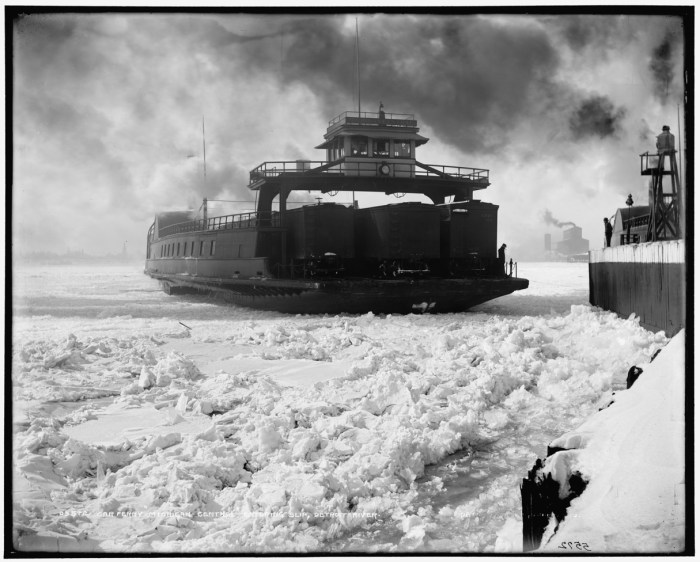
Rail Car Ferry Michigan Central on the Detroit River

Car ferry, Michigan Central, entering slip, Detroit River, photo by Detroit Publishing Co.

It’s kind of cruel to post a photo like this while it’s still November. I think we all know what’s coming though…

I spent some time learning about this photo I found in the Library of Congress aka maybe the coolest place on the internet. (You probably paid 3 cents for it last year, so check it out sometime). I finally found the same photo on the fantastic photo blog Shorpy. One of the commentors writes:

This is the Detroit side. The river flows extremely fast, and the ferry docks were set up so the boats always entered dock facing upstream. Michigan Central was built in 1884 by Detroit Dry Dock in Wyandotte, while Transport was built there in 1880. Both were cut down to barges by the 1930’s. A nearly identical boat, Lansdowne of 1884, survived in steam until 1970 for CN/Grand Trunk, until she blew a cylinder head (I remember the shock among the Detroit trainwatching community at the time).

You can see the Lansdowne of Windsor on Michigan in Pictures and check the comments at Shorpy for more including a shot of this location from the Ambassador Bridge in 1957.

See the photo background bigtacular at Shorpy.

Michigan’s Toughest Subject? Chapel Rock And Roots

Chapel Rock And Roots

Chapel Rock And Roots, photo by James Marvin Phelps (mandj98).

Today I’m hoping to visit Chapel Rock in the Pictured Rocks National Lakeshore. You can read more about it right here on Michigan in Pictures.

One thing I have to say is that this is one of the toughest subjects I’ve ever shot and that James has done a great job of capturing the awesomeness of this natural wonder of Michigan. Check it out bigger and in his Pictured Rocks National Lakeshore slideshow.