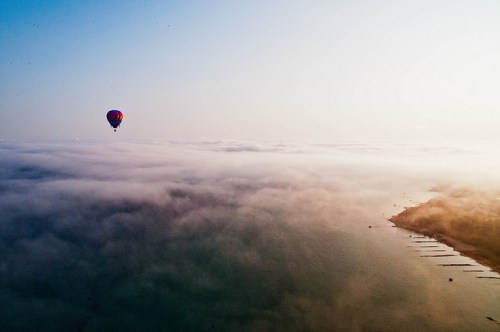
Hot Air Balloon Ride over Grand Traverse Bay

Hot Air Balloon Ride-19

Hot Air Balloon Ride-19, photo by alioops1956

Here’s a great set of photos from a misty hot air balloon ride over Grand Traverse Bay. Check it out background bigtacular and in Alison’s Hot Air Balloon Ride slideshow.

I’m pretty sure this is a balloon from Grand Traverse Balloon.

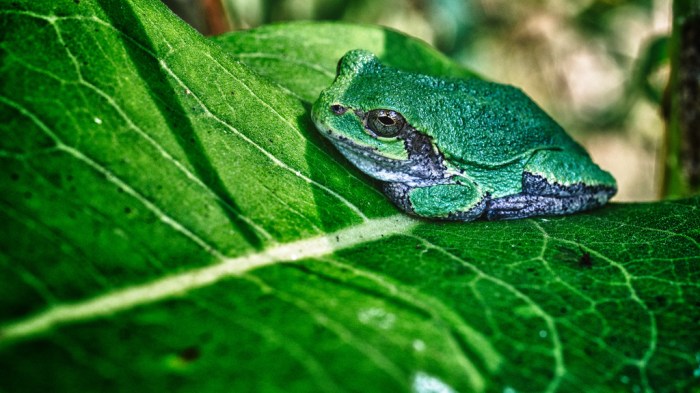
The Gray Treefrog doesn’t care if you’re confused

Gray Tree Frog

You Can’t See Me, photo by MacDonald_Photo (Formerly Sl33stak)

Michigan has two species of Gray Treefrog – the Eastern (Hyla versicolor) and Cope’s (H. chrysoscelis) that are hard to distinguish, sometimes even sharing the same ponds. Check out the Hyla versicolor page at the UM Animal Diversity Web for a bit about that. Their color spans a range of gray, green or brown according to environment or activity. See a collection of photos showing their wide range of color at the UM Animal Diversity Web.

They can be found in woods, swamps and your own backyard. Their ability to climb vertically & horizontally is due to their specially adapted toe pads, and you’ll sometimes find them on your screen windows at night. You’ll hear their short musical trill on warm spring & summer nights.

Jamie writes that he walked 20′ into the woods off a heavily used path and ran into this little guy – small as his thumb and sitting on a milkweed. Check this out background bigtacular and see more in his Fauna slideshow.

More Michigan frogs on Michigan in Pictures. Or, for something different, here’s what we have for green!

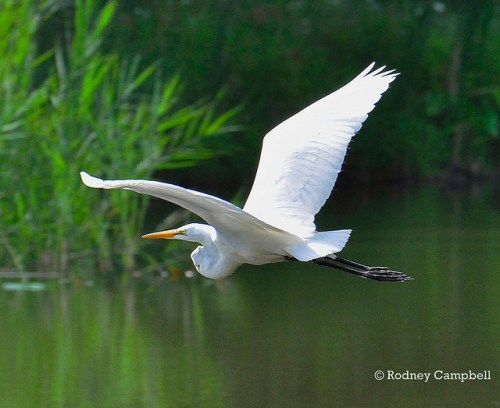
Great Egret (Ardea alba) in Flight

Great Egret (Ardea alba) in Flight

Great Egret (Ardea alba) in Flight, photo by AcrylicArtist

The Michigan Bird Atlas has a nice document on the Great Egret in Michigan that says (in part):

Today, the Great Egret is a powerful symbol of early conservation efforts mounted to safeguard it and other species from overhunting for their feathers in the 1800s. Protection in the early 1900s is credited with population recovery and establishment of the Great Egret as a breeding species in Michigan approximately 50 years ago.

…Great Egrets reach the northern edge of their U.S. distribution in Michigan. Historically, there is no evidence that this species nested in Michigan until the 1950s. For example, Barrows (1912) and Wood (1951) did not report Great Egrets as breeders in Michigan at the time of their studies, but Kelley et al. (1963) confirmed nesting in 1954 by nine pairs on Stoney Island (Detroit River) and seven on Dickinson Island (Lake St. Clair). These colonies appear to have persisted into the mid-1970s when W. Scharf et al. (1978) documented egrets at these sites in 1976. Although these colonies were no longer active at the time of the 1989-91 Great Lakes Colonial Waterbird Census, Sharf and Shugart (1998) reported new colonies in Saginaw Bay and at Pte. Mouillee State Game Area, Monroe Co.

The UM Animal Diversity Web has some information, calls and photos for Ardea alba, and also Great Egret (Ardea alba) on Michigan in Pictures.

Check this photo out background big and see more in Rodney’s Animals slideshow.

More Michigan birds on Michigan in Pictures.

Comerica Park, home of the Detroit Tigers

Tigers Game_2012-07-21_15-08-05_P7210017_©MikeBoening_2012_HDR (1)

Tigers Game, July 21, 2012, photo by memories_by_mike

It may come as a surprise to regular readers that despite all the posts about the Detroit Tigers here and at Absolute Michigan, I’ve never been to Comerica Park. Today I not only get to go – I get to sit on the 3rd base line (2nd row!!)as the red-hot Detroit Tigers face the New York Yankees tonight!

Wikipedia’s entry for Comerica Park (edited a bit by me) explains that:

Groundbreaking for a new ballpark to replace Tiger Stadium for the Tigers was held on October 29, 1997 and the new stadium was opened to the public in 2000. In December 1998, Comerica Bank agreed to pay $66 million over 30 years for the naming rights for the new ballpark. Comerica Park sits on the original site of the Detroit College of Law.

In contrast to Tiger Stadium, which had long been considered one of the most hitter-friendly parks in baseball, Comerica Park is considered to be extremely friendly to pitchers. Except for dead center – 420 feet versus Tiger Stadium’s 440 feet – the outfield dimensions were more expansive than those at Tiger Stadium. This led to complaints from players and fans alike, and engendered the sarcastic nickname Comerica National Park.

Although a few public figures—notably radio announcer Ernie Harwell—supported the dimensions, most agreed that the left-field wall, in particular, needed to be brought closer to home plate. Before the 2003 MLB season the club did so, moving the distance from left-center field from 395 to 370 feet. In place of the old bullpens in right field, 950 seats were added for a new capacity of 41,070.

At the time of construction, the scoreboard in left field was the largest in Major League Baseball. The first playoff game at Comerica was played on October 6, 2006 against the New York Yankees. It hosted its first World Series later that month. The stadium also includes many baseball-themed features, including a “Monument Park” in the deep center field stands, complete with statues of former Tigers Ty Cobb, Hal Newhouser, Charlie Gehringer, Hank Greenberg, Al Kaline, and Willie Horton.

A few neat things I found are Comerica Park from Ballparks.com, baseball writer Geoff Baker touring Comerica,  Calvin Johnson hitting a HR in BP, Comerica on Michigan in Pictures, a time-lapse of the installation of the new high-def scoreboard, the slightly bizarre Comerica UFO footage and a very cool RC plane fly-over of Comerica.

Check this photo out big as a ballpark and in Mike’s slideshow.

A Map of the Wind

Breakwall Waves

Breakwall Waves, photo by Gary of the North

The Great Lakes Echo’s Jennifer Kalish has a feature on an animated wind map that’s driven by real-time data.

Two digital artists recently released an animated map illustrating the speed and direction of surface winds across the U.S.

Its ever changing patterns are driven by wind data from the National Digital Forecast Database kept by the National Oceanic and Atmospheric Administration.

The database also feeds information to the administration’s Great Lakes current map released last month to help the public better understand lake currents.

Click here to see the Wind Map.

Terry Pepper’s Seeing the Light says that the iron pier light is 55 feet tall, and Gary’s photo from Sunday at the breakwall in Grand Marais shows what wind can do to the waves of Lake Superior! See this photo as big as the big lake or jump into his slideshow for a couple more shots of the wave action!

Read more about the Grand Marais Pier Light on Michigan in Pictures.

The Beauty of Lake Charlevoix

Lake Charlevoix Yacht Race

Lake Charlevoix Yacht Race, photo by Innerspacealien

Last week USA Today released their list of the best lakes in America. The Great Lakes were not eligible and Lake Tahoe was the winner, but Lake Charlevoix in Northern Michigan managed to grab the runner-up spot. Click that link to read what some of their readers wrote. The Lake Charlevoix Lake Association says:

Lake Charlevoix is the third largest lake in the state with a surface area of over 17,200 acres and approximately 60 miles of shoreline. The maximum depth in the main basin is 122 feet and in the south arm, 58 feet. It is located at 45 degrees north latitude and 85 degrees west longitude. It has direct access to Lake Michigan via dredged channels in and out of Round Lake in the city of Charlevoix. There are close to 1,700 lots on the lake, with approximately 1,200 different owners. The lake is usually frozen for about three months of the year from near the end of January to early April.

There are three cities at the ends of the lake. Boyne City is at the east end of the main lake and is a historic lumber and tannery town. It is now a year round recreation center with the lake in the summer and Boyne Mountain ski resort in the winter. East Jordan is at end of the south arm and was also important in lumbering in the nineteenth century as well has having a large iron works that is still there today. The city of Charlevoix is at the mouth of the lake and is both a historic and present day resort town.

The city of Charlevoix is named after Pierre François Xavier de Charlevoix, a French explorer who traveled the Great Lakes and was said to have stayed the night on nearby Fisherman’s Island one night during a harsh storm. Lake Charlevoix had been named “Pine Lake” until 1926 when it was decided to change the name because, among other reasons, most of the pines had been harvested in the previous century and there were 25 other lakes in Michigan with that name.

They also have some great historic photos you can check out.

See Craig’s photo background big and see more photos from the area in his Up North slideshow.

More great Michigan lakes on Michigan in Pictures!

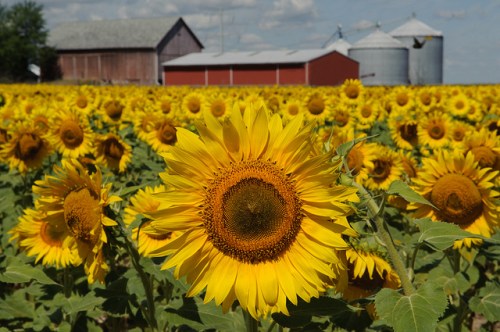
Sunflower Season in Saline

Sunflower Field

Sunflower Field, photo by C E Andersen

August is sunflower season in Michigan, and this shot is a beaut!

Check it out background bigtacular and in Chuck’s Sunflowers slideshow.

More great Michigan wallpaper on Michigan in Pictures!

How Alpena got its name

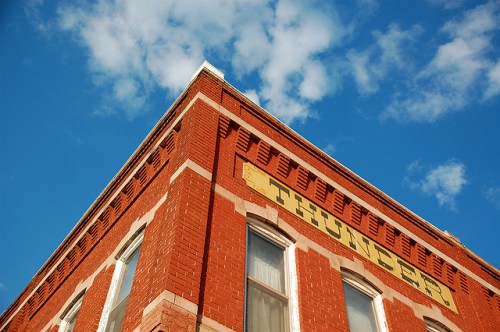
Brick Thunder

Brick Thunder, photo by cmu chem prof

The Pure Michigan Blog has an excellent series on how Michigan cities got their names. They are up to Part 10. One of the cities is Alpena:

Alpena

Alpena County was first named “An-a-ma-kee,” or “Thunder,” in honor of an old Chippewa chief of the Thunder Bay band who had signed a treaty negotiated with Henry Schoolcraft in 1826. After studying the Indian legends around the word “An-a-ma-kee” (or Animikee), Henry Schoolcraft concluded that the name was not completely appropriate. Then he manufactured the name Alpena from “Al,” an Indian syllable meaning “the”, and either “pinai,” an Arabic word meaning “partridge,” or “peanaisse,” an old French word meaning “bird.”

Check this photo out background big and in Phil’s huge Cities & Towns slideshow.

Cloud Bridge

cloud bridge

cloud bridge, photo by gerrybuckel

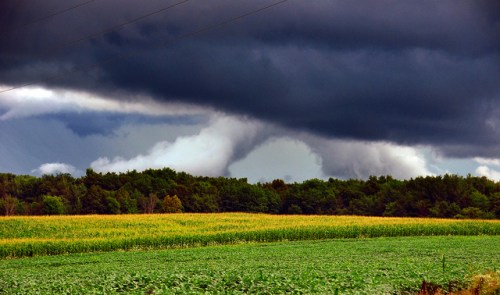
In honor of the rain we’ve recently received in parts of Michigan…

Check this out big as the sky and see more shots she’s shared in the Absolute Michigan pool in her Absolute Michigan slideshow.

More Michigan skies on Michigan in Pictures!

Gypsum & Alabaster

Old Off Shore Alabaster Loading facility

Old Off Shore Alabaster Loading facility, photo by hz536n/George Thomas

One of the neatest features for me about Michigan in Pictures are the many things I learn from the photos that are posted. Today’s photo of the Lake Huron loading platform for US Gypsum is a perfect example. The Iosco County Historical Society explains that:

The tramway of the U. S. Gypsum Company at Alabaster has long been a tourist attraction. Built in 1928 the tramway stretches 1.3 miles out into Saginaw Bay. Like a horizontal ski-lift, the cable system carries 72 “buckets” of gypsum to a waiting ship or to the storage bin. Each bucket holds more than two tons. The tramway includes 6,450 feet of one and three-quarter inch steel cable and 14,000 feet of three-quarter inch cable. At a length of 6,350 feet it is the longest over-water bucket tramway in the world.

…Until 1898 when the railroad spur was installed, all shipments were made by sailing vessels that tied up to a 600 foot dock. Marine shipments were resumed in 1929 after the building of the tramway enabled the larger ships to load in deeper water at the end of the tramway. Rail shipments were then made when the boat season was closed.

The tramway was dismantled (though concrete pads which may house wind turbines remain). You can also read an interesting account detailing the history of the town of Alabaster. While I knew that gypsum was used in drywall, I had no idea of its versatility (or Michigan’s status as a leading gypsum producer). You can learn about in great detail from MSU Geology’s page on gypsum:

If you were given a chance to win a jackpot by correctly naming a material that was used in the pyramids and in your toothpaste; that helps peanuts grow and makes movie snow; and that is used in mushroom beds and the walls of your house, chances are at least 100 to 1 that the quizmaster would holler “Sorry, your time is up,” before you could say “hydrous calcium sulphate.”

But, don’t feel badly.

Even though more than 12 1/2 million tons of gypsum were used in the USA last year, and even though the average person is surrounded by gypsum products from dawn to dusk, from the cradle to the grave, people do not know much about gypsum.

Gypsum can be ground up and “boiled” (calcined) at a comparatively low temperature until 75% of its moisture content has evaporated. When that happens, the rock becomes a fine powder, commonly known as Plaster of Paris. By returning the water to the powder, one can make a pliable mortar that can be formed into any shape and hardened. Gypsum is the only natural substance that can be restored to its original rock-like state by the addition of water alone.

Check this photo out background big and see more in George’s Fall 2009 slideshow.