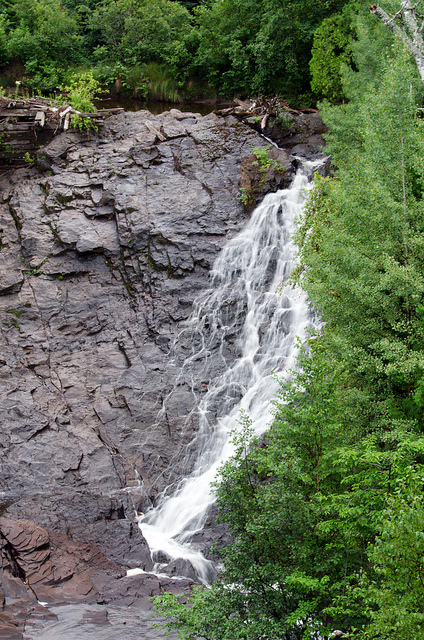
Channel Currents & Longshore Currents at Picnic Rocks

Storm Clouds over Picnic Rocks in Marquette, MI Labor Day 2012

Storm Clouds over Picnic Rocks in Marquette, MI Labor Day 2012, photo by Superior Seasons

Picnic Rocks is a popular beach area in Marquette. I thought that I’d come up with a good story for the name, but instead, I learned about the formation and dangers of what are known as channel & longshore currents. The Marquette National Weather Service explains:

A channel current is caused when water is squeezed between the shore and an offshore structure or feature (such as an island). When water is squeezed it speeds up, thus causing the current. This is like putting a smaller nozzle on a garden hose. When the smaller nozzle is on, the water comes out faster.

This current can be enhanced by what is known as a longshore current, a current that is generated by waves breaking onshore. As waves move onshore, they break in the direction they are moving in order to dissipate their energy. This causes the longshore current. Overtime, the current spans the entire width of the surf zone (the place where you swim). In the case of a channel current, the longshore current can speed up the channeling effect between the shore and the rocks, causing dangerous conditions to develop for those who are walking along the sandbar. The longshore current is maximized during times of higher waves that come in at a 45 degree angle to the shore.

…One could escape a channel current by swimming back to towards the shore. Many people make the mistake of swimming against the current as they are trying to get back to the sandbar. Think of the current as an underwater treadmill. In order to get off the treadmill, one needs to step off to the side of it. The channel current will be moving parallel to shore, so in order to escape, swim perpendicular to the shore.

Read on for more including a diagram demonstrating the best way to escape if you’re caught in these currents. A swimmer recently drowned here and this summer has been a deadly one – please use your knowledge to help others stay safe!

So we don’t end on a down note, let me say that in good weather, Picnic Rocks is a fantastic, natural playground for folks of all ages!!

Check this out background big and in Superior Season’s Marquette slideshow.

More from Marquette on Michigan in Pictures.
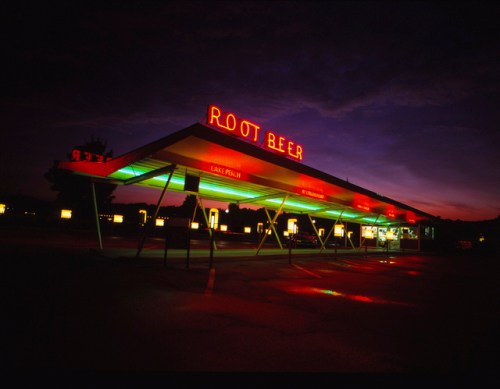
Film?

Film

Film, photo by karstenphoto

Film. How does it make you feel? When you see a photo shot with real film on a computer – whether as a print or in the developing tray – is there a difference?

Check this out background bigtacular and see this and several more in Steve’s ectachrome slideshow and please share your comments below.

More on cameras & film on Michigan in Pictures.

Some say Masquigon, some say Muskegon

Masquigon

Masquigon, photo by Rudy Malmquist

Wikipedia’s Muskegon entry explains that:

“Muskegon” is derived from the Ottawa Indian term “Masquigon” meaning “marshy river or swamp”. The “Masquigon” river was identified on French maps dating from the late seventeenth century, suggesting that French explorers had reached Michigan’s western coast by that time.

Father Jacques Marquette traveled northward through the area on his fateful trip to St. Ignace in 1675 and a party of French soldiers under La Salle’s lieutenant, Henry de Tonty, passed through the area in 1679.

The earliest known Euro-American resident of the county was Edward Fitzgerald, a fur trader and trapper who first came to the Muskegon area in 1748 and who died here, reportedly being buried in the vicinity of White Lake. Sometime between 1790 and 1800, a French-Canadian trader named Joseph La Framboise established a fur trading post at the mouth of Duck Lake. Between 1810 and 1820, several French Canadian fur traders, including Lamar Andie, Jean Baptiste Recollect, and Pierre Constant had established fur trading posts around Muskegon Lake. In 1830 Muskegon was an Ottawa village.

Euro-American settlement of Muskegon began in earnest in 1837, which coincided with the beginning of the exploitation of the area’s extensive timber resources. The commencement of the lumber industry in 1837 inaugurated what some regard as the most romantic era in the history of the region.

Read on at Wikipedia.

Check this photo out background bigtacular and see more in Rudy’s Neutral Density slideshow. While we’re at Wikipedia…

In photography and optics, a neutral density filter or ND filter is a filter that reduces and/or modifies intensity of all wavelengths or colors of light equally, giving no changes in hue of color rendition. It can be a colorless (clear) or grey filter. The purpose of a standard photographic neutral density filter is to allow the photographer greater flexibility to change the aperture, exposure time and/or motion blur of subject in different situations and atmospheric conditions.

History? Yes, Michigan in Pictures has lots and lots of Michigan history … and a fair bit on Muskegon too!

Eastern Chipmunk (Tamias striatus)

Untitled

Untitled, photo by kdclarkfarm1

The newly redesigned University of Michigan Animal Diversity Web says that Tamias striatus (eastern chipmunk):

Eastern chipmunks live in shallow burrows in the ground. They are partial to areas near rocky crevices, decayed tree trunks, and fence corners. They do not like dense forests where no sunlight reaches the ground. Burrows are made by digging and carrying away the dirt in their pouched mouths. Unlike prairie dogs and other sciurids, eastern chipmunks do not leave the dirt in mounds near the entrances of their burrows. This makes it harder for predators to find chipmunks in their homes. These burrows can be up to 30 ft. in length with several different exits and tunnels. Eastern chipmunks conceal the exits with leaves and rocks. They may inhabit these burrows for several years.

Eastern chipmunks are larger than most chipmunks. They are reddish brown in color with 5 black stripes on their backs. These stripes are separated by brown, white, or grey fur stripes. They also have white and dark markings around their eyes. The stomach is usually a yellowish brown or white color. Their tails are reddish brown and furry, but not bushy like common squirrels. Like many rodents, Tamias striatus has 4 toes on the front feet and 5 toes on the rear feet.

…Eastern chipmunks have excellent vision, hearing, and sense of smell. They communicate with each other by making a variety of sounds, including the ‘chip’ for which they are named.

Tamias striatus eats a wide variety of foods including nuts, acorns, seeds, mushrooms, fruits, berries, and corn. They also eat insects, bird eggs, and sometimes small vertebrates such as young mice.

Read more and see a bunch more photos of chipmunks as well!

Check this out background big (which is decidedly bigger than a chipmunk) and see more in Diane’s slideshow.

More Michigan animals right here.

The biggest apple in Michigan … and the smallest crop

Biggest apple in Michigan. Wolf River apple. 1996

Biggest apple in Michigan. Wolf River apple. 1996, photo by vostok71

Orange Pippin says that the Wolf River apple (first discovered along the river of the same name in Wisconsin) is:

A well-known American cooking apple, notable for its large size. Wolf River is mainly used for cooking, and it keeps its shape when cooked. It is fairly sweet and doesn’t need much sugar added.

Wolf River has a very high natural resistance to the disease apple scab, and good resistance to fireblight and mildew. It is also very cold hardy, making it a good choice for growing in the northern part of North America.

The Freep notes that the extreme damage to Michigan’s 2012 apple crop has created problems for those in the apple business:

Prices will vary, but consumers can expect fresh apple prices to be about 30% to 50% higher than last year, according to Bob Tritten, Michigan State University Extension Service fruit educator for southeast Michigan. Cider prices are up about 50%.

Last year’s Michigan apple crop was about 26 million bushels, said Dawn Drake, manager of the Michigan Processing Apple Growers Division, a branch of the Michigan Farm Bureau. But early warm weather forced the apple blossoms out early, and that was followed by several days of freezes, which killed most of the tender young blooms.

“This year they’ll be lucky to have 2 (million bushels),” Drake said.

Sergei didn’t think much of the taste when he tried it at the Tree-Mendus Fruit Farm in Eau Claire, but I read that the Wolf River doesn’t reach full flavor unless it gets hit by frost. Check it out bigger and see more in his Fall slideshow.

Purple Martins (and Mosquitos)

Decoy Upside down

Decoy Upside down, photo by F. D. Richards

Putting up a Purple Martin house is like installing a miniature neighborhood in your backyard. In the East, dark, glossy-blue males and brown females will peer from the entrances and chirp from the rooftops all summer … Our largest swallows, Purple Martins perform aerial acrobatics to snap up flying insects.
~ All About Birds

The Purple Martin Conservation Association says that Purple Martins (Progne subis) are the largest member of the swallow family in North America, measuring 7 1/2 inches (19 cm) long and weighing 1.9 ounces (55 grams). Of the three races (subspecies), the ones we see in Michigan are Progne subis subis. The PMCA page on Attracting & Managing Purple Martins says:

Purple Martins spend the non-breeding season in Brazil then migrate to North America to nest. East of the Rockies they are totally dependent on human-supplied housing. West of the Rockies and in the deserts they largely nest in their ancestral ways, in abandoned woodpecker nest cavities. In the Pacific northwest, Martins are beginning to use gourds and clusters of single-unit boxes for nesting.

The pair-bond of the Purple Martin is monogamous. The male and female cooperate equally in building the nest out of mud, grass and twigs. The female lays two to seven pure-white eggs at a rate of one egg per day. The female incubates the clutch for approximately fifteen days, then the young hatch. The parents both feed the young continuously for a period of 26-32 days until the young fledge. The young continue to be dependent on their parents for food and training for an additional one to two weeks after fledging. It’s not uncommon for the fledglings to return to their human-supplied housing at night to sleep during this period. (Click to see an animation of the growth of a nestling purple martin.)

Martins, like all swallows, are aerial insectivores. They eat only flying insects, which they catch in flight. Their diet is diverse, including dragonflies, damselflies, flies, midges, mayflies, stinkbugs, leafhoppers, Japanese beetles, June bugs, butterflies, moths, grasshoppers, cicadas, bees, wasps, flying ants, and ballooning spiders. Martins are not, however, prodigious consumers of mosquitoes as is so often claimed by companies that manufacture martin housing. An intensive 7-year diet study conducted at PMCA headquarters in Edinboro, PA, failed to find a single mosquito among the 500 diet samples collected from parent martins bringing beakfuls of insects to their young. The samples were collected from martins during all hours of the day, all season long, and in numerous habitats, including mosquito-infested ones. Purple Martins and freshwater mosquitoes rarely ever cross paths. Martins are daytime feeders, and feed high in the sky; mosquitoes, on the other hand, stay low in damp places during daylight hours, or only come out at night.

While it sounds like purple martins aren’t the mosquito machine that they’re sometimes billed as, it does sound like they’d make a great addition to your yard!  Read on to learn about all kinds of things you can do to make your martin house a home. Also check out their songs page and get a lot more info and photos from the All About Birds Purple Martin page.

Check this photo out background big and in F.D.’s Birds slideshow.

Aboard the Friends Good Will

P5115272_4639

Untitled, photo by bvriesem

“We have met the enemy and they are ours: Two Ships, two brigs, one schooner and one sloop.”
~United States Commodore Oliver Perry

The sloop was Friends Good Will, captured by the British briefly. The story of the Friends Good Will begins:

Oliver Williams was born in Roxbury, Massachusetts, a village near Boston, in 1774. Undoubtedly, he grew up aware of, and hearing stories about, the birth of his young nation.

Oliver Williams later saw opportunity in the vast Northwest Territory. He opened a dry goods store in Detroit, Michigan Territory, in 1808. The inventory for his store, like nearly all finished goods, came from the east. He made two trips each year, overland. The trips were slow and the resources he expended were never anything more than a continuing drain against whatever profits early businesses in the cash starved frontier would permit.

In 1810, Oliver Williams took a chance. The gamble was not particularly unusual for men of his nature. Men did not conduct business on the frontier without an entrepreneurial instinct. He decided to build a ship. The vessel would use the only “highway” available – Lake Erie; Buffalo to Detroit, non-stop, direct. His inventory would arrive faster, and in greater quantity, and while the vessel was a substantial capital outlay, she would sail for years and could earn money by shipping goods the length of each shipping season. Other vessels plying the Lakes were finding cargoes and the steady stream of settlers assured volumes of cargo and demand for the ship would only grow with each coming season.

Oliver Williams built his ship at the River Rouge, on the banks of the Detroit River. A private shipyard was laid out adjacent to the Federal yard, where the army transport snow Adams, the only government vessel on the upper Lakes, was built years before. Other ships sailed past while this new vessel took shape, the schooners Salina and Ellen and the sloop Contractor. The sight of each of them only encouraged Oliver Williams. His idea had merit; his gamble would pay.

The new ship slid down the ways, in early 1811. He christened her Friends Good Will. While no one knows for certain the origin of the name, a coincidence seems too obvious to ignore. The name may well have been in honor of an earlier Friends Good Will, which transported the first wave of Irish immigrants from Larne to Boston in 1717. It is likely Oliver Williams knew her story and borrowed her name. His vessel, he likely hoped, would also bring waves of settlers to a new land of opportunity ­ the Michigan Territory.

Read on for much more of the story of the remarkable story of the Friends Good Will including her capture by the British and subsequent adventures. See a video right here and definitely visit the Michigan Maritime Museum, online and when you’re South Haven for much more of Michigan’s maritime history.

Check this out background big and take a trip in Bill’s May 2012 Aboard the Friends Good Will slideshow.

What’s in a Name? Tahquamenon Falls edition

Tahquamenon Falls

Tahquamenon Falls, photo by AndrewH324

We’ll close out Waterfall Week on Michigan in Pictures with this photo that has been the cover photo on the Absolute Michigan Facebook all week. Here’s hoping that you get a chance to enjoy one of Michigan’s nearly 200 waterfalls soon!

With a drop of nearly 50 feet, a width of over 200 feet and a maximum flow of more than 50,000 gallons of water, the Upper Tahquamenon Falls are one of the largest waterfalls east of the Mississippi. Pronounced about how it looks – like “phenomenon,” the falls gained fame way back in 1856 in Henry Wadsworth Longfellow’s Song of Hiawatha:

Lay aside your cloak, O Birch-tree! lay aside your white-skin wrapper,
For the Summer-time is coming, and the sun is warm in heaven,
And you need no white-skin wrapper!” thus aloud cried Hiawatha
In the solitary forest, by the rushing Taquamenaw

A feature back in 2006 from the Chicago Tribune offers one popular theory for the name:

The river and its two falls (the smaller Lower Falls are further downstream) are located in the northeast part of Michigan’s Upper Peninsula, just miles from Lake Superior, in the 46,000-acre Tahquamenon Falls State Park. The Upper Falls is one of the largest waterfalls this side of the Mississippi in the United States. (Niagara–shared with Canada–is the largest.)The park is dense with both hardwoods and pine and filled with wildlife. Sightings of moose, gray wolves, black bears, American martens and river otters are typical, and have always been an attraction for nature lovers–including Henry Wadsworth Longfellow, whose poem about this area recounts how Hiawatha built his canoe “by the rushing Tahquamenaw.” The spelling was a variation of Tahquamenon, which comes from an Ojibwa word meaning “dark berry.”

Origins of the Name from the Michigan DNR suggests an alternative root of the name:

The word Tahquamenon has not been as easy to trace. There have been many theories to the origins of this name, such as the color of the water of the Tahquamenon River or meaning the place of the blueberry swamps.

In his book, “Lake Superior Place Names: From Bawating to the Montreal,” Dr. Bernard C. Peters sheds additional light on the subject. Peters suggests the word Tahquamenon comes from the word Outakouaminan, which appears on a 1671 Jesuit map. The key is its location on the map. Because it is shown near an island in what now is Whitefish Bay, Peters believes the name actually refers to a shortcut across the bay.

Wherever the name came from, there’s no doubt that this is a “can’t miss” waterfall. You can get the 411 on Tahquamenon Falls at Go Waterfalling.com and see a video of the case for the falls as one of the Seven Wonders of Michigan. Also check out this great video of the falls from 1950 and see a cool old photo of the falls right here.

Check this photo out background bigtacular and in Andrew’s Upper Peninsula slideshow.

Lots more Tahquamenon Falls on Michigan in Pictures.

Ocqueoc Falls, a big fish in a small pond

Ocqueoc Falls

Ocqueoc Falls, photo by joeldinda

Way back in 2006 Michigan in Pictures featured another photo of Ocqueoc Falls. If towering falls are what you’re looking for, you’ll probably need to keep looking. GoWaterfalling.com has this to say about Ocequeoc Falls near Onaway:

Ocqueoc Falls is the only “major” waterfall in Michigan’s lower peninsula. In rockier, hillier parts of the world this would be a nameless rapids of no note but here in the farmlands and forests of Michigan it merits its own little park. The falls is at most 5 feet high. There is a small gorge below the falls, with rocky walls about 20 feet high. The Ocqueoc Falls State Forest Campground is just across the road, and the Bicentennial Pathway passes by the falls.

Check this out background bigtacular and see more in Joel’s Waterfalls slideshow.

More Michigan waterfalls on Michigan in Pictures!

Eagle River Falls, actually

DSC_3761_edited-1.jpg

DSC_3761_edited-1.jpg, photo by Bearcats Photography

Only the second day of Waterfall Week on Michigan in Pictures and already I have egg on my face … maybe all those waterfalls can wash it off. An alert commenter noted that this waterfall is not Jacobs Falls but actually nearby Eagle River Falls. GoWaterfalling fortunately has the 411 on these falls that are about 4 miles from Jacobs Falls.

Eagle River Falls is in Eagle River, on MI-26. This is a roadside falls. There is a small park and a pedestrian bridge from where you can get a nice view of the falls. There is an old dam at the top of the falls. The falls used to power the Lake Superior Safety Fuse Factory. In the spring the falls is much wider and sometimes flows over the dam…

The pedestrian bridge used to be the main bridge, and is of historical interest. It is an early steel bridge. Personally, I thought the modern bridge it was replaced with was much more interesting.

Click through for more and also information about other nearby waterfalls. If you’re curious about the Lake Superior Safety Fuse Factory, click that link from some photos & recollections about this Eagle River business at pasty.com.

Speaking of nearby waterfalls, I found another cool site this morning. Waterfalls of the Keweenaw Area by Jacob Emerick features a nice map of waterfalls in the area as well as a list of waterfalls. He has several albums of photos on the Eagle River Falls page – check it out!

Check this out big as a waterfall and see more in Mike’s Upper Peninsula, mi slideshow.

More waterfalls on Michigan in Pictures.