The Other Witch of November: Witch Hazel

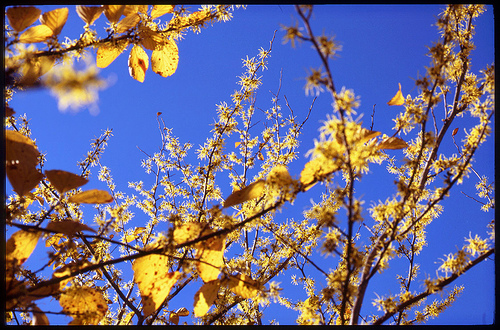
Witch Hazel

Witch Hazel, photo by Voxphoto

Naturalist Jonathan Schechter wrote an article last year entitled Witch of the Woods – and her name is Hazel about this small  tree that actually flowers in November:

Native Americans knew this tree before the invaders with guns and axes in tall sailing ships landed on the eastern shore and carved the land to suit their wants and needs. In colonial America even as the British exchanged shots with the rebellious colonists, the shrub’s flexible forked branches was being used as “witching stick” by the dousers: folks who held the forked branches in hand waiting for the tip to point to hidden waters. Bad news for Halloween fans: The word witch in witch hazel originates from the old English word for pliable branches “wych” and has nothing to do with a lady in black straddling an airborne broom.

Your grandmother and probably your mom (and maybe you) used this plant for a wide array of medical ailments. It is found in a liquid form in almost all drug stores today and sold as an astringent, and for treaments of irritations, pain and itching, skin conditions and another 20 or 30 uses!

More about Witch Hazel (Hamamelis) on Wikipedia.

Check this out background big, see  more in Ross’s garden slideshow and also see his past work on Michigan in Pictures.

Nawadaha Falls and the Sweet Singer of Hiawatha

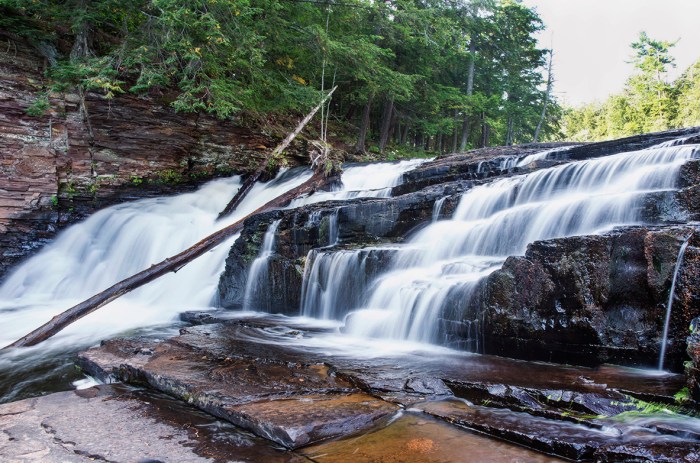
Nawadaha Falls

Nawadaha Falls, photo by Jason W Lacey

Should you ask me, whence these stories, whence these legends and traditions,
With the odors of the forest, with the dew and damp of meadows,
With the curling smoke of wigwams, with the rushing of great rivers,
With their frequent repetitions, and their wild reverberations,
As of thunder in the mountains.

I should answer, I should tell you: “From the forests and the prairies,
From the great lakes of the Northland, from the land of the Ojibways,
From the land of the Dacotahs, from the mountains, moors, and fenlands,
Where the heron, the Shuh-shuh-gah,  feeds among the reeds and rushes.
I repeat them as I heard them.
From the lips of Nawadaha, the musician, the sweet singer.”

~Henry Wadsworth Longfellow, The Song of Hiawatha

You may already be aware that one of the main purposes of this blog is to allow me to indulge in my passion for Michigan and its history. Names of the first people who dwelt in Michigan are of particular interest to me, and I was very gratified to discover not only that nawadjiwan is an Ojibway word meaning in the midst of the rapids, but also that it was the name of the singer who taught Longfellow The Song of Hiawatha.

I almost had to leave it there, but then I found a reference in Michael Witgen’s book An Infinity of Nations: How the Native New World Shaped Early North America.

Longfellow acknowledges Schoolcraft’s influence on veiled fashion, when he tells the reader he learned Hiawatha’s story “from the lips of Nawadaha.”  Few readers would realize that this was the Indian agent’s Ojibwe name. Logfellow asserts that Nawadaha had merely repeated these stories, not unlike himself and not unlike an Indian sitting in his lodge on long winter nights telling stories to amuse the children.

You can read on for the author’s puzzlement that Michigan Indian agent Henry Rowe Schoolcraft – himself married to a native woman Jane Johnston Schoolcraft (Oshauguscodawaquat) – would tell tales that are in large part false. As the Wikipedia entry on the Song of Hiawatha notes however,  Longfellow was far more concerned with excitement over accuracy and made numerous editorial decisions in the construction of his epic poem.

GoWaterfalling.com says that Nawadaha Falls is the upper most of the three falls along the Presque Isle Rivers final stretch.

This is a low, wide waterfall. Its width varies greatly depending on the water levels. Nawadaha Falls is similar to but a little higher than Manido Falls. The steepest part of the falls is on the eastern side, and when the river is low, most of the water flows there. There is a nice natural overlook out in front of this drop easily reached from the trail on the east side of the river.

South Boundary Road is not to far beyond Nawadaha Falls. You can cross river here and hike down the other side to make a loop around all the Presque Isle Falls. The eastern side is much wilder, but the whole hike is very enjoyable.

They add that Manabezho Falls is the larger and most interesting but that the whole hike is well worth it. To bring this full circle, the figure that Hiawatha is modeled on is the trickster god and emissary of the Great Spirit, Manabezho.

Check this out background bigtacular and see more in Jason’s great Michigan slideshow.

Many more Michigan waterfalls on Michigan in Pictures!

Zombies love Michigan Blood

ZombieDay

ZombieDay, photo by cpcaines

The Annual Grand Rapids Zombie Dash bills itself as the most terrifying night race in the world. Much as in the forthcoming zombie apocalypse, participants are divided into 2 classes, hardy survivors who will run a 5k for their lives a 5k, and members of the zombie horde who will attempt to separate said survivors from said lives. All the details are on the web site, and there’s also a post-race concert.

The event is also raising awareness for a topic near and dear to the un-beating hearts of zombies everywhere and also Michigan citizens. They’re holding early registration where you can also register for Michigan Blood Stem Cell Program at Gazelle Sports in Grand Rapids on Friday the 26th.

According to Barbara Hile, Program Manager for Michigan Blood’s Marrow/Stem Cell Program, “Patients needing blood stem cell (marrow) transplants can only find a suitable match within their family about 30% of the time. The remaining 70% of matches are made between complete strangers via the Be the Match Registry. Therefore, the more young people who join the Registry, the more chances we have of a match for thousands of patients with leukemia, lymphoma, and other blood diseases. A marrow transplant is often the patient’s last, best chance for survival.”

Read more at the link above or at www.BeTheMatch.org/join.

Check this out gruesomely gigantic and see more in cpcaines World Zombie Day, Royal Oak MI 2012 … if you dare.

Interesting (for me) side note: CP added three photos to the Absolute Michigan pool on Flickr and one of them was of my friend Bradley!

Michigan Wild & Scenic Rivers: Au Sable River

Changing Skies over the Au Sable HDR

Changing Skies over the Au Sable HDR, photo by hz536n/George Thomas

It is hereby declared to be the policy of the United States that certain selected rivers of the Nation which, with their immediate environments, possess outstandingly remarkable scenic, recreational, geologic, fish and wildlife, historic, cultural or other similar values, shall be preserved in free-flowing condition, and that they and their immediate environments shall be protected for the benefit and enjoyment of present and future generations.

~Wild & Scenic Rivers Act, October 2, 1968

Michigan’s has 16 Wild & Scenic Rivers. One of these is the Au Sable River. The 23 mile stretch of the river from Mio downstream to the 401 Bridge is the portion that has the National Scenic River designation, considered to offer some of the best canoeing in Michigan. It’s also a blue ribbon trout stream with excellent brown trout fly fishing and holding walleye, pike and bass as well.

With all that going for it, I was surprised by the lack of quality information available online about this river. Sometimes, having to dive a little deeper pays off as it has this morning with Michigan’s Au Sable River: Today and Tomorrow by G. E. Hendrickson. The paper was prepared way back in 1966 for the Michigan Department of Conservation under Gov. George Romney’s administration in conjunction with the Geological Survey and the United States Department of the Interior.

Located in the northern lower peninsula of Michigan, the Au Sable is known for its high water quality, scenery, recreational opportunities, coldwater fishery, and historic and cultural significance. It may just be the. If that were not enough reason to visit the river, the Au Sable is also one of the best canoeing rivers in the Midwest.

Two south-flowing rivers rise in the country north of Grayling. One, the Manistee, turns west to Lake Michigan; the other, the Au Sable, turns east to Lake Huron. Both are famous trout streams, but the Au Sable is perhaps enjoyed and cherished by more people than any other Michigan river. Cool clean flowing water, natural cover, and gravel spawning beds make it an outstanding trout stream. Its natural beauty attracts canoeists, campers, and cabin dwellers.

The upper Au Sable is a young river, as rivers go, having settled down to its present course after the glaciers retreated about 12,000 years ago. It was named by early French explorers, the name meaning “River of Sands.” Following close on the heels of the retreating ice, the earliest Indians moved into Michigan, and possibly into the Au Sable area. The Indians hunted for deer, bear, mastodons, giant beaver, caribou, and other wildlife. They also fished for many species. To the Indians the Au Sable was a source of food and drink and a highway for canoe travel. Early white traders and explorers used the river for the same purposes, while the lumbermen valued it chiefly for transporting logs.

You can read on for a lot more including the story of the extinction of the Au Sable river Grayling and Au Sable River drift boats.

Check this out background bigtacular and see a ton more in George’s Fall & Autumn slideshow.

More of Michigan’s Wild & Scenic Rivers on Michigan in Pictures.

Bobcat or Lynx?

Bobcat

Bobcat, photo by sharona 315 사론아

Today’s post got an assist from 5-year-old Landen, who when I showed him this photo of a ‘bobcat’. After a careful look, he told me “Nope, that’s a lynx.” When I asked how he was so sure, he pointed out the prominent black ear tufts. Sure enough, as How Stuff Works explains on What’s the difference between a bobcat and a lynx? the ears are a big clue:

To begin with, the bobcat looks a bit more like an overgrown house cat than a lynx does. With extra-long tufts of fur on its ears and a shaggy mane of fur around its cheeks, the lynx takes on an otherworldly appearance. The long black ear tufts, which can grow to be almost an inch (2.5 centimeters) long, act as excellent hearing aids, enabling the agile cat to pick up on the soft footsteps of its prey.

A lynx also has larger feet and longer legs than a bobcat to help it navigate the deep snow common in its range. Its big, furry paws act like snowshoes to help this feline chase down food in the winter.

I couldn’t tell whether or not this is a lynx or bobcat, but it’s an interesting bit of knowledge. It’s pretty certain it’s a bobcat as the pic was taken near Howell, and the US Fish & Wildlife Service endangered species list for Michigan lists counties with the highest potential for Lynx presence as all UP counties: Alger, Baraga, Chippewa, Delta, Dickinson, Gogebic, Houghton, Iron, Keweenaw, Luce, Mackinac, Marquette, Menominee, Ontonagon and Schoolcraft.

The UM Animal Diversity Web adds more about lynx, and the Michigan DNR has a guide for distinguishing bobcat & lynx as well. If you do see one, report it to the DNR.

Check this out bigger than a bobcat or on Sharon’s map.

More Michigan animals on Michigan in Pictures including our Bobcat article.

ArtPrize 2012 Winner: Adonna Khare’s Elephants

Elephants 4

Elephants 4, photo by rkramer62

For the second time in 3 years, a large drawing at the Grand Rapids Art Museum has captured top honors in ArtPrize. mLive reports:

Adonna Khare, a week before the Sept. 19 opening of ArtPrize, installed her 8-foot tall, 35-foot wide drawing “Elephants,” on a second-story wall of the museum.

As ArtPrize unfolded, the artist from Burbank, Calif., continued to add daily to the original triptych, spilling over onto the museum walls with additional figures and more details, as thousands of people every day passed through the ArtPrize exhibition center.

“People would come and sit with me,” she said. “Kids would sit with me, and I could share about art.” More than three weeks later, Khare’s drawing has grown to be 14 feet tall, 40 feet wide, and her purse has grown $200,000 richer.

You can see this background big, check out a wider view of the entire piece or watch Rachel’s ArtPrize 2012 slideshow.

More art on Michigan in Pictures.

Fall is golden in Michigan

DSC01145

DSC01145, photo by ansonredford

One of the greatest treats Michigan offers is the annual fall color show, and I find it’s nice to have a little deeper appreciation about what’s going on inside sugar maples and other trees whose leaves change color in the fall. The Science of Color in Autumn Leaves from the US Arboretum explains that:

During the growing season, chlorophyll is replaced constantly in the leaves. Chlorophyll breaks down with exposure to light in the same way that colored paper fades in sunlight. The leaves must manufacture new chlorophyll to replace chlorophyll that is lost in this way. In autumn, when the connection between the leaf and the rest of the plant begins to be blocked off, the production of chlorophyll slows and then stops. In a relatively short time period, the chlorophyll disappears completely.

This is when autumn colors are revealed. Chlorophyll normally masks the yellow pigments known as xanthophylls and the orange pigments called carotenoids — both then become visible when the green chlorophyll is gone. These colors are present in the leaf throughout the growing season. Red and purple pigments come from anthocyanins. In the fall anthocyanins are manufactured from the sugars that are trapped in the leaf. In most plants anthocyanins are typically not present during the growing season.

Check this out big as a maple tree and in Donald’s autumn slideshow.

Set your background for fall with this photo or find lots more Fall wallpaper on Michigan in Pictures!

Things you may not know about Blue Jays

Back yard Blue Jay

Back yard Blue Jay, photo by kmenne

The All About Birds entry for Blue Jay (Cyanocitta cristata) says that these birds are known for their intelligence and complex social systems. Here’s a few facts – click above for more:

  • Thousands of Blue Jays migrate in flocks along the Great Lakes and Atlantic coasts, but much about their migration remains a mystery. Some are present throughout winter in all parts of their range. Young jays may be more likely to migrate than adults, but many adults also migrate. Some individual jays migrate south one year, stay north the next winter, and then migrate south again the next year. No one has worked out why they migrate when they do.
  • Their fondness for acorns is credited with helping spread oak trees after the last glacial period.
  • Blue Jays are known to take and eat eggs and nestlings of other birds, but we don’t know how common this is. In an extensive study of Blue Jay feeding habits, only 1% of jays had evidence of eggs or birds in their stomachs. Most of their diet was composed of insects and nuts.
  • The Blue Jay frequently mimics the calls of hawks, especially the Red-shouldered Hawk. These calls may provide information to other jays that a hawk is around, or may be used to deceive other species into believing a hawk is present.
  • Tool use has never been reported for wild Blue Jays, but captive Blue Jays used strips of newspaper to rake in food pellets from outside their cages.

They add that the oldest known wild, banded Blue Jay lived to be at least 17 years 6 months old, and the UM Animal Diversity Web adds that one captive female lived for 26 years and 3 months. If you’re wondering where that ranks in the avian actuarial tables, it’s longer than a cardinal and shorter than a crane – click that link for the details.

Check this photo out bigger than a Blue Jay or in Keith’s nature slideshow.

More Michigan birds on Michigan in Pictures.

Thursday Morning Face-off: Michigan Moose Edition

Foggy Morning Face-off

Foggy Morning Face-off, photo by yooper1949

In their History of Moose in Michigan, the DNR notes that moose are native to Michigan and were present throughout the state except for the southwestern Lower Peninsula prior to European settlement. Due to extensive logging of their habitat, hunting and likely a parasitic brainworm, they disappeared from the Lower Peninsula in the 1890s, with only a few hanging on in the UP. You can click the link above for the story of the recovery to the current level of around 500 and see Moose in Michigan for more.

Nature Works page on Moose – Alces alces tells us that:

The moose is the largest member of the deer family and the tallest mammal in North America. It stands six feet tall from shoulders to feet. Females weigh between 800 to 1,300 pounds and males weigh 1,200 to 1,600 pounds. The moose has long, thick, light brown to dark brown fur. Moose hair is hollow, which helps keep the moose warm. The moose has long legs. Its front legs are longer than its rear legs. This helps it jump over fallen trees and other forest debris…

The male or bull moose has huge broad and flat antlers that can stretch 4 to 5 feet across. Antlers start to grow in the early summer. When antlers first start to grow, they are covered with a soft fuzzy skin called velvet. The velvet has blood vessels in it that deliver nutrients that help the antlers grow. By late summer, when the antlers reach full size, the blood supply dries up and the velvet starts to drop off.

Moose mate in early fall. During mating season, females attract males with their deep calls and strong scent. Bull moose use their antlers in threat displays when they are fighting over females. Sometimes they will get into a pushing fight with their antlers. These fights rarely get too serious because the antlers could catch together and both moose could die.

The UM Animal Diversity Web entry for Alces alces Eurasian elk aka Moose has a lot of great information and photos as well and they add that:

The word “moose” comes from the Native American tribe, the Algonquins, which means “twig eater” in their language. It is an appropriate name because moose primarily browse upon the stems and twigs of woody plants in the winter and the leaves and shoots of deciduous plants in the summer.

If you happen to come across moose and want to help Michigan out with moose management, consider filing a moose observation report.

Carl says that the two young moose locked horns and pushed each other around for a while, but no real battle ensued. Check this out big as a moose, see a close-up of the confrontation and in his slideshow.

More Michigan animals on Michigan in Pictures.

Fall is coming down the road

Autumn

Autumn, photo by AcrylicArtist

After 70s and 80s for weeks & weeks, there’s a snap in the air as the north wind is rustling the leaves and it’s still dark at 6:30 in the morning. Those longer nights are key to the Science of Fall Color, and you can read all about what makes leaves change color and see another cool fall photo at that link!

Starting to lay plans as to how to enjoy Michigan’s fall color? While a helicopter color tour is probably out of reach for most of us, the fall color tours on Pure Michigan offer some solid ideas for experiencing Michigan at its colorful best. One note: while they invite you to see the dynamic colors of a trillion trees, the actual number (according to Michigan Forests Forever) is about 11.3 billion. That’s still quite a lot – here’s hoping you get to see at least a few hundred thousand!

Check this out background bigtacular and in Rodney’s Autumn slideshow.

Many more fall photos & wallpaper from Michigan in Pictures.