Detroit Water Board Building

Water Board Building Upper Floors--Detroit MI

Water Board Building Upper Floors–Detroit MI, photo by pinehurst19475

historicdetroit.org’s page on the Water Board Building explains:

The Art Moderne-styled Water Board Building has been a familiar part of Detroit’s skyline since October 1928. The Common council provided $1 million in the 1927-28 city budget for a triangular-shaped building on a site bounded by Randolph, Farmer, and Bates Streets. Louis Kamper – a Detroit-based architect known for his work on the houses of prominent Detroiters, as well as Detroit landmarks like the Book Building (1917), the Washington Boulevard Building (1923), and the Book-Cadillac Hotel (1924) – originally planned for a 14-story building. But, “because of the high value of the site, the Board decided that … it would build a twenty story building.”

The completed building reflects the trend toward simplification of forms typical of the Jazz Age. Standing 23 stories, it is comprised of a five-story base, a 15-story shaft, and a three-story penthouse. The total cost – including the $250,000 paid for the site, and the architect’s five-percent commission – was $1,768,760.20. It was one of the last buildings designed by Kamper, who was in his late sixties during its design and construction.

…The BOWC’s new building was constructed in a record-breaking seven months. It was considered state-of-the-art and fireproof by 1928 standards.

Click over to Historic Detroit to read a whole lot more and see a couple of old photos. Also check out the Water Board Building at Detroit 1701 where I found a link to this 300 year history of the Detroit Water Board.

View the photo big as the building and see more in pinehurst19475’s water board building slideshow.

More architecture on Michigan in Pictures.

Poe Reef Lighthouse

Poe Reef Light

Poe Reef Light, photo by joeldinda

Terry Pepper has (as usual) a very detailed entry for Poe Reef Lighthouse on his Seeing the Light website. This crib style lighthouse is located off Bois Blanc Island in Lake Huron. The reef is very close to the surface and posed a significant threat to navigation until the decision was made in the 1890s to anchor a lightship there. This served until Lighthouse Service decided to build a permanent station on Poe Reef in 1927:

The station building at Poe Reef was to be an exact duplicate of that which the crew had previously completed at Martins Reef. The main twenty-five foot square structure consisted of a steel skeletal framework to which an exterior sheathing of riveted steel plates was applied. Thirty-eight feet tall, it contained three levels, or “decks”, as the crews assigned to the station knew them. The two upper decks were set up as living quarters, while the main lower deck served as housing for the machinery required for powering the lights, heating system and foghorn.

Centered atop the main structure stood sixteen-foot square, ten-foot high watch room of similar construction, with a single observation window on each side. Finally, a decagonal cast iron lantern room was installed on the roof of the watch room, and outfitted with a Third Order Fresnel lens. The combination of pier and tower provided the Fresnel with a seventy-one foot focal plane, and a visibility range of almost twenty nautical miles in clear conditions. Work was completed at the station and the light exhibited for the first time on the evening of August 15, 1929.

At some point in time, in order to eliminate the possibility of the Poe Reef Light being mistaken for the identical all white structure at Martin Reef, the main deck and watch room of the Poe structure were given a contrasting coat of black paint.

Terry has some cool shots of this light as well including this wide shot with cormorants.

Check Joel’s photo out background bigtacular and see more shots from Poe Reef and elsewhere in his Lighthouses slideshow.

More Michigan lighthouses on Michigan in Pictures.

Crocus kind of mood

DSC08382

DSC08382, photo by ansonredford

Crocuses have to be one of my favorite flowers. In addition to being beautiful, they are also one of the leading harbingers of spring in Michigan!

Check this out background bigtacular, get yourself in a springtime mood with Donald’s Flowers slideshow and see more of his photos on Michigan in Pictures.

More flowers on Michigan in Pictures, and if you want to be particular, here’s just the crocuses!

Wind, Water & Warmth

DSC00936

Untitled, photo by Jben21

As the air heats up we will get these warm and wave-tossing winds in the Great Lakes. The Chicago Tribune explains why spring brings us stronger lake breezes, the coastal wind that blows from the lake to land:

It’s powered by differences in density between warm (less dense) air over land and cool (more dense) air over Lake Michigan. Because temperature greatly affects air density, a lake breeze is most likely to form (and it will blow most strongly) when large temperature differences exist between the “land air” and “lake air.” Those temperature differences are greatest in April and May when the lake air is chilly because Lake Michigan waters still retain much of winter’s cold and the land air is warming strongly in response to the strengthening spring sun.

Check this photo from last April near Muskegon out big as the Big Lake and see more in Jben’s Sunsets on Lake Michigan slideshow. It’s also the cover of the Michigan in Pictures Facebook!

More spring wallpaper on Michigan in Pictures and also lots more cool wind photos!

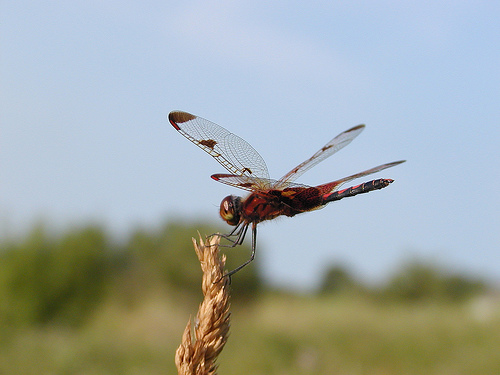
Don’t mess with a Dragonfly

DragOnFly

DragOnFly, photo by farlane

Yesterday Michigan in Pictures regular Mark O’Brien shared Nature’s Drone, Pretty and Deadly. The article says that although lions (25% hunting success rate) and great white sharks (50% success) look deadly, the dainty dragonfly may be the most effective hunter in the animal kingdom:

When setting off to feed on other flying insects, dragonflies manage to snatch their targets in midair more than 95 percent of the time, often wolfishly consuming the fresh meat on the spur without bothering to alight. “They’ll tear up the prey and mash it into a glob, munch, munch, munch,” said Michael L. May, an emeritus professor of entomology at Rutgers. “It almost looks like a wad of snuff in the mouth before they swallow it.”

Next step: grab more food. Dragonflies may be bantam, but their appetite is bottomless. Stacey Combes, who studies the biomechanics of dragonfly flight at Harvard, once watched a laboratory dragonfly eat 30 flies in a row. “It would have happily kept eating,” she said, “if there had been more food available.”

In a string of recent papers, scientists have pinpointed key features of the dragonfly’s brain, eyes and wings that allow it to hunt so unerringly. One research team has determined that the nervous system of a dragonfly displays an almost human capacity for selective attention, able to focus on a single prey as it flies amid a cloud of similarly fluttering insects, just as a guest at a party can attend to a friend’s words while ignoring the background chatter.

Read on for more including some very cool videos of dragonflies in action.

I don’t usually use my own photos on Michigan in Pictures, but I really like this one. Check it out background big and see more in my Leelanau slideshow.

More science on Michigan in Pictures!

Spring Return: Eastern Redbud

I'll Return With Spring

I’ll Return With Spring, photo by MightyBoyBrian

On AnnArbor.com Rick Meader writes:

When you think about popular, colorful ornamentals, Eastern Redbud (Cercis canadensis) often comes to mind. It’s a real crowd-pleaser, with a graceful, ornamental shape that puts out a “bouquet on a stem” look, with thousands of tiny pink/purple flowers lining its branches in early spring before its leaves emerge.

And, the best thing about it is, it’s native to southern Michigan, as well as most of the eastern half of the United States south of here. Furthermore, as a member of the Pea family (Fabaceae) it’s a cousin to the previous pod-producers we’ve learned about, Honeylocust (Gleditsia triacanthos) and Kentucky Coffeetree (Gymnocladus dioica).

As mentioned before, Eastern redbud is native to southern Michigan, occurring naturally up to a line across the lower peninsula from Kent County to Genesee County.

…If you want to use it in your landscape, it is fairly flexible in terms of where it will grow. It naturally occurs in rich soil along stream and river banks but is tolerant of a wider range of conditions. It likes sun or partial shade and can do well in most soils except waterlogged soils and dry, sandy soils.

Read on for more including Rick’s advice to make sure your tree comes from a northern nursery because trees from southern nurseries often are killed off by Michigan’s cold winters.

Brian’s photo is the first background we selected for the new Absolute Michigan, and  as you can see from past features of his work on Michigan in Pictures, he’s a really talented photographer who uploads big enough for backgrounds. See this shot from April of last year background bigilicious and see more in his Nature slideshow.

More spring wallpaper on Michigan in Pictures!

Give me a home, where the dinosaurs roam

blah blah blah about being bigger than oneself

blah blah blah about being bigger than oneself, photo by hardyc

Is it just me or has the cloning of extinct species gone too far?

Check this out big as a brachiosaur and see more in Chris’s slideshow!

More April 1 fun on Absolute Michigan today!

Locally Known as “the Bowl”

Locally Known as "the Bowl"

Locally Known as “the Bowl”, photo by karstenphoto

EDIT: Wow I really messed this one up, sleepily citing an article that gave the dune’s age in the millions of years. Thanks to Tom Burrows for the catch. Let’s see if this information on coastal dunes from the DNR makes more sense:

Michigan’s glacial history provides an explanation for the formation of dunes. The Great Lakes dune complex is relatively young, in terms of geological time. As recently as 16,000 years ago, Michigan was covered with glacial ice thousands of feet thick. This glacial ice contained a mix of boulders, cobbles, sand, and clay. During glacial melting, this deposit was left and is known as glacial drift.

This glacial drift is the source of sand in most of Michigan’s dunes. The sands were either eroded from glacial drift along the coast by wave activity or eroded from inland deposits and carried by rivers and streams. Only the hardest, smallest, and least soluble sand grains were moved. Waves and currents eventually moved these tiny rocks inland, creating beaches along the Great Lakes shoreline.

…Blowouts are saddle shaped or U shaped (parabolic) depressions in a stabilized sand dune, caused by the local destabilization of the dune sands. Blowouts, which originate on the summit or windward face of a dune, are often rapidly formed by the wind, creating narrow channels and exposing plant roots. Blowouts can create interruptions in the shape of parallel dunes that may result in deeply carved indentions called parabolic dunes. It is the combination of interwoven parallel dune ridges and U shaped depressions, including parabolic dunes, that characterizes the classic dunes from Indiana, northward to Ludington, in Michigan.

Awesome Michigan wrote a little about The Bowl at Holland saying:

The Bowl is an gigantic sand bowl, resembling a sort of concave desert. Along with the other dunes and Lake Michigan itself, The Bowl was carved out of the earth by glaciers millions of years ago and was likely a small lake before drying up. Standing at the center of The Bowl and being surrounded on all sides by enormous walls of sand is quite breathtaking. The landscape is truly like no other. This awesome sight alone makes a trip to Laketown a summer necessity and a great, relaxing place to bring friends and family.

You can also check in there on Foursquare. Here’s another shot from the bowl from all the way back in 2007. Amazing to me how long Michigan in Pictures has endured – thank you all for staying with me!

Check Stephen’s photo out big as the Bowl and see this and many more in his FILM! slideshow.

More dunes on Michigan in Pictures.

Four Silo Barn

DSC02860_1_2_3_tonemapped

DSC02860_1_2_3_tonemapped, photo by ansonredford

Donald writes that he’s never seen a quad-silo barn before he came across this one – me neither!!

Check this out big as a barn and see several more looks at this barn in his Barns & Silos slideshow.

More barns on Michigan in Pictures.

Miners Castle in Winter

Ice Cove

Ice Cove, photo by Rudy Malmquist

Since I’m up in the Pictured Rocks, I thought it would be a good time to share this video of Lake Superior waves at Pictured Rocks in winter by Lars Jensen.

Check this out background bigtacular and see more in Rudy’s UP Winter 2010 slideshow.

More from the Pictured Rocks National Lakeshore on Michigan in Pictures including a feature from Lars on Miners Castle from the winter of 2006!