Great Blue Heron Rookeries

Great Blue Heons adding sticks to their nest

Great Blue Herons adding sticks to their nest, photo by ellenm1

The Michigan Natural Features Inventory entry for Great Blue Heron Rookeries explains:

The great blue herons in Michigan are largely migratory, with almost all leaving the state during the winter months. Most leave by end of October and return in early to mid-March.

The great blue heron is mostly a colonial nester, occasionally they nest in single pairs. Colonies are typically found in lowland swamps, islands, upland hardwoods and forests adjacent to lakes, ponds and rivers. Nests are usually in trees and may be as high as 98 ft. (30 m) or more from the ground. The platform like nests are constructed out of medium-sized sticks and materials may be added throughout the nesting cycle. Nests are usually lined with finer twigs, leaves, grass, pine needles, moss, reeds, or dry gras. The same nests are refurbished and used year after year. Nest size varies; newer nests may be 1.5 ft. (0.5 m) in diameter with older nests reaching up to 4 ft (1.2 m) in diameter (Andrle 1988). Nests can also be used by Canada geese (Branta canadensis), house sparrows (Passer domesticus), and great-horned owls (Bubo virginianus)…

Most great blue herons return to southern Michigan heronries in mid-March although a few may remain through the winter if there are areas of open water. Courtship and nest building commences from early April in southern Michigan to early May in the extreme northern portions of the state. Both sexes are involved in the nest building process with males primarily gathering sticks from the ground, nearby trees, or ungarded nearby nests. Males pass sticks to females who then place them on the nests. Between 3 and 7 (usually 4) greenish blue eggs are laid in April and May in Michigan. Both sexes take a turn at incubation with females incubating mostly at night and males during the day. The incubation period lasts from 25-29 days. In Michigan hatching occurs in the first week of May in the south while parents are still incubating nests in the far northern part of the state. For the first 3-4 weeks post hatching, one parent remains on the nest with the young.

Check this photo out big as the sky and see more in Ellen’s Kensington Metropark slideshow.

More heronsbirds on Michigan in Pictures, and also check out this photo of a Heronry on Absolute Michigan.
The Deadliest Game: Fort Michilimackinac Massacre of 1763

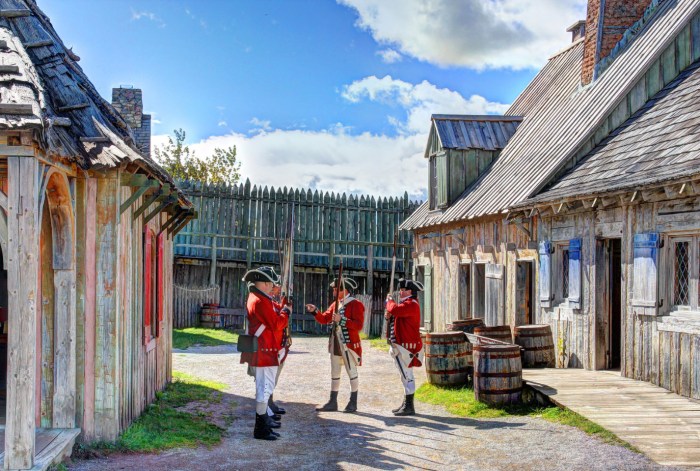
British Troops at Fort Michilimackinac by Robert F Carter

British Troops at Fort Michilimackinac, photo by Robert F Carter

This year marks the 250th anniversary of the most dramatic event at Fort Michilimackinac. On June 2, 1763 the fort was captured by Ojibwa & Sauk warriors, who gathered under the guise of playing a huge game of baggatiway. Elizabeth Edwards of Traverse Magazine has an in-depth article about the massacre that begins:

Under an unusually hot sun on a late spring day on the Straits of Mackinac, British Major George Etherington, commandant of Fort Michilimackinac, was suffering from an acute case of cultural blindness. And there was no excuse for it. Relaxed at the sidelines of a rousing game of baggatiway (similar to lacrosse) outside the fort, the major should have seen the danger signs in this Ojibwe versus Sauk contest of sweaty, half-naked bodies painted with white clay and charcoal.

The 30-year-old officer was born in the colonies, and most likely grew up on stories of Indian uprisings. He’d even served in the just-ending French and Indian War, in which the English had wrested control of North America from the French—a victory that had put this previously French fort in Etherington’s care. Though the major had been raised on American soil and had fought on it, he was still English. And in that country, a battle was a battle, and a sporting event was a sporting event.

Perhaps that explains why the major missed the clues…

Definitely read on for much more at Traverse! Every Memorial Weekend on Saturday, Sunday & Monday, they re-enact this event and much more of the fort’s history in the  annual Fort Michilimackinac Pageant. Next Sunday (June 2) they will commemorate the 250th anniversary of the attack at Michilimackinac at the fort as they open the new South Southwest Rowhouse.

Robert has some more good information about the events at the fort including a link to the painting The Conspiracy – Fort Michilimackinac by Robert Griffing that imagines the planning of the massacre. See his photo background bigtacular and see more in his My Neighborhood slideshow.

More from the Straits of Mackinac & Mackinac Island on Michigan in Pictures.

Know your Michigan turtles

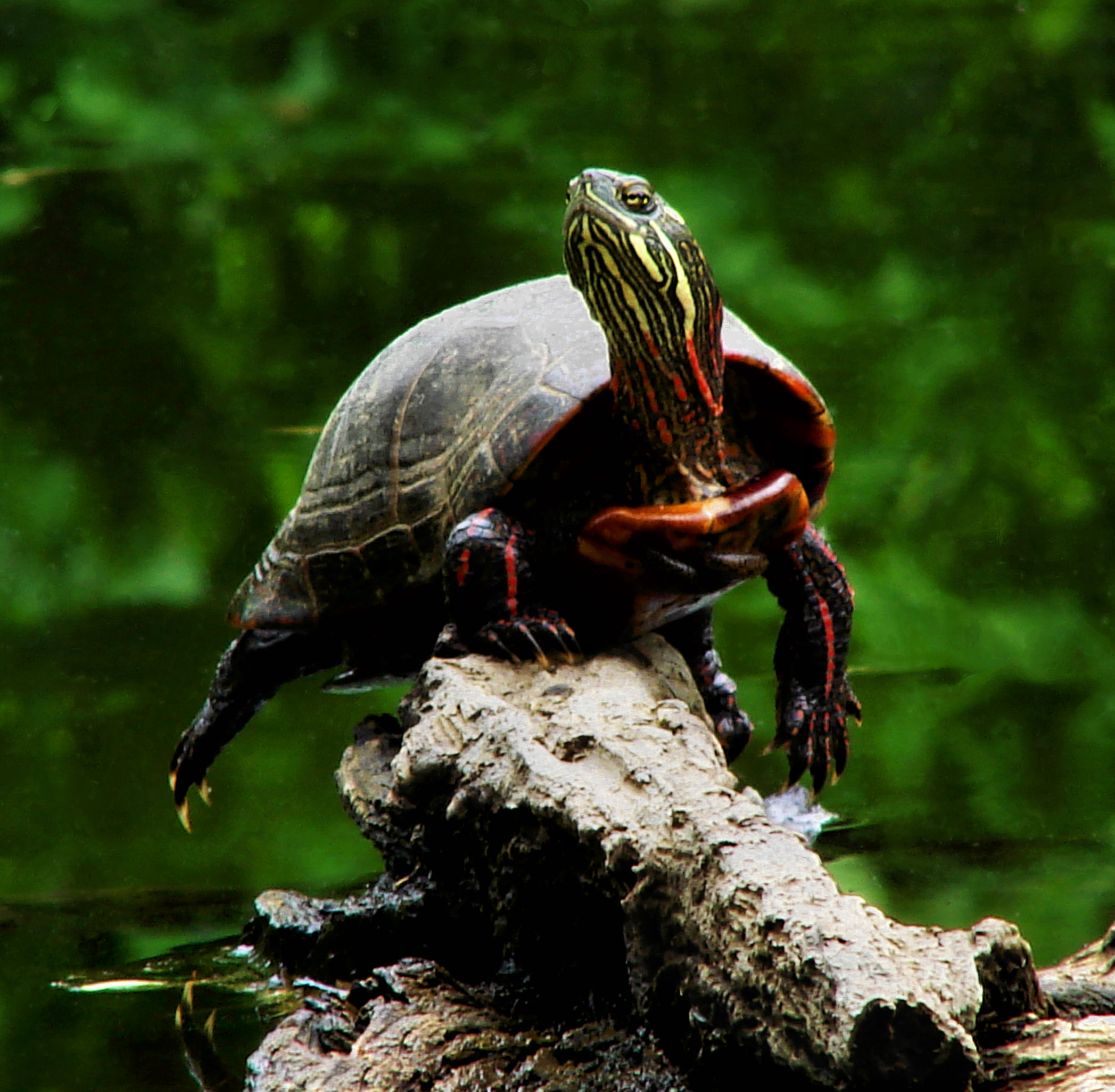
Posing Painted Turtle

I’m Posing for the Camera, photo by capcbd

It appears the turtle above is aware that Michigan’s state reptile is the painted turtle.

I thought it perfect for my day-late post celebrating World Turtle Day (May 23), an annual day of recognition that was started in 2000 by American Tortoise Rescue. They offer some tips to help preserve endangered turtles worldwide including not buying turtles or tortoises from pet shop (it increases demand from the wild), not removing turtles from the wild unless they are injured, and something that we can all do when we’re on the roads: if a turtle is crossing a busy street, pick it up and send it in the same direction it was going – if you try to make it go back, it will turn right around again!

It might surprise you to learn that Michigan is home to 10 native turtle species. Learn about all of them on Michigan in Pictures:

If you’re trying to identify a turtle you’ve found, Check out Nick Scobel’s Herping Michigan Blog and James Harding “The Critter Guy” at the MSU museum has a great Michigan turtle identification guide and loads of turtle lore.

Speaking of Turtle Lore, I always like to shout out a book I read as a kid that did more to foster my love of Michigan than any other: Lore of the Great Turtle. It was filled with Indian tales of Mackinac Island , and one of these was the formation of the island. While this version adapted by Basil Johnston is not quite the same, I think you’ll enjoy it!

Check this photo out background bigtacular and see more in capcbd’s water slideshow.

Also check out more turtles on Michigan in Pictures and definitely have a look at the turtle slideshow from the Absolute Michigan pool on Flickr!

PS: This is one of the most popular posts on Michigan in Pictures. Hooray for turtles!

Happiness is a Bowlful of Morels!

A day's find

A day’s find, photo by HLHigham

Morels are popping up all over, and though you might not find 98 like Heather did, even a handful of these delectable  mushrooms will make it all worth it. If you’re in the Boyne City area this weekend, they hold their annual National Morel Mushroom Festival. You might also be interested in Five Things You Need to Know about Michigan Morel Mushrooms on Absolute Michigan.

Heather got this tasty haul near Rapid City and she might write about it on her blog, Rapid City Recess. Check it out background bigtacular and see more in her slideshow!

Lots more morel goodness on Michigan in Pictures!

Lady ducks, take notice (of the Mallard)

Lady ducks take notice

Lady ducks take notice, photo by R.J.E.

It’s been too long since I’ve added to the Michigan in Pictures Duckie Gallery. The All about Birds entry for Mallard Anas platyrhynchos explains:

Mallards are large ducks with hefty bodies, rounded heads, and wide, flat bills. Like many “dabbling ducks” the body is long and the tail rides high out of the water, giving a blunt shape. In flight their wings are broad and set back toward the rear.

Male Mallards have a dark, iridescent-green head and bright yellow bill. The gray body is sandwiched between a brown breast and black rear. Females and juveniles are mottled brown with orange-and-brown bills. Both sexes have a white-bordered, blue “speculum” patch in the wing.

Mallards are “dabbling ducks”—they feed in the water by tipping forward and grazing on underwater plants. They almost never dive. They can be very tame ducks especially in city ponds, and often group together with other Mallards and other species of dabbling ducks.

Read on for more including photos and some fun facts:

  • The Mallard is the ancestor of nearly all domestic duck breeds (everything except the Muscovy Duck).
  • Mallard pairs are generally monogamous, but paired males pursue females other than their mates. So-called “extra-pair copulations” are common among birds and in many species are consensual, but male Mallards often force these copulations, with several males chasing a single female and then mating with her.
  • Mallard pairs form long before the spring breeding season. Pairing takes place in the fall, but courtship can be seen all winter. Only the female incubates the eggs and takes care of the ducklings.
  • The standard duck’s quack is the sound of a female Mallard. Males don’t quack; they make a quieter, rasping sound.
  • Mallards, like other ducks, shed all their flight feathers at the end of the breeding season and are flightless for 3–4 weeks. They are secretive during this vulnerable time, and their body feathers molt into a concealing “eclipse” plumage that can make them hard to identify.
  • The oldest known Mallard lived to be at least 27 years 7 months old.

Check this photo out bigger and in R.J.E.’s slideshow.

Turnip Rock in Lake Huron

Turnip Rock

Turnip Rock, photo by SimsShots Photography

A page about the Point Aux Barques – Turnip Rock geocache had the best information I found about this Lake Huron Landmark. The author explains:

This cache is accessible by a kayak, canoe, jet ski or boat on Lake Huron. Port Austin is the closest harbor which is approximately three miles west. The land around this feature is a gated community. I must stress that this cache is only accessible by a water craft via Lake Huron. If you are not comfortable navigating the waters of Lake Huron, do not attempt to do this cache. Lake Huron can be dangerous at times for small water craft such as kayaks or canoes.

…Everyone that received their grade school education in Michigan learned that glaciers pushed their way over Michigan several times. The result is glacial drift averaging 200 to 300 feet deep covering on top of the bedrock. The thickness of drift has measured over 1,000 feet in a few Michigan locations. Rarely can we see exposed bedrock that has been sculptured by non glacier forces. This is one of the locations in southern Michigan where the sandstone bedrock is exposed at the surface. The amount of shoreline that has exposed sandstone is about one mile, but a lot of beauty has been sculptured in the stone.

The locals call the main structure here “Turnip Rock”, because of it’s shape. Geologists call it a “Sea Stack”. A definition of a sea stack is an isolated pillar-like rocky island or mass near a cliff shore, detached from a headland by wave erosion assisted by weathering. Waves force air and small pieces of rock into small cracks, future opening them. The cracks then gradually get larger and turn into a small cave. When the cave wears through the headland, an arch forms. Further erosion causes the arch to collapse. This causes a pillar of hard rock standing away from the coast. Generally occurring in sedimentary rocks, sea stacks can occur in any rock type.

Read on for more and also see the Atlas Obscura entry for Turnip Rock has a map and photos. Michigan in Pictures favorite Lars Jensen has some great photos of Turnip Rock as well, and you should definitely check out Jason Glazer’s panoramic photos of Turnip Rock.

Check this out background big and see more in Rob’s Landmarks slideshow.

More Michigan landmarks on Michigan in Pictures.

Cherry Blossom Season all across Michigan

Cherry Blossoms II

Cherry Blossoms II, photo by leelanau2010

A run of warm weather has the cherry trees in Michigan ready to blossom. Due to their pent up demand to bloom, we should see blossoms all across the state this weekend. Up here in the “Cherry Capital of the World” near Traverse City, we saw leaves pushing out over the weekend and the first buds are getting ready to burst. The same is true in Southwest Michigan.

Even better news is that despite a little flirting with the 30s expected for the coming weekend, we aren’t likely to see full-on frost in 2013. This is a welcome change from 2012 when Michigan saw near total losses across a broad range of fruit crops due to our “summer in March.”

Check David’s photo out background bigtacular and see more in his Spring 2008 in Leelanau slideshow.

More blossoms and also more spring wallpaper on Michigan in Pictures.

Sign of spring #77: Trillium in the Woods!

Trillium

Trillium, photo by karstenphoto

One of the many signs of spring in Michigan is the appearance of the endangered trillium flower in the woods. In Plant Focus: Trillium, George Papadelis of the Michigan Gardener writes that for hundreds of years, this plant and its name have been used to symbolize purity, simplicity, elegance, and beauty.

In Ohio, where all 88 counties have masses of wild trillium, it was selected as the state’s official wildflower. Its flowers have twice graced a U.S. postage stamp. Even our Canadian friends across the bridge have declared white trillium (Trillium grandiflorum) the official provincial flower of Ontario. Other parts of the world share our passionate admiration for this plant. In Europe, where trilliums are not found in nature, gardeners dedicate vast amounts of time and money acquiring them, especially rare species. In Japan, a cult-like interest has developed towards trillium.

The most readily available species is Trillium grandiflorum or white wake-robin. This has large, pure white flowers up to 5 inches across. These develop in great abundance throughout the northeastern U.S. Its flowers usually fade to a dull pink and sometimes red. Trillium erectum is a much more diverse species with flowers ranging from red to purple to yellow-green and beige. It also grows wild in the Northeast and Michigan. Trillium luteum is the most common yellow species. It originates from areas around eastern Tennessee. One of its most notable features is the beautiful dark green leaves decorated with pale green markings. The flowers are relatively small. Trillium recurvatum bears maroon-purple to clear yellow flowers with strongly curved petals.

Read on for information about how to legally grow trillium.

Check this out background bigtacular, check out his Spring slideshow and see more from Steve on Michigan in Pictures.

More spring wallpaper

The Ghost Bike

The Ghost Bike Commemorating Curt Dombecky, 4/23/1948-7/14/2012

The Ghost Bike Commemorating Curt Dombecky, 4/23/1948-7/14/2012, photo by joeldinda

This is a somber reminder as the weather warms and bikers return to the roads that hurrying or texting or lack of attention can result in tragedy. Ghostbikes.org explains:

Ghost Bikes are small and somber memorials for bicyclists who are killed or hit on the street. A bicycle is painted all white and locked to a street sign near the crash site, accompanied by a small plaque. They serve as reminders of the tragedy that took place on an otherwise anonymous street corner, and as quiet statements in support of cyclists’ right to safe travel.

The first ghost bikes were created in St. Louis, Missouri in 2003. Currently there are over 500 ghost bikes that have since appeared in over 180 locations throughout the world. For those who create and install the memorials, the death of a fellow bicyclist hits home. We all travel the same unsafe streets and face the same risks; it could just as easily be any one of us. Each time we say we hope to never have to do it again — but we remain committed to making these memorials as long as they are needed.

View Joel’s photo background big and see more in his Grand Ledge slideshow.

The observant will note that Michigan in Pictures featured a photo from Joel just last week, but sometimes that’s just how it goes. Much more from Joel on Michigan in Pictures.


Tulip Time in Holland

Yellow Tulips
Yellow Tulips, photo by srab44_2000

Holland’s annual celebration of Dutch heritage and culture, the Tulip Time Festival, starts Friday May 4th and runs through May 11th. While last year’s crazy March heatwave had tulips blooming in mid-April, tulips have been in the slow lane in 2013 due to a cool spring. The good news according to meteorologist Bill Steffen is that a well-timed warmup should have tulips in near perfect bloom this year.

Check this photo out background bigtacular and see more in E. Benson’s Tulip Time Festival 05/2009 slideshow.

More tulips and more Holland on Michigan in Pictures.