Grand Marais, Michigan

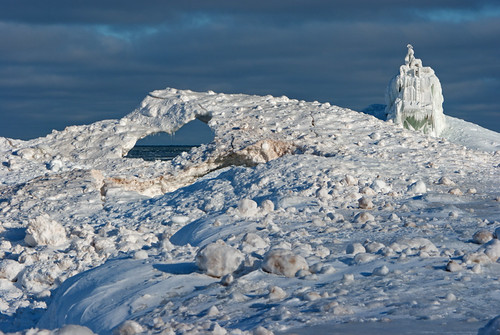
Grand Marais Harbor Outer Light Station

Grand Marais Harbor Outer Light Station, photo by Gary of the North

The Michigan Historical Marker at Grand Marais reads:

Grand Marais, which is among Michigan’s oldest place names, received its name from French explorers, missionaries and traders who passed here in the 1600s. “Marais” in this case was a term used by the voyaguers to designate a harbor of refuge. In the 1800s Lewis Cass, Henry Schoolcraft and Douglass Houghton also found the sheltering harbor a welcome stopping place. Grand Marais’s permanent settlement dates from the 1860s with the establishment of fishing and lumbering. At the turn of the century Grand Marais was a boom town served by a railroad from the south. Its mills turned out millions of board feet annually. Lumbering declined around 1910, and Grand Marais became almost a ghost town, but the fishing industry continued. Many shipping disasters have occurred at or near the harbor of refuge, which has been served by the Coast Guard since 1899. In 1942 the first radar station in Michigan was built in Grand Marais. Fishing, lumbering and tourism now give Grand Marais its livelihood.

Check this out big as Lake Superior and see more in Gary’s slideshow.

More Grand Marais on Michigan in Pictures!

Holland Harbor’s Big Red Lighthouse and the Red Right Return

Big Red

Big Red, photo by Rick Lanting

Sometimes I see photos of certain places so much that I figure I’ve said all there is to say about them. Such was the case with one of one of Michigan’s most iconic lighthouses. I realized that although I’d seen hundreds of photos, I had no idea how “Big Red” in Holland got its name. Terry Pepper’s Seeing the Light tells the story of the Holland Harbor Light from the construction of a timber frame beacon on the south pier in 1870 up until the 1930s when:

The Holland Lights were electrified in 1932. Equipped with a 5,000 candlepower incandescent electric bulb, the Fourth Order lens was now visible for a distance of 15 miles. The old steam-operated ten-inch fog whistle was removed from the fog signal building the following year, and replaced with an air operated whistle powered by an electric motor-driven compressor. In 1936, a square tower was erected at the west end of the fog signal building roof peak, and capped with an octagonal cast iron lantern, the lens from the pierhead beacon moved into the new lantern. The steel pierhead beacon was then removed from the pier and shipped to Calumet, where it was placed at the south end of the breakwater.

A Coast Guard crew arrived in Holland in 1956, and gave the combined fog signal building and lighthouse a fresh coat of bright red paint in order to conform to its “Red Right Return” standard, which called for all aids to navigation located on the right side of a harbor entrance to be red in coloration. Local residents thus began referring to the fifty year old structure as “Big Red,” a name which has stuck through the years. The Fourth Order lens was subsequently removed from the fog signal lantern in the late 1960’s, and replaced with a 250 mm Tidelands Signal acrylic optic.

Much more including photos at Seeing the Light.

Check this out Big Red big and see more in Rick’s Lighthouses or Hipstamatic slideshows.

Many more Michigan lighthouses on Michigan in Pictures!

Ice on the Chippewa River

_JMC5873aw

_JMC5873aw, photo by Jeff Caverly

Wikipedia’s Chippewa River (Michigan) says that the river runs 91.8 miles from its beginning in northeast Mecosta County in the village of Barryton to where it flows into Big Cranberry Lake in southwest Clare County. It’s a tributary of the Tittabawassee River and part of the Saginaw River drainage basin.

To learn more about the river and some of the natural preserves on the river, visit the Chippewa River Watershed. You can also check out the Chippewa River Water Trail.

Get Jeff’s photo background bigtacular and see more in his slideshow.

More Michigan rivers on Michigan in Pictures.

Weird Wednesday: South Arm Nessie

South Arm Nessie

South Arm Nessie, photo by Cvx_Wx

Absolute Michigan has been known to hold Weird Wednesdays on the last Wednesday of every month. Our Michigan Sea Monsters post featured two denizens of the deep courtesy Linda Godfrey’s Weird Michigan, the Sea Monster of the Straits and the Lake Leelanau Monster:

The story of an early 20th Century sea monster sighting was sent to The Shadowlands Web site by a reader whose great-grandfather was the witness. The boy was fishing for perch one day in 1910 in the shallows of Lake Leelanau in Leelanau County. The lake had been dammed in the late 1800’s to provide water power for the local mill and to enable logging. The dam also flooded much surrounding area, turning it into swamps and bogs punctuated by dead, standing trees.

On that particular day, the young great-grandfather, William Gauthier, rowed out to a new fishing spot near the town of Lake Leelanau. Looking for good perch habitat, he paddled up close to a tree that he estimated to stand about five feet tall above the water, with a six-inch trunk. He was in about seven feet of water, and after deciding this would be a good place to stop and cast a line, began tying the boat to the tree.

That’s when young William discovered the tree had eyes. They were staring him dead in the face at about four feet above water level. The boy and serpent exchanged a long gaze, then the creature went, “Bloop” into the water. Gauthier said later that the creature’s head passed one end of the boat while the tail was still at the other end, though it was undulating very quickly through the water. The writer noted that Gauthier always admitted to having been thoroughly frightened by his encounter, and that the event caused him to stay off that lake for many years.

The writer added that his great-grandfather came from a prominent area family and was very well-educated, and that he knew others who would admit privately but not publicly that they, too, had seen the creature. No sightings have been reported in recent times, but who knows how many people have believed they were passing by a rotting old cedar when in fact they had just grazed the Leelanau lake monster?

Could the South Arm of Lake Charlevoix hold similar creatures? Check this out big as a beastie and see more in Ed’s My Neighborhood slideshow.

More weird Michigan on Michigan in Pictures!

city

city

city, photo by buckshot.jones

Check Scott’s photo out background big and see more in his slideshow.

More Detroit on Michigan in Pictures

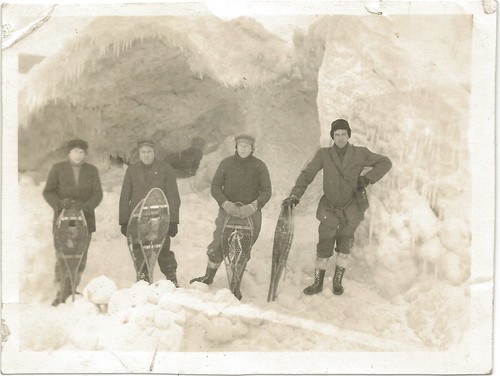
Men at Work, Snowshoe Edition

Real Photo Men at Work with Snow Shoes Winter Ice and Snow location Unknown 4-1 2 x 3-1 2 size

Real Photo Men at Work with Snow Shoes Winter Ice and Snow location Unknown, photo by UpNorth Memories – Donald (Don) Harrison

Don Harrison collects and sells postcards. His Flickr features some really great old postcards, mostly from Michigan. Check this photo out background bigtacular and see many more in Don’s Winter slideshow.

More postcards on Michigan in Pictures.

Bond Falls in black & white

Bond Falls

Bond Falls, photo by wingsfan1705

Michigan in Pictures has a number of photos from Bond Falls, but there’s always room for one more. ;)

Check this out background bigtacular and see more including some detail shots in Kim’s slideshow.

More black & white photography on Michigan in Pictures.

Frosted

Natures Weeping Willow Drapes

Natures Weeping Willow Drapes, photo by LadyDragonflyCC

Christine writes:

Hoar Frost (also called radiation frost or hoarfrost or pruina) refers to the white ice crystals, loosely deposited on the ground or exposed objects, that form on cold clear nights when heat is lost into the open sky causing objects to become colder than the surrounding air. A related effect is flood frost or frost pocket which occurs when air cooled by ground-level radiation losses travels downhill to form pockets of very cold air in depressions, valleys, and hollows. Hoar Frost can form in these areas even when the air temperature a few feet above ground is well above freezing. Nonetheless the frost itself will be at or below the freezing temperature of water.

Hoar Frost may have different names depending on where it forms. For example, air hoar is a deposit of hoar frost on objects above the surface, such as tree branches, plant stems, wires; surface hoar is formed by fern-like ice crystals directly deposited on snow, ice or already frozen surfaces; crevasse hoar consists of crystals that form in glacial crevasses where water vapor can accumulate under calm weather conditions; depth hoar refers to cup shaped, faceted crystals formed within dry snow, beneath the surface.

Check it out background bigtacular and see more in her Winter 2013 slideshow.

More winter wallpaper on Michigan in Pictures.

MNA Memorial Falls aka Twin Falls

Memorial Falls in Winter (pano)

Memorial Falls in Winter (pano), photo by nasunto

GoWaterfalling’s page on Memorial Falls in Munising says:

MNA Memorial Falls is in Munising, off of H-58. Some of the locals refer to this waterfalls as “Twin Falls”. This is a very seasonal waterfall and is often dry. However when the water is flowing, which may only be after a good rain or when the snow is melting, you will be treated to a very pretty gorge with two waterfalls in it. MNA Memorial Falls is owned by the Michigan Nature Association and it is open to the public.

…Two streams empty into this gorge, but the second one likely only has water after or during a good rain. One very interesting feature of this gorge is a “window” in the walls between the two falls. You can crawl through this window, or just walk around it. You can see each of the waterfalls through this window.

Another nice thing about this waterfall is its proximity to Tannery Falls. The trail from Nestor streets forks just before it descends into the gorge. The trail to the right leads to the base of the falls. The trail to the left leads to H-58, about 100 feet away from the stairway to Tannery Falls, so you can visit both falls on the same hike.

In the winter both of these falls turn into ice columns that are tackled by the ice climbers. Despite their low volume of water, each of these falls manages to produce a very impressive column. Every winter Munising hosts an ice climbing festival. After the festival the ice columns look like they have been attacked by woodpeckers. There are many other interesting ice formations to see in the area.

Read on for more and definitely click through to see a pic of a person beside the 40′ fall and a shot of the “window”. Also see Memorial Falls at the Waterfall Record.

Check this out background big and see more in Nina’s Michigan Waterfalls slideshow. If you look carefully, you’ll see another photographer in the shadows!

There’s many more waterfalls on Michigan in Pictures including the above-mentioned Tannery Falls.

Cyanocitta cristata, the Blue Jay

Blue Jay in Winter

Blue Jay in Winter, photo by AcrylicArtist

The UM Animal Diversity Web entry for Cyanocitta cristata blue jay says (in part):

Blue jays are bright blue on top and whitish gray on the belly and chin. They have a gray-blue, feather crested head, which they can raise and lower. The feathers on their wings and tails are bright blue with white and black bands. Blue jays also have a collar of black feathers across the throat and continuing around the head. Their bills, legs, feet, and eyes are black. Males are just a little larger, on average, than females.

…Blue jays are very aggressive and noisy birds,driving other birds away from food sources and their territories. In the winter, Blue jays hide far more food than they can eat, perhaps to remove food from their territories to discourage intruders. They are also partially migratory, and in the fall they can be seen traveling in flocks of more than a hundred birds.

…Blue jays are omnivorous. They feed on fruits, nuts, seeds, insects, mice, frogs, and will rob other nests for small songbirds and bird eggs. To eat nuts, blue jays hold them with their feet and then crack the shell with their bill. Blue jays in captivity have been known to fashion tools in order to get at foods. Blue jays will also steal foods from other birds by frightening them into dropping what they have. They cache foods, such as seeds, for later use.

Read on for much more (including photos)  and don’t miss a previous feature, Things you may not know about Blue Jays.

Check this out background bigtacular and see more in Rodney’s Animals slideshow.

Many more Michigan birds on Michigan in Pictures.