We interrupt this winter…

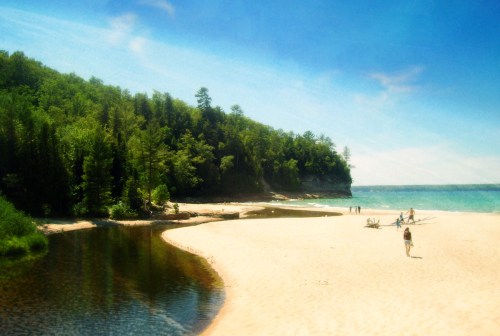
Pure Relaxation

Pure Relaxation, photo by Jessie Eileen

We interrupt this winter to bring you a special announcement from summer:

“What good is the warmth of summer, without the cold of winter to give it sweetness.”
~John Steinbeck

View Jessie’s photo of Miner’s Beach at the Pictured Rocks National Lakeshore background big and see more in her dreamy Upper Peninsula: Summer 2006 slideshow.

More summer & summer wallpaper on Michigan in Pictures

Buried by the Polar Vortex in Michigan

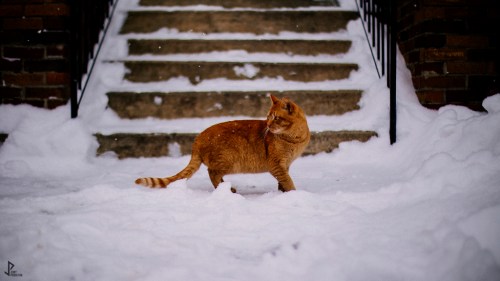
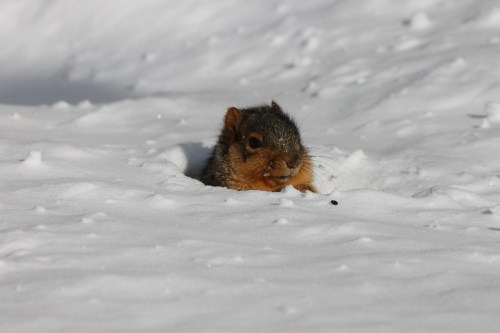
Squirrels and other pictures at the University of Michigan on an awful cold wintry day (January 6, 2014)

Squirrels and other pictures at the University of Michigan on an awful cold wintry day (January 6, 2014), photo by cseeman

If yesterday’s Michigan temps seemed chilly, today’s are worse! Ironwood is still the coldest, but they are up a few degrees at -20 (before the -33 windchill of course). Most of the rest of the state is joining them below zero this morning. Detroit and Lansing are at -11, Marquette is at -15 and Grand Rapids is at a balmy 1.6 degrees!

Dr. Jeff Masters blog on the Extreme Cold Blast at Weather Underground, the site he founded and runs in Michigan says:

The most extreme cold air outbreak since 1994 is in store for much of the U.S. on Monday and Tuesday, as Arctic air behind a major winter storm invades the Midwest. The powerful 989 mb storm blasted the Upper Midwest on Sunday, bringing snows in excess of a foot over portions of Illinois, Michigan, Indiana, Missouri, and Ohio. The 11.4″ that fell on Sunday in Indianapolis, Indiana made it that city’s second snowiest day on record (the all-time record: 12.1″ on March 19, 1906); Flint, Michigan also recorded its second snowiest day on record: 14.5″ (the all time record: 15.0″ on November 28, 1937.) … The high temperature in Detroit on Tuesday is expected to remain below zero; the city’s list of days with a high temperature below zero is a short one, with only three such days in recorded history. The frigid air is being propelled by strong Arctic winds of 15 – 25 mph, which will generate dangerously low wind chill readings in the -30° to -60°F range from Michigan to Minnesota on Monday and Tuesday.

In the winter, the 24-hour darkness over the snow and ice-covered polar regions allows a huge dome of cold air to form. This cold air increases the difference in temperature between the pole and the Equator, and leads to an intensification of the strong upper-level winds of the jet stream. The strong jet stream winds act to isolate the polar regions from intrusions of warmer air, creating a “polar vortex” of frigid counter-clockwise swirling air over the Arctic. The chaotic flow of the air in the polar vortex sometimes allows a large dip (a sharp trough of low pressure) to form in the jet stream over North America, allowing the Arctic air that had been steadily cooling in the northern reaches of Canada in areas with 24-hour darkness to spill southwards deep into the United States. In theory, the 1.5°F increase in global surface temperatures that Earth has experienced since 1880 due to global warming should reduce the frequency of 1-in-20 year extreme cold weather events like the current one. However, it is possible that climate change could alter jet stream circulation patterns in a way that could increase the incidence of unusual jet stream “kinks” that allow cold air to spill southwards over the Eastern U.S., a topic I have blogged about extensively, and plan to say more about later this week.

Read on for more and to see a shot of Jeff shoveling 14″ off his metro Detroit roof!

Corey took this shot on the campus of the University of Michigan. View it background big and see more in his massive Squirrels of the Univ. of Michigan slideshow.

PS: Curiously enough, there’s a Campus Squirrels photo group on Flickr.

2014 Meteor Shower Calendar starts tonight with the Quadrantids

meteor and milky way

meteor and milky way, photo by HLHigham

EarthSky’s meteor shower guide for 2014 says that:

Although the Quadrantids can produce over 100 meteors per hour, the sharp peak of this shower tends to last only a few hours, and doesn’t always come at an opportune time. In other words, you have to be in the right spot on Earth to view this meteor shower in all its splendor. The radiant point is in the part of the sky that used to be considered the constellation Quadrans Muralis the Mural Quadrant. You’ll find this radiant near the famous Big Dipper asterism (chart here), in the north-northeastern sky after midnight and highest up before dawn.

Because the radiant is fairly far to the north on the sky’s dome, meteor numbers will be greater in the Northern Hemisphere. In 2014, watch in the wee hours – after midnight and before dawn – on January 3 in North America and January 4 in Asia. Fortunately, the waxing crescent moon sets soon after sunset, providing a dark sky for meteor watching.

Click through for more and a calendar of 2014 meteor showers. The next shower isn’t until the Lyrids on April 22nd so check them out tonight and early AM on the 4th if you can! You can get viewing tips for the Quads from Universe today too!

View Heather’s photo big as the sky and in her Night Sky slideshow.

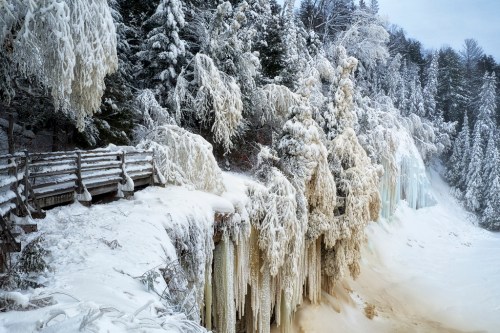
Winter Wonderland at Tahquamenon Falls

winter, upper tahquamenon falls, michigan

winter, upper tahquamenon falls, michigan, photo by twurdemann

twurdemann writes that this winter wonderland at Tahquamenon Falls State Park is created by freezing spray/mist from the adjacent waterfall and that the brown color is from tannins in the water. One second exposure in the Upper Peninsula. View his photo bigger and see more his awesome winter slideshow.

There’s lots more about Michigan’s largest waterfall on Michigan in Pictures!

Christmas Wishes

November 27th

November 27th, photo by dudesitsgabby

Today is Christmas for me and my family. I hope that whatever today is for you & yours, your life is filled with warmth and love.

View Gabby’s photo background bigtacular and see more in her slideshow.

Don’t look back, winter might be gaining on you

IMG_9393

Untitled, photo by JerryPHD

Check Jerry’s photo out background bigilicious and see more in his slideshow.

More winter wallpaper on Michigan in Pictures.

Slam Dunk for Old Man Winter

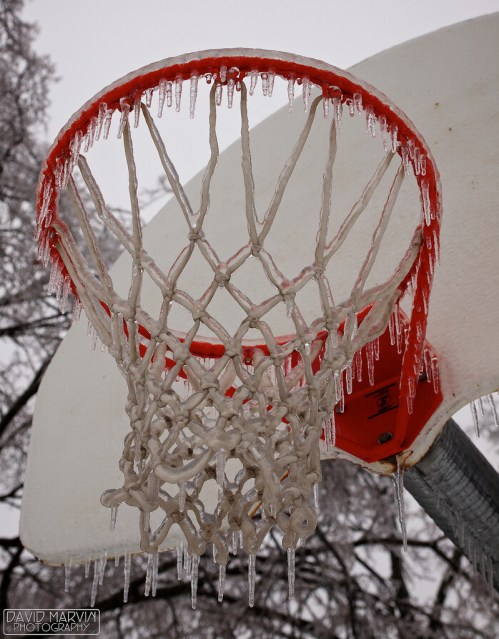
Icy Michigan Morning

Icy Michigan Morning, photo by daveumich

Much like Uncle Drew, Old Man Winter brought his A-game over the weekend, creating havoc across much of the state. The Freep reports that this weekend’s ice storm knocked out power for over 300,000 people. An interesting fact I learned from the article is that a quarter of an inch of ice is the equivalent of 500 pounds of weight on a span of power line. WLNS adds that thousands of people might be out of power through Christmas – here’s hoping that’s wrong!

View David’s photo from Lansing background big and see more shots of the storm in his slideshow.

There’s more ice on Michigan in Pictures, and mLive has a nice gallery of photos from around the state too!

One year after the End of the World

Mayan Calendar---Weather Edition

Mayan Calendar—Weather Edition, photo by katerha

In addition to marking a full year of surviving the expiration date of the previous Mayan calendar, the winter solstice happens at 12:11 PM today. EarthSky has a guide to everything you need to know about the Winter Solstice that has all the details.

The weather outside is frightful though – stay safe and take care!

Check Kate’s photo from Cedarville out background bigtacular and see more in her winter slideshow.

Time to update your background to winter? There’s 7+ years of Michigan winter wallpaper on Michigan in Pictures!

Let’s Do Lunch (Snowy Owl Style)

Snowy Owl 1

Snowy Owl 1, Sherri & Dan

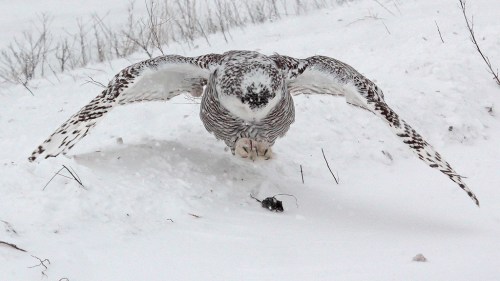
Dan Lockard captured a cool sequence last weekend of a snowy owl on the hunt. View his photo background big, watch the hunt (which doesn’t end well for Mr. Mouse) or check out his owls slideshow.

The Owl Pages entry for the Snowy Owl (Bubo scandiacus) says in part:

The Snowy Owl is a large diurnal white Owl with a rounded head, yellow eyes and black bill. The name “scandiacus” is a Latinised word referring to Scandinavia, as the Owl was first observed in the northern parts of Europe. Some other names for the Snowy Owl are Snow Owl, Arctic Owl, Great White Owl, Ghost Owl, Ermine Owl, Tundra Ghost, Ookpik, Scandinavian Nightbird, White Terror of the North, and Highland Tundra Owl.

…Most hunting is done in the “sit and wait” style. These Owls are highly diurnal, although they may hunt at night as well. Prey are captured on the ground, in the air, or snatched off the surface of water bodies. When taking snowshoe hares, a Snowy Owl will sink its talons into the back and backflap until the hare is exhausted. The Owl will then break its neck with its beak. Snowy Owls have been known to raid traplines for trapped animals and bait, and will learn to follow traplines regularly. They also snatch fish with their talons. Small prey up to small hares are swallowed whole, while larger prey are carried away and torn into large chunks. Small young are fed boneless and furless pieces. Large prey are carried of in the Owl’s talons, with prey like lemmings being carried in the beak.

…Snowy Owls produce large, rough-looking cylindrical pellets with numerous bones, feathers, and fur showing. They are usually expelled at traditional roosting sites and large numbers of pellets can be found in one spot. When large prey are eaten in small pieces with little roughage, pellets will not be produced.

Read on for much more about these winter visitors, who the DNR explain migrate to Michigan in wintertime and have been sighted as far south as Lansing. They add that because snowy owls see few if any humans in their Arctic home, they are not very timid and easier to observe than other owl species.

More Michigan owls on Michigan in Pictures!

Michigan Aviation Pioneer Augustus Herring: First in Flight?

Augustus_Moore_Herring_flight

Augustus Moore Herring, (1867 — 1926) with his early glider (1894), via Wikimedia Commons

110 years ago on December 17, 1903, Orville & Wilbur Wright made aviation history with four flights of the Wright Flyer.

Seeking Michigan has a feature by Roger Rosentreter from Michigan History Magazine titled First in Flight? It tells the story of Augustus Herring, who followed his dream in St. Joseph and became one of this country’s aviation pioneers perhaps even pre-dating the Wright Brothers in powered flight:

Herring worked with other aviation pioneers, especially in experimenting with gliders. Finally, he put a gasoline-powered engine on a two-winged glider that had a wingspan of nineteen feet. The 2.5-horsepower engine (smaller than most of today’s lawnmower engines) gave the “pilot” power for about fifteen seconds In October 1898, Herring “flew” this contraption on the Lake Michigan beach at St. Joseph, Michigan. On a second flight, according to one eyewitness, the airplane stayed in the air for ten seconds and went seventy-three feet.

Herring had problems. His airplane was difficult to control, and he needed a lighter-weight engine to keep the plane flying longer, but none existed. Finally, the photographer who had been on the beach that day failed to capture Herring’s plane in the air. There was no visual proof that he had flown.

…Historians have mixed reviews for Herring. One labeled his work as “insignificant,” while another said, “one cannot deny that Herring flew or was very close to having flown.” As for Augustus Herring, he never claimed to be the first to fly. He knew his engine-powered glider was not a practical airplane. But he argued that his work proved that powered flight was “solvable.” That claim is undisputed.

You can read on and also learn more about Herring via Wikipedia and get the above pic background bigtacular right here.