Seul Choix Point Lighthouse

Seul Choix Lighthouse

Seul Choix Lighthouse, photo by DanielBrinks.

The Seul Choix Point Lighthouse (map) is operated by the Gulliver Historical Society and DNR as a park & museum. Terry Pepper’s Seeing the Light’s page for Seul Choix Pointe Light explains:

At the dawn of the 1880’s, the volume of maritime traffic passing between harbors on the western shore of Lake Michigan and Green Bay and the Straits of Mackinac exploded. While the St. Helena Island light station lighted the eastern entry into the Straits, mariners were forced to navigate blind along 100 miles of unlighted upper peninsula coastline before the Poverty Island light came into view at the western end of the passage. With treacherous storms frequent at both ends of the navigation season, mariners frequently chose to ride out such storms in the lee of points protruding into the lake along this 100-mile stretch of unlighted shoreline.

Seeking to both make identification of such a refuge easier, and to mark the shore at an interim point between the two existing lights, the Lighthouse Board recommended that establishment of a light station on the end of Point Patterson, approximately midway between St. Helena Island and Manistique.

It took nearly 20 years to complete – read on for more about what was apparently the Cadillac of lighthouses. The light is also reputed to be haunted, and you can read a lot more about that in The Haunting of Seul Choix Point Lighthouse on Michigan in Pictures.

Check this out bigger and see more in Daniel’s 2020110700 Vacation slideshow.

Bare Bluff overlooking Bete Grise Bay

n2c_111-8083

n2c_111-8083, photo by sgowtham.

The Keweenaw Free Guide’s entry for Bare Bluff begins:

Towering some 500 feet above the sparkling waters of Lake Superior, Bare Bluff commands a spectacular view across the lush green forest of the Keweenaw Tip and the encompassing waters of Lake Superior. The rocky bluff sits several miles from any semblance of civilization, standing along the far northern arm of Bete Grise Bay. In fact the only hint of civilization glimpsed from its vantage point os the Mendota Canal breakwaters and lighthouse – producing a landscape much like the early explorers to the region might have experienced. Highlights include the rocky shore of the Keweenaw, Smith Fisheries, the mouth of the Montreal River, Bete Grise Beach, and on clear days the Huron Mountains on the horizon.

Read on for directions. While the Guide deems it “a very difficult trail with a good amount of steep cliffs and sudden drop offs along the way,” Gowtham says it’s a “moderate hike is a price worth paying any day for a glorious view of the eastern shore of Michigan’s Keweenaw Peninsula.”  We should add a link to the Fall Color Tour for the Keweenaw Peninsula (Houghton, Eagle River, Copper Harbor) courtesy Pure Michigan’s Fall Color Tours.

In any case – stunning vista! He took it on October 4th, and you can see there’s still lots of color left! Check it out bigger and on his photo map.

September Storm on Lake Superior

September Storm

September Storm, photo by gkretovic.

Incredible wave action on Lake Superior in Marquette from a few days ago.

Check it out bigger and in Greg’s Upper Peninsula of Michigan slideshow.

You can purchase this and other photos at MichiganNaturePhotos.com and stay connected on Facebook. Speaking of Facebook, Greg has a great slideshow there that includes this pic and several more including a cool surfing shot!

October in Michigan is filled with light & color … and some great events!

A River Runs Through It, my New Years Resolution version

A River Runs Through It, my New Years Resolution version, photo by posthumus_cake (www.pinnaclephotography.net).

“How beautifully leaves grow old. How full of light and color are their last days.”
~John Burroughs

We’ve posted our October Michigan Event Calendar on Absolute Michigan. It’s one of Michigan’s best listings of events, featuring everything from ArtPrize in Grand Rapids to the Famous Pumpkin Train. Check them all out and learn a lot more about the 10th month!

The photo is the Big Carp River seen from one of Michigan’s premier vistas, the Lake of the Clouds Overlook in Porcupine Mountains Wilderness State Park. Check it out on black and in his Porcupine Mountains slideshow. He adds that one year later, it was a blizzard! More from Matthew at pinnaclephotography.net.

The Science of Fall Color

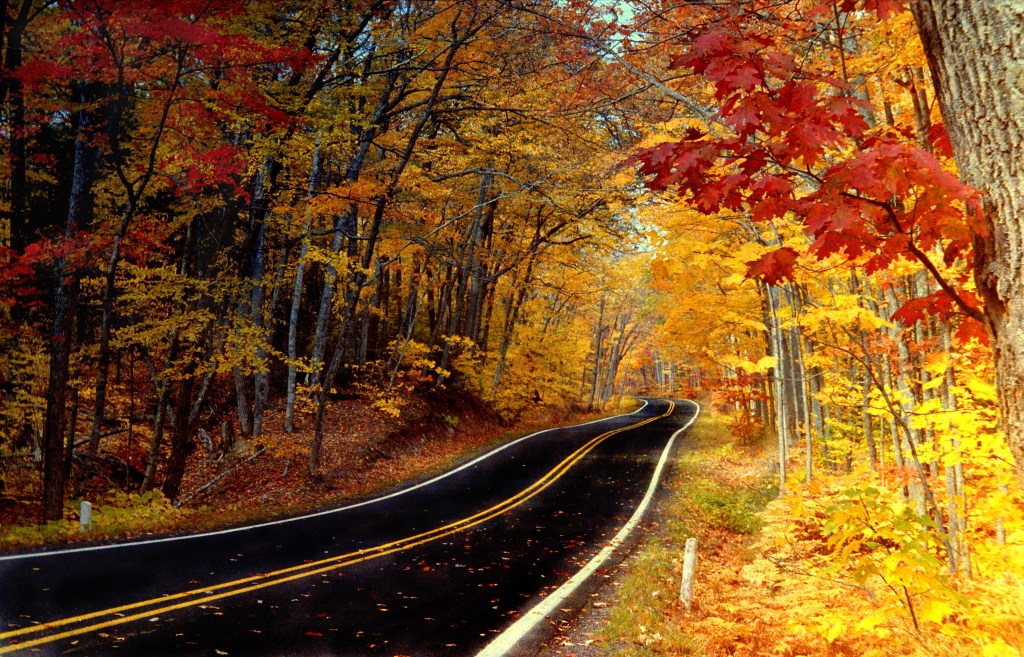
Autumn Copper Harbor, photo by Brian Callahan (Luxgnos.com)

There’s no doubt that the annual fall show that Michigan puts on is one of the best, but did you ever stop to think about the process that causes deciduous trees to change color? Well, here’s your chance…

The Science of Color in Autumn Leaves from the United States National Arboretum explains that process that starts the cascade of events that result in fall color is a growth process that starts in late summer or early autumn. When the nights get long enough, a layer of cells called the abscission layer forms that begins to block transport of materials from the leaf to the branch.

During the growing season, chlorophyll is replaced constantly in the leaves. Chlorophyll breaks down with exposure to light in the same way that colored paper fades in sunlight. The leaves must manufacture new chlorophyll to replace chlorophyll that is lost in this way. In autumn, when the connection between the leaf and the rest of the plant begins to be blocked off, the production of chlorophyll slows and then stops. In a relatively short time period, the chlorophyll disappears completely.

This is when autumn colors are revealed. Chlorophyll normally masks the yellow pigments known as xanthophylls and the orange pigments called carotenoids — both then become visible when the green chlorophyll is gone. These colors are present in the leaf throughout the growing season. Red and purple pigments come from anthocyanins. In the fall anthocyanins are manufactured from the sugars that are trapped in the leaf. In most plants anthocyanins are typically not present during the growing season.

As autumn progresses, the cells in the abscission layer become more dry and corky. The connections between cells become weakened, and the leaves break off with time. Many trees and shrubs lose their leaves when they are still very colorful. Some plants retain a great deal of their foliage through much of the winter, but the leaves do not retain their color for long. Like chlorophyll, the other pigments eventually break down in light or when they are frozen. The only pigments that remain are tannins, which are brown.

The explain that because the starting time of the whole process is dependent on night length, fall colors appear at more or less the same time every year and are not overly dependent on temperature, rainfall or other factors, other than the fact that weather can shorten or prolong the show by stripping leaves from trees.

Click through to the US Arboretum for more and also see Fall & Fuit from the Science of Color and Wikipedia’s entry on Autumn leaf color.

This photo was taken on Highway 41, just outside of Copper Harbor. Michigan in Pictures has a great Fall Color Tour for the Keweenaw Peninsula (Houghton, Eagle River, Copper Harbor) that you’ll want to check out. It’s one of a number of Travel Michigan’s Fall Color Tours that you can enjoy courtesy Pure Michigan. More fall fun in the Michigan Fall Wallpaper Series and The Colors of Fall.

Check this photo out bigger and see more in Brian’s Autumn Color slideshow.

Big Bay Point Lighthouse

Big Bay Point Lighthouse - Big Bay ,  Michigan

Big Bay Point Lighthouse – Big Bay , Michigan, photo by Michigan Nut.

Probably the most unique thing about Big Bay Point Lighthouse is that it’s a bed & breakfast! A friend of mine ran it for a while, and take it from me: there’s few better places to stay on the shore of Lake Superior!

As always, Terry Pepper’s Seeing the Light has great information & photos on the history of Big Bay Point Lighthouse:

The lighthouse was built as a two-story brick duplex dwelling, 52 feet by 52 feet with 18 rooms. The light tower rose from the center of the house 105 feet above Lake Superior. There were also two small brick outhouses, a brick oil storage building, and a 20 foot by 15 foot brick fog signal building. The first fog signal consisted of two steam operated ten-inch train whistles that protruded from the roof of the building.

…The duplex dwelling housed the Head Keeper and his family on one side, and the Assistant Keeper and family on the other. There was an office on the lower level of the tower; accessible only from the head keeper’s side of the building. Each dwelling had six rooms consisting of kitchen, parlor and dining room on the first floor, and three bedrooms on the second.

Read on for more including its peripheral role in the film Anatomy of a Murder.

Check this out bigger and in Johns’ spectacular Michigan lighthouses slideshow.

Many (many) more Michigan lighthouses on Michigan in Pictures!

Tannery Falls

Tannery Falls

Tannery Falls, photo by trumansnare.

GoWaterfalling.com says that Tannery Falls:

…is not as well advertised as the larger Munising Falls, but as a result it is somewhat wilder and less visited. Like other waterfalls in the area, it suffers from a lack of water in the summer.

Click through for information on finding this out-of-the-way gem.

Check the photo out on black and see more including Tahquamenon Falls and the Pictured Rocks in Nick’s Upper Peninsula Michigan slideshow.

Blackberries … the taste of summer

The taste of summer.. The taste of summer.., photo by Blondieyooper.

Our feature on blackberries on Absolute Michigan has some blackberry facts courtesy Taste the Local Difference says:

Blackberries are very high in Vitamin C and K and manganese and a good source of Vitamin E, folate, magnesium, potassium, and copper. They have one of the highest levels of the antioxidant antocyanin, which may help fight cancer, aging, and improve vision. Some fun facts:

  • Blackberries are also known as “black caps”
  • Blackberry tea was considered a cure for dysentery during the Civil War
  • The blackberry leaf was used as a hair dye
  • Blackberries are one of the easiest fruits to grow

Get more including some tasty blackberry recipes like Blackberry and Peach Buttermilk Cobbler! The article also features another photo by April, who I’m guessing really likes blackberries! She shot these wild Michigan blackberries late last August in the U.P. – check this one out background bigilicious and see more in her Nature (Upper Michigan) slideshow!

Fort Wilkins State Park on Lake Fanny Hooe


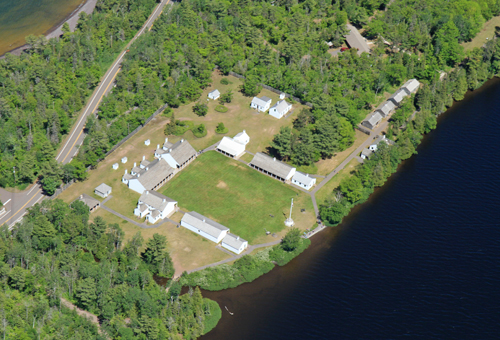
Fort Wilkins, photo by Neil Harri Aerial Photography

A number of years ago, I camped at Fort Wilkins State Park on Lake Fanny Hooe on the Keweenaw Peninsula. Hunts Guide to the UP says that Fort Wilkins was a typical 19th-century frontier garrison, the most northern in the U.S.:

The 1843 Keweenaw copper rush in this distant area, way beyond the frontier of settlement, led to building this small fort. From 1844 to 1846 the fort was the area’s only source of law and order. The government’s greatest concern was friction between native Indians and unruly miners. But little hostility actually broke out. By 1846 most of the small-time prospectors had left. Large mining companies had stabilized the region, so the fort was abandoned. It reopened after the Civil War, from 1867 to 1870, due to inadequate barracks facilities elsewhere in Michigan.

The army abandoned Fort Wilkins for good in the 1870s. Within two decades it had become a favorite picnic and camping destination. Local people appreciated its beautiful, forested location on Lake Fanny Hooe.

Today you can camp on the shores of the lake, which is still beautiful and forested and offers great fishing. They do some interpretive demonstrations at the park as well.

I couldn’t find a photo that I liked for the fort until I found these aerial shots in the photo gallery at the Fort Wilkins Natural History Association, a nonprofit that raises money to support and sponsor programs and special events at the park. They have some cool videos about the history of Fort Wilkins that are worth your time.

Neil Harri is a professional aerial photographer who also has some great Upper Peninsula photos, books and DVDs for sale through his website.  The DVD aerial tours look especially cool and there are several from the Keweenaw including a historical aerial tour of Keweenaw’s Copper Ridge!

More Michigan aerial photography on Michigan in Pictures!

G1, X Flare … could it be an Aurora Borealis Bingo?

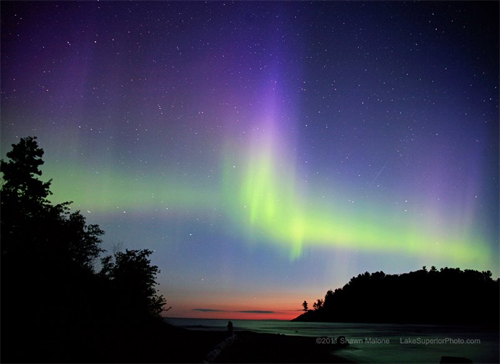
Northern Lights at Little Presque Isle, photo by Lake Superior Photo

This is a little technical, but you can boil it down to say “We might well see some northern lights in the next few days!”

Space Weather says that a category G1 (Minor) geomagnetic storm is expected on August 5th due to the effects of a CME (Coronal Mass Ejection) observed early on 02 August 2nd. In plain English, that means we might see the Northern Lights on the 5th! Don’t get too terribly excited though – according to NOAA Space Weather who puts out the email alerts that I subscribe to, G1 is the lowest level of a scale that goes up to 5. Don’t get depressed either though, as they say that during G1 activity, the Aurora Borealis is commonly visible at high latitudes (northern Michigan and Maine)!

I posted the above on Facebook, and my friend Shawn Malone (who took the photo above) told me that it is also possible for an x flare this week producing an EARTHWARD directed flare that would hit earth probably some time next week which would produce a northern lights display to remember! There was a brief x flare on July 29 – read about it here and see a video from NASA here. The displays in February 2011 were produced by a powerful x flare…

You can see & purchase lots more of Shawn’s photos of northern lights through LakeSuperiorPhoto.com and also check out her cool Northern Lights – square format album!

Michigan in Pictures has LOTS more pictures and information about the Aurora Borealis (Northern Lights).