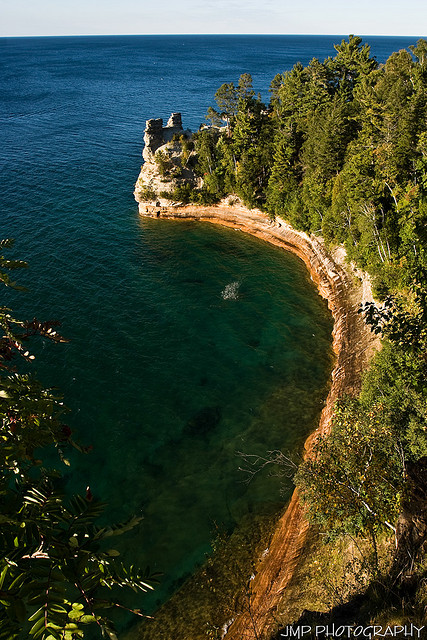
Before the fall at Miner’s Castle

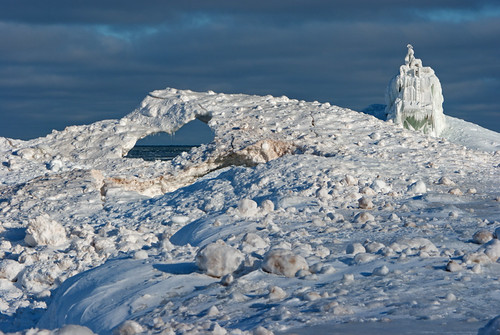
Miners Castle

Miners Castle, photo by James Marvin Phelps

The Pictured Rocks National Lakeshore feature on the collapse of one of the two turrets at Miner’s Castle explains that 7 years ago today:

On Thursday morning, April 13, 2006, the northeast turret of Miners Castle collapsed. One turret remains on Miners Castle, the best-known feature of Pictured Rocks National Lakeshore. The collapse was reported via cell phone by fisherman in the area, according to chief ranger Larry Hach.

Most of the rock fell north and into Lake Superior, and there were no injuries. The lower overlook platform near Miners Castle appears to be unaffected.

While the rockfall at Miners Castle on April 13 was startling, such events are not rare along the Pictured Rocks escarpment. At least five major falls have occurred over the past dozen years: 1) two different portions of Grand Portal Point, 2) the eastern side of Indian Head just east of Grand Portal Point, 3) Miners Falls just below the (now modified) viewing platform, and 4) beneath the lip of Munising Falls (along the former trail that went behind the cascade).

All the rockfalls involved the same rock unit, the Miners Castle Member of the Munising Formation. Rock units are named for places where they were first technically described. The Miners Castle Member consists of crumbly cross-bedded sandstone that is poorly cemented by secondary quartz, according to U.S. Geological Survey Research Ecologist Walter Loope.

Rockfalls along the cliffs typically occur in the spring and fall due to freezing and thawing action of Mother Nature.

Check this photo out bigger, see Jim’s “after” photo and get a lot more great photos in his Pictured Rocks National Lakeshore slideshow.

There’s more from Jim and more from Pictured Rocks on Michigan in Pictures!

Can you feel the summer?

Can you feel it.

Can you feel it., photo by Majestic View Photography

I can tell when winter is wearing on folks when the spring & summer pictures start to flood in. I love the fact that we’re having the first normal Michigan winter in years but I can’t wait until the blues & greens and warm days return!

Check this out on black and see more in Dan’s Water’s View slideshow.

More islands on Michigan in Pictures.

Grand Marais, Michigan

Grand Marais Harbor Outer Light Station

Grand Marais Harbor Outer Light Station, photo by Gary of the North

The Michigan Historical Marker at Grand Marais reads:

Grand Marais, which is among Michigan’s oldest place names, received its name from French explorers, missionaries and traders who passed here in the 1600s. “Marais” in this case was a term used by the voyaguers to designate a harbor of refuge. In the 1800s Lewis Cass, Henry Schoolcraft and Douglass Houghton also found the sheltering harbor a welcome stopping place. Grand Marais’s permanent settlement dates from the 1860s with the establishment of fishing and lumbering. At the turn of the century Grand Marais was a boom town served by a railroad from the south. Its mills turned out millions of board feet annually. Lumbering declined around 1910, and Grand Marais became almost a ghost town, but the fishing industry continued. Many shipping disasters have occurred at or near the harbor of refuge, which has been served by the Coast Guard since 1899. In 1942 the first radar station in Michigan was built in Grand Marais. Fishing, lumbering and tourism now give Grand Marais its livelihood.

Check this out big as Lake Superior and see more in Gary’s slideshow.

More Grand Marais on Michigan in Pictures!

The Northern Lights of March 1989

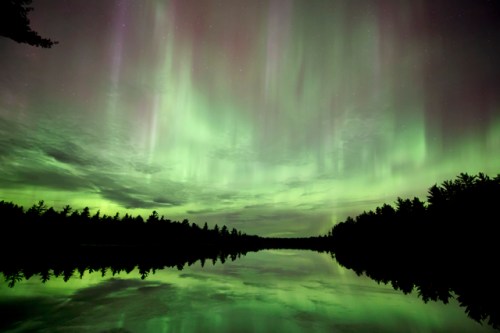
Emerald Radiance by Shawn Malone

Emerald Radiance, photo by by Shawn Malone

Last week on Michigan in Pictures for a post titled Heavy (space) Weather,  I referenced The 23rd Cycle:Learning to live with a stormy star by Dr. Sten Odenwald. This out-of-print book is available online for free and explores the impact of solar storms upon our electromagnetic grid. Chapter 1 is titled A Conflagration of Storms, and it begins with an account of one of the most memorable aurora borealis I’ve ever experienced:

On Thursday, March 9, 1989 astronomers at the Kitt Peak Solar Observatory spotted a major solar flare in progress. Eight minutes later, the Earth’s outer atmosphere was struck by a wave of powerful ultraviolet and X-ray radiation. Then the next day, an even more powerful eruption launched a cloud of gas 36 times the size of the from Active Region 5395 nearly dead center on the Sun. The storm cloud rushed out from the Sun at a million miles an hour, and on the evening of Monday, March 13 it struck the Earth. Alaskan and Scandinavian observers were treated to a spectacular auroral display that night. Intense colors from the rare Great Aurora painted the skies around the world in vivid shapes that moved like legendary dragons. Ghostly celestial armies battled from sunset to midnight. Newspapers that reported this event considered the aurora, itself, to be the most newsworthy aspect of the storm. Seen as far south as Florida and Cuba, the vast majority of people in the Northern Hemisphere had never seen such a spectacle. Some even worried that a nuclear first-strike might be in progress.

Read on for more about the impact of this and other solar storms or check out the whole book.

While I couldn’t find photos from ’89 of these amazing northern lights, I was able to get a really cool photo from one of Michigan’s best aurora photographers, Shawn Malone. About the display above from November 14, 2012 she writes:

I think this photo is my favorite to date. It felt like years of observing and photographing resulted in the reward of being able to catch this image. Beautiful place, right time, right conditions, and a great geomagnetic event materialized!

You can purchase the photo at LakeSuperiorPhoto.com at and see many more in her Northern Lights Gallery.

There’s more from Shawn and LOTS more about the Northern Lights on Michigan in Pictures.

Heavy (Space) Weather: Coronal Mass Ejections and the Northern Lights

Northern Lights

Northern Lights, photo by gkretovic

Michigan in Pictures has a whole lot on the Northern Lights.

The aurora borealis are one of the world’s most rare and wonderful sights and Michigan – especially the Upper Peninsula – is blessed with more than a few nights every year when this elusive phenomenon makes an appearance.

The Library of Congress page What Are the Northern Lights? calls on NASA’s Dr. Sten Odenwald, author of The 23rd Cycle, Learning to Live with a Stormy Star, to provide insight to how northern lights are formed:

The origin of the aurora begins on the surface of the sun when solar activity ejects a cloud of gas. Scientists call this a coronal mass ejection (CME). If one of these reaches earth, taking about 2 to 3 days, it collides with the Earth’s magnetic field. This field is invisible, and if you could see its shape, it would make Earth look like a comet with a long magnetic ‘tail’ stretching a million miles behind Earth in the opposite direction of the sun.

When a coronal mass ejection collides with the magnetic field, it causes complex changes to happen to the magnetic tail region. These changes generate currents of charged particles, which then flow along lines of magnetic force into the Polar Regions. These particles are boosted in energy in Earth’s upper atmosphere, and when they collide with oxygen and nitrogen atoms, they produce dazzling auroral light.

We focus on the beauty, but as he explains:

“Aurora are beautiful, but the invisible flows of particles and magnetism that go on at the same time can damage our electrical power grid and satellites operating in space. This is why scientists are so keen to understand the physics of aurora and solar storms, so we can predict when our technologies may be affected.”

Dr. Odenwald’s book is out of print but he has made it available online. There’s some interesting stuff in there, and be sure to check out his Astronomy Cafe site too.

One benefit from the economic & security concerns of predicting space weather is that you can get some great northern light forecasts. My favorite is NOAA’s Space Weather Service. They reported a G1 storm on March 1st – it’s the lowest intensity on the Space Weather Scales but as you can see is still able to produce auroral activity!

Greg took this photo Saturday night just before midnight at Presque Isle in Marquette – check it out on black and in his slideshow. You can see more of Greg’s work on Michigan in Pictures, at michigannaturephotos.com and definitely follow him at Michigan Nature Photos on Facebook.

Northern Hawk Owl, and the NMC Hawk Owls

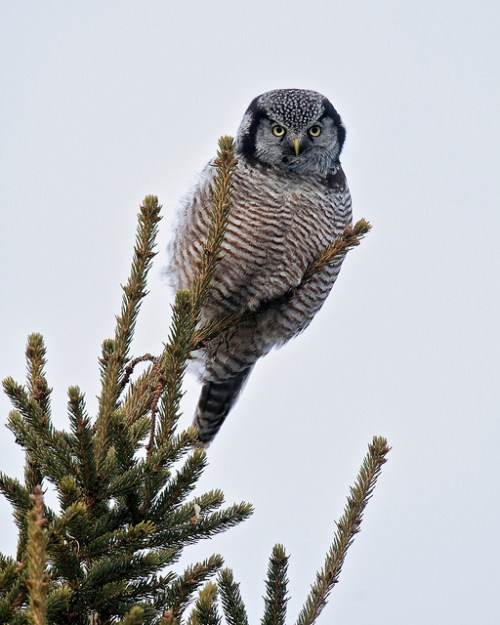
northern hawk owl, chippewa county, michigan

northern hawk owl, chippewa county, michigan, photo by twurdemann

Northwestern Michigan College here in Traverse City has just under 5000 students and is turning from a 2 year to a 4 year college. As part of this, they will be adding athletics again, and that means they need a mascot. So this week they selected a new one – the NMC Hawk Owls.

With a weight of half a pound to a pound, a length of just 14-16″ and a wingspan of just under 2 1/2 feet, the Northern Hawk Owl appears to be the perfect mascot:

Northern Hawk Owl – Surnia ulula at OwlPages.com:

Hunting & Food: Takes mainly small mammals as prey, mostly lemmings and voles. Will also take birds, frogs and occasionally fish. Prey weight is normally below 70g. Hunts by searching from a lookout, then quickly flying to swoop down on prey. Has been observed hovering also.

Breeding: Male advertises potential nest sites, and the female selects one. Nests in Cavities on top of broken trunks, natural tree hollows, abandoned holes of large woodpeckers. Will accept nest boxes, and occasionally use a stick nest of a larger bird. Laying normally occurs in April and the first half of May. Clutch sizes are usually between 5 and 13 eggs, each 36-44mm  x 29-34.4mm. Eggs are laid at 1-2 day intervals, and incubated by the female alone for 25-30 days. During this time, the male feeds the female.

Northern Hawk-Owl at Wikipedia:

The Northern Hawk-Owl has been said to resemble a hawk in appearance and in behavior. In North America, its appearance in flight is often considered similar to a Cooper’s Hawk (Accipiter cooperii). It has been suggested that this may be because the Hawk-Owl may partially fill an important diurnal niche similar to that of day hunters such as hawks.

…Northern Hawk Owls are unevenly distributed and highly variable throughout the boreal forest. They live mostly in open coniferous forests, or coniferous forests mixed with deciduous species such as larchbirchpoplar, and willow. They are found in muskegs, clearings, swamp valleys, meadows, or recently burnt areas, and generally avoid dense spruce-fir forests. Winter habitat is usually the same as breeding habitat. 

Northern Hawk Owl at All About Birds adds that their International conservation status is Least Concern and some cool facts:

  • The Northern Hawk Owl can detect prey by sight at a distance of up to 800 meters (half a mile).
  • Though it is thought to detect prey primarily by sight, the Northern Hawk Owl can find and seize prey under 30 cm (1 foot) of snow.

The Whitefish Point Bird Observatory adds that Northern Hawk Owl were observed yesterday in Trout Lake and Dryburg, Michigan.

Grabbing a mouse through a foot of snow? That’s a seriously scary predator … at least if you’re the prey. Click all those links to explore photos, calls and more about these tiny terrors.

Check this photo from Chippewa County out on black and see more including another shot of this owl in twurdemann’s Birds slideshow.

More owls (and also apparently words that end with owl) on Michigan in Pictures.


Living in the Light at Friends of Miners Memorial Heritage Park

Miners Memorial Heritage Park (2)

Miners Memorial Heritage Park (2), photo by siskokid

I’ve always found snow & cold to be a lot more tolerable when accompanied by a healthy dose of sun & blue skies. About this photo Jim writes:

During the recent snowshoe weekend with my buddies Jim, Fred and Roger, we snowshoed the trails of this beautiful park located in my hometown. A recent snowfall had left a good blanket of powder that hadn’t been groomed as of yet for cross-country skiing. Lucky for us!

The City of Ironwood, Michigan passed an ordinance in 2011 that designated 167 acres of city-owned land in the center of Ironwood as the Miners Memorial Heritage Park. This area once contained five iron ore mines, the last of which closed in the 1960’s. The Friends of Miners Memorial Heritage Park has created a 2.6 mile looping trail through a portion of this area for hiking in the summer and cross-country skiing and snowshoeing in the winter. The Park is “Dedicated to those who toiled underground to work these mines. Many died in the darkness so future generations could live in the light.”

More about the park including some old photos at fmmhp.com.

Check this photo out on black, see more from the park in Jim’s slideshow and also view more of his UP shots on Michigan in Pictures.

Bond Falls in black & white

Bond Falls

Bond Falls, photo by wingsfan1705

Michigan in Pictures has a number of photos from Bond Falls, but there’s always room for one more. ;)

Check this out background bigtacular and see more including some detail shots in Kim’s slideshow.

More black & white photography on Michigan in Pictures.

Winter Study: Observing Wolves & Moose on Isle Royale

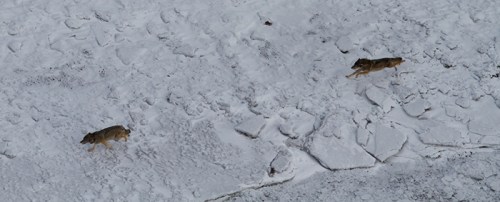
Isabelle being chased by her assailant

Isabelle being chased by her assailant, photo by isleroyalewolf.org

A couple of weeks ago a reader sent me a link isleroyalewolf.org. The website documents the interactions of the island’s wolf & moose population as their decades long dance unfolds on this remote, wilderness island. Their overview explains:

Isle Royale has offered many discoveries… how wolves affect populations of their prey, how population health is affected by inbreeding and genetics, what moose teeth can tell us about long-term trends in air pollution, how ravens give wolves a reason to live in packs, why wolves don’t always eat all the food that they kill, and more. The wolves and moose of Isle Royale also frequently reveal intimate details of their daily life experiences and they have inspired numerous artistic expressions. If we pay attention, they all tell us something important about our relationship with nature. These insights and discoveries are all presented here for you.

Building on the graph above and to develop a deeper understanding, here is more on the history of wolves and moose on Isle Royale. Moose first came to Isle Royale in the early 20th century, and for fifty years, their numbers fluctuated with weather conditions and food abundance. Wolves first arrived in the late 1940s by crossing an ice bridge from Canada. The lives of Isle Royale moose would never be the same.

Every winter since 1958, a team of researchers has spent numerous weeks at Isle Royale observing the lives of these wolves and moose and reporting back. Now they offer a website with photos and detailed reports, a fascinating tale that I encourage you to follow. Today’s photo is from the edition I began with – It’s Complicated. A snapshot:

Isabelle’s signal was surprisingly close. By the time we saw her, she was running for her life, north along the beach of Rainbow Cove. She was being chased by Pip’s two companions. Pip was nowhere in sight. While those two wolves have been eating regularly, Isabelle may not have had a decent meal in weeks, perhaps longer. Isabelle’s half-mile lead was reduced to nothing in just a few minutes.

Definitely read on for photos and a gripping account of these wolves battling and follow the whole 2013 Winter Study as it unfolds (sign up for their email).

More wolves on Michigan in Pictures.

MNA Memorial Falls aka Twin Falls

Memorial Falls in Winter (pano)

Memorial Falls in Winter (pano), photo by nasunto

GoWaterfalling’s page on Memorial Falls in Munising says:

MNA Memorial Falls is in Munising, off of H-58. Some of the locals refer to this waterfalls as “Twin Falls”. This is a very seasonal waterfall and is often dry. However when the water is flowing, which may only be after a good rain or when the snow is melting, you will be treated to a very pretty gorge with two waterfalls in it. MNA Memorial Falls is owned by the Michigan Nature Association and it is open to the public.

…Two streams empty into this gorge, but the second one likely only has water after or during a good rain. One very interesting feature of this gorge is a “window” in the walls between the two falls. You can crawl through this window, or just walk around it. You can see each of the waterfalls through this window.

Another nice thing about this waterfall is its proximity to Tannery Falls. The trail from Nestor streets forks just before it descends into the gorge. The trail to the right leads to the base of the falls. The trail to the left leads to H-58, about 100 feet away from the stairway to Tannery Falls, so you can visit both falls on the same hike.

In the winter both of these falls turn into ice columns that are tackled by the ice climbers. Despite their low volume of water, each of these falls manages to produce a very impressive column. Every winter Munising hosts an ice climbing festival. After the festival the ice columns look like they have been attacked by woodpeckers. There are many other interesting ice formations to see in the area.

Read on for more and definitely click through to see a pic of a person beside the 40′ fall and a shot of the “window”. Also see Memorial Falls at the Waterfall Record.

Check this out background big and see more in Nina’s Michigan Waterfalls slideshow. If you look carefully, you’ll see another photographer in the shadows!

There’s many more waterfalls on Michigan in Pictures including the above-mentioned Tannery Falls.