La Chapele: The Doric Arch & Chapel Rock

Pictured Rocks Shoreline

Pictured Rocks Shoreline, photo by dwfphoto

Their beginning is in the Doric Rock which is about two miles from the line of towers and battlements which compose the grand display of the Pictured Rocks; and seems to have been sent in advance to announce to the voyageur the surprising and appalling grandeur that awaits him ahead.
~Thomas McKenney, 1834

“Appalling grandeur” is indeed fitting for the stretch of the Pictured Rocks. The above quotation comes from a wonderful website I just discovered: Tracing The Trail: The Pictured Rocks Segment of the Anishnaabeg Migration Route. The site has some incredible historic information about the Anishnaabeg and their life & migration through the Pictured Rocks. The site has some fascinating information, and I heartily urge you to check it out. Regarding what is today known as Chapel Rock, they explain that what we see today was once an arch known as Doric Rock or Le Chapelle.

“The voyageurs, of course, coined the name ‘Le Chapelle,’ and they continued to use the term well into the American period. The journals of the 1820 Cass expedition reveal the origin of the new name. David Bates Douglass simply notes that just west of a waterfall cascading over the rocks they visited a ‘fine natural arch.’ Schoolcraft states that near a cascade four miles beyond the beginning of the sandstone bluffs is located ‘Doric Arch.’ Both Charles C. Trowbridge and James Duane Doty indicate that the Cass expedition was responsible for naming the formation ‘Doric Arch.’ The following excerpt from Doty’s journal gives a good description of the formation and reason for naming it ‘Doric Arch.’

About midway of the rocks a stream of water is seen pouring over a perpendicular bank 70 feet high. The sheet is about 10 feet wide. Passing this we soon come to an arched rock separated apparently entirely from the bank. It is 10 feet from the waters edge to the top of the bank on which it is based; the arch then rises about 35 feet. On the right supporting the arch 2 pillars well formed are seen, on the left but one was discovered—the woods however obstructed the view. The arch appeared smooth and elegantly shaped. On its top and under it pine trees were growing –one very large directly on its center….This arch we named Doric Arch from the resemblance which it bears to that order of architecture.

…“The Chapel, which is reported to have collapsed in 1906, has left its name on current topographic maps. At the site of its location is a symbol and the term ‘Chapel Rock.’

While the arch connecting “The Chapel” and the adjacent cliff did indeed collapse in 1906, the intricately sculpted rock remains as Chapel Rock. The great white pine that Doty observed still grows on top of Chapel Rock, and the tree’s roots mark where the rock arch once stood.

Check this out background big and see more in his excellent Pictured Rocks slideshow.

The Pictured Rocks Boat Tour company offers free tours of the Pictured Rocks National Lakeshore shoreline for UP residents every year to celebrate Pictured Rocks Day. That’s this Saturday, so I’m celebrating the Pictured Rocks all week with posts to give everyone a taste of one of Michigan’s most amazing places. Want more Pictured Rocks photos? Michigan in Pictures has tons!

Indian Head at Pictured Rocks

Indian Head | Pictured Rocks

Indian Head | Pictured Rocks, photo by Beth☮♥♬

Pictured Rocks Day is this Saturday, a day when the Pictured Rocks Boat Tour company offers free tours where you can see sights like Indianhead. Their tour highlights page explains:

This gargantuan rock formation is named after what many say resembles an old ‘Indian Head’ carved into an impressive point of Pictured Rocks. The cliffs of Indian Head are nearly vertical walls from the Lake Superior to its peak.

Much more at the Pictured Rocks National Lakeshore website!

View this photo on black and see more in Beth’s Upper Peninsula slideshow.

There’s tons of Pictured Rocks information on Michigan in Pictures!

Grand Island National Recreation Area

Grand Island's North Shore

Grand Island’s North Shore, photo by Rudy Malmquist

Whereas Pictured Rocks Day is this Saturday and whereas this blog loves the Pictured Rocks National Lakeshore, I’ve decided to dedicate the week to posting about one of my favorite areas of Michigan. ;)

Wikipedia explains that the Grand Island National Recreation Area is part of the Hiawatha National Forest. The 13,500-acre island is about 8 miles long and is located about a mile off the Lake Superior shore at Munising. Congress made the island a National Recreation Area in 1990 after the U.S. Forest Service purchased it from the Cleveland Cliffs Iron Co.

Grand Island’s geology is an extension of the sandstone strata of the adjacent Pictured Rocks National Lakeshore. Island sandstone cliffs as tall as 300 feet (91 m) in height plunge down into the lake. A 23-mile (37 km) perimeter trail skirts much of the island’s shoreline.

Native Americans quickly found the fisheries around Grand Island to be a resource for seasonal and year-round living. Artifacts from as early as 3300 years before the present (1300 BCE) have been found.

Grand Island National Recreation Area is served during summer months by a tourist ferry and island tour bus. The ferry ride, which is less than 1 mile (1.6 km) long, shuttles between a dock on M-28, northwest of Munising, and Grand Island’s Williams Landing. Ticket fees and an admission fee to the island are charged. During the summer months, the ferry makes several trips to the island each day.

Also see the Forest Service site for Grand Island, a Google Map of the island and the Grand Island Ferry Service which has all kinds of recreation information including the fact that the island has bike-friendly roads & trails! Here’s a video of that gives a taste of biking there, and definitely check out frequent michpics photographer Nina Asunto’s blogs about Grand Island for an in-depth look at this island.

I’m pretty confident that the biking drew Rudy to the island. Get the photo big as Superior and see more work from Rudy in his slideshow.

See the Grand Island North Lighthouse, the Grand Island East Channel Light and more Michigan islands on Michigan in Pictures.

See Battleship Row on Pictured Rocks Day – June 15, 2013

Pictured Rocks National Lakeshore - May 2013

Pictured Rocks National Lakeshore – May 2013, photo by gbozik photography

Battleship Row is one of the many unique formations you can see on the Pictured Rocks cruises. ABC 10 reports that this Saturday, June 15 is Yooper Day for Pictured Rocks Cruises:

Around 1,000 U.P. residents cruised Pictured Rocks National Lakeshore free of charge in a single day last June. The free cruises were so popular that the company is bringing them back.

“This year in conjunction with the Chamber (of Commerce) and the National Lakeshore, to promote the area, and that day we give free rides to Upper Peninsula residents with a valid Upper Peninsula I.D.,” John Madigan said, who is a co-owner and manager of Pictured Rock Cruises.

On June 15, the Alger County Chamber of Commerce is hosting Pictured Rocks Day. Bayshore Park in Munising will be filled with family activities and eleven hours of live music. “I think they have 35-40 exhibitors. They’ll be selling different products,” Madigan said.

The free cruises will leave the Munising City Pier every hour, on the hour, from 10 a.m. to 7:00 p.m., weather permitting. Tickets will be available on a first-come, first-served basis.

FYI the cruises are just $35 for a 2-3 hour cruise that packs a huge amount of scenic entertainment!

Check it out big as a battleship and see a couple more shots in his Travels in the U.P. slideshow.

Much (much) more about the Pictured Rocks on Michigan in Pictures.

2013 Michigan Strawberry Season: Just around the corner!

farmersmrktMQT_starwberrysmichigan_0471square

farmersmrktMQT_starwberrysmichigan_0471square, photo by CreateWithKim

Ed Vielmetti has his annual strawberry report up for 2013.  He reports that in the Ann Arbor area they’re expecting the first strawberries next week or early the following week. As you move north, the first strawberries move back a few days.

Kim shot this a few years ago in Marquette – check it out bigger and see more in her Farmer’s Markets slideshow.

More strawberries on Michigan in Pictures!


Waterfall Wednesday: Sturgeon Falls in Ottawa National Forest

Sturgeon Falls

Sturgeon Falls, photo by Wenström

I can’t get enough of the great shots of snowmelt-fueled U.P. rivers. Go Waterfalling’s page on Sturgeon Falls says:

Sturgeon Falls is located in the Sturgeon River Gorge Wilderness in Ottawa National Forest. The Sturgeon River has carved out a deep, forested gorge, that is 300 feet deep in some places. The falls are located deep in the gorge. The drop is only 30 feet, but the river is very powerful. Above the falls the river is well over 100 feet wide. It then narrows into a chute only about 30 feet wide before shooting over the falls, spraying mist in all directions.

Read on for directions. The Sturgeon River is a Michigan Wild & Scenic river as well!

Check Sven’s photo out on black and see more in his UP Michigan Waterfalls slideshow.

Many more Michigan waterfalls on Michigan in Pictures!

Rainbow Falls on the Black River

n2c_113-0377

Ragin’ Rainbow Falls, photo by sgowtham

The GoWaterfalling page on Rainbow Falls explains:

This is the last of the main falls on the Black River before it enters Lake Superior. This is an interesting waterfall. Unfortunately the best views are from the east side of the river and the observation deck is on the west side of the river. The hike from the west side trailhead is 1/2 mile. In my opinion the smarter thing to do is to drive down to end of the Black River Scenic Byway, cross the river and hike back up to the falls. A supsension bridge takes you across the river and a mile long, scenic, and mostly level trail, takes you back to the falls. The views are far superior. In low water you can wade across the river above the falls.

The Black River Scenic Byway starts north of US 2 near Bessemer. There are signs on US 2. Rainbow Falls is about 16 miles north of US 2. The scenic area is on the right and is clearly marked. It is about a 1/2 mile walk from the parking area to the falls. There are a lot of stairs at the end.

The waterfall has carved out a large pothole. Most of the river falls into the pothole, but some of the water, depending on how high the river is, goes around or jumps clear over this hole.

Head over to GoWaterfalling for more pics and information about other falls in the area.

View Gowtham’s photo on black and see more in his Nature slideshow.

Many more Michigan waterfalls on Michigan in Pictures!

Gorge Falls on the Black River Scenic Byway

gorge falls-black river, gogebic county, MI

gorge falls-black river, gogebic county, MI, photo by Northwoods Apparition

I’m always happy when someone shares a photo of a waterfall I’ve never seen. Michigan in Pictures has a ton of Michigan waterfall photos, so it’s not often that this happens! The GoWaterfalling.com entry for Gorge Falls explains:

Gorge Falls is named for the deep and narrow gorge above and below the falls. This was my personal favorite of Black River Scenic Byway waterfalls. It is also one of the easier waterfalls to visit, being only a short distance from the parking area. There are a fair number of stairs to the falls overlook. It is only a short walk upstream to see Potawatomi Falls.

I do not know how hard it would be to get to the east side of the gorge, or what the views are like.

The Black River Scenic Byway starts north of US 2 near Bessemer. There are signs on US 2. Gorge Falls is about 14.5 miles north of US 2. The scenic area is on the right and is clearly marked.

Click through for more and see a map of the Black River Scenic Byway.

Check Kirk’s photo out background bigtacular and see more great shots in his slideshow!

North Country Dreamland

North-Country-Dreamland-at-Miners-Castle-by-Shawn-Malone


North Country Dreamland at Miners Castle, photo by Shawn Malone / lakesuperiorphoto.com

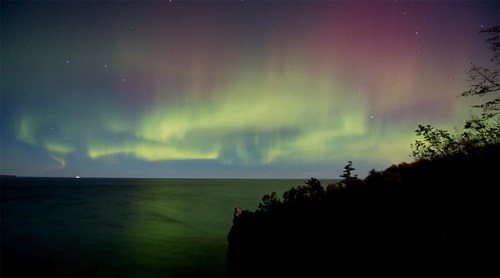
Last night I got an alert of a moderately strong solar flare with the possibility of generating northern lights. When I went looking to see if anyone had photographed them, I discovered that Michigan in Pictures regular Shawn Malone has just released a truly stunning video featuring a series of time-lapses of the night skies of northern Michigan! She writes:

Rare pairings caught on camera include ribbons of aurora above a full moon fogbow on the horizon of Lake Superior, the aurora and an isolated singular lightning storm cloud over Lake Superior, and the aurora and Milky Way in several scenes including Copper Harbor, Marquette, Isle Royale, Pictured Rocks, and Eagle Harbor Lighthouse.

…All scenes are within 200 miles or so of my home in Marquette, Mi. and I feel very blessed to live where I do and to share the beauty that I see ‘in my own backyard’ with you. I hope it inspires others to take time to find the beauty that is everywhere around us and also to raise an awareness about the importance of preserving our night wondrous starlit skies.

You can read about it and see it on Absolute Michigan or head over to Vimeo to watch it.

The shot above is one of 33 different scenes in the video and shows Miners Castle in the Pictured Rocks National Lakeshore. See it bigger in the video and see a lot more on the Lake Superior Photo Facebook.

Much more from Shawn on Michigan in Pictures.

Old Fire

old fire

old fire, photo by Marty Hogan

Marty took this shot near Houle & Wilson in Menominee County in the UP. One of the commenters on his photo who grew up about 3/4 of a mile from there explained that the kilns were used by a sawmill for drying lumber.

Check this out on black, see the whole group of them right here and see several more views of this ruin in his August 2012 slideshow!

More from Marty on Michigan in Pictures!