A Conflagration of Storms: The March 13, 1989 Solar Storm

Conflagration of Storms

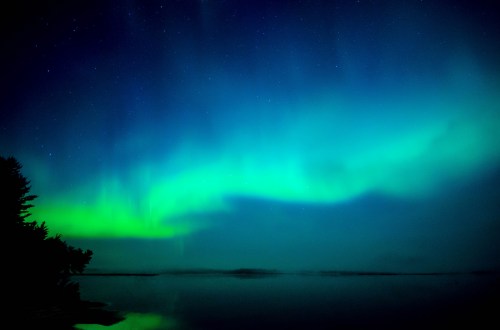
Northern Lights, photo by Stephen Tripp

Intense colors from the rare Great Aurora painted the skies around the world in vivid shapes that moved like legendary dragons. Ghostly celestial armies battled from sunset to midnight. Newspapers that reported this event considered the aurora, itself, to be the most newsworthy aspect of the storm. Seen as far south as Florida and Cuba, the vast majority of people in the Northern Hemisphere had never seen such a spectacle. 
~Dr. Sten Odenwald

I like to revisit this March 13, 1989 incident documented by Dr. Odenwald in A Conflagration of Storms. In addition to being an amazing display of the aurora borealis, this solar storm took down Quebec’s power network and very nearly much more:

In many ways, the Quebec blackout was a sanitized calamity. It was wrapped in a diversion of beautiful colors, and affected a distant population mostly while they slept. There were no houses torn asunder, or streets flooded in the manner of a hurricane or tornado. There was no dramatic footage of waves crashing against the beach. There were no cyclonic whirlwinds cutting a swath of destruction through Kansas trailer parks. The calamity passed without mention in the major metropolitan newspapers, yet six million people were affected as they woke to find no electricity to see them through a cold Quebec wintry night. Engineers from the major North American power companies were not so blasé about what some would later conclude, could easily have escalated into a $6 billion catastrophe affecting most U.S. East Coast cities. All that prevented 50 million more people in the U.S. from joining their Canadian friends in the dark were a dozen or so heroic capacitors on the Allegheny Power Network.

The Media seemed to have missed one of the most human impacts of the beautiful aurora they so meticulously described in article after article. Today the March 1989 ‘Quebec Blackout’ has reached legendary stature, at least among electrical engineers and space scientists, as an example of how solar storms can adversely affect us. It has even begun to appear in science textbooks. Fortunately, storms as powerful as this really are rather rare. It takes quite a solar wallop to cause anything like the conditions leading up to a Quebec-style blackout. When might we expect the next one to happen? About once every ten years or so, but the exact time is largely a game of chance.

Call it the ultimate Friday the 13th! The whole book The 23rd Cycle:Learning to live with a stormy star is available online, and you can read a lot more from Dr. Odenwald at his website, The Astronomy Cafe or at facebook.com/AstronomyCafe.

View Stephen’s photo bigger and see more in his excellent Northern Lights slideshow.

A whole lot more northern lights on Michigan in Pictures!

PS: Keep an eye on solar storminess and get heads up notifications when the northern lights might be visible at NOAA’s Space Weather Prediction Center.
Leaving the Land of Ice & Frost

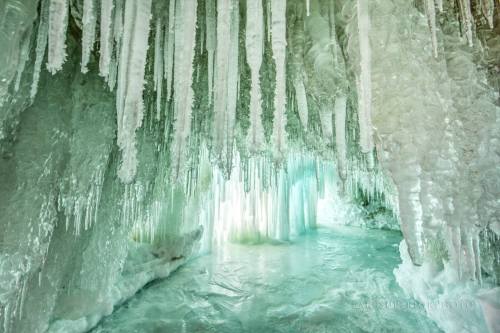
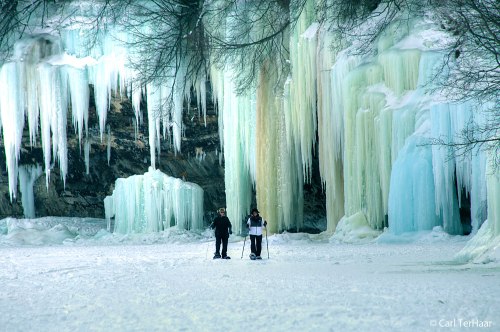
Ice Curtains on Grand Island, Munising, MI

Ice Curtains on Grand Island, Munising, MI, photo by Carl TerHaar

Seems fitting to stay at Grand Island for another day. With a few exceptions, most of Michigan is above freezing even at this early hour, which means it’s time to say goodbye to winter and icy excursions. What a winter!!

View Carl’s photo background bigilicious and see more in his slideshow.

Haven’t had enough? There’s more winter wallpaper on Michigan in Pictures!

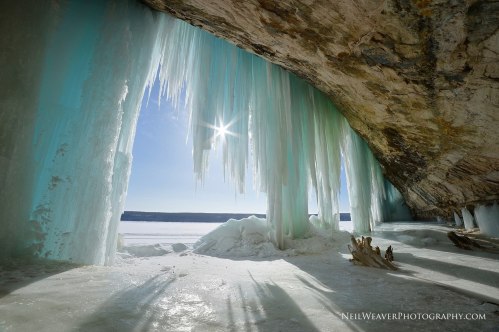
Ice curtains at Grand Island

Ice Curtains at Grand Island

Grand Island Ice Curtains, photo by Neil Weaver Photography

Neil says that seeing these in person was such an awesome experience. View the photo background bigtacular on his Facebook page, purchase a print right here, and check out lots more icy goodness at neilweaverphotography.com.

Except for a tiny sliver, the entirety of this Lake Superior island just off Munising is open for public access as the Grand Island National Recreation Area​. You will definitely want to check with locals regarding ice conditions. With a warming week of weather ahead, this is probably something to put on your 2016 agenda.

More winter wallpaper on Michigan in Pictures!

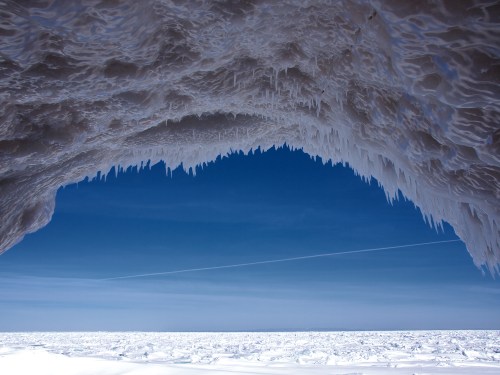
Michigan Ice Cave Collection #77: Whitefish Point Ice Cave

Whitefish Point Ice Cave by David Marvin

Whitefish Point Ice Cave, photo by David Marvin

If you’re collecting Michigan ice caves, you should know that Whitefish Point (up past the Tahquamenon Falls on Lake Superior) has ice caves right now.

View David’s photo background bigtacular and see more in his absolutely stunning Taqhamenon Falls & Whitefish Point – February 28, 2015 slideshow. (seriously, run, don’t walk to see this slideshow!) Lots more from David at his Marvin’s Gardens blog.

More winter wallpaper and more ice caves on Michigan in Pictures.


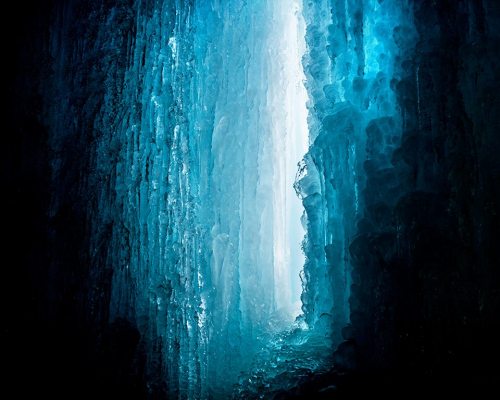
it’s magic you know, never believe it’s not so

Its magic you know, never believe its not so

it’s magic you know, never believe it’s not so, photo by Lake Superior Photo

Shawn says the ice formations of Munising are amazing right now and says she’ll be sharing more soon.

She recommends you check with Munising CVB, the rangers at Pictured Rocks National Lakeshore or the Alger County Sheriff to learn if the ice is safe. Ice conditions are constantly shifting, and as you can see, these are massive structures of ice that you want to be pretty darned careful around.

View her photo background bigtacular, visit LakeSuperiorPhoto.com for galleries like Blue Ice and to purchase pictures, and definitely follow Lake Superior Photo on Facebook.

Now about that title, here’s Pilot singing “Magic” … never believe it’s not so.

#TBT Fortress of Solitude Edition at the Grand Island Ice Caves

Grand Island Ice Cave

Grand Island ice cave, Winter 2012/13, photo by Ash W Photography

A cool site that really gives you to tools to have a lot of fun in the Upper Peninsula is Things to Do in the U.P. #64 is visiting the Grand Island Ice Caves. After providing very detailed tips & information about how to get to these spectacular formations on Lake Superior off Munising, Brian Marticcui writes (in part):

For an intimate look at nature’s awesome power, sidle up to one of the columns and peer into its core. Expecting a solid tower of frozen water? Not a chance. These columns, especially the newer and/or sun-exposed ones, are actually made up of tiny beads and icicle-like formations separated by vertical channels that allow water to pass through them. It’s one of those mind-numbingly complex natural things that’s simultaneously random and orderly – kind of like a geode, but mostly frozen and not quite as colorful.

Inside, things are a bit more stable – and a whole lot more interesting, if that’s possible. For starters, many of the “entrances” to the caves are little more than elevated holes between solid ice columns. Depending on how the caves have set during the weeks leading up to your visit, you may have to scramble up a mound and squeeze yourself through an opening to actually gain access. (Clip-on crampons might be a good idea.)

Once you get in, be careful, both for your own physical safety and for the integrity of the caves themselves. The floors are often mirror-smooth, making regular walking a major challenge. Meanwhile, the ceilings can be low and/or spiky, and some of the most intricate formations – the fuzzy, mold-like bits of “shaved” ice that project from the bare rock of the walls and ceilings – are extremely fragile. Don’t be the guy or girl who ruins a particularly awesome formation for everyone else – those things don’t reform in their original states.

Since the caves’ outer walls aren’t comprised of a single, solid curtain, and blockages abound, you’ll have to enter and exit several times to get the full measure of their interior spaces. Be careful each time you do; in particular, don’t lean on any dubious-looking columns. Ice is heavy, and you’ll probably see the chilling remains of spectacular collapses. You don’t want to be under an unsafe formation when it goes.

Read on for much more and also follow Jesse’s Things to Do in the U.P. on Facebook.

Ash took this shot at Grand Island’s ice caves a couple of years ago. View it bigger on Facebook and see more of her work in her Upper Peninsula of Michigan gallery at ashwphotography.com.

PS: If you’re in the Marquette area, Ash be displaying February 17 through the end of March at Sweet Water Cafe in Marquette from Feb 17th to the end of March, just a few doors down from Zero Degrees Artist Cooperative where she has her work.

PPS: For a little discussion on current conditions on the crossing to Grand Island, see this thread on Facebook, and before you go be sure to talk to someone who knows something about it. Feel welcome to use that advice for anything that’s possibly dangerous that you know little about.

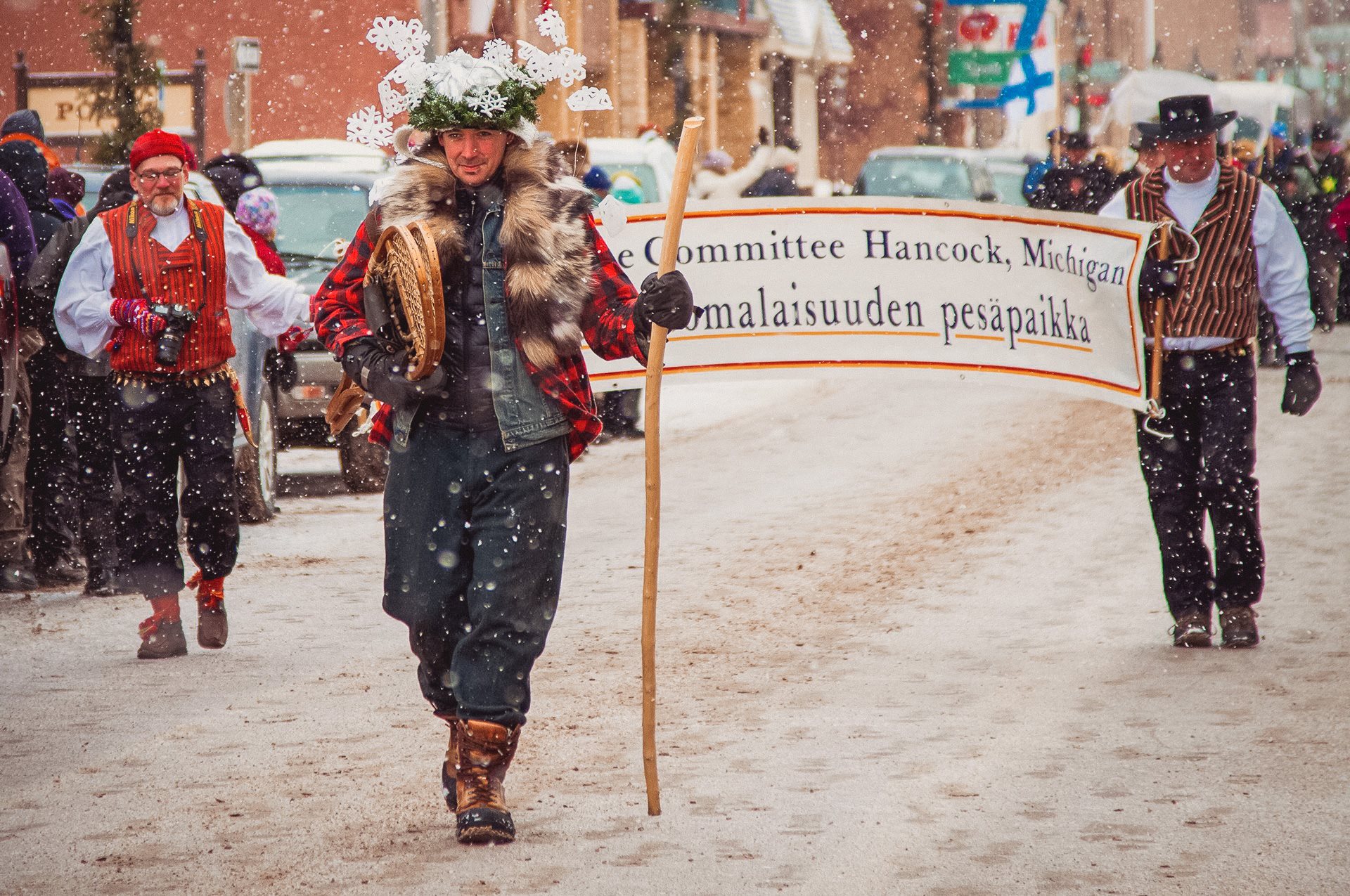
Heikki Lunta alias Hank Snow alias the Guy Responsible for the Snow

Houghtons Heikki Lunta

Hancock’s Heikki Lunta, photo by Mark Riutta / Defined Visuals

I know that many folks in southern Michigan are wondering where the heck all this snow came from. Last night I realized that a friend of mine was actually responsible!

Yooper Steez tells the Legend of Finnish snow god Heikki Lunta:

The name is now often associated with an annual winter festival in Negaunee, but it’s creation is linked to an annual snowmobile race held in Atlantic Mine. In 1970, the U.P. was having one of those winters where it doesn’t snow as much as we might like, which was threatening the success of the race. To increase support, radio salesman David Riutta wrote the “Heikki Lunta Snow Dance Song.” This song created the fictional Heikki Lunta as a creature that lived in the backwoods of Tapiola, twenty miles south of Houghton, and would perform a dance to make it snow. The song went on U.P. airwaves and was a success, and incidentally it did snow that year, causing the snowmobile race to be postponed on account of too much snow.

The song gained popularity enough to be mentioned on “The Today Show” and “The Tonight Show,” and the radio salesman was even invited to sing the song for winter events in California.

As anyone who has been through an Upper Peninsula winter knows, the snow can become relentless, and by the end of that winter, Riutta wrote “Heikki Lunta Go Away,” which is now often paired with the initial song.

The name Heikki Lunta comes from the Finnish translation of the name Hank Snow, like the popular country and western singer.

Read on for more including videos of the Heikki Lunta Song by Da Yoopers and also see Heikki Lunta – A Modern Copper Country Folk Hero at Pasty.com. If you want to go in depth, Hilary Virtanen presents a detailed and fascinating history of this distinctly Yooper phenomenon from 1970 to the present day with press clippings and more in Not Just Talking About the Weather: Tradition, Social Change and Heikki Lunta (use the dates on the left to navigate).

View Mark’s photo bigger and see his work at Defined Visuals on Facebook.

PS: When he’s not making it snow, Adam is also a fantastic photographer. See his work, some of which is potentially NSFW depending on where you work, at brockit.com.

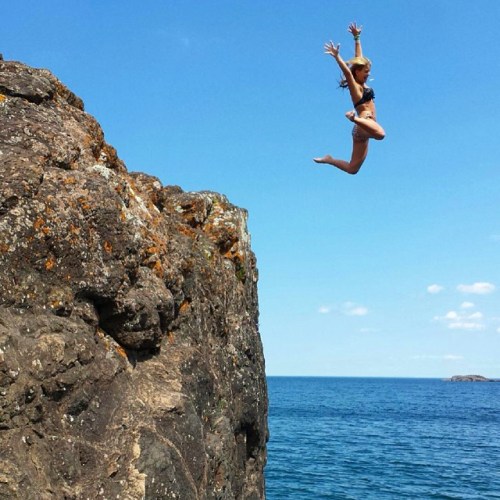
When in Doubt, Jump off a Cliff

When in Doubt Jump off a Cliff

When in Doubt, Jump off a Cliff, photo by shaleewanders

Through the magic of Twitter, I came across the website Shalee Wanders the other day. Created by Shalee Blackmer, it’s a really engaging site she created to inspire people (especially young people) to get out and enjoy traveling on a budget.

The post that drew me in was her Michigan Bucket List, a compilation with some photos of a lot of very fun things to do from to hiking the Porcupine Mountains to exploring the Detroit Packard Plant. Even better, there’s 250+ comments from people with more ideas for getting the most out of Michigan.

View Shalee’s photo from last summer near Marquette bigger and see more on her Instagram.

PS: I do feel that I need to point out that last summer Lake Superior was ice cold, making this leap especially impressive!

Mercurial Dawn II – Five Mile Point

Mercurial Dawn II - Five Mile Point (Hiawatha National Forest - Upper Michigan)

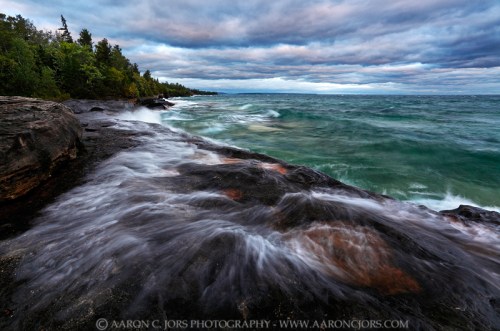
Mercurial Dawn II – Five Mile Point, photo by Aaron C. Jors

Aaron took this shot back in September of 2011 at Five Mile Point near Christmas, MI in the Hiawatha National Forest.

View his photo bigger and see more in his Michigan slideshow. You can also view & purchase Mercurial Dawn I and some other very cool photos in the Great Lakes Shorelines section at aaroncjors.com.

PS: While I was trying to figure out just where this beautiful place is, I stumbled upon this video about Five Mile Point produced by the Great Lakes Center for Youth Development using student photos.

Root Beer Falls

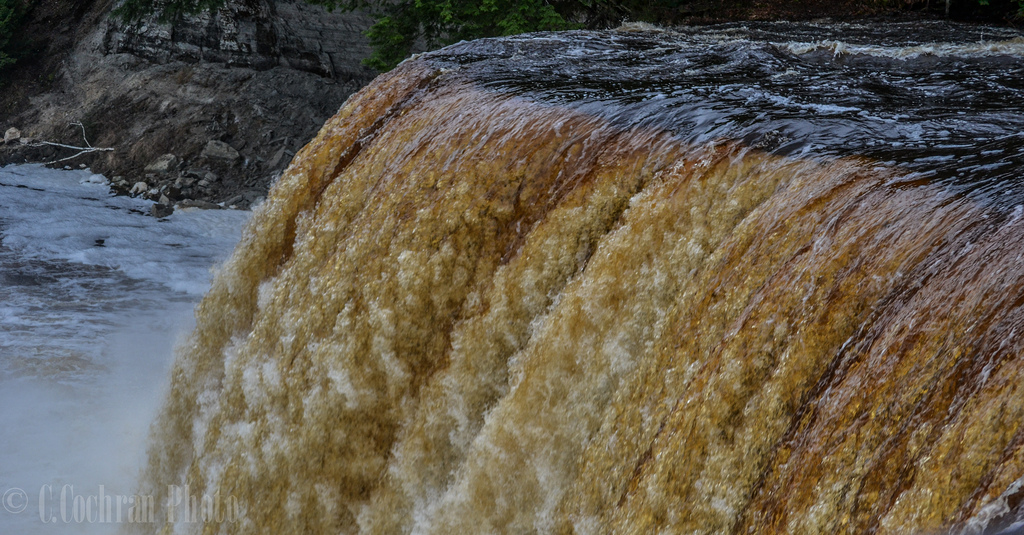
Tahquamenon Falls Root beer falls

Tahquamenon Falls, photo by Courtney Cochran

The Tahquamenon Falls are Michigan’s biggest waterfall and quite a sight to see in any season. It draws its name from the distinctive root beer color of the water which is created by the leaching of tannins from the cedar swamps that feed the river.

At its peak flow, the river drains as much as 50,000 gallons of water per second, making it the second most voluminous vertical waterfall east of the Mississippi River after only Niagara Falls.

View Courtney’s photo bigger and see more in her Landscapes slideshow.

Lots more Tahquamenon Falls on Michigan in Pictures!

Support Michigan in Pictures with Patreon