Loon and friends at Brown Bridge Pond

Loon and friends at Brown Bridge Pond

Loon and friends at Brown Bridge Pond, photo by SBodjack.

Apparently sometimes we all can just get along. Hope your weekend is filled with fun and friends.

Check this out background big and see this and many more in her Brown Bridge Pond slideshow or see where she took it on her map.

The pond is in the 1300-acre Brown Bridge Quiet Area just south of Traverse City. They say that five known species of endangered, threatened, or special concern status have been documented at the Brown Bridge Quiet Area: bald eagles, osprey, red-shouldered hawks, common loons, and wood turtles.

Oyster mushrooms

Fungi stacks

Fungi stacks, photo by ETCphoto

Mushroom guru Wildman Steve Brill says that the Oyster mushroom is a mushroom that lives up to its name – it looks, smells, and tastes like oysters! Not surprisingly, the Michigan Mushroom Hunter’s Club has great info on oyster mushroom hunting in Michigan that begins:

Oysters (Pleurotus ostreatus complex) are the mushroom of the month for June. The delicious oysters can be found in many environments as they are a prime wood recycler. Oysters can be found on dead and dying trees especially hardwoods like poplars (a.k.a. aspen), cottonwoods, elms, box elders, etc. though they also can occur on conifers.

The gills of the oysters are white, branched fanning out toward the cap edge and are very decurrent (running down the stalk). Oysters tend to grow in dense clusters of caps, crowded and overlapping. It is not unusual to find oyster in such quantity that a mushroom hunter ends up measuring her find in pounds.

They says that oysters grow throughout the year but are best in the Spring and Fall when they tend to be less buggy. Read on for much more. As a personal note, we filled a shopping bag in about an hour the weekend before last!

Terry found these beauties on a walk at Pyramid Point. Check them out bigger and in Terry’s slideshow.

Blackberries … the taste of summer

The taste of summer.. The taste of summer.., photo by Blondieyooper.

Our feature on blackberries on Absolute Michigan has some blackberry facts courtesy Taste the Local Difference says:

Blackberries are very high in Vitamin C and K and manganese and a good source of Vitamin E, folate, magnesium, potassium, and copper. They have one of the highest levels of the antioxidant antocyanin, which may help fight cancer, aging, and improve vision. Some fun facts:

  • Blackberries are also known as “black caps”
  • Blackberry tea was considered a cure for dysentery during the Civil War
  • The blackberry leaf was used as a hair dye
  • Blackberries are one of the easiest fruits to grow

Get more including some tasty blackberry recipes like Blackberry and Peach Buttermilk Cobbler! The article also features another photo by April, who I’m guessing really likes blackberries! She shot these wild Michigan blackberries late last August in the U.P. – check this one out background bigilicious and see more in her Nature (Upper Michigan) slideshow!

It ain’t easy being a frog…

It ain't easy...

It ain’t easy…, photo by stevedontsurf.

Steven writes that: Actually, on this day, it seemed pretty easy being green. This guy was eating fly after fly as I snapped away. Must’ve had 5-6 flies in about as many minutes. He looked like lack of food was not an issue. Check it out background big and in his slideshow.

Coincidentally, I came across an article this morning about a nasty fungus called chytrid that has been the culprit of 94 out of 122 frog extinctions since 1980 and that can also affect some toads and salamanders. Brian Gratwicke of the Smithsonian’s National Zoo says:

“There’s frogs all around the world being affected. There’s amphibians that have gone extinct in Australia, in the Caribbean, in North America, in South America, in Central America.”

…There is also a real cost to humans from the frog extinctions. Frogs’ skins are anti-microbial factories. They’ve produced compounds that kill superbugs in hospitals.

“There’s a species of frog in Australia that produces a chemical called caerin, which blocks HIV transmission to T-cells,” Gratwicke says. “The untapped resources of our amphibian biodiversity are virtually unknown.”

Click through to read much more and also check out the Gray Tree Frog (Hyla versicolor) on Michigan in Pictures.

You can build a home for little raptors like the Northern Saw Whet Owl!

saw whet owl

saw whet owl, photo by Sherri & Dan.

My friend Michael told me about Ned the Saw Whet Owl, an avian ambassador that Rebecca Lessard of the nonprofit Wings of Wonder is using to tell folks about nest boxes that you can build for small raptors (pdf). Ned is just 7″ tall and belongs to the smallest species of owl native to Michigan. Click Ned’s link above to see just how tiny he is!

This home will also house a screech owl and another bird recently featured – the American Kestrel (Michigan’s smallest raptor).

The Owl Pages have this to say about the Northern Saw-whet Owl – Aegolius acadicus:

European explorers first discovered this Owl in a North American colony called Acadia (now Nova Scotia). The Latinised word “acadius” refers to this territory. The common name “Saw-whet” comes from these Owls unique calls described below. The Saw-whet Owl is also called Acadian Owl, blind Owl, Kirkland’s Owl, the saw-filer, the sawyer, sparrow Owl, white-fronted Owl, Farmland Owl, Little Nightbird, Queen Charlotte Owl, and even the Whet-saw Owl.

The Northern Saw-whet Owl is a very small, short-bodied, Owl with a relatively short tail. The overly large head has no ear tufts and may appear distorted due to an asymmetrical skull. They look small when perched and tend to shuffle their feet, but in flight appear larger because of their broad wings.

…Northern Saw-whet Owls are strictly Nocturnal, with activity beginning at late dusk. During the day, they depend on plumage for camouflage when roosting in foliage, usually close to the ground.

You can hear their call at the link above and learn more at Wikipedia and All About Birds who explain that their defense upon discovery is to sit still and not fly, leading people to perceive them as “tame.”

Check this out way bigger than a saw whet owl and in Sherri & Dan’s slideshow. They took the shot at Whitefish Point Bird Observatory – read more at that link!

Many more Michigan birds on Michigan in Pictures.

Eastern Hog-nose Snake

Eastern Hog Nose Snake 2

Eastern Hog Nose Snake 2, photo by ShaneWyatt.

The Michigan DNR page on the Eastern Hog-nosed Snake (Heterodon platirhinos) says this is a:

A thick-bodied, slow-moving snake with a flattened, upturned “nose.” Color is variable some have dark spots and blotches on a yellow, orange, or brown background, but other specimens are solid black, brown, or olive with little or no visible pattern. Easily identified by defensive behavior. Adult length: 20 to 40 inches.

A snake of open, sandy woodlands – found in the wooded dunes of western Michigan. The upturned snout is used to burrow after toads, a favorite food. When threatened, hognose snakes puff up with air, flatten their necks and bodies, and hiss loudly. (This has led to local names like “puff adder” or “hissing viper.”) If this act is unsuccessful, they will writhe about, excrete a foul smelling musk, and then turn over with mouth agape and lie still, as though dead. Despite this intimidating behavior, Hog-nosed snakes are harmless to humans.

You can see a lot of pictures at the UM Animal Diversity Web and definitely check out Hog Wild on the Herping Michigan blog.

Shane writes that it was pretty intimidating to see the snake flair like a cobra and start hissing at him. Check it out bigger and see some more shots in his eastern hognose slideshow.

More Michigan snakes on Michigan in Pictures!

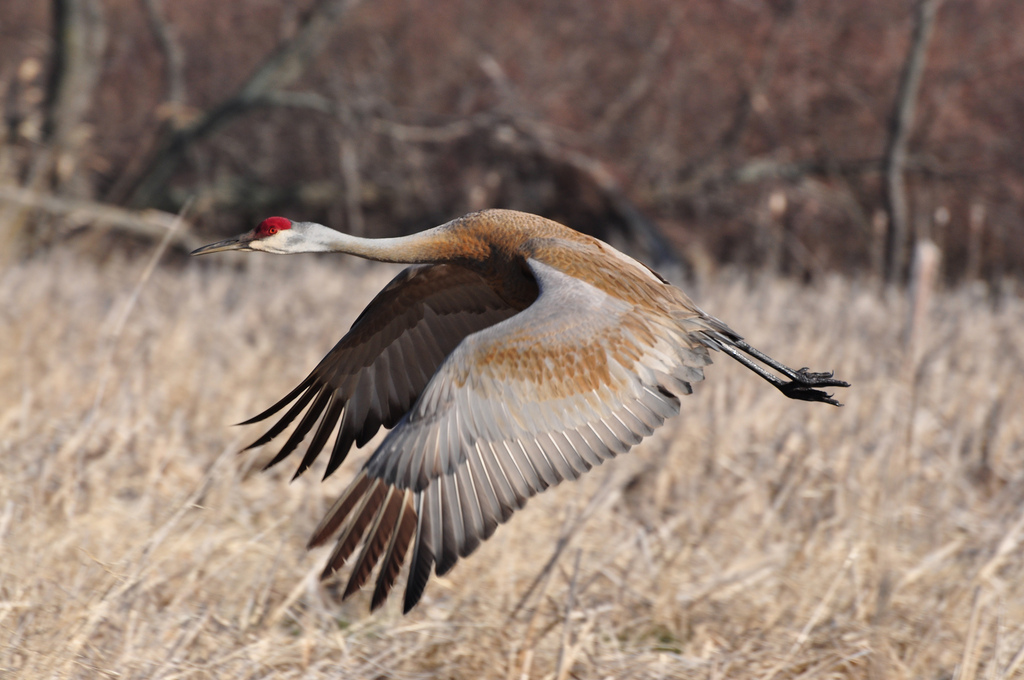
Michigan Birds: Sandhill Crane

Michigan Sandhill Crane in Flight

Flying Crain by Mark Miller

The Baker Sanctuary in northwest Calhoun County is a Michigan Audubon sanctuary that hosts thousands of cranes. It was established in 1947 and was the first crane sanctuary in America. They have fantastic information about sandhill cranes in Michigan. They write that the Sandhill Crane (Grus canadensis) is one of only 15 species of cranes in the world and is one of just two crane species native to North America.

While the Whooping Crane, our other native crane, is highly endangered and restricted to only a few areas of the West, the Sandhill is more widespread and in most areas is more abundant. Once nearly eliminated from Michigan, Sandhill Cranes have made a comeback and now are becoming one of the state’s most popular watchable wildlife species.

Cranes are tall, stately birds with a heavy body, long neck and long legs. Standing four to five feet high and possessing a wing span of six to seven feet, Sandhill Cranes are Michigan’s largest bird. Long, skinny legs and neck give a false impression of size; the males weigh an average of about 12 pounds and the females around 9-1/2 pounds. Except for this size difference, both sexes look alike.

…Sandhill Cranes have a variety of vocalizations, the most common of which is generally described as a repeated series of trumpeting “garoo-a-a-a” calls that can be heard for over a mile. One of the reasons for this remarkably loud and penetrating call is an unusual windpipe. In most birds the trachea passes directly from the throat to the lungs, but in Sandhills it is elongated by forming a single loop which fills a cavity in the sternum. It is not surprising that the louder and more harmonic Whooping Crane has a longer trachea with a double loop.

You can hear these crane calls including the unison call at that link. Don’t miss the Michigan Audubon Crane Fest they hold every October too! Also see Sandhill Crane on All About Birds has more information and some crane calls and on Wikipedia

Mark says that sandhill cranes are quickly becoming his favorite birds. Check this out bigger and see a couple more views in his slideshow.

The Absolute Michigan pool on Flickr has a cool Sandhill Crane slideshow.

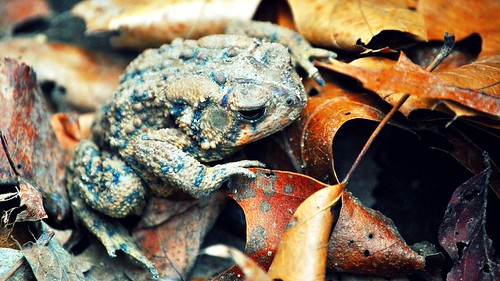
I Am Toad

I Am Toad

I Am Toad, photo by DavidGuthrie.

The Michigan DNR Frog & Toad page answers the question “How can you tell a frog from a toad?” saying:

It’s been said that a toad is just a lumpy frog! Toads do have thicker, more warty skins compared to the smoother skin of most frogs. Toads are adapted for drier conditions than frogs, though they spend much of their time burrowed into moist soil during times when the air is drier. Toads have shorter hind legs than frogs, comparatively speaking, and move in short hops or simply walk instead of making long leaps.

They say that Michigan has two species of “true” toads, the American Toad and Fowler’s Toad. This little guy is an Eastern American Toad (Bufo americanus) and you can read more about them on Michigan in Pictures. If you’re in a friendly mood, consider building a toad house!

Check this out bigger and in David’s Spring slideshow.

The Red-Bellied Woodpecker sings Happy Birthday, John James Audubon

Bobby Dazzler

Bobby Dazzler, photo by Spring Noel.

I never for a day gave up listening to the songs of our birds, or watching their peculiar habits, or delineating them in the best way I could.
~John James Audubon

Today is the birthday of John James Audubon. That entry on Wikipedia relates that he was born Jean-Jacques Fougère Audubon. In 1803 at age 18, he immigrated to the United States and anglicized his name to John James Audubon. Learn more about him and the society that bears his name at audubon.org.

I didn’t really think that there would be a Michigan tie-in, but it turns out that the single most valuable book in the University of Michigan is (you guessed it) Audubon’s Birds of America:

In 1838, the Regents of the University of Michigan authorized the purchase of John James Audubon’s Birds of America. Held in the Special Collections Library, the eight-volume, double-elephant-folio edition is the single most valuable printed book in the MLibrary collections.

Here’s the beginning of the Family XVI. PICINAE. WOODPECKERS. GENUS I. PICUS, Linn. WOODPECKER. entry from that book:

Much of what I have said respecting the habits of several of our Spotted Woodpeckers applies to the present species, which differs, however, in the greater extent of its migration in the spring and summer months, when the greater number of those which return from the south to our Middle and Eastern Districts proceed considerably farther northward than the Hairy Woodpecker, although not so far as the Canadian. In winter I have found the Red-bellied Woodpecker the most abundant of all in the pine barrens of the Floridas, and especially on the plantations bordering the St. John’s river, where on any day it would have been easy to procure half a hundred. Indeed, on this account, and from its well-known notes, the officers and men of the United States’ schooner Spark, as well as my assistants, always spoke of it by the name of chaw-chaw. Perhaps it partly obtained this name from the numbers of it cooked by the crew in the same manner as the dish known to sailors by the same name.

It is, however, less common in the United States than the Hairy Woodpecker; but its range is as extensive, for I have found it from the Texas to the extremities of the British provinces of Nova Scotia, and as far inland as I have travelled. It appears, however, that it does not inhabit the Fur Countries, as no mention is made of it by Dr. RICHARDSON, in the Fauna Boreali-Americana. It is generally more confined to the interior of the forests, especially during the time of its breeding, than the Hairy Woodpecker, although in winter I have found it quite as easily approached. In autumn it frequently occurs in the corn-fields, where it takes its share of the grain, in common with the Hairy, the Downy, and other Woodpeckers. It is a lively and active bird, fond of rolling its tappings against the decayed top-branches of trees, often launching forth after passing insects, and feeding during winter on all such berries as it can procure. Its flight is strong and better sustained than that of the Yellow-bellied or Hairy Woodpeckers, and, like the Golden-winged species, it not unfrequently alights across the smaller branches of the trees, a habit which, I assure you, is oftener exhibited than has been supposed, by all our species of this interesting tribe of birds.

More at Red-bellied Woodpecker on All About Birds including their calls & drums.

Spring writes that you can see why they’re called Red Bellied Woopeckers when you see one the red belly exposed. Check it out bigger and in her Birds slideshow.

Many (many) more birds on Michigan in Pictures.

Michigan moose viewing isn’t hard when there’s a Bull Moose in the road

Bull Moose

Bull Moose, photo by Pure Michigan.

The entry for Alces alces (moose) at the UM Animal Diversity Web says that what we call “moose” are known as Eurasian elk in Europe. Moose live near water ponds, lakes, rivers and swamps that hold their favorite foods and help keep them cool. Their large bodies, inability to sweat and the heat produced by fermentation in their guts mean they can’t endure temperatures above 80 degrees for long. Also see Moose on Wikipedia.

Moose are native to Michigan but although Michigan granted moose full legal protection in 1889, moose had disappeared from the Lower Peninsula in the 1890s and only a handful remained in the Upper Peninsula. (Moose in Michigan whitepaper). The February survey of Michigan moose estimates 500 total moose, with about 433 of these concentrated in Marquette, Baraga and northern Iron counties.

The DNR’s Guide to Moose Viewing in the Upper Peninsula includes maps and suggests that to while moose locations are difficult to predicta:

…there are three areas where visitors would do well to begin their quest. The center of the moose country in the western U.P. is Van Riper State Park. In the eastern Upper Peninsula, Tahquamenon Falls State Park and Seney National Wildlife Refuge offer the best chances of seeing moose.

…Look for moose in the early morning and evening when summer temperatures are coolest.

Moose often are associated with water, so areas around beaver ponds and along the edges of lakes, streams, and swamps are good places to look. Van Riper and Tahquamenon Falls state parks have moose information centers with interpretive materials including a kiosk and a video on Michigan moose recovery efforts. Interpretive staff can provide the latest information on the local herd and recent sightings. In addition to moose, loons, eagles, black bears, deer, foxes, and even wolves may be seen in moose country.

Caution must be taken when watching moose. Moose should not be approached. They can be unpredictable and aggressive. Most dangerous are cow moose with young, or bulls during the mating season (September and October).

Pure Michigan has the name “Susan Ballreich on this photo so I assume she caught the shot of the bull moose on the Peshekee Grade road near Marquette. Check it out bigger and in their massive Fall 2010 slideshow.