Eastern Hog-nose Snake

Eastern Hog Nose Snake 2

Eastern Hog Nose Snake 2, photo by ShaneWyatt.

The Michigan DNR page on the Eastern Hog-nosed Snake (Heterodon platirhinos) says this is a:

A thick-bodied, slow-moving snake with a flattened, upturned “nose.” Color is variable some have dark spots and blotches on a yellow, orange, or brown background, but other specimens are solid black, brown, or olive with little or no visible pattern. Easily identified by defensive behavior. Adult length: 20 to 40 inches.

A snake of open, sandy woodlands – found in the wooded dunes of western Michigan. The upturned snout is used to burrow after toads, a favorite food. When threatened, hognose snakes puff up with air, flatten their necks and bodies, and hiss loudly. (This has led to local names like “puff adder” or “hissing viper.”) If this act is unsuccessful, they will writhe about, excrete a foul smelling musk, and then turn over with mouth agape and lie still, as though dead. Despite this intimidating behavior, Hog-nosed snakes are harmless to humans.

You can see a lot of pictures at the UM Animal Diversity Web and definitely check out Hog Wild on the Herping Michigan blog.

Shane writes that it was pretty intimidating to see the snake flair like a cobra and start hissing at him. Check it out bigger and see some more shots in his eastern hognose slideshow.

More Michigan snakes on Michigan in Pictures!

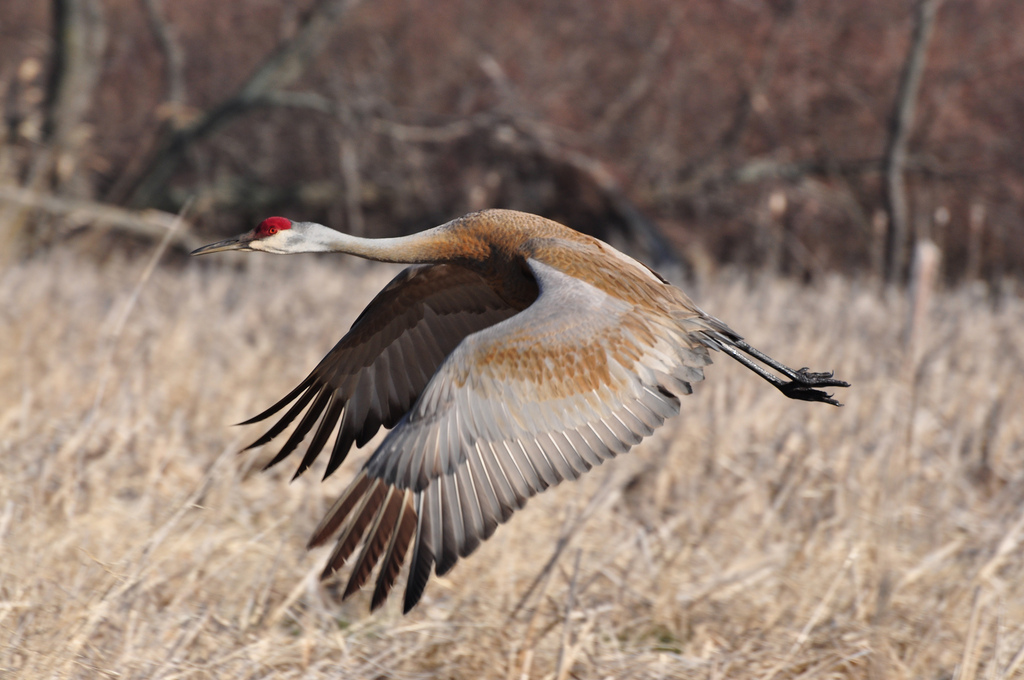
Michigan Birds: Sandhill Crane

Michigan Sandhill Crane in Flight

Flying Crain by Mark Miller

The Baker Sanctuary in northwest Calhoun County is a Michigan Audubon sanctuary that hosts thousands of cranes. It was established in 1947 and was the first crane sanctuary in America. They have fantastic information about sandhill cranes in Michigan. They write that the Sandhill Crane (Grus canadensis) is one of only 15 species of cranes in the world and is one of just two crane species native to North America.

While the Whooping Crane, our other native crane, is highly endangered and restricted to only a few areas of the West, the Sandhill is more widespread and in most areas is more abundant. Once nearly eliminated from Michigan, Sandhill Cranes have made a comeback and now are becoming one of the state’s most popular watchable wildlife species.

Cranes are tall, stately birds with a heavy body, long neck and long legs. Standing four to five feet high and possessing a wing span of six to seven feet, Sandhill Cranes are Michigan’s largest bird. Long, skinny legs and neck give a false impression of size; the males weigh an average of about 12 pounds and the females around 9-1/2 pounds. Except for this size difference, both sexes look alike.

…Sandhill Cranes have a variety of vocalizations, the most common of which is generally described as a repeated series of trumpeting “garoo-a-a-a” calls that can be heard for over a mile. One of the reasons for this remarkably loud and penetrating call is an unusual windpipe. In most birds the trachea passes directly from the throat to the lungs, but in Sandhills it is elongated by forming a single loop which fills a cavity in the sternum. It is not surprising that the louder and more harmonic Whooping Crane has a longer trachea with a double loop.

You can hear these crane calls including the unison call at that link. Don’t miss the Michigan Audubon Crane Fest they hold every October too! Also see Sandhill Crane on All About Birds has more information and some crane calls and on Wikipedia

Mark says that sandhill cranes are quickly becoming his favorite birds. Check this out bigger and see a couple more views in his slideshow.

The Absolute Michigan pool on Flickr has a cool Sandhill Crane slideshow.

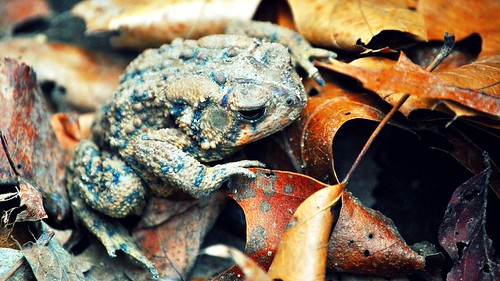
I Am Toad

I Am Toad

I Am Toad, photo by DavidGuthrie.

The Michigan DNR Frog & Toad page answers the question “How can you tell a frog from a toad?” saying:

It’s been said that a toad is just a lumpy frog! Toads do have thicker, more warty skins compared to the smoother skin of most frogs. Toads are adapted for drier conditions than frogs, though they spend much of their time burrowed into moist soil during times when the air is drier. Toads have shorter hind legs than frogs, comparatively speaking, and move in short hops or simply walk instead of making long leaps.

They say that Michigan has two species of “true” toads, the American Toad and Fowler’s Toad. This little guy is an Eastern American Toad (Bufo americanus) and you can read more about them on Michigan in Pictures. If you’re in a friendly mood, consider building a toad house!

Check this out bigger and in David’s Spring slideshow.

The Red-Bellied Woodpecker sings Happy Birthday, John James Audubon

Bobby Dazzler

Bobby Dazzler, photo by Spring Noel.

I never for a day gave up listening to the songs of our birds, or watching their peculiar habits, or delineating them in the best way I could.
~John James Audubon

Today is the birthday of John James Audubon. That entry on Wikipedia relates that he was born Jean-Jacques Fougère Audubon. In 1803 at age 18, he immigrated to the United States and anglicized his name to John James Audubon. Learn more about him and the society that bears his name at audubon.org.

I didn’t really think that there would be a Michigan tie-in, but it turns out that the single most valuable book in the University of Michigan is (you guessed it) Audubon’s Birds of America:

In 1838, the Regents of the University of Michigan authorized the purchase of John James Audubon’s Birds of America. Held in the Special Collections Library, the eight-volume, double-elephant-folio edition is the single most valuable printed book in the MLibrary collections.

Here’s the beginning of the Family XVI. PICINAE. WOODPECKERS. GENUS I. PICUS, Linn. WOODPECKER. entry from that book:

Much of what I have said respecting the habits of several of our Spotted Woodpeckers applies to the present species, which differs, however, in the greater extent of its migration in the spring and summer months, when the greater number of those which return from the south to our Middle and Eastern Districts proceed considerably farther northward than the Hairy Woodpecker, although not so far as the Canadian. In winter I have found the Red-bellied Woodpecker the most abundant of all in the pine barrens of the Floridas, and especially on the plantations bordering the St. John’s river, where on any day it would have been easy to procure half a hundred. Indeed, on this account, and from its well-known notes, the officers and men of the United States’ schooner Spark, as well as my assistants, always spoke of it by the name of chaw-chaw. Perhaps it partly obtained this name from the numbers of it cooked by the crew in the same manner as the dish known to sailors by the same name.

It is, however, less common in the United States than the Hairy Woodpecker; but its range is as extensive, for I have found it from the Texas to the extremities of the British provinces of Nova Scotia, and as far inland as I have travelled. It appears, however, that it does not inhabit the Fur Countries, as no mention is made of it by Dr. RICHARDSON, in the Fauna Boreali-Americana. It is generally more confined to the interior of the forests, especially during the time of its breeding, than the Hairy Woodpecker, although in winter I have found it quite as easily approached. In autumn it frequently occurs in the corn-fields, where it takes its share of the grain, in common with the Hairy, the Downy, and other Woodpeckers. It is a lively and active bird, fond of rolling its tappings against the decayed top-branches of trees, often launching forth after passing insects, and feeding during winter on all such berries as it can procure. Its flight is strong and better sustained than that of the Yellow-bellied or Hairy Woodpeckers, and, like the Golden-winged species, it not unfrequently alights across the smaller branches of the trees, a habit which, I assure you, is oftener exhibited than has been supposed, by all our species of this interesting tribe of birds.

More at Red-bellied Woodpecker on All About Birds including their calls & drums.

Spring writes that you can see why they’re called Red Bellied Woopeckers when you see one the red belly exposed. Check it out bigger and in her Birds slideshow.

Many (many) more birds on Michigan in Pictures.

Michigan moose viewing isn’t hard when there’s a Bull Moose in the road

Bull Moose

Bull Moose, photo by Pure Michigan.

The entry for Alces alces (moose) at the UM Animal Diversity Web says that what we call “moose” are known as Eurasian elk in Europe. Moose live near water ponds, lakes, rivers and swamps that hold their favorite foods and help keep them cool. Their large bodies, inability to sweat and the heat produced by fermentation in their guts mean they can’t endure temperatures above 80 degrees for long. Also see Moose on Wikipedia.

Moose are native to Michigan but although Michigan granted moose full legal protection in 1889, moose had disappeared from the Lower Peninsula in the 1890s and only a handful remained in the Upper Peninsula. (Moose in Michigan whitepaper). The February survey of Michigan moose estimates 500 total moose, with about 433 of these concentrated in Marquette, Baraga and northern Iron counties.

The DNR’s Guide to Moose Viewing in the Upper Peninsula includes maps and suggests that to while moose locations are difficult to predicta:

…there are three areas where visitors would do well to begin their quest. The center of the moose country in the western U.P. is Van Riper State Park. In the eastern Upper Peninsula, Tahquamenon Falls State Park and Seney National Wildlife Refuge offer the best chances of seeing moose.

…Look for moose in the early morning and evening when summer temperatures are coolest.

Moose often are associated with water, so areas around beaver ponds and along the edges of lakes, streams, and swamps are good places to look. Van Riper and Tahquamenon Falls state parks have moose information centers with interpretive materials including a kiosk and a video on Michigan moose recovery efforts. Interpretive staff can provide the latest information on the local herd and recent sightings. In addition to moose, loons, eagles, black bears, deer, foxes, and even wolves may be seen in moose country.

Caution must be taken when watching moose. Moose should not be approached. They can be unpredictable and aggressive. Most dangerous are cow moose with young, or bulls during the mating season (September and October).

Pure Michigan has the name “Susan Ballreich on this photo so I assume she caught the shot of the bull moose on the Peshekee Grade road near Marquette. Check it out bigger and in their massive Fall 2010 slideshow.

Michigan Mushroom Nation!

The First Morels this Year  05/02/2010

The First Morels this Year 05/02/2010, photo by rickrjw

The TIME Magazine feature Mushroom Nation linked over to our feature on yellow chanterelle mushrooms. In it, James Beard Award–winning food writer Josh Ozersky takes a look at how wild mushrooms are becoming as American as apple pie. He writes that:

…for all their exoticism, they’re still pretty cheap. Even a mom-and-pop restaurant can make a mood-altering dish with some woodsy mushrooms, roasted up with salt and served along side a gelatinous hunk of braised short rib. A few fresh chanterelles in a little omelet with some small spring asparagus, and you’ve got an appetizer of unsurpassable elegance. Unlike their fetishized cousins the truffles, people still use mushrooms as staple items and not luxuries — a practice that might not persist if they become more popular. They add a level of flavor and texture to everything they touch, and there’s a variety for nearly every use, from the delicacy of enoki to the almost obscene potency of portobellos.

Compared with the crappy little button mushrooms you see at the supermarket, de-natured and nude, and grown somewhere far from the forest floor, they represent an instant ticket to a better vision of life. If a restaurant, you can charge for that; if cooking at home, you can brag on it. Either way, it costs little. And of course there are no calories to speak of in mushrooms, so even the most ascetic of eaters can consume them with abandon. They’re apparently loaded with various unpronounceable anti-oxidants too, so that’s another benefit.

Read on at TIME and find more about mushrooms on Michigan in Pictures. It won’t be long now before morels make their appearance in Michigan woods!

Rick bagged his first blonde morels in 2010 on May 2nd and says (with true morel hunter evasiveness) that he found them “in the woods”. See this photo background bigilicious and check out more in his Boyne City, Michigan slideshow.

Kent Lake in Kensington Metropark … and a photowalk

Panorama Kent Lake

Panorama Kent Lake, photo by ansonredford

In the Absolute Michigan pool on Flickr, Charles posted an announcement of a spring photo walk taking place this Saturday (April 16) at Kensington Metro Park in Milford:

The walk is hosted by Southeast Michigan Digital Photography group and will take place on the Kensington nature trails with a raffle and optional lunch afterwards. Spring is a beautiful time of year for local photographers to enjoy photography together. The event is free though a permit is required to enter the park, permit prices can be found in the event details at Southeast Michigan Digital Photography or at our Facebook group site.

I have hazy but fond memories of my grandmother taking me here to feed the carp Ritz crackers when I was little. The Huron-Clinton Metroparks page on Kensington Metropark says:

Kensington’s 4,481 sprawling acres of wooded, hilly terrain surrounds beautiful Kent Lake, and is home to an abundance of wildlife and waterfowl. Kensington Metropark offers a multitude of recreational activities throughout the year, from biking and boating to cross-country skiing and tobogganing. In addition to striking sunrises and sunsets, 1,200-acre Kent Lake offers plenty of fun activities: swim at Martindale or Maple beaches, get soaked at the Splash ‘n’ Blast, or just spend the day fishing, boating or picnicking along the water. Take a tour of the lake aboard the Island Queen II in the summer and fall. Or, enjoy a winter day ice-fishing or skating on frozen lake waters.

This first-class recreational area also features an 18-hole regulation golf course, 27-hole disc course, nature center, farm center, beautiful picnic areas and scenic hiking and biking trails for hours of enjoyment. With two and a half million visitors every year Kensington Metropark is a favorite place to enjoy Michigan’s natural treasures.

Donald took this photo a couple of weeks ago. Check it out background big and see a lot more photos in his Kensington Metro Park slideshow!

There’s even more photos that show the diversity of wildlife and scenery in this slideshow from the Absolute Michigan group!

Auto trail coming to Shiawassee National Wildlife Refuge

Shiawassee National Wildlife Refuge

Shiawassee National Wildlife Refuge, photo by Wigwam Jones.

The Great Lakes Echo has a feature by Emma Ogutu about a 7.5-mile auto trail through Saginaw County’s Shiawassee National Wildlife Refuge that opens in May (assuming the eagles cooperate).

“Everything will depend on a pair of eagles which built a nest just 50 feet off the road. It all depends if they start nesting early or late– it’s critical that we do not disturb them,” DeVries said (Ed DeVries, assistant manager of the refuge).

The gravel trail, which was completed in November, will be the second of its kind in the state, after one in the Upper Peninsula’s Seney National Wildlife Refuge.

Along the trail are two new observation decks with spotting scopes to assist visitors in viewing more birds, DeVries said. The refuge has also constructed a parking area to accommodate the anticipated larger amount of traffic and a new fishing and canoe access site along the Spaulding Drain.

“Previously we had only one day in September where tourists were allowed to drive in the refuge,” DeVries said. “With the new trail, it’s going to be possible for more people to view a wider variety of birds and other wildlife throughout spring and summer seasons.”

The Shiawassee refuge was established in 1953 to protect and increase the breeding of migratory birds and other wildlife. The refuge includes marsh areas, swamps, bogs, grasslands and forests and has one of largest and most productive wetland ecosystems in the state, according to the service.

Learn more about the Shiawassee National Wildlife Refuge.

Check Wigwam Jones’ photo out background big and in his Shiawassee National Wildlife Refuge slideshow.

New Year’s Resolution Case Study #77: The Tufted Titmouse

Im not Fat, Im Fluffy!

Im not Fat, Im Fluffy!, photo by Spring Noel.

All About Birds says that the Tufted Titmouse is common in eastern deciduous forests and a frequent visitor to feeders. They eat mostly insects in the summer but aren’t above seeds, nuts, and berries and (in the case of this fellow) cheesecake and jelly donuts. Fun facts:


  • Experiments with Tufted Titmice indicate they always choose the largest seeds they can when foraging. (see above)
  • Tufted Titmice hoard food in fall and winter, a behavior they share with many of their relatives, including the chickadees and tits. Titmice take advantage of a bird feeder’s bounty by storing many of the seeds they get. Usually, the storage sites are within 130 feet of the feeder. The birds take only one seed per trip and usually shell the seeds before hiding them.
  • Tufted Titmice nest in tree holes (and nest boxes), but they can’t excavate their own nest cavities. Instead, they use natural holes and cavities left by woodpeckers.
  • Tufted Titmice often line the inner cup of their nest with hair, sometimes plucked directly from living animals. The list of hair types identified from old nests includes raccoons, opossums, mice, woodchucks, squirrels, rabbits, livestock, pets, and even humans.
  • The oldest known wild Tufted Titmouse lived to be 13 years 3 months old.
  •  

Check out Birding in Michigan’s Ode to the Tufted Titmouse and see more birds on Michigan in Pictures.

See this bigger in Spring’s Birds slideshow.

Short Eared Owl

P1090935

P1090935, photo by Sherri & Dan.

The Short-eared Owl – Asio flammeus entry at Owl Pages says:

A Danish bishop and amateur naturalist, Erich Ludvigsen Pontoppidan, published the first description of this Owl in 1763. In Latin, the word “flammeus” means fiery, flaming, or the colour of fire. Local names for the Short-eared Owl include the Evening Owl, Marsh Owl Bog or Swamp Owl, Grass Owl, Meadow Owl, Mouse-hawk, and Flat-faced Owl.

The Short-eared Owl is a medium-sized Owl. The plumage is buffy brown with dark streaks on the chest, belly, and back. Males tend to be lighter in colour than females. This colouring provides good camouflage, but if this fails, a Short-eared Owl will feign death to avoid detection. The wings and tail are strongly barred. The yellow eyes are circled with black and set in whitish or buffy-white facial disks, which are suffused with a ring of brown. The bill is black. The head appears round without ear tufts, but at very close range small ear tufts are visible. In flight, the dark “wrist” on the underwing is the key field mark.

Check it out background big and in see more great shots of this bird in Sherri & Dan’s Animals slideshow.