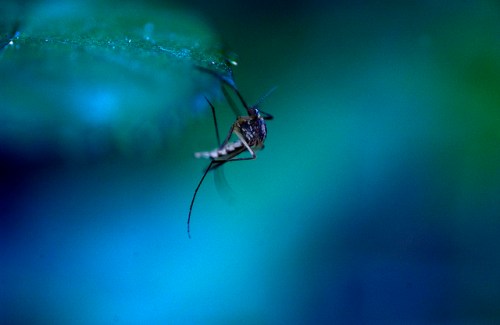
Of Michigan, Mosquitoes & Malaria

Mosquito

Mosquito, photo by stepponme123456789

If you think you’re too small to have an impact, try going to bed with a mosquito.
~Anita Roddick

Today on Absolute Michigan we posted a weird little cartoon from the early 1900s by Michigan animator Winsor McCay who is often known as “The Father of Animation” titled “How a Mosquito Works.” That seemed to me to be good enough reason to take a closer look at these pesky pests.

Wikipedia’s Mosquito entry says that mosquitoes are a family of small, midge-like flies: the Culicidae. The word mosquito is from the Spanish and Portuguese for “little fly”. You can click that link for likely more than you want to know about how they feed. The Michigan Mosquito Control Association claims that:

Mosquitoes are by far the most dangerous animals on earth. It is hard to comprehend the amount of disease and the resulting sickness, death, and economic loss caused by the mosquito. Some scientists estimate between 500 and 700 million people get malaria worldwide each year. That’s more than twice the entire population of the United States each year. Malaria has since been virtually eliminated here in Michigan , but the threat of mosquito-borne disease is still very real. Of the 60 different species of mosquitoes found in Michigan many are known to be vectors (carriers or transporters) of important diseases such as West Nile virus, Eastern Equine Encephalitis, St. Louis Encephalitis, and the California Group of encephalitis.

An interesting thing I learned was that Michigan was once a hotbed of malaria as Daniel Hager from the Mackinac Institute of Public Policy explained:

Willis F. Dunbar in “Michigan: A History of the Wolverine State,” writes that the disease “was so prevalent that it was rather unusual to escape it.” Ruth Hoppin, who grew up in a pioneer family in St. Joseph County near Three Rivers, recalled that “the pale, sallow, bloated faces of that period were the rule; there were no healthy faces except of persons just arrived.” A. D. P. Van Buren, whose family came to Calhoun County near Battle Creek in 1836, noted that the first question asked of new settlers was whether or not they had contracted malaria yet, and “if answered in the negative, the reply would be, `Well, you will have it; everybody has it before they’ve been here long.'”

The settlers’ common word for malaria was ague (pronounced “ag-yew”), which derived from the Latin word acuta, as in febris acuta, or “sharp fever.”

The state of Michigan has a ton of information about mosquito control in Michigan. You might also enjoy an interview with MSU Entomologist Howard Russell about mosquitos and this detailed article on Gallinipper mosquitoes, which are native to Michigan and large enough to bite through canvas shorts.

Check this out background big and see some more great shots in Stephanie’s Bugs slideshow.
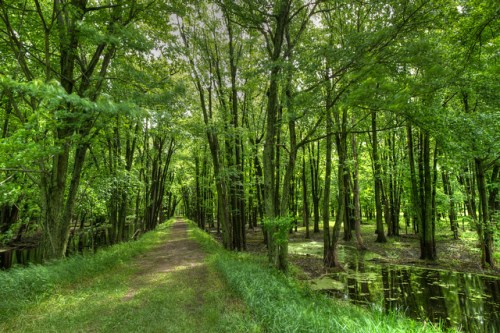
Tunnel of Trees

Tunnel of Trees Ferguson Slough Trail

Tunnel of Trees Ferguson Slough Trail, photo by DTWpuck

Scott wonders who in Michigan doesn’t get weak in the knees when looking down a tree canopied road or trail. This trail is located alongside the Ferguson Slough in the Shiawassee National Wildlife Refuge.

Check it out background bigtacular and see more on his map.

Piping Plover (Charadrius melodus)

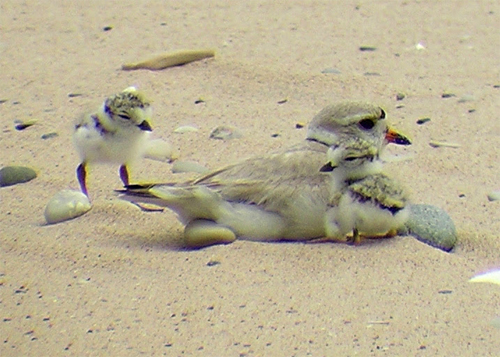
Adult Piping Plover caring for her chicks, photo courtesy National Park Service

The Sleeping Bear Dunes National Lakeshore page on piping plovers begins:

The Piping Plover (Charadrius melodus) is an endangered shorebird. They are sand-colored on the back and white below. During the breeding season adults have a black forehead band between the eyes and a single black band around the neck. (Its larger relative the Killdeer is commonly seen at parks, playgrounds, and golf courses, and has two dark bands around the neck.) Piping Plovers nest only on beaches and prefer beaches with cobble. There are three small populations: one in the Great Plains, one on the Atlantic Coast, and the one here in the Great Lakes. They winter together on the Gulf Coast but travel to the separate areas during the breeding season. It is a special opportunity to be able observe Piping Plovers since there are only between 50 and 60 nesting pairs in the entire Great Lakes area and less than 5000 individuals worldwide.

You can read more about piping plovers at All About Birds where they also have some photos, a plover call and a video. You can also check out a video of a piping plover feeding from the other side of the state on Saginaw Bay.

The Sleeping Bear Dunes National Lakeshore reports that four pairs of this federally endangered shorebird have made the Glen Haven beach their home for the summer. It’s an easily accessible location that provides visitors an excellent opportunity to view a rare bird in its natural habitat. While the entire shoreline will be open for walking, certain areas of the beach will be temporarily closed to all entry.

More photos of piping plovers from Alice van Zoeren and the Sleeping Bear Dunes National Lakeshore.

Before we were owls

10

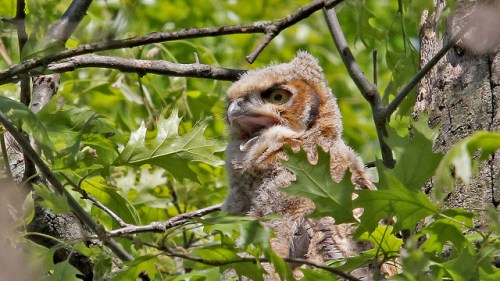
10, photo by Sherri & Dan

The Great Horned Owl article on Michigan in Pictures is stocked with all kinds of information about what this little guy will grow up to be (Sherri & Dan also took that photo). Also see Bubo virginianus (great horned owl) on the University of Michigan Animal Diversity Web and check out this video of three little horned owlets.

See this photo background big and and follow this owl’s growth in  Sherri & Dan’s owls slideshow.

Omagakii: Frog in Anishinaabemowin

Ribbit Tell'em

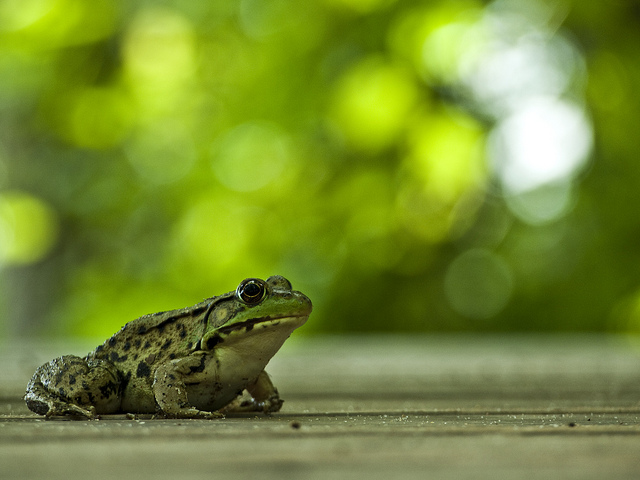
Ribbit Tell’em, photo by EEKaWILL

Spring is frog season, and today’s Anishinaabemowin word of the day is Omagakii which means frog. Omagakiins means little frog and Omagakiinsag means little frogs.

Anishinaabemow.in is a very cool (though no longer updated) website that used short videos to teach words and short phrases in Anishinaabemowin. They explain that:

Anishinaabemowin is the traditional language of the Anishinaabe people. It is sometimes referred to as Ojibwe, Ojibway, Saulteaux or Indian by people in the community. Outsiders sometimes refer to it as Ojibwa or Chippewa. On this site we refer to it by the proper name in the language Anishinaabemowin.

Some facts about Anishinaabemowin

  • During the Fur Trade era Anishinaabemowin was referred to as the ‘Lingua Franca’ or trade language of what is now called Canada, meaning at one time if you wanted to conduct business here you had to speak Anishinaabemowin
  • At one time Guiness Book of World Records listed Anishinaabemowin as having the most complex verb structure of any language in the world, a testament to the intellectual capacity of our ancestors
  • A number of English words are adopted from Anishinaabemowing including Totem (used in Freudian studies and to refer to West Coast art) which is adapted from Dodem or clan, Mocassin (leather slipper) which is adapted from Makasin or shoe and countless place names.
  • Anishinaabemowin is spoken in communities from Quebec to British Columbia, From Northern Ontario to the Midwestern United States. The diffusion of speakers means that it is now spoken in places where there never were Anishinaabeg before.
  • Old Anishinaabeg don’t die, they just Maazhiwe.

Check Will’s photo out bigger and also see the Frog slideshow from the Absolute Michigan pool!

True/False (morel)

True | False

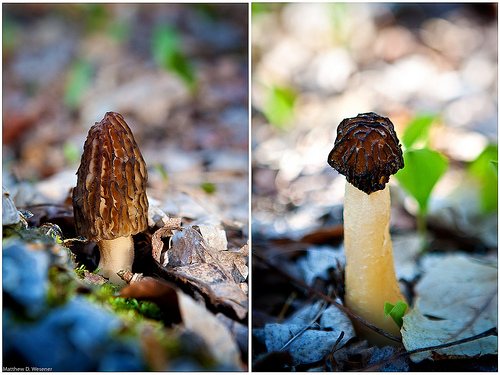
True | False, photo by M_Wesener

When in doubt, throw it out!
~The Mushroom Hunter’s Mantra

When you’re out looking for morels, this is one True or False question you want to get right! The False Morel page at The Great Morel exlains:

The “False Morel” has several species which carry scientific names such as Gyromitra esculenta, Verpa, Hellvella, and Disciotis. The Verpa and gyromitrin species are the most often mis-identified variety. The gyroomitrin is oten referred to as the “red mushroom”, the “beefsteak mushroom” or the “lorchel”. There are several true species of the false morel, and while some will say they can prepare and eat the false morel with no problem, others have a drastically opposite reaction to them. Hence, The Great Morel suggests that you do not attempt to digest this particular mushroom.

Research shows this species of the morel family is said to contain a toxic chemical called Gyromitrin, a toxic and possible carcinogenic chemical.

…The texture or makeup of the cap or head can typically have brain-like features, with folds in the caps, which some might describe as wrinkles, and are often brittle to the touch. The color will appear reddish or a brownish red, and will darken to almost a blackish red as the false morel ages. You can see some of this darkening beginning to take place on the image below. Sizes can vary from 2 inches to 10 inches.

One of the easiest ways of determining the false morel is by slicing it long ways. See the image below of a crosscut sectioning and note the meaty texture of the stem. False morels are not hollow, which is the most definite tip that you have stumbled up one of these ugly bad boys. The false morel shown in this image is also quite heavy as it is almost solid in the stem and meaty, and often referred to as “cottony”. Some expert mycologists go into greater detail in defining the relationship of the cap and the stem.

You can click through for some helpful photos and also check out the morel identification page at MichiganMorels.com.

Check this out bigger and in M Wesener’s slideshow.

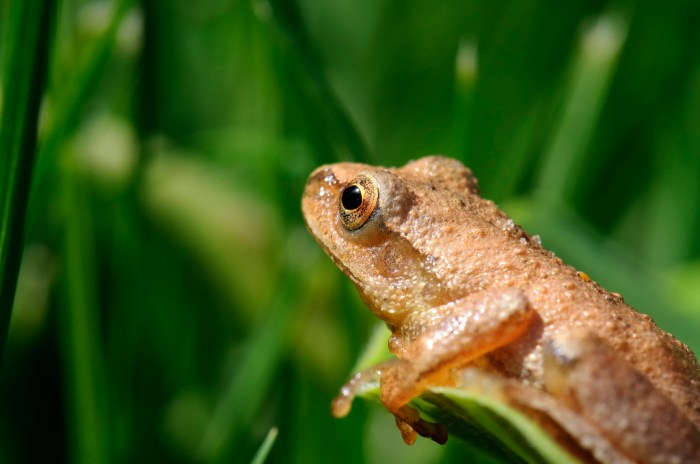
Signs of Spring in Michigan: Spring Peepers (Pseudacris crucifer)

Spring Peeper Pseudacris crucifer

Untitled, photo by Tim Mayo.

The Michigan DNR’s page on Northern Spring Peeper (Pseudacris crucifer) says:

The tinkling of bells is a popular description of the spring peeper’s spring mating call. Spring peepers are one of the earliest callers among the dozen frog species found in Michigan. During the first warm evenings of spring in late March or early April through May, their distinctive single note, high pitched “peep” is considered a harbinger of spring. The intensity of calling increases and can become a deafening chorus during humid evenings or just after a warm spring rain when many males congregate.

Only the male frogs call. They establish territories near the edge of permanent or ephemeral wetlands. They may call from elevated perches of submerged grass or shrubs near the water. The faster and louder a male sings, the more likely he is to attract a mate.

The female will lay between 750-1,200 eggs. The strings or clumps are attached to twigs and aquatic vegetation. Depending on the temperatures, eggs may hatch within four days or may take up to two weeks during cooler periods. After another two to three months, young tadpoles are fully transformed into young frogs and leave the pond.
They resemble their parents with the most distinctive mark being a dark brown “X” (may be irregular or incomplete on some) on their lighter brown or tan back. They begin feeding on small food items like spiders, mites, ticks, pill bugs, ants, and caterpillars. By the end of the summer, they have reached the adult size of about 1 – 1 1/2 inches. As the days cool, the peepers dig into the soft mud near ponds for the winter. Still, during warm spells into the fall they can be confused and emerge to give their spring mating call.

The spring peeper is the most abundant of Michigan’s singing frogs and is common statewide. They prefer damp woodlands, swamps, and marshes. However, they still need protection – local populations around small ponds and wetlands can be highly susceptible to surface water runoff. These waters can carry chemicals, pesticides, or silt that can kill adults, eggs, or tadpoles. Good soil erosion practices and the careful application of pesticides and fertilizers are good for spring peepers.

The most distinctive thing about peepers is their call, which can become deafening in springtime. The Pseudacris crucifer (Spring Peeper) section from UM Animal Diversity Web has a short peeper call from Livingston County, and you can see a peeper peeping in this video.

Some more peeper particulars: Wikipedia’s Spring Peeper entry notes that their calls can be heard from as far as 1 – 2.5 miles depending on the number of peepers in a pond, that peepers generally like to breed when it is closer to dusk and throughout the evening and early morning hours, and that peepers can live up to 3 years in the wild. At Portage Lake in Washtenaw County, Michigan in the 1950s, surveys in March, April, and May found that spring peepers were the most abundant animals. The page on peepers from watersheds.org notes that spring peepers produce glucose (sugar) in their livers that acts as an anti-freeze and is pumped to vital organs including the heart and lungs to allow them to freeze and thaw without developing ice crystals. Our Peeper-pedia on Absolute Michigan has a few more links and a cool video of a Michigan peeper in action.

Check Tim’s photo out bigger and in his PJ Hoffmaster State Park slideshow.

More frogs on Michigan in Pictures.

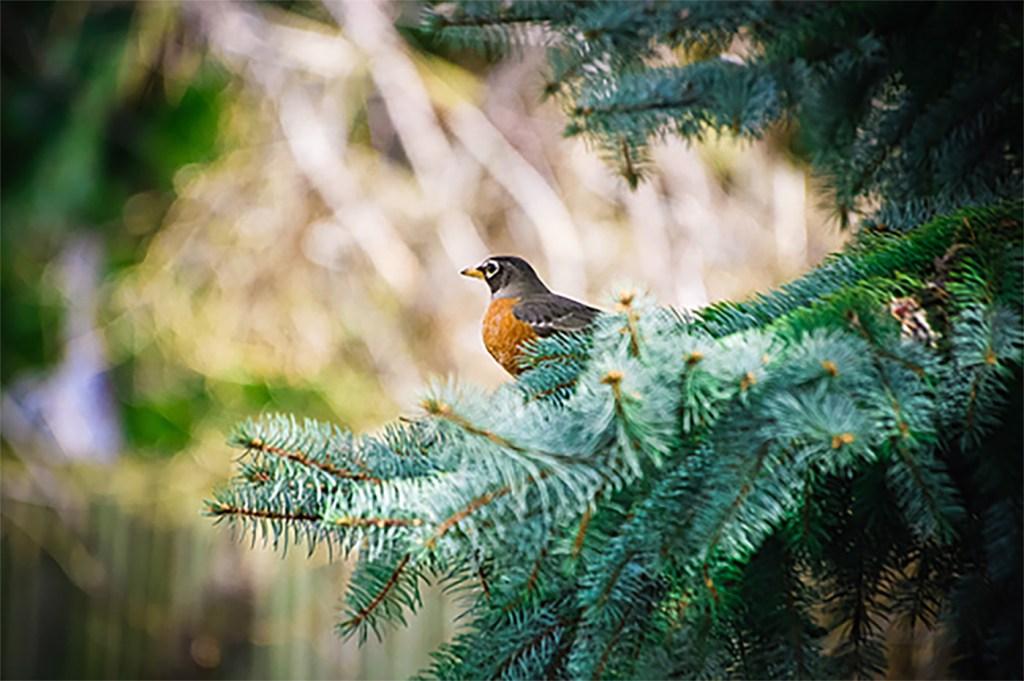
Michigan’s State Bird: The American Robin

American Robin by ShannenOMalley

American Robin by ShannenOMalley

“WHEREAS, A widely and generally conducted contest to choose a State bird, carried on by the Michigan Audubon Society, resulted in nearly 200,000 votes being cast, of which Robin Red Breast received many more votes than any other bird as the most popular bird in Michigan; and WHEREAS, The robin is the best known and best loved of all the birds in the State of Michigan; therefore BE IT RESOLVED BY THE HOUSE OF REPRESENTATIVES (THE SENATE CONCURRING), That the robin be and the same is hereby designated and adopted as the official State bird of the State of Michigan.”
~Michigan House & Concurrent Resolution, April 8, 1931

A sign of spring in Michigan is the sighting of your first robin. Like daffodils, they’ve showed up early this year. American Robin (Turdus migratorius) at All About Birds has some great facts and photos about our state bird:

The quintessential early bird, American Robins are common sights on lawns across North America, where you often see them tugging earthworms out of the ground. Robins are popular birds for their warm orange breast, cheery song, and early appearance at the end of winter…

  • An American Robin can produce three successful broods in one year. On average, though, only 40 percent of nests successfully produce young. Only 25 percent of those fledged young survive to November. From that point on, about half of the robins alive in any year will make it to the next. Despite the fact that a lucky robin can live to be 14 years old, the entire population turns over on average every six years.
  • Although robins are considered harbingers of spring, many American Robins spend the whole winter in their breeding range. But because they spend more time roosting in trees and less time in your yard, you’re much less likely to see them. The number of robins present in the northern parts of the range varies each year with the local conditions.
  • Robins eat a lot of fruit in fall and winter. When they eat honeysuckle berries exclusively, they sometimes become intoxicated.
  • Robin roosts can be huge, sometimes including a quarter-million birds during winter. In summer, females sleep at their nests and males gather at roosts. As young robins become independent, they join the males. Female adults go to the roosts only after they have finished nesting.
  • Robins eat different types of food depending on the time of day: more earthworms in the morning and more fruit later in the day. Because the robin forages largely on lawns, it is vulnerable to pesticide poisoning and can be an important indicator of chemical pollution.
  • The oldest recorded American Robin was 13 years and 11 months old.

Read on for more including the various songs of the robin and some video. More photos and info from Turdus migratorius (American robin) at UM Animal Diversity Web and at American Robin on Wikipedia. Also don’t miss A blue like no other: Robin’s Egg Blue on Michigan in Pictures.

More Michigan state symbols on Michigan in Pictures.

Support Michigan in Pictures with Patreon

Michigan Snakes: Blue Racer (Coluber constrictor foxi)

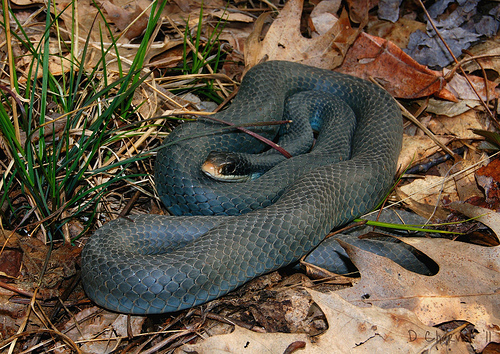
Blue Racer

Blue Racer, photo by d charvat.

“I liked to go on the road and catch the blue racers and sort of scare my brothers,” she said. “I’d drape them around my neck and around my wrist. I was the ultimate tomboy when I grew up here in Manistee and I loved the Great Lakes. “
~Ann Romney recalling her Michigan childhood (article)

While Mitt Romney’s “the trees are the right height” memories of Michigan drew some laughter, I doubt that anyone would laugh at tomboy Ann Davies with a couple of blue racers draped around her arms.

The DNR’s page on Michigan snakes says that Michigan has 17 native species. Their Blue Racer (Coluber constrictor foxi) page explains:

A large gray or blue snake with smooth scales. The head is usually darker than the body, though the chin and throat are white. The belly is light blue or white. Young racers are grayish, with a pattern of darker blotches and spots. Adult length: 4 to 6 feet.

Racers inhabit a variety of places, including open woods, meadows, hedge rows, marshes, and weedy lake edges. They are alert, active snakes that may climb into low bushes to escape enemies. These snakes feed on rodents, frogs, smaller snakes, birds, and insects. Although they will bite if cornered or grabbed, racers are not venomous.

Females lay 6 to 25 eggs in rotting wood or underground during June and July. The young racers hatch in late summer and, as noted above, are colored differently than the adults.

Racers have been found through most of the Lower Peninsula (except the northernmost sections) and the southern tip of the Upper Peninsula. Once common, their numbers have fallen in many places. Needless persecution by humans as well as habitat loss are probable factors in this decline.

The Coluber constrictor Eastern Racer entry from Animal Diversity Web says that the blue racer is one of several different racer subpopulations and adds a lot more information and photos including that in the wild, racers have been known to live over 10 years. You can also watch a cool video of a BIG blue racer by the Saline Snake Guy.

d charvat writes that they saw this good-sized blue racer while hiking in the Middleville MI state game area. Check it out background big and see a lot more cool shots from out and about in their slideshow.

Snowy Owl Irruption in Michigan

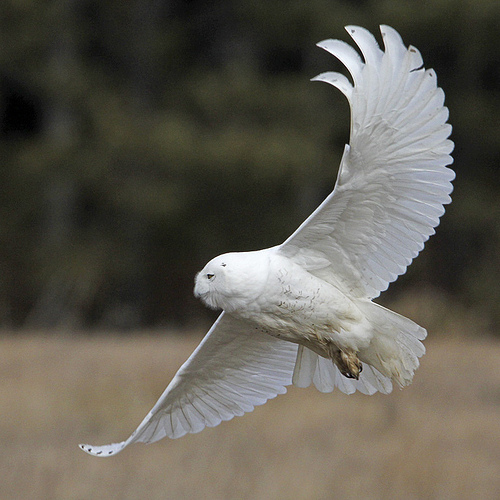
Snowy Owl (Bubo scandiacus)_0314_1

Snowy Owl (Bubo scandiacus)_0314_1, photo by johndykstraphotography.

We’ve been seeing a lot of snowy owls this winter in the Absolute Michigan pool on Flickr. These 2′ birds are native to the Arctic tundra, but they’ve been sighted in large numbers in Michigan this winter. Snowy owls flock to Mich. in unusual numbers in USA Today explains:

Scientists say the likely reason for the explosion is that the owls’ chief food source, small animals called lemmings, was abundant last summer, allowing the adults to raise more young. Now, in search of food, young owls are heading farther south.

Although there are a few snowy owls spotted in Michigan every year, “I can tell you this winter is highly unusual,” said Karen Cleveland, bird biologist with the Michigan Department of Natural Resources.

…The phenomenon is called an irruption, an invasion of birds in unusual places or in high numbers. It usually occurs because of a lack of food in the birds’ home territory.

They even talk with photographer Stacy Niedzwiecki about her snowy owl photos, which we featured on Michigan in Pictures a few months ago!

The Snowy Owl page at All About Birds notes that they are the northernmost, heaviest, and most distinctively marked owl of North America, and that an individual adult Snowy Owl may eat three to five lemmings per day, or up to 1,600 per year! While this irruption means that there are many more owls than usual in Michigan, they are a common wintertime visitor.

John captured this owl in Muskegon County earlier this month. See it bigger and see more in his Snowy Owl slideshow.

More Michigan birds on Michigan in Pictures!