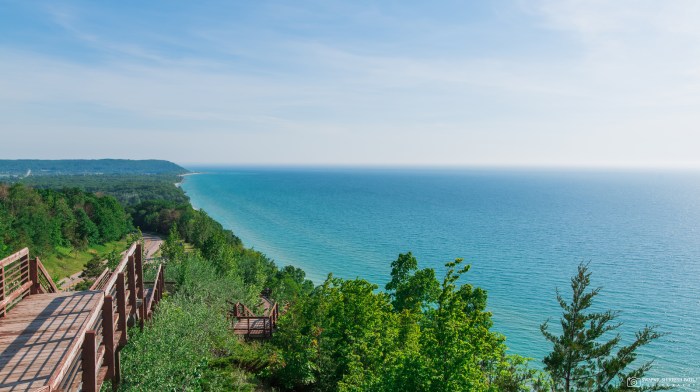
Inspiration Point, Arcadia

Inspiration Point Arcadia

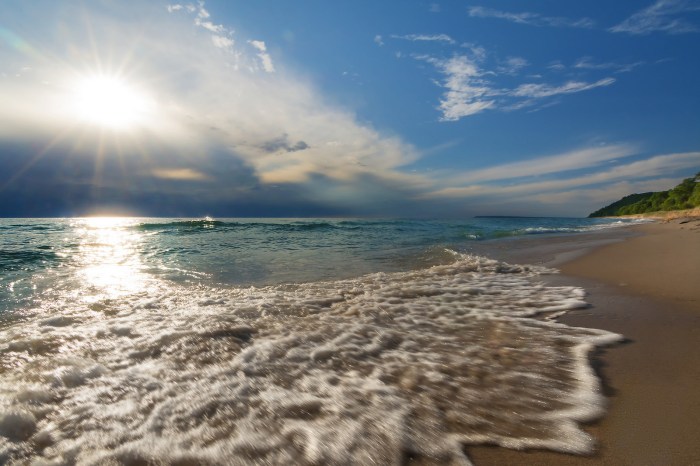
Inspiration Point, Arcadia, photo by Swapnil

Pure Michigan relates that the Arcadia Overlook aka Inspiration Point is the highest point on Lake Michigan’s western shore. This TripAdvisor review says it all I think:

The view of Lake Michigan is perhaps the loveliest for the Eastern shore of the Lake. High above the Lake and even higher when you climb well-constructed stairs. Some people drive up every night to watch the sunset. We know of scores of marriage proposals that transpired there. Very near the C. S. Mott Nature Preserve, which we know as the blow-out and others call Old Baldy. On Highway M-22, one of the most beautiful roads in the Midwest. by all means, stop for awhile and watch the breakers (whitecaps) on a windy day.

View Swapnil’s photo bigger and see more in his Pure Michigan slideshow.
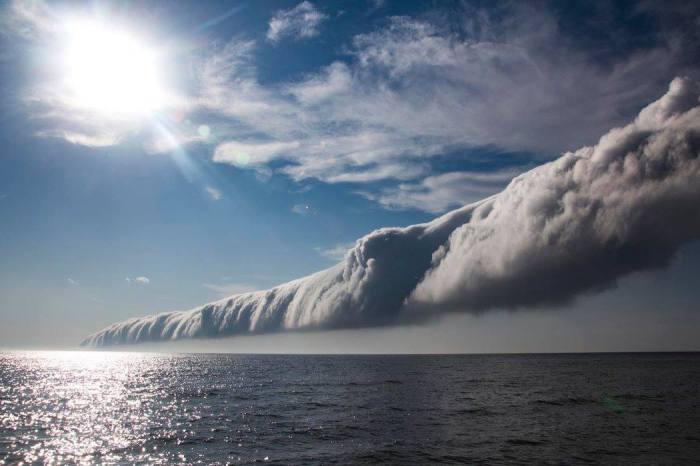
The Vortex: Roll cloud over Lake Michigan

Vortex Cloud

The Vortex, photo by Nick Nerbonne

My corner of Northern Michigan was all abuzz last weekend due to a relatively rare meteorological phenomenon known as a “roll cloud.” Wikipedia’s entry on Arcus clouds explains:

An arcus cloud is a low, horizontal cloud formation. Roll clouds and shelf clouds are the two types of arcus clouds. A shelf cloud is usually associated with the leading edge of thunderstorm outflow; roll clouds are usually formed by outflows of cold air from sea breezes or cold fronts in the absence of thunderstorms.

…A roll cloud is a low, horizontal, tube-shaped, and relatively rare type of arcus cloud. They differ from shelf clouds by being completely detached from other cloud features. Roll clouds usually appear to be “rolling” about a horizontal axis. They are a solitary wave called a soliton, which is a wave that has a single crest and moves without changing speed or shape.

View Nick’s photo background bigscroll through his pictures on Facebook, and watch this time-lapse of the cloud…

Summer is Rushing In

Rushing In by Heather Higham

Rushing In, photo by Heather Higham

It looks like parts of Michigan will be close to the 90s tomorrow, so get out there and start soaking up some of Michigan’s summertime beauty.

View Heather’s photo bigger, see more in her Summer slideshow, and definitely follow her at Snap Happy Gal Photography on Facebook where she’s got some really incredible shots from the past few days!

Sunset rainbow over Lake Michigan

Frankfort Rainbow

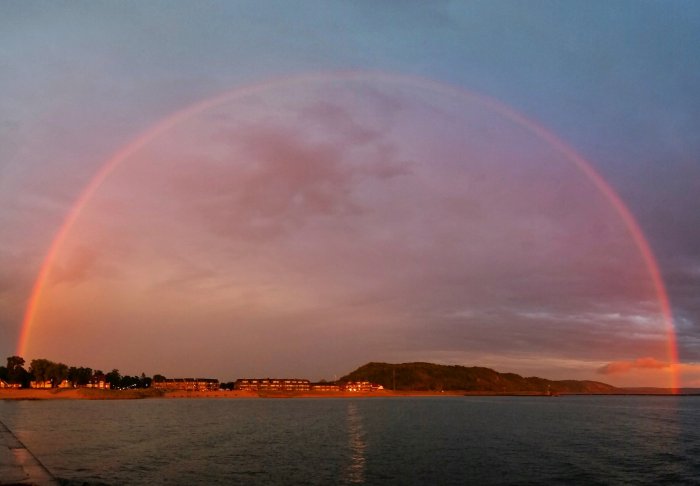
The best rainbow I’ve ever seen last night over Frankfort, photo by Noah Sorensen

Atmospheric Optics from the UK is far and away the best website for rainbow science as well as other atmospheric optical phenomena. Regarding primary rainbows as seen in Noah’s photo from Frankfort, they say:

To see a rainbow we need sunshine and falling rain. Rainbows are rarer than might be thought … Halos occur much more frequently.

Early morning and late afternoon are the best times to see them because the sun must not be too high. Rainbows are always opposite the sun and their centres are below the horizon at the the antisolar point. The lower the sun the higher is the bow.

Red is always outermost in the primary bow with orange, yellow, green and blue within. Occasionally, when the raindrops are small, fainter supernumerary arcs of electric greens, pinks and purples lie just inside the main bow.

A rainbow is not just a set of coloured rings. The sky inside is bright because raindrops direct light there too. The primary bow is a shining disk brightening very strongly towards its rim.

View Noah’s photo background bigilicious, see more in his slideshow, and be sure to follow him on Instagram!

Lots more rainbow information and more summer wallpaper on Michigan in Pictures!

Hammock with a view at P.J. Hoffmaster State Park

View from my hammock Hoffmaster State Park

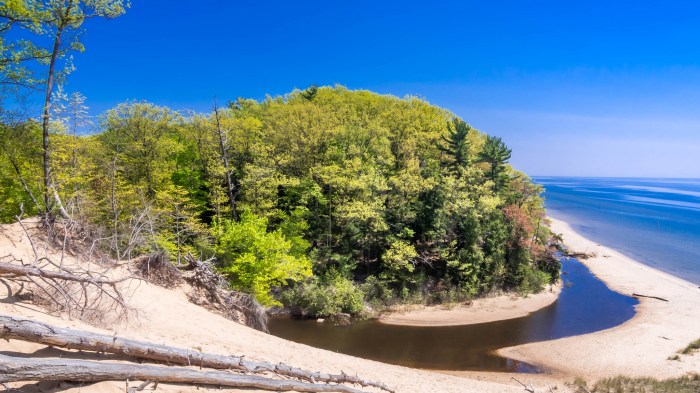
View from my hammock, photo by Bailiwick Studios

The photographer says that the outlet of Little Black Creek was the view from his hammock at Hoffmaster State Park near Muskegon. Not too shabby!

The Gillette Nature Center’s page on P.J. Hoffmaster State Park says (in part):

P.J. Hoffmaster State Park was established in the 1960s in honor of Percy James Hoffmaster, the longest acting Director of Conservation and the first chief of state parks in Michigan. The park encompasses 1200 acres, including 3 miles of Lake Michigan shoreline, and represents one of the finest examples of high relief, parabolic dunes and forested backdunes on the Great Lakes. The undisturbed quality of the habitat makes the park a refuge for 460 species of plants, nearly 90 species of birds and a rich array of mammals, reptiles, amphibians and insects. Hoffmaster is home to several listed species of plants, reptiles and birds.

The park’s pristine sandy beach is often described in magazines and travel guides as one of the wildest and most scenic beaches in Michigan.

…The park’s ten miles of trails and diversity of birds provides a birding experience unparalleled in the region, especially in the spring at the peak of migration. The park’s 293 site campground provides the opportunity for an overnight stay, and the surrounding landscape abounds with outdoor adventure for overnight or day visitors alike.

View the photo background bigtacular and see more in Bailwick Studios’ slideshow.

More summer wallpaper on Michigan in Pictures.

Flip out because Summer 2016 is here!!

Grand Haven Flip

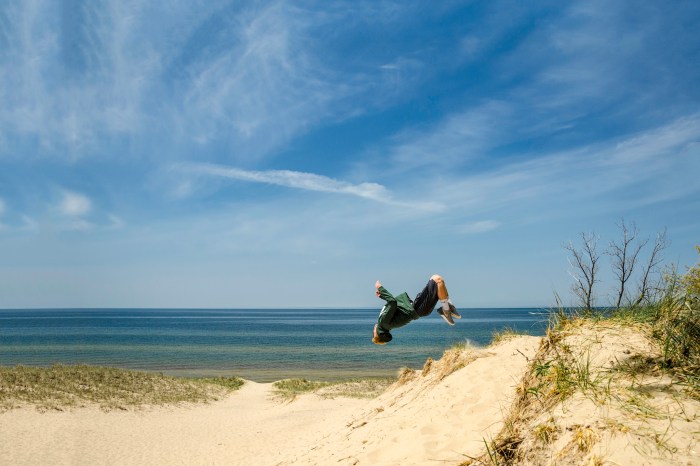
Grand Haven MI, photo by Cyndie M

Summer 2016 is here, and as it’s the only Summer 2016 you’re ever gonna have – I recommend you get the most out of it!!

Cyndie took this last week at the sand dunes by Grand Haven. View it background bigtacular, see more in her slideshow, and check out more of her work on her website.

PS: More summer wallpaper on Michigan in Pictures!

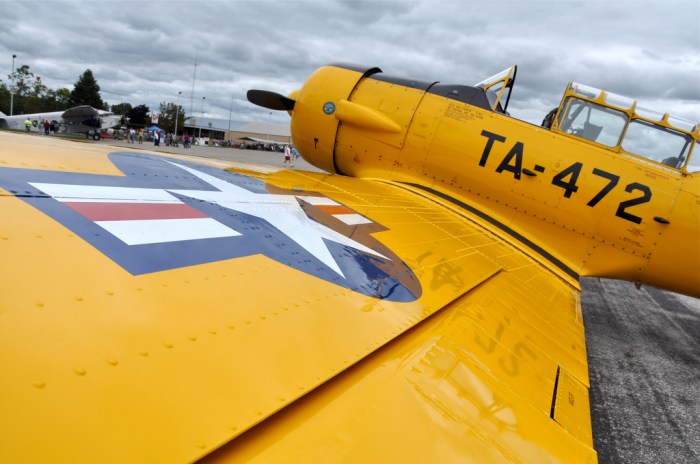
World War II Training on Lake Michigan

Wingspan

Wingspan, photo by Phil Squattrito

in advance of Memorial Day, the New York Times reviewed Heroes on Deck: World War II on Lake Michigan (trailer below) that tells the tale of how dozens of wrecked planes came to be on the bottom of that body of water. They write:

The film, by John Davies, recounts the training of pilots in how to land on aircraft carriers. Two passenger liners were stripped down and fitted with long decks (though not as long as the decks on actual aircraft carriers) and floated on Lake Michigan, where the training could take place without the threat posed by enemy submarines. Landing a plane on a floating airstrip was easier for some young men than others.

…Vintage footage shows crash after crash, though only a few fatalities resulted, in part because preflight training included how to escape if your plane were to go into the drink.

The film, showing on many public television outlets (including NJTV on Saturday and WLIW World on Sunday; check local listings), does more than just revisit an interesting tidbit of military history. It also chronicles present-day efforts to raise some of the planes from the lake bottom and restore them for display in museums and airports.

View Phil’s photo of this World War II fighter plane from the 2009 Gratiot County Airport open house background big and see more in his Transportation slideshow.

Here’s the trailer…

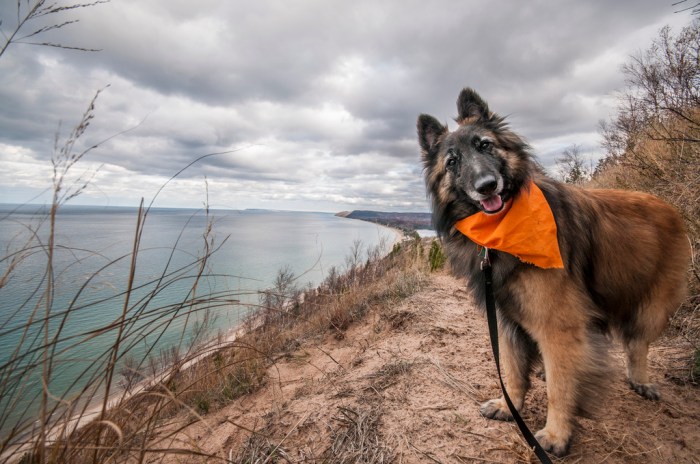
Major Explorer on Empire Bluffs

Major at Empire Bluff

Major Explores Empire Bluff, photo by Mark Miller

Over on Leelanau.com I shared upcoming meetings for folks interested in becoming “Bark Rangers” in the Sleeping Bear Dunes National Lakeshore. Major looked so awesome that I had to share him with all of you too!

Bark Ranger volunteers and their canine companions will serve as ambassadors on National Lakeshore beaches to provide visitors information about the park, highlight pet policies, and pet safety. They will also help to protect the National Lakeshore’s nesting shorebirds.

Dogs can’t come to the meeting, but Bark Rangers will receive training and Bark Ranger gear for their dog if they are volunteering with a dog. You don’t have to own a dog to become a Bark Ranger, and there’s two orientation sessions. The first meeting on Saturday, May 21 at 1 PM and the second on Tuesday, May 24th at 7 PM, and there’s also an option if you’re interested and can’t make it.

Mark is a longtime contributor to Michigan in Pictures. You can view this photo bigger and if you have any doubt that Major has more fun than you, one look at Mark’s slideshow of Major should be enough for your surrender.

More dogs on Michigan in Pictures.

PS: I promise to share some dog-friendly Michigan stuff folks – I know some of you have been asking for it!!

PPS: More about the Empire Bluff Trail from the Sleeping Bear Dunes National Lakeshore.

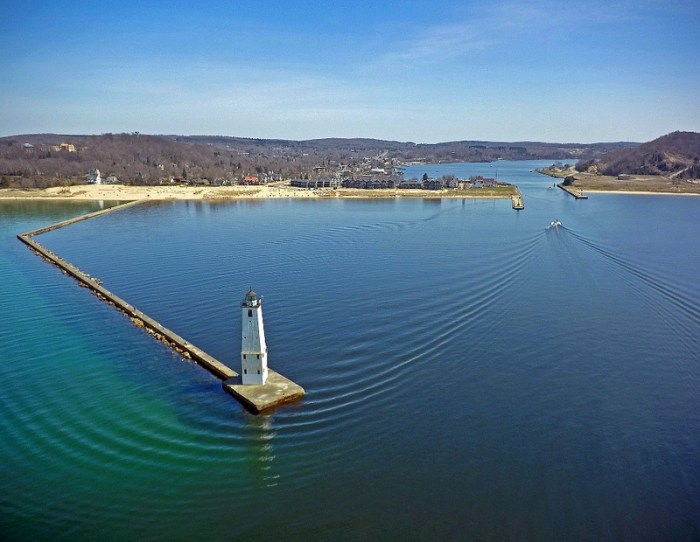
Above Frankfort Harbor

Above Frankfort Harbor

Frankfort Harbor, photo by Julie

My friend Enrico of Traverse Today and his sons shared a great aerial video from Frankfort the other day:

Julie took this stunning shot last Saturday. View her photo bigger and see more in her Drone shots slideshow.

Lots more from Frankfort on Michigan in Pictures.

Line 5 and the Great Lakes

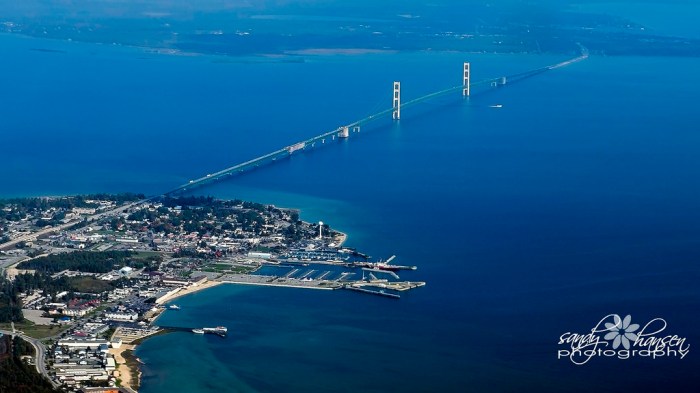
Mackinaw-City-and-Mackinac-Bridge

Mackinaw City and Mackinac Bridge, photo by Sandy Hansen Photography 

“There is a pipeline that‘s sitting at the bottom of the Straits of Mackinac. It was designed for a 50 year life and it’s been down there for 63 years. There’s a risk involved in this.”
-Mark Shriberg, National Wildlife Federation

In Line 5 puts Great Lakes at risk on Absolute Michigan via the University of Michigan (video below):

Up to 152 miles (245 km) of coastline in lakes Huron and Michigan could be fouled by a single oil spill at the straits, according to the simulations. When all 840 simulated spills are plotted on a map, a total of 720 miles (1,162 km) of shoreline in the U.S. and Canada are considered potentially vulnerable to spills that would require cleanup. Seven hundred twenty miles is roughly the distance from Detroit to Atlanta.

Areas at highest risk include Mackinac and Bois Blanc islands, as well as locations directly east and west of Mackinaw City. Communities also at risk include Beaver Island, Cross Village, Harbor Springs, Cheboygan and other places along the lakes Huron-Michigan shoreline.

…”Until now, no one knew exactly how much shoreline was vulnerable to spills in the Straits of Mackinac,” said Schwab, a research scientist at the U-M Water Center. “These findings show that under the right conditions, a spill in the Straits of Mackinac could affect a significant amount of shoreline and open-water areas in either Lake Michigan or Lake Huron, or both, very quickly.”

View Sandy’s photo bigger, see more in her aerial slideshow, and follow her on at Sandy Hansen Photography on Facebook.