Another (Michigan) Roadside Attraction

Paul Bunyan

Paul Bunyan, photo by I am Jacques Strappe.

The Michigan Historical Museum is planning an exhibit called Michigan’s Roadside Attractions, set to run from January to June of 2009. They are looking for stories, pictures and artifacts of the unique places – open or long shuttered – that folks visit on the way from someplace to someplace else. Michigan Historical Museum System Director Phillip C. Kwiatkowski says:

We want to hear what made you stop at these roadside attractions – places like the Mystery Spot in St. Ignace, Deer Forest in Coloma, Windmill Island in Holland and the multiple locations where Paul Bunyan has been spotted – and to see the photos you took and the souvenirs that you kept. Our biggest need is your treasured mementoes, from miniature Paul Bunyan statues and plastic purses to dinosaurs, seashells and even ceramic doll dish sets.

If you can help, please contact Eve Weipert, curator of collections, at (517) 373-1509 or weiperte@michigan.gov. Most artifacts used in the exhibit will be considered on loan and will be returned after the exhibit ends. The museum has an established review process that is utilized prior to acceptance of loans or permanent donations. Artifacts are needed by April 1, 2008 to allow time to complete the exhibit storyline around the available artifacts.

This photo by Marjorie is part of her Roadside Curiosities set (slideshow) and it’s available “Bunyan-sized” for your desktop wallpaper.

If you’re interested in Michigan’s roadside attractions, here’s some “roadside” photos from the Absolute Michigan pool, Michigan Tourist Traps from WaterWinterWonderland.com, the “roadside” tag on Michigan in Pictures, this Absolute Michigan “Weird Wednesday” featuring Domke’s Dinosaur Gardens and of course, Michigan’s legendary Big Boy Graveyard.

If you have links or memories to share, post them in the comments!

Old Steel, New Library of Congress

Hanna furnaces of the Great Lakes Steel Corporation, Detroit, Mich. Coal tower atop coke ovens (LOC)

Hanna furnaces of the Great Lakes Steel Corporation, Detroit, Mich. Coal tower atop coke ovens (LOC), photo by The Library of Congress.

Yesterday I learned through a couple of emails, an IM, Lifehacker and even this post in the Absolute Michigan pool (yay!) that the Library of Congress has embarked on a new project to increase access to their photographic collection and also to more completely “tag” their photos. From My Friend Flickr: A Match Made in Photo Heaven on the Library of Congress blog:

The project is beginning somewhat modestly, but we hope to learn a lot from it. Out of some 14 million prints, photographs and other visual materials at the Library of Congress, 3,000 photos from two of our most popular collections are being made available on our new Flickr page, to include only images for which no copyright restrictions are known to exist.

The real magic comes when the power of the Flickr community takes over. We want people to tag, comment and make notes on the images, just like any other Flickr photo, which will benefit not only the community but also the collections themselves. For instance, many photos are missing key caption information such as where the photo was taken and who is pictured. If such information is collected via Flickr members, it can potentially enhance the quality of the bibliographic records for the images.

This photo was taken in November of 1942 by Arthur Siegel of the Hanna furnaces of the Great Lakes Steel Corporation in Detroit (now U.S. Steel’s Great Lakes Works). You can see (and perhaps help to classify) more photos tagged as Michigan right here.

Much as I love Detroit’s rich industrial history, I really hope that the good people at the Library of Congress can toss up a few photos from elsewhere in the state, including some that highlight Michigan’s natural beauty!

LOC Call Number: LC-USW36-811 (link)

Y is for Yellow … as in yellow Chevy Nomad

Chevy Nomad

Chevy Nomad, photo by pbosker2001.

In the Absolute Michigan group on Flickr, there’s a thread of Michigan photos from A to Z that just finished its third time through the alphabet.

This photo of a Chevy Nomad (made available in wallpaper sized glory) was taken at the annual Grand Rapids Metro Cruise in August of 2007.

I’m guessing that the owner would find it easy to join the Chevy Nomad Club. Wikipedia’s entry for the Chevrolet Nomad says:

The Nomad’s unique design had its roots in a General Motors Motorama show car of the same name that was based on the Corvette. The Concept was introduced at the GM Motorama in 1954 as one of Head Stylist, Harley Earl’s “dream cars”…

There have been two Nomad concept cars. The first one from 1999 was based on the F-body (Camaro) and was V8 powered. The second concept presented in 2004 was based on the GM Kappa platform, and highly resembled the original 1954 Corvette-based Nomad showcar.

You can see the 2004 Nomad concept (though I prefer the 1955-57 Nomad) and check out this year’s concepts at the Detroit Auto Show.

Michigan Week Youth Photo Contest

2007 Michigan Week Youth Photo Contest

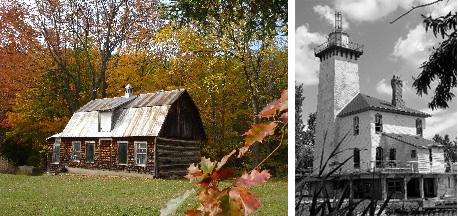
The photos above are two of the winners of the 2007 Michigan Week Youth Photo Contest: Bufka Shed at Sleeping Bear Dunes National Lakeshore taken by Kyle Helwig of Leelanau County and Saginaw River Rear Range Lighthouse taken by Cody Janczewski of Ogemaw County. You can click the photos above to see all the state and regional winners and runners up.

Every year, Michigan State University Extension’s 4-H Youth Development, the Michigan Department of History, Arts and Libraries and Michigan History for Kids magazine (with additional financial support from the Michigan Barn Preservation Network) sponsor the Michigan Week Youth Photo Contest. The contest is for photographers between the ages of 9 and 19 and challenges photographers to take a photo of their favorite Michigan historic site. The deadline for photo submission is Feb. 15, 2008.

If you’re looking for historical sites that would qualify, check out the Michigan State Historic Preservation Office’s Historic Sites Online website.

The Octagon House

wash up

wash up, photo by n.elle.

Nicole writes:

a few of us from exposure detroit took a road trip up to the northern burbs and further. some poked fun that i wanted to stop at the octagon house, but i think it’s a pretty cool building.

tucked behind the octagon house were a few old barns. sitting out it front of one of them was this old claw foot tub and sink. just in case you need to wash up.

The Friends of the Loren Andrus Octagon House say that in 1828, Loren traveled with his father to find a new home in the Territory of Michigan, settling in Washington Township in Macomb County. In 1858 with the help of prominent architect and brother-in-law David Stewart and using Orson Squire Fowler’s book about the wonders of 8-sided houses, A Home For All, Andrus built the Octagon House as his entry in a home-for-show contest between several families to see who could build the most unusual house. He won.

The Octagon House is Italianate in style, surrounded on six sides by a Corinthian-columned porch. A cedar shake shingled roof, with elegant scrolled brackets, supports the octagonal cupola. The house has eight sides with eight-foot windows letting daylight fill the interior. The interior is centered around a dramatic, 55-step cantilevered spiral staircase which winds from the first floor to the third story cupola.

The Friends of the Loren Andrus Octagon House was formed to preserve this structure (which is on the National Register and you can learn a lot more about it, see a slideshow and help them to save the old barns.

Here’s an entry for The Octagon House on the Absolute Michigan map of Michigan.

Phototherapy, breakfast cereal and the Battle Creek Sanitarium

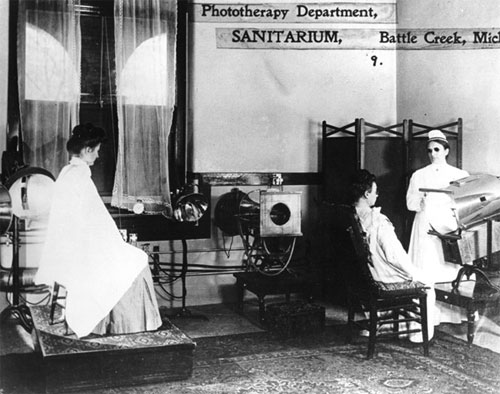
Phototherapy Department at the Battle Creek Sanitarium

Phototherapy Department at the Battle Creek Sanitarium, courtesy Willard Library

The Willard Library has an amazing collection of photos from the Battle Creek’s history. Prominent among these are of course photos from the Battle Creek Sanitarium. The Battle Creek Sanitarium Years from the Battle Creek Federal Center is a good companion article and explains:

Dr. John Harvey Kellogg (1852-1943) took charge of the Institute for the Seventh-day Adventist Church in 1876 and changed the name to the Battle Creek Sanitarium. He came up with the word “sanitarium” to reflect his idea of a sanitary retreat for health restoration and training (“a place where people learn to stay well”) rather than “sanitorium,” which meant a hospital for invalids or for treatment of tuberculosis. The San, as the place was familiarly known, prospered under Dr. Kellogg’s direction…

Dr. Kellogg’s medical treatment embraced all branches of medicine, including surgery, but with emphasis on fresh air, sunshine, exercise, rest and diet. The SDA dietary practices eliminated meats, condiments, spices, alcohol, chocolate, coffee and tea. Nutritious substitutes were created for “harmful” foods. Dr. Kellogg invented some 80 grain and nut products.

Somewhere amidst all of this, flaked cereal was invented and John’s brother William Keith Kellogg and C.W. Post began a breakfast bowl battle that basically created the breakfast cereal industry. There’s much more at the link above (including some more great photos) and you can also see Wikipedia’s entry on the Battle Creek Sanitarium, the entry on John Harvey Kellogg from the Battle Creek Historical Society and Mr. Breakfast’s Early Days of Breakfast Cereal.

Abbott Road Park … but what about Theophilus Capen Abbot?

Abbot Park

Abbot Park, photo by jstealth03.

Abbot Road Park is one of the City of East Lansing’s 24 neighborhood parks. It’s located north of Lake Lansing Road and designated as a hiking and cross-country ski trails natural area with access to the Northern Tier Trail.

The city can’t seem to settle on a name for the park. Their web page calls it “Abbot Park” but the road is “Abbott Rd”. The city’s park & facilities map (pdf) lists it as “Abbot Road Park” so that’s probably correct. However, there’s the matter of Abbot Hall, about which Kevin Forsyth’s fabulous History of East Lansing says:

The hall was named for Theophilus Capen Abbot (1826-1892). Dr. Abbot joined M.A.C. as Professor of English from 1858 to 1866. He then became acting Secretary of the Board of Agriculture, a position he effectively held until 1871. Concurrently — and most importantly — he was third President of the College from 1862 until 1884. During his long and distinguished tenure, he guided the growth of the school through difficult times, and “showed an eye single to the grand object for which the College was established. Nothing could swerve him from a course which should ever keep in view the aid and promotion of agriculture.”

In any case, I’ve added a marker for Abbott Road Park to our Absolute Michigan map of Michigan and requested some sort of clarification from Mr. Forsyth – if you have anything to add to my confusion or the discussion, please post it in the comments!

Newaygo Mill … and Newaygo County

Newaygo Mill

Newaygo Mill, photo by evanfarinosi.

Evan started the Newaygo County group on Flickr and he’d love it if you’d share your photos on the area there.

The City of Newaygo’s history page says:

The City of Newaygo is the oldest community in Newaygo County. The Penoyer and Brooks families were among the first settlers to Newaygo. They founded Newaygo’s first saw mill known as the “Big Red Mill” … The proximity of the Muskegon River was the driving force of Newaygo’s early economy, with mills, lumbering, and recreation developing near by.

I also found a cool gallery of historical photos of logging in Newaygo County in the Newaygo County Historical Archives.

Since I don’t know when we’ll pass this way again, I should say that Wikipedia’s entry on Newaygo says that the population was 1,670 at the 2000 census. I also added Newaygo, MI to the Absolute Michigan map of Michigan.

The Copper Miner’s Strike of 1913 and the tragedy at Calumet’s Italian Hall

Copper Miners outside Dunn's Bar

dunns 6th calumet, photo by Ztef

I usually try to make Michigan in Pictures a happy place to be because there’s enough unhappy things out there. Every so often, however, I think there are stories that warrant a look and rememberance if only to say: “Let’s make darn sure this never, ever happens again.”

Ztef captioned the above photo rather sparsely with Copper miners strike outside of Dunn’s bar on 6th Street in Calumet, Michigan – 1913, but he has provided a link to Calumet: The Copper Miner Strike of 1913. This page offers a very detailed and readable account (complete with some great old photos) of the labor troubles in Keweenaw during the early part of 20th Century from the perspective of the Zawada family, Poles who worked in the copper mines for the mining giant Calumet & Hecla. Of this photo it says:

Strikers outside of Dunn’s Bar, a favourite among miners. Just next door to Dunn’s was the No. 203 local WFM office (Western Federation of Miners). The sign on the left reads: “Something just as good Miners ask for bread, Jim [MacNaughton, C&H General Manager] offers lead”. The sign in the middle reads: “One man machine Our Agitator”. The sign on the right reads: “We demand higher wages and better working conditions”. The men in front are holding copies of the Miner’s Bulletin, but the headlines are not clear.

As you can read at the link above, the strike was characterized by escalating violence, calling in of the National Guard and even murder. The chaos culminated with what has been called a Disaster, Tragedy and even Massacre at Calumet’s Italian Hall. Copper Country Reflections’ Italian Hall Tragedy page at Pasty.com explains:

By the end of December, the miner’s strike had been waged for 5 long months, with no end in sight. The mining companies and their supporters were holding firm in their resistance to the WFM, while the union was still somewhat solid in its position.

To temporarily set aside their cares, a group of union members planned a Christmas eve celebration for their children at the Italian Hall on Seventh Street in Calumet. I can only assume that the activities that evening must have been the most fun these children had since the start of the strike. Unfortunately, the excitement turned to tragedy as someone, his identity never learned, cried FIRE. As the children and adults panicked, many worked their way towards the stairwell. The first unlucky souls quickly realized the doors at the bottom would not open. Were they locked? Was somebody holding them closed?

It is hard to comprehend, but 73 men, women and children died in that staircase. Some were crushed, others died from suffocation. Can you imagine the shock of the rescuers when they finally pried open the doors? As they pulled bodies up and out of the staircase?

The page above also includes photos that are definitely not for the faint of heart. If you’d like to explore further, there’s more information and photos at the Italian Hall 1913 Massacre site and you can see a photo of the Michigan historical marker & memorial at the site of Italian Hall in Calumet.

One thing you definitely should do is watch the moving accounts of survivors of the tragedy at the December 2007 update from the 1913 Massacre Film Project. The movie project has been going for several years and it looks like it will be very good.

The Absolute Michigan map of Michigan has the location of Italian Hall in Calumet.

Winter at Black Lake

Winter at Black Lake

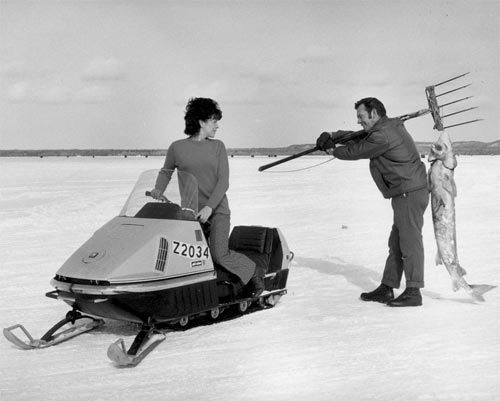
Winter at Black Lake, photo courtesy Archives of Michigan

The Archives of Michigan’s Image of the Month for December 2007 comes from a Michigan Tourist Council collection. No date is provided, but it likely dates from the late 1960’s or early 1970’s.

…The description on the back identifies the man as “Al Berry” and notes that he’s carrying a fifty-pound sturgeon. The woman on the snowmobile is not named. The description further notes that the photo was taken at Black Lake, near Onaway in Cheboygan County, Michigan.

Like many Michiganians, this man and woman were engaging in some winter fun. Winter recreation has a long tradition in the state. Back in the 1700’s, Detroit’s French-Canadian residents held horse races on the frozen Detroit River. In the 19th Century, miners and lumber jacks often raced horse-drawn cutters over the ice. For as long as anyone alive can remember, Michiganians have indulged in hockey, ice fishing, ice skating, skiing, sledding and sleigh riding. Snowmobiling represents a more modern activity – made possible by 20th Century technological advances. Judith Helmker, in her Manual of Snowmobiling (Cranbury, New Jersey: A. S. Barnes and Company, 1971) credits Wisconsin resident Carl Eliason as inventing a “motorized tobaggon” in 1928.

You can learn more about Black Lake and the massive lake sturgeon (Acipenser Fulvescens) from the Black Lake, Michigan Chapter of Sturgeon for Tomorrow.