Boyne Mountain & Michigan ski industry pioneer Everett Kircher

Snowmaking on Victor @ Boyne Mountain

Snowmaking on Victor @ Boyne Mountain, photo by Boyne Michigan

If you’re a skier in Michigan, chances are you’ve heard the name of Everett Kircher. Boyne Resorts history page says that this Detroit native moved to northern Michigan in 1947 to build a ski resort, buying the land for what has become Boyne Mountain for just one dollar. Boyne founder Everett KircherIn addition to founding one of the world’s largest ski empires in Michigan, Kircher (who passed away in 2002) was one of the ski industry’s leading innovators:
Kircher had many firsts including the world’s first triple chair installed in 1964 at Boyne Highlands Resort, and the world’s first four-person chair, installed in 1969 at Boyne Mountain. In 1990 Kircher installed Michigan’s first high-speed detachable quad chairlift at Boyne Highlands Resort. And in 1992, Boyne Mountain unveiled America’s first 6-seat high-speed chairlift.

Kircher’s ski innovation also included the introduction of snowmaking. He invented the Boyne Snowmaker, the first efficient snowmaker widely accepted as the standard for marginal temperature snowmaking. It combines small amounts of air and electricity with large quantities of water to provide a high efficiency snowmaking system with energy savings, and minimum noise level. He also pioneered the design of much of the snow grooming equipment and techniques in use today.

Be sure to take a moment to watch this 2001 interview of Everett Kircher by Michigan Skier TV’s Jim Neff about the growth of Boyne, snowmaking and the ski industry.
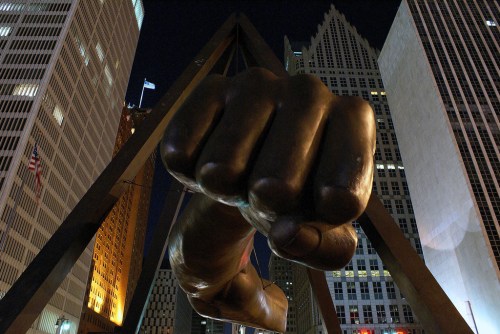
Fist of a Champion – Detroit’s Monument to Joe Louis

Joe Louis 2

Joe Louis 2, photo by buckshot.jones.

Scott writes I simply love this piece of art work. It says so much about the heart and soul, the toughness, about the town and the people who live here and have built this area. Joe Louis Barrow, aka “The Brown Bomber” is one of the all-time great boxers. The 24 x 24 x 11.5 feet Monument to Joe Louis was commissioned by Time Inc. for the City of Detroit to honor Joe Louis. It was created by sculptor Robert Graham and installed at Jefferson Avenue at Woodward, Detroit on October 16, 1986.

Robert Graham’s page on the Joe Louis Memorial says:

The monument is a 24-foot long arm and fist held in balanced suspension from a pyramidal support of bronze poles. Weighing approximately 8,000 lb., it rises 24 feet above a major downtown intersection.

The initial arm was modeled in clay at 14 inches in length. With the aid of a computer, a full-scale steel armature, 24 feet in length, was made and wrapped with wire and covered with clay. The final clay model was divided into eight sections and cast in bronze, then assembled. The pyramid structure was fabricated out of steel, and faced with bronze plates. A tribute to Joe Louis is inscribed on the arm.

Detroit Yes writes in Downtown Montage that he may be the only person in Detroit (other than Scott) who likes the Fist:

So great was Joe Louis that is difficult to measure the historical contribution of this immense figure who, without a close second, is by far the greatest sports figure to ever arise from Detroit and assume center stage on the world theater. It was he who helped shatter the Nazi myth of racial superiority with his dramatic defeat of German champion Max Schmeling during the rise of Nazism. In doing so and then serving his country nobly in the segregated army of World War II, he laid bare the disgraceful hypocrisy that denied Afro American athletes access to the major leagues of American sport, not to mention all Afro Americans who were and are denied the basic birthrights of American citizenship.

He did this with his fists and determination. So it is fitting that he is honored with a place at the center of his hometown with an artwork as powerful and controversial as he was.

You can get a birds eye view of the Joe Louis Memorial on the Absolute Michigan map of Michigan. Also see Monuments of Detroit from the Detroit News, a slideshow of photos of the Fist and a video look at the Joe Louis Fist Statue. For more about Joe Louis, Wikipedia’s Joe Louis entry and the Official site of the Joe Louis Estate.

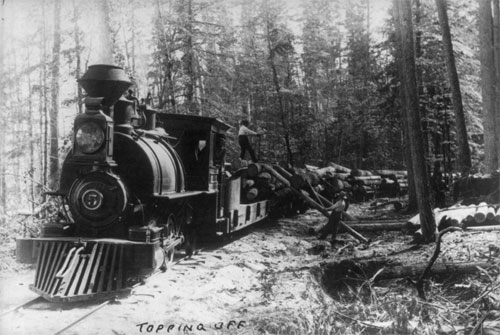
Topping off engine number 5

Topping Off the logging train

Topping Off, photo by William Morrell Harmer

The photo shows some lumbermen loading the last few logs onto a logging train near Cadillac, Michigan somewhere around 1892. While looking around for something about Cadillac and logging, and on the City of Cadillac’s history page, I learned:

The Shay Locomotive was invented in Cadillac by Ephriam Shay in 1878. The Shay Locomotive was one of the first to have the ability to haul logs on uneven terrain, sharp curves, and up steep hills. Shay Locomotives were used throughout the United States between 1880 and 1945.

That sounded promising, so I went over to ShayLocomotives.com and found in their many pictures a photo of one of the surviving Shays – engine no. 5 in Cass, WV (official site. Take a look at that and tell me if you think they’re the same train. Probably not, but still, I’m thinking this one is a Shay.

Wikipedia’s Shay Locomotive entry says that Shays were built by the Lima Locomotive Works of Lima, Ohio. However six Shay Patent locomotives, known as Henderson style Shays, were built by the Michigan Iron Works in Cadillac.

Fiborn Quarry and the Michigan Karst Conservancy

Portal for the locomotives.jpg

Portal for the locomotives, photo by smartee_martee.

In addition to taking some great pictures, Marty does a wonderful job of digging up and presenting background information. Fiborn Quarry was one of the largest early 20th century quarry operations in the Upper Peninsula, and Marty’s Fiborn Quarry set (slideshow) begins:

Fiborn Quarry was created by a partnership of the Duluth, South Shore & Atlantic Railroad in 1904. This small company town was built to house the workers (homes and a boarding house), offer a school and a general store. The operations consisted of the quarry plant, crusher house and steam engine shop.

Marty goes on to tell you about the role of limestone in the history of the UP, and he also links over to the Michigan Karst Conservancy. In addition to extensive information on the history of Fiborn (be sure to click the little photos at the bottom of the pages too), the MKC tells you about karst:

Karst is a term that was first applied to a plateau region of the Dinaric Alps in Yugoslavia. It is now used to describe similar regions throughout the world that have features formed largely by underground drainage. Karst terrains are characterized by caves, steep valleys, sinkholes, and a general lack of surface streams because drainage is underground…

What does this have to do with Michigan, a land literally scoured by glaciers, a land covered with glacial clay, sand and gravel? Surprisingly, Michigan contains some areas of true karst. They are limited in extent, but this rarity increases their interest and importance. There is also considerable variety in Michigan karst areas: gypsum karst is found in Kent and Iosco counties; a significant amount of surface drainage goes underground in Monroe County, and reappears at “blue holes” in Lake Erie; spectacular sinkholes and earth cracks are found in Alpena and Presque Isle counties; and the broad band of outcrops of the Niagara Escarpment in the Upper Peninsula hosts a number of karst sinks, springs and caves.

Exploring the Florida in the Thunder Bay National Marine Sanctuary

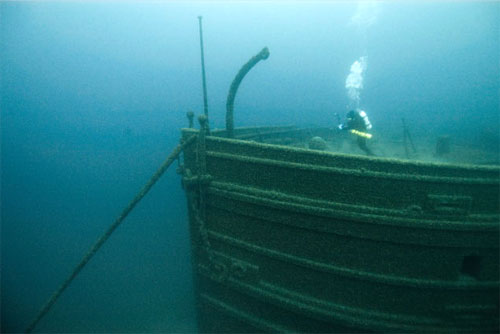
Diver exploring the wreck of the Florida

Exploring the Florida, Thunder Bay National Marine Sanctuary

The Thunder Bay National Marine Sanctuary encompasses almost 450 square miles of Lake Huron’s bottomlands off Alpena. It is the thirteenth national marine sanctuary and was established in 2000 to protect a nationally significant collection of nearly 200 shipwrecks, spanning over a century of Great Lakes shipping history. Thunder Bay is the first Great Lakes sanctuary and also the first to focus solely on a large collection of underwater cultural resources. The headquarters of the Sanctuary is the Great Lakes Maritime Heritage Center in Alpena.

The photo above is one of many awesome underwater photos of the Florida and other shipwrecks that can be viewed in their Fieldwork 2007 Gallery. Seriously, this is cool – go look at it and be sure to click the “slideshow” view at the top left to see the larger sized images.

Dave Swayze’s amazing Great Lakes Shipwrecks File includes information on 4,760 great lakes shipwrecks. It says that on May 21, 1897 in dense fog off False Presque Isle, the 271′ package freighter Florida, one of largest boats on the Great Lakes, collided with one of the few that was larger, the steamer George W. Roby. The Roby rescued her crew, but with a large hole in her starboard side, the Florida sank in just 12 minutes in 250′ of water.

There’s more information on the Thunder Bay National Marine Sanctuary and Underwater Preserve over at Absolute Michigan.

Wyandotte shipbuilding, the Fitzgerald brothers and the launch of the Little Fitz

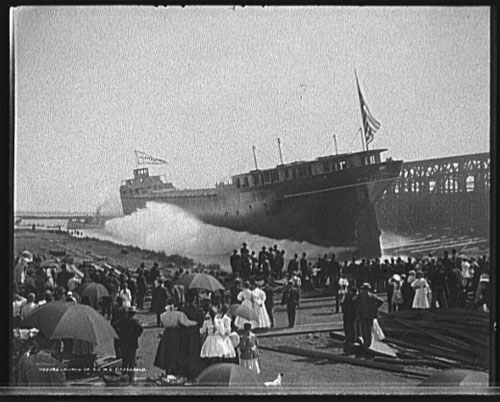
Launch of the W.E. Fitzgerald at Wyandotte

Launch of the S.S. W.E. Fitzgerald at Wyandotte, Detroit Publishing Co.

I have no idea how I ended up at this photo (and why I suddenly feel like Paul Harvey), but here’s what I’ve learned through Boatnerd.com and a forum with a brief article from Boatnerd by Dick Wiklund about the “Little Fitz.”

William and Julia Fitzgerald of Marine City, Michigan sired six sons. The sons were fascinated by the wooden sailing ships and early steamboats on the St. Clair River, and all six became captains of Great Lakes ships. The youngest of these was John Fitzgerald, who started a shipyard in Milwaukee. His son, William E. Fitzgerald, took over the business in the 1890s but died just a few years later. William’s close friend, Captain Dennis Sullivan, built and christened the W.E. Fitzgerald in Wyandotte in his honor in 1906.

The Wyandotte Historical Museum’s history page says that Wyandotte’s shipbuilding industry was started by Eber B. Ward:

Wyandotte produced over 200 ships, varying from small tugs to large steamers and passenger ferries. Under the name of the American Shipbuilding Company the Wyandotte yards flourished. Hulls were constructed in Wyandotte and were taken up the Detroit River to Detroit, Michigan were they were outfitted. Smaller companies such as the E.H.Doyle Hoop & Stave Works(1889)who provided the city’s first electric power, the Regeant Stove Company, the McCord Corp. and the Beals & Selkirk Trunk Company soon made Wyandotte a famous industrial town.

In 1953, the WE Fitzgerald became known as the Little Fitz when the massive freighter named after William’s son was launched. His name, of course, was Edmund Fitzgerald.

The Library of Congress index of Wyandotte photos is heavy ships & shipyards (you may need to go to this page and search for “Wyandotte”). If you’re in the mood for a ton of Great Lakes freighter information (and a little music and “Laker” cooking), head over to Absolute Michigan’s word of the week: Freighter.

The Ultimate Sacrifice

The Ultimate Sacrifice - Black and White

The Ultimate Sacrifice – Black and White, photo by DarrinW.

Darrin took this photo at Veterans Cemetery in Grand Rapids, Michigan. I think it’s a good idea for everyone to take a pause in their activity this weekend to consider the profound sacrifices that so many have made on the behalf of our nation … and also that there are people today making those same sacrifices.

Of the nearly 4000 US Iraq War casualties listed at icasualties.org are 145 Michigan residents from Alpena to Ypsilanti and points in between. Take a moment to read the names listed under Michigan on this page.

I am reminded of a brief comment by former Governor William Milliken in this 2006 WKAR interview where he briefly touched on the war in Iraq, saying he was gravely concerned that Americans are not called upon to sacrifice personally in this war as we have been in past conflicts. Food for thought.

Speaking of WKAR, they are have a pretty cool Michigan Voices from World War II program airing at 7 PM Sunday night (Nov 11). Their web site includes stories shared by veterans – here’s a couple from Michigan WW II veterans and you can add your own story. There’s also a link to The War by Ken Burns on PBS that includes a number of online segments.

The Freep has a number of Detroit area Veteran’s Day observances and we received details on the Detroit Veteran’s Day March held today (Saturday, Nov 10) at noon from Grand Circus Park to Campus Martius. I suppose your local paper has more because there doesn’t seem to be a statewide listing to be found.

You might also appreciate the Michigan Soldiers & Sailors Monument on Michigan in Pictures, photos for “veteran” in the Absolute Michigan pool on Flickr (slideshow), and many of the items at Absolute Michigan keyword veteran including Michigan Veterans and Veterans Day from last year.

100 years of Faygo Pop

Faygo Pop

Faygo Pop, photo by -anna-.

Anna shot this photo of Faygo Orange, Redpop, Black Raspberry, and Rock & Rye – 4 old school Faygo flavors for sure.

I apparently slept through Faygo’s 100th birthday on Sunday and failed to raise a bottle of Michigan’s own in celebration. You can get a timeline and lots of Faygo fun (including recipes – Faygo Rock & Rye Burger Bean Pie anyone?) at Faygo.com. Faygo’s history is easier to read over at the Soda Museum’s Faygo Room that begins:

Ben and Perry Feigenson, formerly bakers in Russia, began Feigenson Brothers Bottling Works on November 4, 1907. Their original flavors, Fruit Punch, Strawberry and Grape, were based upon their own frosting recipes. That is why these, and the flavors they developed later, were (and still are) so unique. They produced the soda one day, closed the factory the next day, loaded the product on a horse drawn wagon, and sold it for three cents or two for a nickel. They and their families lived above the plant. In the winter, when little soda was sold, they supplemented their incomes by selling bread and fish.

Later, when the Feigenson families moved into individual homes, they hired their first employees, bought their second horse and added Lithiated Lemon and Sassafras Soda (Root Beer) to their product line. They began calling the product “pop,” because of the sound made when opening the bottle.

There’s a big old list of Faygo flavors at Wikipedia and you can watch the Faygo Boat Song TV commercial on YouTube. If you want to go really old school, check out The Faygo Kid over at detroitkidshow.com (scroll to the bottom to see the commercial!).

Union City history and the Flood of 1908

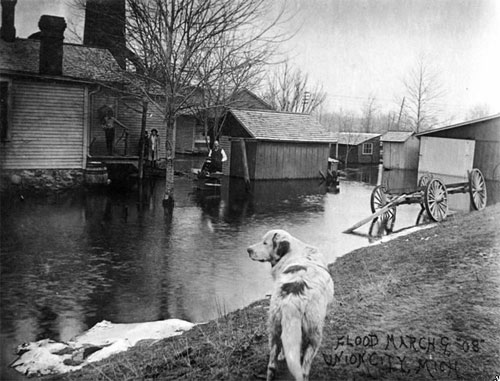
Union City Flood, 1908

Union City 1908 Flood, photo from UC1960

This photo is one of hundreds of historical postcards from Union City, Michigan posted to a site called Footnote to which I was recently referred. The site has an interesting interface and is one of a growing number of sites that try to leverage the power of social networks (and of course clicky-draggy stuff) to provide a richer experience. In Footnote’s case, they’re focusing on history and the result is pretty cool.

Union City is located south of Battle Creek, where the Coldwater River joins the St. Joseph River (I swear I didn’t plan that tie-in!). In an effort to prove that they have everything about everything, Wikipedia has an entry titled Floods in the United States: 1901-2000 which has this to say about the Michigan Flood of March 1908:

In February, snowstorms had deposited a significant snowpack across the region. Then, in early March, heavy rains and warmer conditions set in, setting the stage for a flood. The Kalamazoo River flooded Albion when the Homer Dam broke around 3 p.m. on March 7. By midnight, the bridges surrounding town were underwater. Six buildings in Albion collapsed, which caused over US$125,000 in damage (1908 dollars).

Union City lost its bridge in the flooding – here’s a photo. You have to see this great photo from the same flood in Battle Creek.

Diving the Wreck of the Vienna off Whitefish Point

Vienna - 19

Vienna – 19, photo by mschout.

Global Underwater Explorers page on diving the Vienna says that although extended range divers often use the Vienna as a “blow-off dive because it’s shallow and near shore, it’s also one of the finest wrecks to dive in Michigan’s Upper Peninsula. They write that this 191′ wooden steamer:

…came to her demise the same way that many do in Lake Superior, by collision. On 16 September 1892, she was down bound from Marquette, Michigan, with a load of iron ore. In tow was the schooner Mattie C. Bell. At Whitefish Point, the Vienna met up with the Nipigon. The Nipigon also had schooners in tow. Without warning, the Nipigon suddenly veered and struck the Vienna. Despite the efforts of both crews to save the Vienna, the vessel sank approximately one mile from shore. It was never fully understood why the Nipigon veered off course.

You can get more information about this wreck and others near Whitefish Point including a great photo of the Vienna at the ore docks in Marquette at Nordic Diver’s page on the wreck of the steamer Vienna.

Michael Schout has more photos of diving the Vienna (slideshow) and from diving more Great Lakes wrecks including the William Young, Panther, Minneapolis, Northwest, Sandusky and the Eber Ward in his very cool Diving set.

Much more shipwreck info (along with another great photo from Michael) can be found at the Absolute Michigan word of the week: Shipwreck!