Pickerel Spears, Ice Shanties and the Fishing History of Saginaw Bay

Saginaw Bay Ice Shanty c.1925

Saginaw Bay Ice Shanty c.1925, photo by oldog_oltrix.

Larry writes that this photo was taken by his grandfather at his ice shanty on Saginaw Bay (probably near Bay Park) in the mid-1920s. The 6′ bar between the shovel and the axe is a “spud” used with the axe to make the hole in the hole in ice and the pole coming from the top of the shanty is likely a “pickerel spear”. The This is one of the photos in his Oldog’s OLD PHOTOS set, and it also appears in the Michigan Thumb Memories group.

Over on Michigan Sportsman, Capt. Dan Manyen has written a nice little article titled The Fishing History of the Saginaw Bay. In it, he shares a number of old photos and provides a nice overview of the last few centuries of fishing on what I’m going to guess is Michigan’s largest bay. Capt. Manyen writes that walleye was mis-identified by many back then as pickerel and sold in great numbers to both local fish market outlets and buyers from the eastern states. He says that for many in the area, the burgeoning auto industry…

…did not stop or ease the pain of the Great Depression during this time. What did for many though, including my own Grandfather, was the plentiful fishing and hunting resources the Bay area offered. When Grandpa couldn’t get a job unloading the (Bean Boat) as he called it for .50 cents a day, he’d be out hunting or fishing for a meal for his family. Grandpa talked often about spending all winter out on the ice on Saginaw Bay in a (Pickerel Shanty) spearing pickerel.

I’m not sure where you might want to take this, so here’s the Wikipedia entries for Pickerel, Walleye and Saginaw Bay. You might also be interested in the Saginaw Bay Watershed Initiative Network, the Saginaw Bay Fishing Report and a more recent photo of ice fishing on Saginaw Bay.

Also see Saginaw Bay on Absolute Michigan’s Map of Michigan.
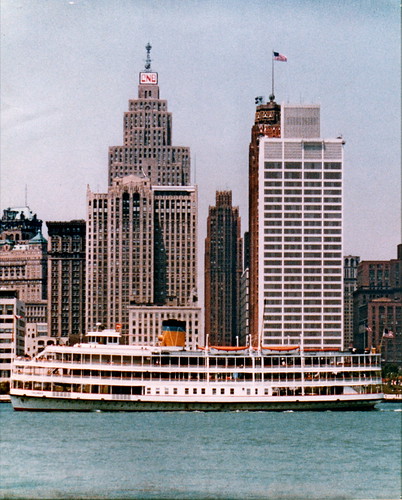
Oh, There Were Once Great Ships On Our Mighty River!

Oh, There Were Once Great Ships On Our Mighty River!

Oh, There Were Once Great Ships On Our Mighty River!, photo by “CAVE CANEM”.
CAVE CANEM writes…

So there I was… (On Black)

rutting through some boxes for some tax documents and BAM, look what I found!

If grew you up in Detroit between 1910 and the early eighties this should make you smile. This is an Detroit icon for all us kids that had to run the concrete jungle during the dog days summer. As I remember there were few things better than to take that first step onto the boat full of excitement waiting for those big steam monsters to start up, or catching that breeze in the face, any hot August morning while traveling the island. To be honest I can still feel that gentle wind as I ran what seemed like endless decks, it’s wonderful. Cruising to and from Bob-lo was the perfect way to cap off the season before the return of school and gray skys.

This is the S.S Columbia one of “twin steam boats” made for the Detroit, Windsor, and Belle Isle Ferry Company to cruise the Detroit River in-between the ice flows. I remember it was just cool to sit and watch them lazily make their way up and down the any day you were downtown, or to hear the voices bouncing off the wateras a ship full of revelers lost themselves on hot night while I caught a breeze with pops. If I miss anything it’s the late afternoon picnics with my family we had on that amusement island (Mangos! who knew?). This was one the best things about being in the city as a kid it saddens to think me my friends will never treat their children to such a day.

Oh well all good things come to an end….
The question is when will the bad things?

Probably the only link you really need is Bob-Lo Boats: a Tribute to the Bob-Lo Steamers, but lest I look too lazy, here’s the S.S. Columbia in Wikipedia which includes a 1905 photo of the Steamer Columbia on the Detroit River. I also found a 1959 video from the deck of either the Columbia or the Ste. Clair on YouTube.

The Columbia is now on the Hudson river and the S.S. Columbia Project is seeking to restore the vessel. Be sure to have a look at their gallery of historic photos. There’s a group of folks working to restore the S.S. Ste. Clair which is docked most of the year at Tricentennial Park in Detroit – get all the details and more about the boat at bobloboat.com!

Trumpeter Swan and the Birds of Michigan

trumpeter swan

trumpeter swan, photo by tobibritsch.

On the Michigan DNR’s page on the trumpeter swan, says that at 25-35 pounds when fully grown, the trumpeter swan is the world’s largest waterfowl with a wingspan of nearly 8′ and that:

Historically, trumpeter swans were most likely abundant throughout the Great Lakes region, even in the southern Michigan marshlands. On his travels along the Detroit River in 1701, Cadillac compared the abundance of swans to lilies among the rushes. However, with the settlement of America, the populations of trumpeters plummeted. Beginning in the late 1800s, European settlers cleared the land, draining and filling important marsh habitat, and market hunters took swans for their fine down and quills. By 1933, only 66 trumpeter swans remained in the continental United States, mainly in remote parts of the Rocky Mountains and Alaska. Nearly 100 years passed before trumpeter swans were seen again in the Michigan wilds.

In the 1980s Michigan began a swan reintroduction program as part of the North American Restoration Plan. While the program has been a success and dramatically increased the number of nesting pairs, there are some who question whether these birds did in fact historically nest in Michigan. Nuthatch at the excellent Michigan blog bootstrap analysis presents the case in with great links in swans, take 2. It’s something that merits consideration as swans are pretty rough on aquatic habitats!

For more on these birds, check out The Trumpeter Swan Society. Also, the UM Animal Diversity Web Cygnus buccinator (trumpeter swan) listing has some photos but unfortunately no sounds. Wikipedia’s Trumpeter Swan entry also includes creative commons photos of trumpeter swans for use and download.

The photographer has a cool set of waterbird photos (slideshow) and this photo is in the Birds of Michigan group on Flickr. It’s for sharing photos of birds found anywhere in the State of Michigan and they say that if you cannot identify the bird, post it to the group and likely someone there can!

The U.P. 200 & Midnight Run Sled Dog Races

P1010050c

P1010050c, photo by Dan & Mary.

The web site for the annual UP 200 / Midnight Run and Jack Pine 30 sled dog races explains that 1988 a group of mushers and others began to discuss a dogsled race in the Upper Peninsula.

When the race finally began to take shape, the trail encompassed Marquette, Alger, and Delta counties, and ran from Marquette to Chatham, Rapid River, Escanaba, Gwinn, and back to Marquette…

…and on a snowy Friday evening in February of 1990, the dedication and perseverance finally paid off. To the cheers of 10,000 spectators, the mushers of the first UP 200 Sled Dog Championship ten dog race sped down Washington street in Marquette into the night. At midnight, in the community of Chatham the first Midnight Run racers departed on the long, cold journey towards Escanaba. These racers went on their way into history, with many “tails of the trails” for the years to come.

The UP200 and Midnight Run have remained successful events each year and they take place this weekend (Feb 15-17) and you can get all the details (including the trail map and Breakaway’s Blog at the link above!

Mary writes that this photo shows a team is approaching the crossing at Forest Highway 13, heading west to the next checkpoint at Munising/Wetmore, MI. It’s part of a set of UP 200 / Midnight Run dogsled races 2007 photos (slideshow)

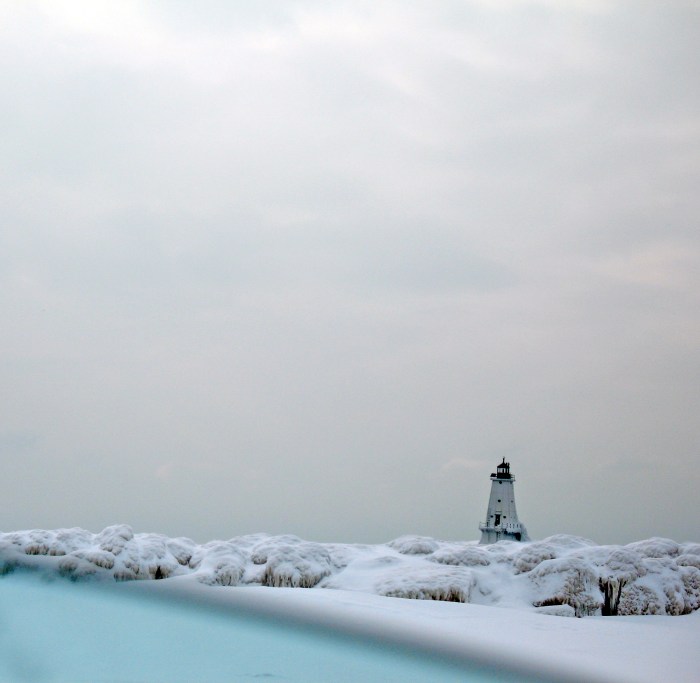
Winter Blues at the Ludington North Breakwater Light

Winter Blues by Sumply Dianne

Winter Blues, photo by simply, Diann.

Diann writes What I’m really wondering is whether or not its a good idea to edit out the blue shadows that often show up in winter shots when the sun is behind the camera. She offers this shot for comparison and discussion. She also has a bunch more photos of Ludington’s lighthouse, many in the crashing seas that are referred to below! (and usually uploads her photos at desktop wallpaper size!)

Terry Pepper’s page on the Ludington North Breakwater Light has a really fascinating history of this lighthouse at the mouth of the Pere Marquette river. A lighthouse was established here in 1870 to aid in the navigation of the lumber ships that served the mills of Ludington and Pepper’s article details the trials endured by the keeper after Congress appropriated funds for the light but none for his dwelling (sound familiar?). Pepper goes on to detail the unique structure of the current North Pier Light:

Over the summer of 1924, a unique structure took shape at the end of the North Breakwater. The main tower, fabricated of steel plates over an internal steel skeleton, took the form of a four-sided pyramidal tower with four round porthole windows on each of the three decks within. With plans calling for the installation of an air diaphragm fog signal operated by an electrically powered compressor, there was no need for a large fog signal building, and thus the signal building took the form of a relatively small structure integrated into the base of the landward side of the main tower. In order to help protect the structure from the force of waves crashing across the breakwater, the concrete foundation at the base of the structure was formed with angled surfaces designed to deflect the force of wave action up and away from the building. The white painted tower was capped by a square gallery and an octagonal iron lantern installed at its center.

There’s great historical photos at the link above and if you’re a lighthouse buff, I can’t recommend Terry Pepper’s site enough. His pages on lighthouses of Michigan and the rest of the Great Lakes are the best there is.

Although Wikipedia’s entry on the Ludington Light is downright feeble, it does link to a nice set of videos of the Ludington lighthouse. There’s also this cool video of the lighthouse.

I’ve also added the Ludington Light to Absolute Michigan’s Map of Michigan.

Thru the Woods on an Aero Sleigh

thru the woods

thru the woods, photo by litchard.

I’d never heard of the Wing Aero Sleigh – designed & built by Blain Wing in St. Ignace, Michigan in the 1940s – but Milton has a bunch of cool photos of the Aero Sleigh in action (slideshow)

There’s some information about how these were used from the Drummond Island Yacht Haven.

He uploaded the photos pretty large so be sure to click through check them out!

William Leabs, Jr. and Michigan’s Black History

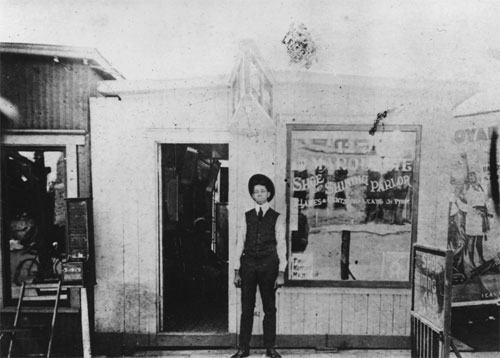
William Leabs, Jr. at his Marquette Shoe Shining Parlor

William Leabs, Jr., photo courtesy the Archives of Michigan

The description from the Archives of Michigan begins:

Here, we see William Leabs, Jr., an African American businessman. He’s standing in front of his store, the Marquette Shoe Shining Parlor (view larger). This business is listed in the Lansing City Directories of 1902 and 1904, and the photo presumably dates from about that same time frame.

Lansing’s African American heritage is as old as the city itself. Lansing’s first black resident of record is James Little, a freed slave from New York state. Little came to Lansing in 1847 (the year of the city’s founding) and started a farm.

Lansing’s black population increased slowly during the remainder of the 19th Century. Many black settlers came from other Northern states and from the upper South. Some were Canadians descended from escaped slaves. Others came from elsewhere in Michigan, with the majority of those hailing from Cass County (Freed slave communities had been established there before the Civil War.).

You can read more at the Image of the Month for February 2008 and also in Robert Garrett’s article The Birth and Death of Lansing’s Black Neighborhoods in the Lansing City Pulse.

February is Black History Month in Michigan and you can get a ton more articles from Absolute Michigan’s Black History in Michigan.

The Grand Marais Lifesaving Station

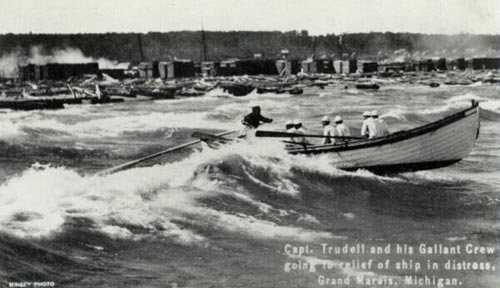
Captain Trudell and his crew from the Grand Marais Lifesaving Station

Captain Trudell and his Gallant Crew, courtesy Archives of Michigan

Something about the weather of the last few days has made me think about what an amazingly tough job members of the US Lifesaving Service must have had. This photo is of Captain Trudell and his Gallant Crew going to relief ship in distress, Grand Marais, Michigan (c. 1910). Anyone who has ever been to Grand Marais during inclement weather will know that those rollers they’re stroking through for a photo op are mere ripples compared to what they saw when they were really needed.

The Grand Marais Lighthouse page on Terry Pepper’s Seeing the Light has a brief bit about the station:

With traffic exploding along the south shore, the frequency of maritime accidents increased proportionally. To help guard the safety of mariners, 1898 also saw the beginning of construction of a life-saving station at the foot of the west pier. On its completion the following year, the station was considered one of the finest in all of the Great Lakes, boasting 2 surf boats, a 34-foot self-righting life boat, and a full complement of beach apparatus.

There’s a nice photo of the entirety of the Grand Marais complex from 1910, and you can see a few more photos at the Archives including a view of the station and the track to launch the surfboats, a Captain Trudell & his crew at attention in front of the station and the Grand Marais Harbor Range with the station in the background. The awesome historic photo gallery from the Grand Marais Chamber of Commerce has an aerial view of the complex, a photo of the station on July 4, 1927 and some other photos of maritime history.

The lifesaving station was replaced in 1938 by a US Coast Guard Station, which was deactivated in 1981 and transfered to the Pictured Rocks National Lakeshore for use as a ranger station.

The first Capitol Building in Michigan was here

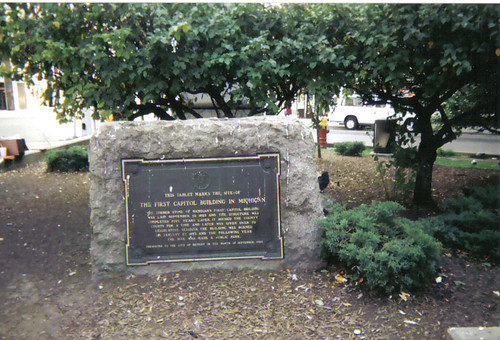
The first Capitol Building in Michigan was here

The first Capitol Building in Michigan was here, photo by femaletrumpet02.

Lauren writes: Here is the historical marker for the first capitol building in the state of Michigan, hence the name for Capitol Park.

January 26 is Michigan’s Statehood Day, our state’s birthday – 171 years since the day Michigan joined the Union as the nation’s 26th state on January 26, 1837. If you’re in Lansing, you might drop by the Michigan Historical Museum for the Statehood Day Celebration. There’s a lot of special activities and it’s the one time of year that Michigan’s first constitution is displayed for the public. (pdf of the text of Michigan’s Constitution)

I spent a lot of time looking for some grand online commemoration of Michigan’s founding, but the site of the state’s first capitol isn’t even an official state historic marker and Capitol Park appears to be an afterthought in the annals of our state’s history.

Anyway, Happy Birthday, Michigan. I love you, pigeon poop and all.

And No One Showed

And No One Showed

And No One Showed, photo by Amy Palomar.

Music Hall is located in Detroit’s Theatre District. On the History page at the Music Hall Center for the Performing Arts they have some cool old photos and say:

Since Matilda Dodge Wilson opened Music Hall’s doors in 1928, our intimate downtown venue has been a significant player in Detroit’s performing arts sector. As the last remaining legitimate stage theatre, Music Hall is the only Detroit venue built for the primary purpose of presenting live performances. We have been home to the Detroit Symphony Orchestra, Michigan Opera Theatre, one of the nation’s first Cinerama screens, and a wide variety of quality performances that embody the diverse cultures of the world.

They seem to have the best schedule on their MySpace at myspace.com/musichalldetroit – yes, even 80 year old theaters have MySpaces – and you can see the location of Music Hall on the Absolute Michigan Map of Michigan.