Propeller and some Henry Ford HDR

Propeller

Propeller, photo by country_boy_shane.

Shane says …if you view this large, you can see many signatures on the right-most blade. Talk about neat stuff you can find with your camera! Here it is large and on black.

He has a set of photos from his trip to the Henry Ford Museum and he went with several other photographers, most of whom were shooting HDR. See their collected work in this very cool slideshow.

Here’s the web site for The Henry Ford Museum & Greenfield Village.

Michigan March Madness: Crisler Arena at the University of Michigan

Gophers at Crisler Arena by B Cohen

Gophers at Crisler Arena, photo by B Cohen

Crisler Arena at the University of Michigan hosts men’s basketball, women’s basketball, men’s gymnastics and women’s gymnastics. It opened in 1967, was named for Fritz Crisler, legendary UM football coach and athletic director and designed by Dan Dworsky. Wikipedia’s page on Crisler Arena says that is is often called “The House that Cazzie Built,” a reference to superstar Cazzie Russell. Russell led UM to Big Ten titles ’64-66 and his popularity caused the team’s fanbase to outgrow Yost Fieldhouse. The arena seats almost 14,000 and you can read more about it at the Crisler Arena page at MGOBLUE.com.

Wikipedia’s entry for the University of Michigan Wolverines men’s basketball says:

The Wolverines have won 12 Big Ten regular-season conference titles, as well as the inaugural Big Ten Tournament in 1998, which it later forfeited due to NCAA violations. The team has appeared in the NCAA Final Four on six occasions (1964, 1965, 1976, 1989, 1992* and 1993*) and won the national championship in 1989 under Steve Fisher. The program later forfeited its 1992 and 1993 Final Four appearances due to NCAA violations. Other notable players who played for Michigan include Daniel Horton, Bernard Robinson, Gary Grant, Terry Mills, Glen Rice, Jalen Rose, Rumeal Robinson, Jamal Crawford, Juwan Howard, Chris Webber, Cazzie Russell, and Mark Hughes. (I’ll  add Robert Traylor, Rudy Tomjanovich and Phil Hubbard to that list)

More items of interest for you include a biggee-sized view from up high, this photoset titled Paging the Fab Five and a couple of photos of Crisler Arena from the Bentley Historical Library.

More Michpics Michigan March Madness!

Native American Maple Sugaring: One Drip at a Time

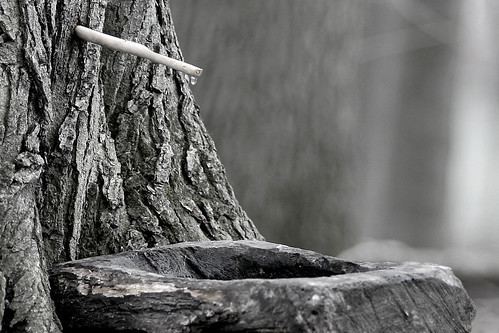
One Drip at a Time

One Drip at a Time, photo by Graphic Knight.

Eric took this photo of an American Indian demonstration on how maple trees were tapped for collecting the sap to make maple syrup at the Kensington Metropark Farm Learning Center. He also has a couple photos of them boiling the say to make maple syrup.

It’s said that there was a time when the sap of the maple tree was as thick and sweet as honey. More practical tales are told of how Nanahboozhoo taught the making of maple sugar:

Then Nanahboozhoo gave the Indians a bucket made of Birch bark, and a stone tapping-gouge with which to make holes in the tree-trunks; and he shaped for them some Cedar spiles or little spouts, to put in the holes, and through which the sap might run from the trees into buckets. He told them, too, that they must build great fireplaces in the woods near the Maple groves, and when the buckets were full of sap, they must pour it into their kettles, and boil it down. And the amount of Sugar they might boil each Spring would depend on the number of Cedar spiles and Birch bark buckets they made during the Winter.

You can learn about a traditional Native American sugarbush from NativeTech and take a look inside the book Ininatig’s Gift of Sugar: Traditional Native Sugarmaking.

Also be sure to check out The Cycle of Sweetness: From Sap to Maple Syrup on Michigan in Pictures for more photos of this fascinating process.

Wayne County Courthouse

Wayne County Courthouse by St. Laurent Photography

Wayne County Courthouse, photo by St. Laurent Photography

This photo is from Alanna’s Detroit 03.14.08 set that she took while on an Exposure.Detroit outing downtown last Friday evening (slideshow).

Wikipedia’s Wayne County Courthouse entry says that Detroit architect John Scott designed the five story, copper, granite, and stone building which was completed in 1902. The entry adds that it may be the nation’s finest surviving example of Roman Baroque architecture (and has a gallery of photos illustrating that claim). Along with a photo from the Library of Congress of the courthouse taken around 1905, the Wayne County Courthouse page in the National Park Service’s Detroit Historical Register Tour relates that:

The Courthouse served as the center of Wayne County government for the first half of 20th century, holding most of its offices, court sessions, and public hearings. It was here that in 1906 roads commissioner Henry Ford reported to work; twenty years later, Clarence Darrow used one of its courtrooms to defend a play charged with obscenity. After the 1950s, however, most government functions moved to a new building several blocks away.

Here’s a close-up satellite view of the Wayne County Courthouse location on the Absolute Michigan Map of Michigan.

Michigan conservationist Genevieve Gillette

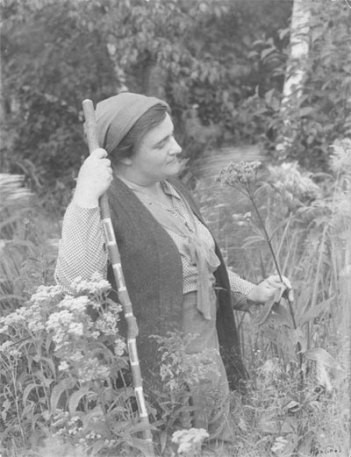
Michigan conservationist Genevieve Gillette

Genevieve Gillette, photo courtesy Archives of Michigan

In honor of Women’s History Month, the Archives of Michigan is highlighting conservationist Genevieve Gillette, one of the prime movers in the creation of Michigan’s State Park system. Gillette was born in 1898 and in 1920 she became the first woman to earn a degree in Landscape Architecture from the Michigan Agricultural College. Over the course of her lifetime, the number of Michigan state parks increased from one to ninety-six.

She was instrumental in creating P.J. Hoffmaster State Park near Muskegon, and the park includes the E. Genevieve Gillette Nature Center (Michigan’s Sand Dune Interpretive Center). Gillette was one of the inaugural inductees of the Michigan Walk of Fame in 2006 and is also in the Michigan Women’s Hall of Fame. Also see Emma Genevieve Gillette in Wikipedia.

Michigan March Madness: Eastern Michigan University’s Convocation Center

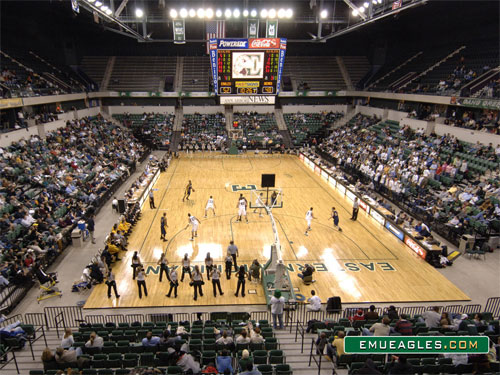
Eastern Michigan University Convocation Center

Convocation Center, photo courtesy Eastern Michigan University

From Wikipedia’s Eastern Michigan University entry I learned that the school was founded in Ypsilanti in 1849 as Michigan State Normal School, the first normal school created outside the original 13 colonies. It became the Michigan State Normal College in 1899, Eastern Michigan College in 1956 and ultimately Eastern Michigan University in 1959. In 1991, the school become one of the first to abandon a Native American mascot (the Hurons) for the current name of Eagles. In 1991, when EMU qualified for the NCAA tournament for the first time in school history, announcer Brent Musburger referred to the team on-air as the “No-Names” and there is apparently still a campaign to restore the Huron. EMU is in the Mid-American Conference (MAC) and:

Eastern’s men’s basketball team has appeared in four NCAA Division I tournaments, and have a 3-4 record, tied for third best among Michigan colleges. In the 1996 Men’s Basketball Tournament, Eastern Michigan defeated the Duke Blue Devils in the opening round; it would be the Blue Devils’ last first- or second-round defeat until 2007, when they were upended by VCU in the opening round.

EMU plays their games at Convocation Center, a nearly 205,000 sq ft structure that was completed in 1998. Here’s a photo of the arena dressed up for convocation. They don’t list what programs use the facility, but here’s a link to their women’s basketball (2008 MAC champions) and men’s basketball programs. Basketball Reference lists a number of notable EMU grads in the NBA including Earl Boynkins.

More Michpics Michigan March Madness.

Exploring the Masonic Temple of Detroit

Untitled by zakzorah

Untitled, photo by zakzorah

My original thought was to remind folks of tonight’s Exposure.Detroit show at the Bean & Leaf Cafe in Royal Oak.

This photo is part of Cris’s Masonic Temple set and you can see more photos from the March 1, 2008 Exposure.Detroit trip to the Masonic Temple of Detroit (view slideshow). One of the photos linked to the History of the Masonic Temple, which says (in part):

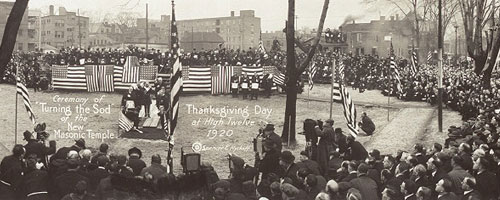
It was on Thanksgiving day in 1920 that the sod was first turned. And with many more months of planning and labor ahead, the Craft was at work on this undertaking of worldwide interest. A great host stood in Cass Park for this occasion and flowed in human currents up and down Second Boulevard and what was then Bagg Street. It is certain that no man will forget the occasion.

George Washington’s own working tools, brought from his Virginia Lodge, were employed. The first mortar was spread with the same trowel that our first president used in the corner stone laying of the National Capitol. On September 18, 1922, thousands of Master Masons and their families witnessed the corner stone of the Masonic Temple of Detroit being placed into position.

That jogged my memory and I recalled seeing the photo below of the “Turning of the Sod” ceremony in the Library of Congress from Thanksgiving Day, 1920. There’s also an exterior view of the completed Detroit Masonic Temple from 1922.

Turning of the Sod ceremony at the Detroit Masonic Temple

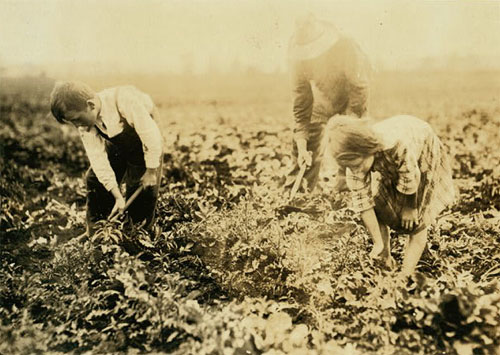
Corunna, Michigan beet farmers and the photography of Lewis Wickes Hine

Corunna, Michigan beet farmers by Lewis Wickes Hine

Corunna, Michigan beet farmers, photo by Lewis Wickes Hine

This photo from the Library of Congress from July 17, 1917 is captioned: Jo Durco. This man, his wife and two children, Mary 8 years, Tony 10 years, do all the work on a large plot of beets. They are blocking and thinning now. Location: Corunna, Michigan / L.W. Hine. Here are several more from Hine’s visit to Corunna.

Not too many of Hine’s 5000 photos in the Library of Congress (hit “Preview” to see thumbnails) are from Michigan, but I figured a tiny opening was all that was required to introduce the work of one of this country’s truly legendary portrait photographers.

You can read more about Hine in Wikipedia, search the National Child Labor Committee’s collection at the Library of Congress and view some selected photos of child laborers from the collection at The History Place. There’s a few videos on YouTube – I thought this one titled Lewis Hine: Taking a Stand Against Child Labor was by far the most informative, relating details of how Hine gained access to closed factories and other aspects of his “sociological photography”.

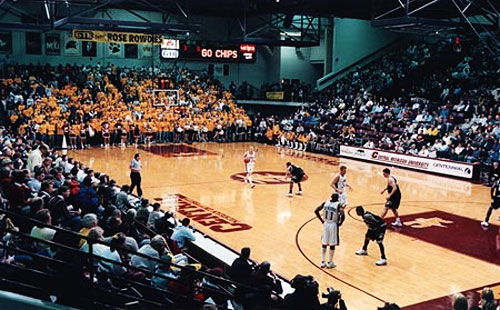
Michigan March Madness: Rose Arena at Central Michigan University

Rose Arena at Central Michigan University

Rose Arena, photo by CMU Sports Information

I noticed that March has 5 Saturdays this year and that Michigan has 5 NCAA Division I schools. Seemed like a plan to feature the basketball arenas of all five schools in honor of March Madness. I decided to feature them in alphabetical order, so we begin with Central Michigan University’s Rose Arena, home of the CMU Chippewas men’s basketball, women’s basketball, volleyball, wrestling and gymnastics programs.

The Daniel P. Rose Center (commonly called Rose Arena) is a 5,200-seat arena that opened in 1975. The Chippewas play on a wooden court was used only once prior to CMU’s purchase — for the 1986 NBA All-Star Game. CMU’s media kit says:

Since its opening in 1973, Rose Arena has been the site of two women’s championships and four men’s championships. In 1980, Rose was the site of the national AIAW Division I National Championships (at the time, the equivalent of the men’s NCAA Tournament). And, in 1984, Rose hosted the first round of the women’s NCAA Tournament. Rose has also been the site of the Michigan High School Athletic Association’s girls basketball finals since 1997.

The Rose Rowdies are right on top of the action in the east end zone. A true “sixth man,” this group is an intimidating force for opposing teams. Their chants and cheers create an intense, enthusiastic atmosphere.

Wikipedia’s entry for the Daniel P. Rose Center has a few photos and you might be interested in NBA players who played at CMU and the CMU Sports Hall of Fame. NCAA Men’s Division I Tournament bids by school on Wikipedia says Central has 4 NCAA Tourney appearances with the last being 2003 when Chris Kaman led the Chips to an upset over Creighton before being dispatched by Duke.

The other Division I schools are EMU, MSU, UM & WSU and if you have a cool photo of one of them, post a link below or send an email. Likewise, any links to related Rose Arena / Central Michigan University stuff would be welcome!

More Michpics Michigan March Madness.

Catch of the Day: Archives of Michigan at Flickr

Fly fisherman with Brown Trout

Fly fisherman with Brown Trout, photo by Photos from the Archives of Michigan.

The photo is captioned Unidentified man holding a brown trout caught on a fly. Location is somewhere in northern Michigan, c. 1930. They have several more Michigan fishing photos including one of Gov. George Romney releasing the first Atlantic Salmon into the Great Lakes in the early 1960s.

View more images from the Archives of Michigan on their Flickr page and also at seekingmichigan.org. Learn more about the Archives at archivesofmichigan.org.