Linden Mills on the Shiawassee River

Linden Mill, photo by Patrick T Power

MichMarkers.com has the text from the historical marker at Linden Mills in the village Linden (also a map).

The Linden Mills were a vital source of this village’s economic growth. The first mill, located on land granted to Consider Warner, was used to cut lumber. From 1845-1850 Seth Sadler and Samuel W. Warren, local residents, erected both a saw and grist mill. Operating along with the earlier facility, this complex was called the Linden Mills. The grist mill continued to function for over a century until the machinery was dismantled and sold at auction in 1956. The village then purchased the building for municipal offices and a public Library.

Today the mill is the site of the Linden Mills Historical Museum.

Edsel

Big Rear Edsel (IMGP2057h)

Big Rear Edsel (IMGP2057h), photo by norjam8.

September 4, 1957: It’s E-day, as Ford Motor Company introduces its newest make, the Edsel.

In an industry celebrated for its spectacular failures, the Edsel still takes the cake. Although as mechanically sound as other Ford products, the car was criticized from Day One for being too ugly, too expensive and vastly overhyped.
Short, Unhappy Life of the Edsel, WIRED

The Edsel was named for Henry Ford’s son Edsel Bryant Ford, president of Ford Motor Company from 1919 to 1943. Edsel was responsible for making the design & styling of automobiles a key consideration at Ford in their manufacture before he died in 1943 at the age of 49. (also see this great bio of Edsel Ford)

While Edsel was never a very popular name (peaking at 400th behind names like Kermit, Buford and Elvin in 1927), Edsel Agonistes in TIME Magazine says that a quick check of demographic records suggests that a convention of Americans first-named Edsel could be held in a hotel linen closet. Why?

The Edsel had been frantically ballyhooed for months ahead of its arrival with a new kind of highly scientific marketing, an alchemical blend of psychology, mass media and old-fashioned hucksterism. Call it the iEdsel. By the time the silk was pulled off the Edsel in hundreds of showrooms around the country, people were panting to see their automotive deliverance, the plutonium-powered, pancake-making supercar they’d been promised. What they saw was a large, relatively expensive, curiously styled Mercury–curious insofar as the vertical grille looked like a midwife’s view of labor and delivery.

A thorough article in Failure Magazine about the Edsel relates how the Edsel drew scorn from reviewers as “an Oldsmobile sucking a lemon” and “a Pontiac pushing a toilet seat” and nowhere near the forecast sales. If you click through, you’ll see that it was impacted by the same faulty assumptions that have lots full of SUVs today. You can get 1000% of the minimum RDA of Edsel at edsel.com.

Norm has some sweet Edsel photos in his Rusty Cars & Trucks set (slideshow). You can find even more in the Edsel group and some of my friends have some pretty sweet Edsel photos too!

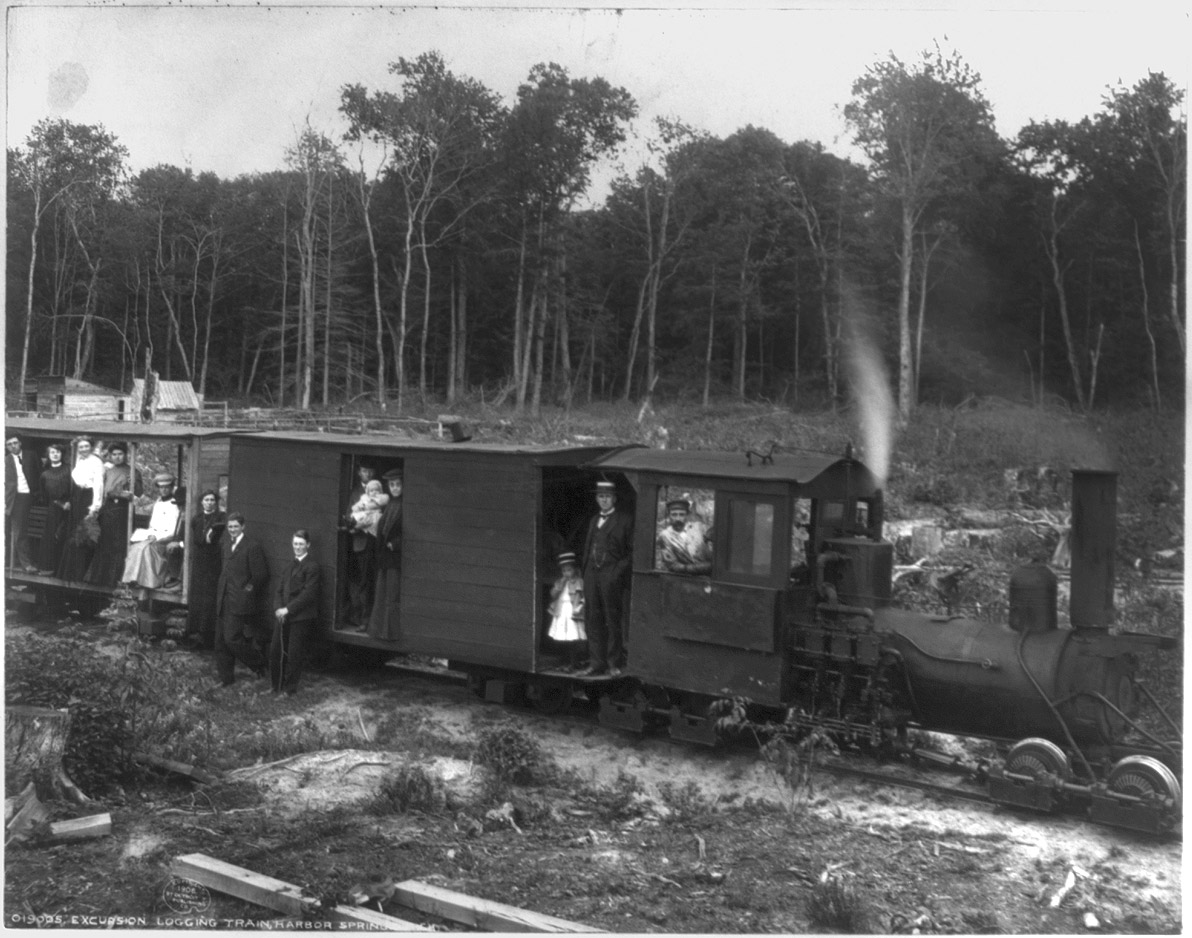
Michigan Logging Train Excursion

Excursion Logging Train, Harbor Springs, photo from Detroit Publishing Co., c1906 (at the Library of Congress)

I noticed that the Newaygo Logging Festival (Eventful link w/ map) happens this weekend. Several recent conversations and excursions of my own have driven home how profoundly the logging industry has shaped Michigan. Like miners, the timber trade roamed from river mouth to natural harbor up and down our Great Lake shoreline, into connected lakes and with the coming of the railroad, across the entire Lower & Upper Peninsulas.

At every stop, when the trees were gone, the land was left cleared and ready for villages and farms. Many of those working in the timber trade turned to farming and town building, and the names of the founders of these towns (and the owners of the dry goods stores) were often the names of the principals of the lumber companies.

Over Labor Day Weekend, I think it would be neat if Michigan were to somehow remember and honor the role of logging and loggers played in creating our state.

…and when it’s not such a lovely, last weekend of summer out there, be sure to check out some Michigan lumbering history and this really cool collection of Michigan logging photos from MichiganEpic.org.

Seriously, these logging photos are great!

Michigan Lake Monsters, Sea Serpents & Serendipity

at Mackinac

at Mackinac :: a composite from -3 and -43 by Emery Co Photo

Last night I was looking for Creative Commons photos* with the appropriate license of the Mackinac Bridge so I could photoshop up a little something for Weird Wednesday: Michigan Sea Monsters (be sure to go back and read this!). I love it when the last Wednesday of the month rolls around as I get a chance to indulge my love of fooling with Photoshop. I was especially fired up as this month’s feature from Weird Michigan by Linda S. Godfrey because it was the feature that I had hoped to run last year as the debut of Weird Wednesdays on Absolute Michigan.

In my search, I saw this photo of the Bridge and thought “Now that looks cool & misty.” Then I came upon this photo of a rock and said “Sea serpent ahoy!” The coolest part was that both photos were taken by Emery Co Photo (emerycophoto.com). I contacted her and she graciously allowed me to use them.

Hope you all get some time on the water this weekend and that everyone remembers that on the list of things we should be worrying about, sea serpents in Michigan come in somewhere around #23,432,555. ;)

*That would be the Attribution-ShareAlike Creative Commons license. There are also a number of people in the Absolute Michigan pool who have told me that they are OK with me manipulating their photos for features on Absolute Michigan.

51st Annual Mackinac Bridge Walk

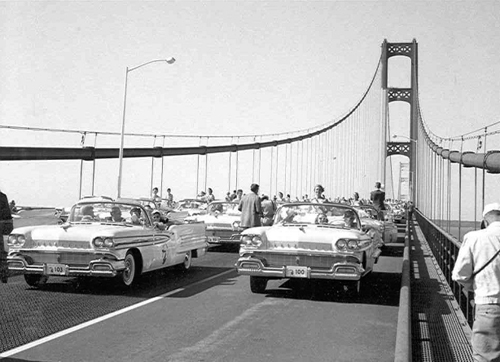
Mackinac Bridge Opening

While this year’s annual Labor Day walk across the Mackinac Bridge isn’t getting nearly the fanfare of last year’s 50th anniversary walk across the Mighty Mac, it’s still the one day each year that you can walk across Michigan’s engineering wonder.

The photo above is from the Opening Ceremony gallery at the Mackinac Bridge Authority web site where you can also find a Bridge Walk gallery and more information about the bridge. For a ton more photos and stories about the Mackinac Bridge, click the button below!

The Mackinac Bridge

The Fabulous Fox Theater of Detroit

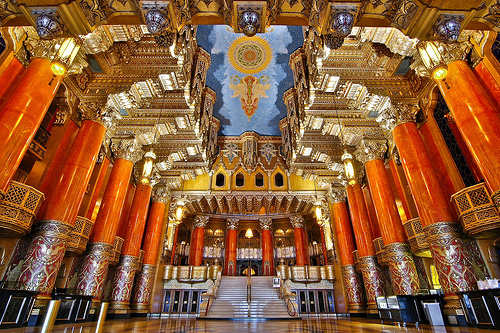
Fox Theatre Detroit

The Fabulous Fox Theater of Detroit, photo by SNWEB.ORG Photography

Wikipedia’s Fox Theatre (Detroit) entry says that Detroit’s Fox is the largest of the 28 Theaters built by movie mogul and 20th Century Fox founder William Fox (or purchased by his company):

…it was the first movie palace to have live sound. The architect, C. Howard Crane, designed a lavish interior blend of Burmese, Chinese, Indian and Persian motifs. There are three levels of seating, the Main Floor above the orchestra pit, the Mezzanine, and the Gallery (balcony). The exterior of the attached 10-story building features an Art Deco facade, which at night is illuminated and can be seen for several blocks.

The Fox was Detroit’s premier movie palace for decades, but by the 1970s it was a shadow of itself, showing horror and Kung fu movies to sparse audiences. In 1988, new owners Mike and Marian Ilitch conducted a $12 million renovation by its new owners which restored the theater to its former glory as Detroit’s premier venue.

Detroit’s historic Fox Theatre from the Detroit News has some great historical photos and details some of the amazing materials utilized. Those red columns, for example, are solid marble and each apparently holds a jeweled figure representing various Asiatic Gods and the lobby held the largest wool rug ever made in the US.

You can see a whole lot more photos of this amazing structure in a Flickr search for Fox Theatre Detroit (slideshow) and you can purchase the photo above at snweb.org.

Here’s a link to the official site for the Fox Theatre (where you can order tickets to Broadway and other shows) and here’s the Fox Theatre on the Absolute Michigan Map.

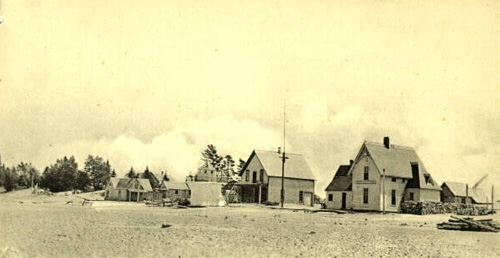
Vermilion Point and the Vermillion Life Saving Station

Vermilion Bunkhouse, photo by Odalaigh

The Little Traverse Conservancy says that the Vermilion Point Nature Preserve is a 175 acre tract on Whitefish Point (north of Paradise in Chippewa County) that features over 9000 feet of Lake Superior frontage:

This preserve is defined by the majesty and moods of Lake Superior and its remote location. It contains a wide sandy beach, low shore dunes, upland forest, old cranberry bog wetlands, and a stream. Ecologically, the land is known habitat for the federally endangered piping plover.

…Historically, this property and its associated buildings were a life saving station first built in 1847. Years of neglect and harsh Lake Superior weather have taken a toll on the buildings which are being restored. Researchers from Lake Superior State University, The Nature Conservancy, and Michigan Audubon use the property to study the piping plovers as well as other birds, and the wetlands.

Charles works for the Conservancy and has a ton of photos of their preserves everything from installing the new sign to these cool bird prints. He posts his photos in beautiful, background bigness – check out his Vermilion set and this slideshow of his vermilion tag.

Marty Hogan has some pictures from the Vermillion Life Saving Station, and more pics can be found at Vermilion Michigan and this photo map for the Whitefish Point area on Flickr.

If you’d like to go back in time, check out the Vermillion Life Saving Station courtesy Archives of Michigan Digital Collection

Vermillion Life Saving Station


Heidi Johnson and the angels in the architecture

Heidi Johnson, Third Floor, Men's Ward

Heidi Johnson, Third Floor, Men’s Ward, photo by mstephens7.

Michael told me yesterday that Heidi Johnson passed on. He has a post Remembering Heidi Johnson and took a tour of Building 50 with her (slideshow).

I didn’t know her well, but I’ve always had an enormous amount of respect for her work and her depth of passion for photography, and specifically her teaching of photography and Interlochen and her photography of the former Traverse City State Hospital. I don’t know what role (if any) her work played in the rebirth of the former mental institution as The Village at Grand Traverse Commons, but I do know that it did awaken the community to what an architectural and natural treasure it was.

On her web site, heidijohnson.com she wrote:

about the book Angels in the Architecture

I have been fascinated by the history of rural America for years and specifically with the history of the former Traverse City State Hospital in Traverse City Michigan (also called The Northern Michigan Asylum until 1911.) Based upon childhood memories of having an Aunt institutionalized there from the 1950’s – 1970’s to the belief that I was meant to tell this story lead me to embark upon a three year immersion into the early history of the facility as well as special permission to photograph inside the various structures (primarily Building 50) from 1997 -1998. This body of work evolved into a book which was published by Wayne State University Press in 2001 entitled Angels in the Architecture: A Photographic Elegy to an American Asylum

You can view an amazing gallery of Heidi Johnson’s photography through her site and learn more about the Traverse City State Hospital from Kirkbride Buildings.

Heidi’s obituary in the Record-Eagle directs memorials to the American Institute for Cancer Research and the Arthritis Foundation.

A great weekend for the Great Lakes Folk Festival!

Stephen LeBlanc by Patrick T Power

Stephen LeBlanc, photo by Patrick T Power

The annual Great Lakes Folk Festival takes place this weekend [August 8-10, 2008] in East Lansing. It showcases the traditional musical, art & cultural treasures of the upper Midwest along with a sampling of the best of traditional artists from around the country and the world.

The festival encourages cross-cultural understanding of our diverse society through the presentation of musicians, dancers, cooks, storytellers and craftspeople whose traditions are rooted in their communities.

The festival includes nearly 100 musicians or dancers in groups, who perform at least twice and sometimes as many as four times over the weekend. Also featured are traditional and other food vendors, craft vendors and many other individual artists/demonstrators. There are five performance stages (including one with a 2,400 sq. ft. dance floor), a children’s hands-on activity area, crafts demonstrations, and crafts marketplace. In addition there are special programs every year, which feature some aspect of traditional culture.

You can click for a listing of musical performers that run the gamut from bluegrass to zydeco to gospel to performers of all kinds of ethnic music that make up our shared musical experience. There’s a bunch of MP3s to listen to as well!

This photo is part of Patrick’s Great Lakes Folk Festival 2007 set (slideshow). You may also want to check out his 2005 and 2006 photos.

90th PGA Championship at Oakland Hills Country Club

1st hole Oakland Hills

1st hole Oakland Hills, photo by mandj98.

This photo is part of James’ 2008 90th PGA Championship set (slideshow).

The 90th Professional Golfers’ Association Championship takes place today through Sunday at Oakland Hills Country Club in Bloomfield Hills. They explain that although the South Course of Oakland Hills was formally opened on July 13, 1918, the legendary reputation of the course came some 40 years later:

Although many tournaments have been held throughout the years at Oakland Hills, the one which gave the course its greatest reputation as “The Monster” was the 1951 Open. The result was a tournament in which only two subpar rounds were shot during the entire 72 hole affair. Ben Hogan won with a total of 287 by shooting a final round 67 after which he was quoted as saying “I am glad I brought this course, this monster, to its knees.” He also said that it was “the greatest test of golf I have ever played and the toughest course.” The late Clayton Heafner who had a final round of 69, the only other sub-par of the tournament, finished second two strokes back. There was some comment after the last round of the tournament of the effect that the tee markers had been moved so far forward that last day as to take some of the fairway traps out of play. In any event, the natural result of this extremely difficult Open was that from that point on the USGA no longer permitted the host Clubs to control the layout for an Open tournament.

You can read more about the history of the club through Wikipedia’s Oakland Hills Country Club entry and view more photos through the Oakland Hills CC course tours and a search of Oakland Hills Country Club photos at Flickr (slideshow). The PGA has a great photo gallery with pics of the course and from the tournament.