Saginaw River Rear Range Light

Saginaw River Lighthouse

Saginaw River Lighthouse, photo by SNiedzwiecki.

Stacy says that she took this photo on a boat tour of the Saginaw River and that access is very limited. It’s one of a number of photos in her Michigan Lighthouses set. She has also placed it on a map.

Terry Pepper’s page on the Saginaw River Rear Range Light brings the usual 110% of awesome with historical photos and a complete history of the lighthouse that explains (in part):

Eleventh District Engineer Major Godfrey Weitzel’s design for the combined rear range tower and dwelling was unique. Consisting of a large elevated concrete base supporting a combined brick dwelling and tower, the swampy ground in the chosen site first required the driving of timber piles deep into the ground to provide a solid foundation on which timber forms for the concrete base could be erected and filled. Atop this concrete foundation, a square two-story Cream City brick keeper’s dwelling 26′ 6″ in plan was constructed. Integrated into the northwest corner of the dwelling, a tapered 53′ tall square tower with double walls housed a set of prefabricated cast iron spiral stairs. Winding from the cellar to the lantern, these stairs also serving as the only means of access to the first and second floors by way of landings on each floor, each outfitted with tightly fitting arch-topped iron doors designed to stem the spread of fire between floors. A timber deck supported by timber columns encircled the dwelling at the first floor level, providing easy and dry access to all sides of the structure. The living quarters consisted of a kitchen, parlor and oil storage room on the first floor, and three bedrooms above. The tower was capped with a square iron gallery, supported by five cast iron corbels on each of its four sides. An octagonal cast iron lantern was installed at its center, with a fixed white Fourth Order Fresnel lens placed at a focal plane of 61 feet.

You can also check out some photos of the light and information from the Saginaw River Marine Historical Society and read a bit about the possible haunting of the Saginaw River Lighthouse.
Michigan Archives: Michigan State Police in Silent Film

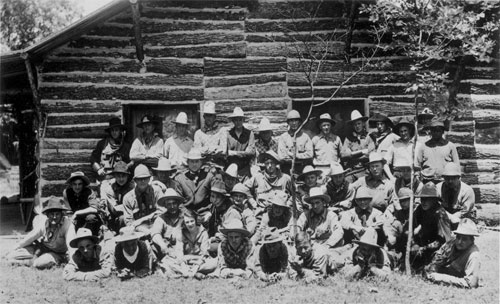
Michigan State Police in The Rich Slave

Michigan State Police in The Rich Slave, photo courtesy Archives of Michigan

The images of the month for August come from Michigan State Police records. State Police officers once appeared in a movie titled The Rich Slave was reportedly filmed in 1917 and released to audiences in 1921. The photo above shows State Police officers wearing their Western cowboy garb (click through for a larger view of the image):

The State Police records include a typed reminiscence of the event. Harriett Faussett Brogan wrote this undated memoir, titled “Early Michigan State Police Movie Heroes.” She stated that her father, Thomas J. Fausett, had formed a movie company with actor Romaine Fielding. Ms. Brogan noted that the company was based in Howell, Mich., her father’s hometown. She recalled that production of The Rich Slave began “about the middle of June 1917” and that much of the movie was filmed in Howell. According to Ms. Brogan, the State Police portrayed cowboys in some action shots, which were filmed “on land now known as Kensington Park near Brighton.” She further wrote, “There was a log cabin there owned by the Labardy family. And this is where the State Police made their debut as movie stars performing admirably all types of outstanding horsemanship.” (At that time, most State Police officers patrolled on horseback, so they were quite skilled at riding.) She noted that the cabin appeared in the film as the Buck Horn Hotel and that “Mr. Labardy also acted in one of the scenes.”

Further research indicates that “Mr. Labardy” was likely either Oliver Labadie or his brother, Hubert. These were brothers of Jo Labadie, whose papers are housed at the University of Michigan. The Jo Labadie Collection Web site notes that Oliver and Hubert opened a film studio, which they named the Labadie-Detroit Motion Picture Company. The Web site lists some films made there, with The Rich Slave appearing on the list. (To read about the studio, click Labadie-Detroit Motion Picture Company and scroll down to the third paragraph.).

Here’s the listing for The Rich Slave from the Internet Movie Database.

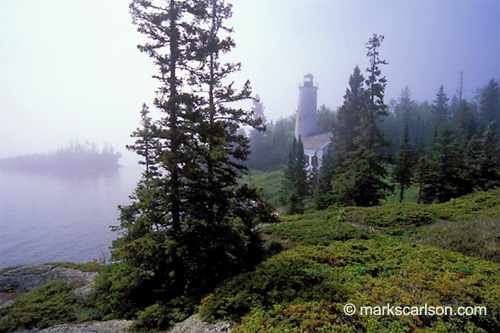
Rock Harbor Lighthouse, in lifting fog – Isle Royale National Park

Rock Harbor Lighthouse, in lifting fog - Isle Royale National Park

Rock Harbor Lighthouse, in lifting fog – Isle Royale National Park, photo by Mark S. Carlson

Mark writes:

This was one of my favorite photographs made during my last visit to the island in spring 2006. I’ve been to the wilderness isle many times and every time is special. It’s ruggedly beautiful, inspirational and one of the most exciting places in Michigan to make photographs if you appreciate pure nature.

You can see more from the island in Mark’s Isle Royale gallery, and more of Michigan in his other galleries and in his book Michigan, Simply Beautiful. Along with fellow photographer Mark also operates Great Lakes Photo Tours, providing personalized and in-depth instruction in nature photography in some of Michigan and the region’s most beautiful locations.

The entry for Rock Harbor Lighthouse at Terry Pepper’s Seeing the Light tells the history of this remote lighthouse and includes a number of historical photos. With the boom of mining on Isle Royale and the new lock at the Soo, a light at Rock Harbor was approved by Congress (for the outrageous sum of $5000). The light was completed in 1856 and:

The station’s rubble stone tower stood 16 feet 11 inches in diameter at the foundation, with its 49 foot 11 inch high walls tapering gently to a diameter of 14 feet 1 inch below the circular gallery. A set of spiral pine stairs supported by a central pine post wound within the tower from the first floor to a trap door in the gallery floor to provide access to the lamp. The lantern itself was fabricated of cast iron, and featured a domed copper roof. Centered within the lantern, a fixed white Fourth Order Fresnel lens sat at a focal plane of 70 feet above lake level, and cast its light 15 miles across the lake The attached rubble stone dwelling, stood 29 feet square and 20 feet 9 ½ inches high at the apex of the cedar shingled roof.

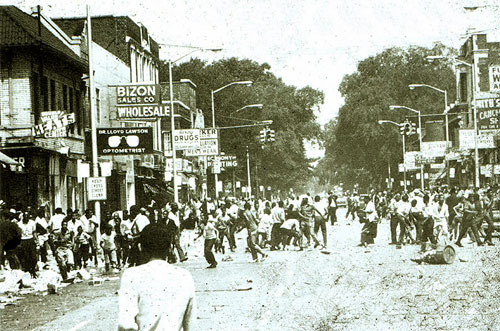
Detroit Riot, July 1967

Remembering the Detroit Riot of 1967 on Absolute Michigan has a lot of information and videos about what was one of the most profound events in Michigan’s history.

Below are some links to photographs I’ve found – please add more links in the comments. I’m surprised by how few there are for such a major event.

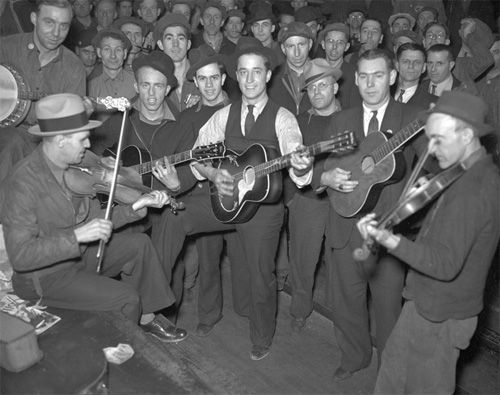
The Reo Ramblers at the 1937 sit-down strike

The Reo Ramblers at the 1937 sit-down strike, March 10-mid April 1937, photo courtesy Archives of Michigan

The Archives of Michigan’s July 2008 Image of the Month comes from the R.C. Leavenworth photographic collection. They write:

Lansing Auto Worker declared during the event, “Reo Strike Is Nation’s Model Demonstration.” Under the stress of wage reductions and layoffs resulting from the nation’s Depression, Reo workers shut down the factory and occupied it for a month. Workers remained peaceful, engaging in activities such as checkers, volleyball, and singing with the Reo Ramblers. The strike was successful and reenergized the local UAW chapter.

Michigan in Pictures has a post titled Remembering the Flint Sit-Down Strike on a Labor Day that has some great info about this landmark strike and – as is often the case – Wikipedia has a nice Flint Sit Down Strike article (with some more photos).

You can click the photo to read about a special Leavenworth exhibit at the Michigan Historical Center and also see another shot by Leavenworth of Jazz Music in Lansing in the 1920s.

In the Jacksonburg Public Square … History of Jackson, Michigan

Casler hardware 2

Casler hardware 2, photo by tstevensphoto.

The photo is part of Travis’s Jackson, MI set (slideshow). The marker denotes the location of the Jacksonburg Public Square – click through for full text of this marker and map of the location.

The best history online I’ve found is Jackson: The First One Hundred Years, 1829-1929 from the Ella Sharp Museum. It says, in part

Over one hundred and fifty years ago, a young New Yorker named Horace Blackman, a frontiersman from Ann Arbor and a Pottawattomie Indian guide, camped on the west bank of the Grand River at the intersection of what is now Jackson Street and Trail Street in the city of Jackson, Michigan. Blackman had been ‘spying out the land’ looking for a ‘location.’ Satisfied with what he saw, he purchased a quarter section and registered his one hundred and sixty acre claim. Several months later, he built himself a log cabin and then went home to collect his family, having become the founder of a future city.

…Jackson-for this is what the village would be called, after brief encounters with the names ‘Jacksonburgh’ and ‘Jacksonopolis’– had location. As the Indian trails clearly indicated, it was a cross-roads-a point through which people, ideas, information and materials going in various directions passed. Now, at a time when transportation had become a critical organizational link between the nation’s eastern populations and the frontier’s seemingly limitless resources and wealth, Jackson was in a position to benefit.

You can get much more at the link above and also check out Jackson, Michigan in Wikipedia.

The Last Days of Tiger Stadium

Tiger Stadium Usher 2, circa 1999

Tiger Stadium Usher 2, circa 1999, photo by LAWRENCEcreative.

Greenberg, Kailine, Manush, Heilmann, Kell, Newhouser, Jennings, Harwell – the stadium may be gone, but the names live on. Brett writes:

These are pictures taken from the last season of Tiger Stadium. Rather than watching all of the the games, I would find myself wandering the hallways and aisleways trying to capture moments significant to this iconic place…

I hope these pics bring back some great memories as we all wait for the final brick to fall on this historic landmark.

View his Tiger Stadium, circa 1999 slideshow (photo set). Do it, for real. The scenes he captured of the daily life of this grand old ballpark are priceless.

Although a series of bids to save all or part of the ballpark over the last several years, the Old Tiger Stadium Conservancy has until August 1st to prove it can raise $12-15 million to preserve the diamond, dugouts, 3,000 seats and an area that would house Hall of Fame Tiger’s broadcaster Ernie Harwell’s collection of sports memorabilia. Detroit News story.

Here’s some more Tiger Stadium Stuff:

Higgins boats discharge their cargo … on the beaches of Saint Joseph

The Higgins boats discharge their cargo. (IMG_1314)

The Higgins boats discharge their cargo. (IMG_1314), photo by bill.d.

From the Things I Wish I Had Known About in Advance files comes this fantastic set of photos of last weekend’s D-Day re-enactment in Benton Harbor and St. Joseph (slideshow). Bill uploaded them all nice and big so be sure to cruise through that slideshow link. Or even better, download PicLens, click the set link and enjoy. (trust me on the PicLens thing – coolest web software I’ve seen in quite some time).

The 2008 Saint Joseph and Benton Harbor WWII Reenactment Weekend took place last weekend and was sponsored by the veterans’ organization Lest We Forget of SW Michigan. It was designed to teach folks about WWII history, veterans, and the equipment utilized and featured reenactments of the battles at Normandy (D-Day) and Peleliu (Palaus archipelago in the Phillipines).

Because I can, here’s a link to an amazing reenactment of the landing at Omaha Beach.

Saginaw Waterfront, 1912 in the Panoramic Photograph Collection

Saginaw Michigan Waterfront, c1912

Saginaw Michigan Waterfront, c1912, photo Courtesy Library of Congress.

Needs to be seen bigger.

This photo is part of the Panoramic Photograph Collection at the Library of Congress, which:

…contains approximately four thousand images featuring American cityscapes, landscapes, and group portraits. These panoramas offer an overview of the nation, its enterprises and its interests, with a focus on the start of the twentieth century when the panoramic photo format was at the height of its popularity. Subject strengths include: agricultural life; beauty contests; disasters; engineering work such as bridges, canals and dams; fairs and expositions; military and naval activities, especially during World War I; the oil industry; schools and college campuses, sports, and transportation… The images date from 1851 to 1991 and depict scenes in all fifty states and the District of Columbia. More than twenty foreign countries and a few U.S. territories are also represented. These panoramas average between twenty-eight inches and six feet in length, with an average width of ten inches.

If you click through and search for “Michigan” you can see a lot of cool panoramas like Camp Grayling, 1921, downtown Bay City and the workers of the Michigan Tanning and Extract Co. of Boyne City.

Check the comments below for a guide to what you’re looking at in the photo!

Bathing Beauties in Northern Michigan

Michigan Women Antique Northern MI Bathing Beauties Card Love It

Michigan Women Antique Northern MI Bathing Beauties Card Love It, photo by UpNorth Memories – Don Harrison.

I am sure that the publishers of this card intended the title to be slightly mocking.

When I saw it, however, I was struck by how much fun they appear to be having and how little they care about anything other than each other’s company and enjoying Michigan’s amazing watery fun.

Hope you get a chance to do some beautiful bathing of your own this summer, and also that you check out Don’s postcards (slideshow) because he posts them big and has hundreds and hundreds!