It’s lonely at Big Sable Lighthouse in wintertime

Untitled, photo by Tim Mayo.

On a bone-chilling morning like today, it’s not too hard to put yourself in the probably none-too-warm shoes of Keeper Hans Hansen of the Big Sable Lighthouse, located at the wrong end of a nine mile walk from Ludington. Here’s his letter to Capt. C.E. Clark, USN, Lighthouse Inspector on September 19, 1887:

Please Sir, I wish to apply to you in regards to a change in location or in other words, if there is any chance for me to be transferred to some small Light. I have now served faithfully at this same Station for five long years lacking eight days, keeping the Light going every night the year around, and in them five years have been absent only three weeks. And this last year has been very hard on me on account I have had so many new men and each one I have to teach to care for the Light, and makes me feel very uneasy all hours of the night. The last man appointed is very quick and wants to learn. He is the best man that has been here for some time. He is a stranger to me. My children I should like very much to get them in school. Here is no school for miles. I prefer a small place where I can be alone with my family. I do not mind loosing [sic] Sixty dollars from my present salary. Would like best a place south from here but prefer best the west shore on Green Bay or would be glad to take some small place north of here. You would make us feel very happy. Please be so kind and do what you can.

You can get more stories from Lighthouses Short & Tall, learn about Big Sable Point Lighthouse in Ludington State Park and see tons more Michigan lighthouses on Michigan in Pictures.

Check this out bigger in Tim’s Lake Michigan slideshow and stay warm people!
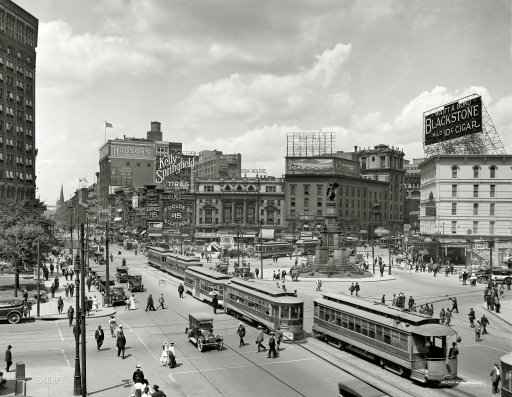
Detroit’s Golden Age: Looking up Woodward Avenue

Looking Up Woodward Avenue, c 1917, photo by Detroit Publishing Company

Thanks Chris Sebok for today’s find and happy birthday to Michigan!

This dry plate glass negative comes from the Detroit Publishing Company. Check out more photos from the Detroit Publishing Company archive and purchase prints from Shorpy’s!

This photo inspired mLive to put together a fantastic photographic timeline feature they titled Photos of Detroit’s Golden Age: The other side of ‘ruin porn’. It begins:

Detroit these days is not exactly the model of a great American city. While still vibrant and beautiful in several areas, the Motor City isn’t what it used to be, and we’re not here to lie or sugarcoat it.

Those abandoned buildings that have been thrust into the world’s spotlight through photo galleries by the likes of Time and Slate are real and a major part of Detroit’s landscape today.

But a few months ago, we came across a different kind of photo from Detroit (above), one that showed the city as a bustling metropolis full of people and booming businesses — in 1917.

People seemed to love it just as much as they loved those Detroit “ruin porn” photos.

Read on (and see some video) at mLive and check the comments at Shorpy’s too!

Old Reliable: Quincy Mine on the Keweenaw Peninsula

24/365 - Quincy Boiler and Shaft

24/365 – Quincy Boiler and Shaft, photo by dcclark.

You can buy mine related stuff and get tour information from the Quincy Mine Hoist Association. You can’t, however, get historical information.

Thankfully, David has posted a bunch. He has some information on his Copper Country Explorer web site (update: actually run by his friend Mike!). On his Cliffs & Ruins blog he writes:

In the foreground are the ruins an old boiler house — once filled with huge steam boilers, providing steam power to the mine. Behind it is the #2 shafthouse, a modern steel structure from a different era of the mine’s development.

The Quincy Mine is a very different mine from the Central Mine, featured yesterday. Although both started in the 1850s, the Central was a “fissure” mine — mining primarily huge, pure chunks of copper. The Quincy, on the other hand, was an “amygdaloid” mine — mining rock with tiny bits of copper infused through it. As it turns out, Quincy’s model was better, and all of the truly successful mines in the Copper Country were amygdaloid mines. Quincy paid dividends for nearly 50 years straight, earning it the name “Old Reliable”. But, just like the Central and all other Copper Country mines, the Quincy is now nothing more than a collection of shafts and ruins.

It’s one of the Keweenaw National Heritage Sites and there’s detailed information on Wikipedia’s Quincy Mine entry.

Be sure to check this out bigger, in David’s store and on his Quincy, Michigan map.

Ojibway spirit god and the Song of … Manabozho


Manabezho Falls in the Porcupine Mountains, photo by Gittinsj

A previous post on Manabezho Falls in the Porcupine Mountains State Park offered another view of these amazing falls and some information from GoWaterfalling’s page on Manebezho Falls.

While trying to find out more about Manebezho, who also seems to be the trickster god Manabozho, I learned from Indian Names in Michigan that although Henry Wadsworth Longfellow’s Song of Hiawatha uses the name of a real-life Mohawk sachem (paramount chief), the deeds are those of Manabozho. That’s enough grounds for me to bring you the Manabozho and the ultimate fish story.


US-27 In Michigan

US 27
US-27 In Michigan, photo by U.S. Highway 12

Ronnie writes:

For 76 years, from 1926-2002, US-27 was a primary highway in the state of Michigan. During the Postwar highway expansion era on the even of the Interstate Highway system, US-27 was extended to St. Ignace, Michigan, across the Mackinac Bridge. However, as I-75 was completed in sections north of Tri-Cities area, US-27 was eventually truncated to just north of Higgins Lake in 1961.

As Interstate 69 was completed in the 1970s around the Charlotte area, US-27 was moved onto the new Interstate freeway. In 1991, MDOT petitioned AASHTO, to have US-27 removed from the state of Michigan’s highway network. This request was denied because MDOT made no mention of their plans for US-27 north of Lansing. However, eight years later on in 1999, they submitted another application, and AAHSTO approved the request to truncate US-27 from south of Grayling to Fort Wayne, Indiana. The end finally came in 2002, when all of the old US-27 marker signs were removed.

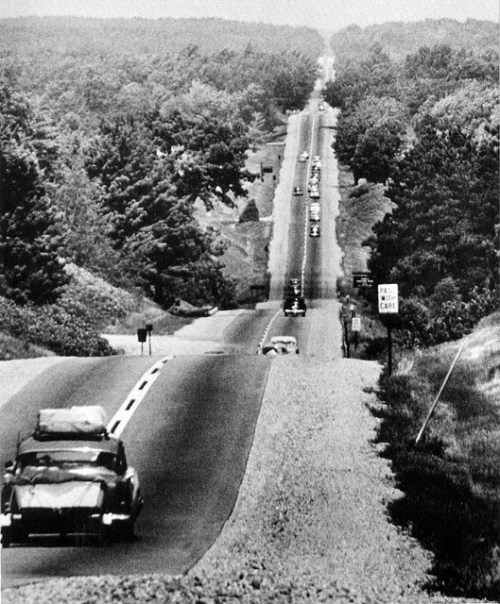
When I think of US-27 and the many other U.S. Highways in Michigan, this two-lane photo from the Michigan State Highway Dept. comes to mind. This image was shot in Clare County, near the community of Harrison during Labor Day in 1955. I can just image driving along this hilly and winding highway at 105 km/h (65 mph), and having a deer run standing in the roadway as I crested the hill.

Image from the Michigan State Highway Dept. (MDOT) and is in the public domain.

Looking for more? Check out the US-27 group slideshow on Flickr and US Route 27 on Wikipedia.

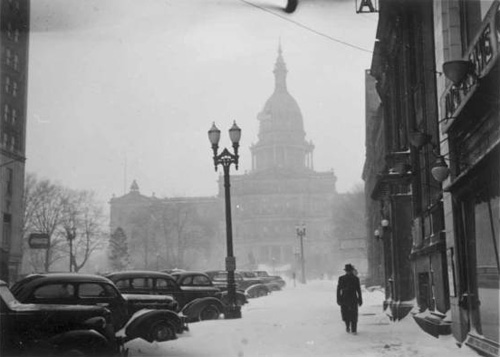
Lansing Winter, 1935

Lansing (Mich.) , photo courtesy Seeking Michigan

I saw this photo of a winter’s day in Lansing in the mid 1930s when I found the photo of the Soo last week. The old cars and the chill wind made me think about how folks in Michigan were probably feeling at the time. This was the depths of the Great Depression, when the Civilian Conservation Corps sought to engage young men in meaningful work, when the UAW was founded and the workers in Flint held their famous sit-down strike – a period of wrenching change for Michigan and the nation.

Probably no time until the present day featured so many people whose way of life had vanished, leaving so much in the way of challenge and so little hope in front of them.

Still, from those dark days Michigan climbed to previously unthinkable heights, led by entrepreneurs, bold leaders and a citizenry that was willing to work hard to realize their dreams.

I hope that gives you the same measure of hope that it gives me.

You can see this photo bigger if you click through and choose “Printable Version”.

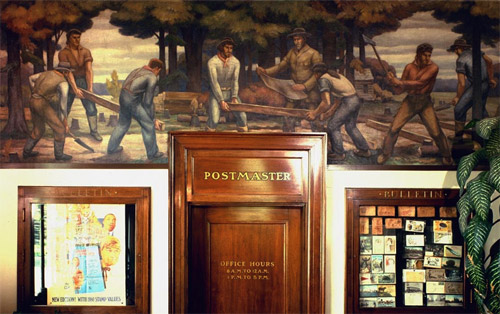
WPA Art in Michigan: Blissfield Post Office

Blissfield, Michigan Post Office, photo © Dirk Bakker

The latest feature from the Michigan Radio Picture Project is WPA Art in Michigan, featuring the photography of Dirk Bakker, who photographed over over fifty Michigan WPA projects for a book from Wayne State University Press (that was actually never published):

Among the bold experimental programs that President Franklin Delano Roosevelt enlisted to aid the profoundly depressed U.S. economy of the early 1930s were “public works” programs to aggressively move people back to work. There was the Civilian Conservation Corp that put young unemployed men to work planting trees to reforest America. The Civilian Works Administration put people to work building or rebuilding the infrastructure of the country by teaching, or by building roads, bridges and dams.

George Biddel, a classmate of Roosevelt’s from Harvard and an artist himself, suggested that FDR follow Mexico’s lead and employ artists to paint murals on government buildings. Roosevelt was convinced and in 1933 founded the “Public Works of Art Project,” funded by the Civilian Works Administration. It was succeeded by numerous other federally aided projects that, in addition to the visual arts, funded theater, music and writing projects.

One of the most productive as well as controversial programs was the Treasury Section of Fine Arts, which selected artists by jury and commissioned them to paint murals in U.S. Post Offices. The State of Michigan was the beneficiary of more than fifty Section post office “murals,” as well as numerous other institutional painting and sculpture commissions.

The Michigan Radio Picture Project is a new site from Michigan Radio that aims to be a forum for photographs that address Michigan people, places, events, and issues. They hope to develop a broad mixture of photo essays to expand on stories from Michigan Radio and to go deeper into Michigan historical photographs, fine art photography and pictures from various archives and collections. Have an idea? Pitch their website coordinators Eric Smith, Doug Aikenhead, and Tamar Charney at michiganradiopictureproject@umich.edu.

You can also check out a cool WPA-themed poster contest over on Absolute Michigan!

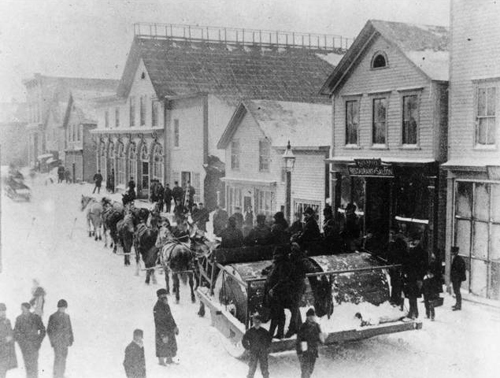
Winter day in Sault Sainte Marie

Sault Ste. Marie, Michigan,photo courtesy Seeking Michigan

This photo was taken by an unknown person on an unknown winter day on Water Street in Sault Sainte Marie. Wikipedia says that Sault Ste. Marie is the county seat of Chippewa County and the second most populous city in the Upper Peninsula.

Founded as a mission in 1668 by Father Jacques Marquette, Sault Ste. Marie is the oldest European settlement in the Midwest. A fur trading settlement soon grew up at this crossroads on both banks of the river, making the area the center of the 3,000-mile fur trade route extending west from Montreal to the Sault, then to the country north of Lake Superior.

The town was split into two in 1797, when the Upper Peninsula was transferred from the province of Upper Canada to the United States.

Sault Sainte Marie is Old French for “falls of St. Mary” (Sault de Sainte Marie), a reference to the rapids in the St. Marys River, which joins Lake Superior to Lake Huron. The spelling Sault-Sainte-Marie is more usual in French, but the name is written without hyphens in English. Both cities and the vicinity as a whole are often referred to as the Sault or the Soo.

You can learn more about the Soo from the  Sault Ste. Marie Visitors Bureau and see a boatload of old photos from Sault Sainte Marie from Seeking Michigan.

Remembering Bob Heft, designer of the 50 star flag

Ren Center at night
Ren Center at night, photo by mikesophia

The Saginaw News has a nice feature on Saginaw resident Bob Heft, designer of the 50 star American flag. Heft was the creator of the longest-serving flag in US history and passed away Saturday at the age of 67:

Heft was 17 in 1958 when he received an unusual phone call from an important individual. When the caller asked for Robert G. Heft, the teenager said, “Yes, but you can call me Bob.” He didn’t realize he was speaking with President Dwight D. Eisenhower. Heft’s high school project had been selected by the president to represent the United States of America and the 50-star U.S. flag was born.

Winford said Heft would “beam with pride” because of his work and was a constant inspiration for children. He said he taught them how to follow their dreams.

Heft visited the White House 14 times under nine presidents and toured with Bob Hope.

You can get a little more about Heft from Wikipedia and at usflag.org, where they relate that his design receieved a B- because it lacked orginality. He did say that he would give Heft a high grade if he could get Congress to accept the design.

Mike says that he loves the flags in front of the Renaissance Center. Check this out bigger and in his Favorite set (slideshow).

The William Peter Mansion in Columbiaville

William Peter Mansion
William Peter Mansion, photo by Sentrawoods

The latest in our series of Mansions Where You Can Spend the Night features the William Peter Mansion. The William Peter Mansion Bed & Breakfast site says that:

William Peter came to Columbiaville in the mid 1800’s as a German immigrant working for the lumber industry. Though he was young and spoke little English, he was a man who worked hard, saved big, and took advantage of the opportunities that came his way.

In 1852 he married a girl by the name of Roxannea Clute. Just 17 at the time her father strongly disapproved of the union due to Peter’s citizenship. Having no other choice the couple decided to elope. They worked hard over the years and built much of the town we know as Columbiaville. With business interests in the town of Toledo the couple decided to move. It was there that they bore and raised two children, Harriet and Alvin.

In 1892 the Peter’s decided to move back to Columbiaville and the Mansion was begun. The materials used in the Mansion’s construction came from Peter’s own lumber yards. Peter’s hired craftsmen and artists from all over to finish the woods and paint the walls and ceilings with gorgeous designs, birds, and flowers. The sixteen room Mansion took four years to complete.

The Mansion possesses a unique architectural style featuring the cubic form of the Italiante which was popular during that time. The main hall and entrance feature a rich paneled oak on the walls with a beautiful parquet floor made from hard oak. Mr. Peter was an expert on timber and enjoyed surrounding himself with its fine specimens.

You can see it bigger and check out the historic marker from Sentrawoods.