Watch your step atop Castle Rock

Watch your step!

Watch your step!, photo by robizphoto.

In their entry about Castle Rock, Hunt’s Guide to the UP says that Castle Rock is a limestone stack, eroded by water and wind to form a “castle” nearly 200 feet above Lake Huron:

Clarence Eby, a St. Ignace photographer and pioneer of area tourism, acquired Castle Rock and, in 1928, opened it as a destination, just as somewhat better area roads enabled motorists to go sightseeing in outlying areas. He made postcards of sights in Mackinac County, the island, and the Straits, created a guidebook with ads from resorts and cabins, and worked to create a Chamber of Commerce information center in town. Today Eby’s grandson Mark runs Castle Rock

Click the link above to see one of Eby’s colorized postcards and get more info including a panoramic photo from Wikipedia.

Check this out bigger and in robizphoto’s Landscapes slideshow.

WAFS, WASPs and Nancy Harkness Love

Nancy Love in a B-17, photo courtesy Air Force Historical Research Agency/Wikipedia

Wikipedia says that Nancy Harkness Love was born (appropriately enough) on Valentine’s Day in 1914. Love was interested in aviation from an early age, took her first flight at 16 and earned her pilot’s license within a month. In 1942 her husband Robert Love was called to active duty as the deputy chief of staff of the Ferrying Command, and Nancy convinced Col. William H. Tunner that experienced women pilots could be used to deliver aircraft from factories to airfields. Although Tunner’s original proposal for female pilots to be be commissioned into the WAACs was rejected, he appointed Love to his staff as Executive of Women’s Pilots.

Within a few months, she had recruited 29 experienced female pilots to join the newly created Women’s Auxiliary Ferrying Squadron (WAFS). Nancy Love became their Commander. In September, 1942, the women pilots began flying at New Castle Army Air Field, Wilmington, Delaware, under the 2nd Ferrying Group.

By June, 1943, Nancy Love was commanding four different squadrons of WAFS at Love Field in Texas, New Castle in Delaware, Romulus in Michigan and Long Beach in California. The WAFS’ number had greatly increased because of the addition of graduates of the Women’s Flying Training Detachment (WFTD) at Avenger Field, Sweetwater, Texas, an organization championed and headed by Jacqueline Cochran.

On August 5, 1943, the WAFS merged with the WFTD and became a single entity: the Women Airforce Service Pilots (WASP). Nancy Love was named as the Executive for all WASP ferrying operations. Under her command, female pilots flew almost every type military aircraft then in the Army Air Force’s arsenal, and their record of achievement proved remarkable.

She was the first woman to be certified to fly the North American P-51 Mustang, C-54, B-25 Mitchell, and along with Betty Gillies, the B-17 Flying Fortress. She was certified in 16 military aircraft, including the Douglas C-47 and the A-36.

In 1944, after the WASPs were disbanded, Love continued to work on the Air Transport Command’s Report. She set a record of being the first woman in aviation to make a flight around the world. She flew the plane at least one-half of the time, including crossing over the Himalayas.

You can learn more about Nancy Harkness Love in the Michigan Women’s Hall of Fame. In Wednesday, the roughly 1000 women from the WASP service were awarded the Congressional Gold Medal for their service. Here’s a fantastic feature from NPR titled Female WWII Pilots: The Original Fly Girls.

Still winter on Kitchi-Gummi

Kitchi-Gummi

Kitchi-Gummi, photo by Holkeboer.

The Great Lakes Information Network has this to say about the world’s largest lake:

The first French explorers approaching the great inland sea by way of the Ottawa River and Lake Huron referred to their discovery as le lac superieur. Properly translated, the expression means “Upper Lake,” that is, the lake above Lake Huron. Kitchi-gummi, a Chippewa Indian translation, signifies Great-water or Great-lake. A Jesuit name, Lac Tracy, was never officially adopted.

An Indian name for Lake Superior was “Kitchi gami” (or “Kitchi-gummi”).

Be sure and check this out bigger or in John’s Feb. Munising Trip set (slideshow).

The rock in the picture is Miner’s Castle, which you can learn more about from Michigan in Pictures.

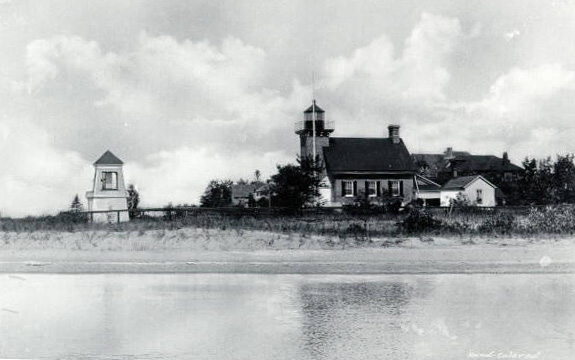
Harbor Point Lighthouse aka the Little Traverse Light

Little Traverse Light (Harbor Point Lighthouse), photo courtesy Archives of Michigan

One of the many Michigan lighthouses at Seeking Michigan is the Little Traverse Light (decommissioned 1963). The Little Traverse Light page at Terry Pepper’s Seeing the Light says:

For centuries the area around Little Traverse Bay had been the home of Ottawa Indians. Around 1700, French Jesuits arrived in the area and constructed a mission at the famous L’Arbre Croche village, a huge native village which stretched from Cross Village to Harbor Springs. Dependent on agriculture, fishing and trapping in 1847, the village of L’Arbre Croche was home to the largest concentration of natives people in what would become the state of Michigan.

…As was frequently the case, treaties with the native Americans were frequently and expeditiously “modified” after their original signing, and with the passage of treaty limitations in 1875, the land around Little Traverse Bay was opened-up for settlers, and the flood gates opened. Harbor Springs was formally incorporated as a village in 1880. After the opening of land availability, land lookers moved through the area, claiming huge tracts of forest for their respective companies, with lumbering operations following quickly on their heels. Simultaneously with this commercial boom, word of the beauty of the bay, its sunsets, clean air, cool breezes and clear water spread throughout the Midwest, and an ever increasing number of moneyed individuals, their pockets bulging with the bounty of the industrialization of the southern Michigan cities began pouring into the area, building summer cottages, mansions and hotels.

With this unprecedented boom in commercial and recreational activity, there was a massive increase in vessel traffic in Little Traverse Bay, and local interests again began petitioning for the construction of the lighthouse recommended almost ten years previously.

Read on and see pictures and get more from Wikipedia’s Little Traverse Light entry. The West Michigan Tourist Association has a cool article on Elizabeth Whitney, who was a keeper at the Little Traverse Light that you might enjoy as well.

Get more shots of the Harbor Point Lighthouse from seekingmichigan.org, including a better shot of the fog bell tower (the structure to the left of the photo).

US Coast Guard Cutter Bramble: A Ramblin’ Gal

USCGC Bramble

USCGC Bramble, photo by k.l.macke.

Wikipedia says that the USCGC Bramble (WLB-392) is one of the 39 original 180-foot  seagoing buoy tenders built between 1942-1944 for the United States Coast Guard. Bramble is currently a museum ship, part of Port Huron Museum. The museum’s page on the USCG Cutter Bramble says:

The Coast Guard Cutter Bramble was commissioned in 1944 at a cost of just over $925,000. Following World War II, the Bramble participated in “Operation Crossroads,” the first test of an atomic bomb’s effect on surface ships, at Bikini Island. In 1957, along with the cutters Spar and Storis, it headed for the Northwest Passage, traveling through the Bering Straits and Arctic Ocean. Traveling for 64 days through 4,500 miles of partially uncharted waters, the vessels finally reached the Atlantic Ocean. These three surface vessels were the first to circumnavigate the North American Continent, an ambition mariners have had for more than 400 years.

In 1962, the Bramble transferred to Detroit to perform the missions of search and rescue, icebreaking, and law enforcement throughout the Great Lakes, in addition to aids to navigation. In 1975, the Bramble reported to Port Huron. The cutter’s areas of responsibility included eastern Lake Erie, southern Lake Huron and Saginaw Bay, and maintaining 187 buoys, one NOAA weather buoy, and three fog signals. During winter months, its capabilities as an icebreaker enabled it to escort ships through ice and assist ships in distress. The Bramble was decommissioned in 2003 to be used as a museum.

Check this out bigger and in Keith’s Ships, Boats & Water Toys set (slideshow).

Saginaw, Michigan … and Happy Birthday to Johnny Cash

Saginaw Bay-Michigan

Saginaw Bay-Michigan, photo by mark5032001.

The song Saginaw, Michigan was written by Bill Anderson and Don Wayne and famously covered by Johnny Cash, who was born on February 26, 1932.

I was born in Saginaw, Michigan.
I grew up in a house on Saginaw Bay.
My dad was a poor hard working Saginaw fisherman:
Too many times he came home with too little pay.

I loved a girl in Saginaw, Michigan.
The daughter of a wealthy, wealthy man.
But he called me: “That son of a Saginaw fisherman.”
And not good enough to claim his daughter’s hand.

Now I’m up here in Alaska looking around for gold.
Like a crazy fool I’m a digging in this frozen ground, so cold.
But with each new day I pray I’ll strike it rich and then,
I’ll go back home and claim my love in Saginaw, Michigan.

I wrote my love in Saginaw, Michigan.
I said: “Honey, I’m a coming home, please wait for me.
“And you can tell your dad, I’m coming back a richer man
“I’ve hit the biggest strike in Klondyke history.”

Her dad met me in Saginaw, Michigan.
He gave me a great big party with champagne.
Then he said: “Son, you’re wise, young ambitious man.
“Will you sell your father-in-law your Klondyke claim?”

Now he’s up there in Alaska digging in the cold, cold ground.
The greedy fool is a looking for the gold I never found.
It serves him right and no-one here is missing him.
Least of all the newly-weds of Saginaw, Michigan.

We’re the happiest man and wife in Saginaw, Michigan.
He’s ashamed to show his face in Saginaw, Michigan.

Much more in Wikipedia’s Johnny Cash entry and on the official Johnny Cash web site.

Unfortunately, I couldn’t find Johnny playing Saginaw, Michigan, but here’s Lefty Frizzell (who had the original hit) and one of my favorites, Leo Kottke singing the song.

Check this photo out bigger in Mark’s slideshow.

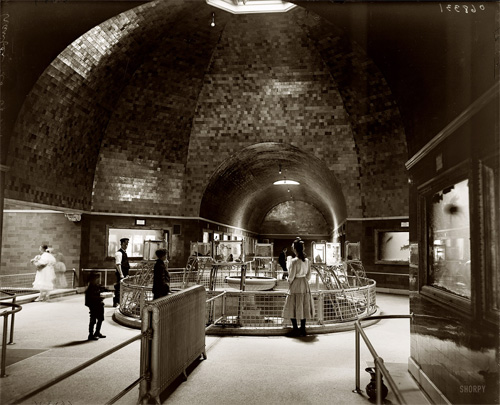
Belle Isle Aquarium – 1905

Fishbowl: 1905, photo via Shorpy Historic Photo Archive

The Friends of Belle Isle Aquarium history page (click through for some great photos & historic postcards) says:

It was August 18, 1904 in Detroit when architect Albert Kahn’s new aquarium would open to the public … The Belle Isle Aquarium, which opened adjacent with the new horticultural building on Belle Isle at a cost of $160,000, would quickly become, “one of the most popular attractions on the Island.”

…The interior of this aquarium were framed cypress tank-lined walls that were filled with fresh and salt water fish. The water contained in many of these tasks were brought direct from the ocean for the aquarium. Under the domed ceiling in the center of the building was a deep pool that was encircled by several small tanks. Later this pool would become the home to a large tank that would sit in the middle.

The most magnificent part of the interior was the grotto ceilings lined with shinny jade green titles, giving visitors a unique feeling of being underwater. Underneath this aquarium was a basement, that would be used by many as a speakeasy during Prohibition.

This photo is one that you absolutely have to check out bigger. You can get more shots from Belle Isle at Shorpy and prints too! and get more view & buy Detroit pics right here!

U.S. National Ski and Snowboard Hall of Fame and Museum in Ishpeming

Iron Mountain MI UP Olympic Ski Jump Slide 1930s RPPC LL Cook C-1693 Unsent

Iron Mountain MI UP Olympic Ski Jump Slide 1930s RPPC LL Cook C-1693 Unsent, photo by UpNorth Memories – Donald (Don) Harrison.

With the Winter Olympics just around the corner, it’s a good time to look back on the history of skiing. I’m guessing many folks aren’t aware of the pivotal role that Michigan has played in the history of skiing.

A great place to start is the U.S. National Ski and Snowboard Hall of Fame and Museum in Ishpeming. It’s the only hall of fame in America dedicated exclusively to skiing and boasts 20,000 square feet that are packed with cross-country, downhill and snowboarding exbibits and memorabilia to take you from the founding of skiing to the latest innovations.

The core of the hall are the 368 inductees who represent some of the great names in skiing history. Included in their ranks are a number of Michiganians from one of the most influential ski resort owners in the nation, Everett Kircher (who developed the double and triple chair and made numerous other innovations at Boyne Mountain) to Lansing native and world class racer Cary Adgate (whose daughter is currently tearing up the slopes in Northern Michigan).

At this point, you may be asking yourself the same question that I did: “Why Ishpeming?”

About a century ago, a group of Ishpeming businessmen and skiing enthusiasts took the first steps to organize the National Skiing Association, now known as the U.S. Ski and Snowboard Association. USSA is the national governing body for Olympic skiing and snowboarding and the entity behind the US Ski Team and US Snowboarding Team. For the story on why that happened in Ishpeming, we have to turn to the International Skiing History Association who explain that:

…The first actual recorded tournament in the Midwest took place in St. Paul, Minnesota, January 25, 1887. Starting from a tower all of twenty feet high, the Norwegian champion Mikkel Hemmestveit went 60 feet in the air to win. Then Hemmestvedt and his brother Torjus took the sport west to Red Wing, Minnesota with an exhibition tourney on February 8, 1887, sponsored by the year-old Aurora Ski Club of Red Wing. That very year, the idea of jumping spread to the Upper Peninsula and Ishpeming soon became a particular hotbed of jumping culture. In the Upper Peninsula after 1900, any town aiming to rank as a place worth living in had at least one big jump trestle. It became a matter of civic pride. The movement was supported by generous donations from the Upper Peninsula mining companies. Along the entire peninsula, ski clubs were founded, copying the organization of earlier Norwegian ski clubs the immigrants had known in their homeland. In Ishpeming, dozens of small backyard jumps were fashioned out of the plentiful snow and a few larger ones were built from trusses of native iron.

The Ishpeming Ski Club was organized in 1887 as the Norden Ski Club. A year later, it changed its name to Den Nordiske Ski Club (the Nordic Ski Club) to reflect its ethnic makeup. Business during club meetings was mostly transacted in Norwegian. Then diversity set in. With the arrival of Finns, the name was changed in 1901 to the Ishpeming Ski Club and meetings were thenceforth conducted in English. From that came a gradual growth toward the birth of organized skiing and, eventually, the founding of the U.S. National Ski Hall of Fame.

Definitely click through to their homepage – there’s an awesome ski history video there – and if you want to know more about ski jumping in Michigan, the Detroit News Rearview Mirror has a cool feature on Michigan’s long history of ski jumping with some great old photos!

The photo above from Pine Mountain is one of countless postcards featuring Michigan’s rich history available from Don Harrison. Be sure to check it out bigger or in his ski slideshow (which leads off with a postcard of the jump they had in Ishpeming).

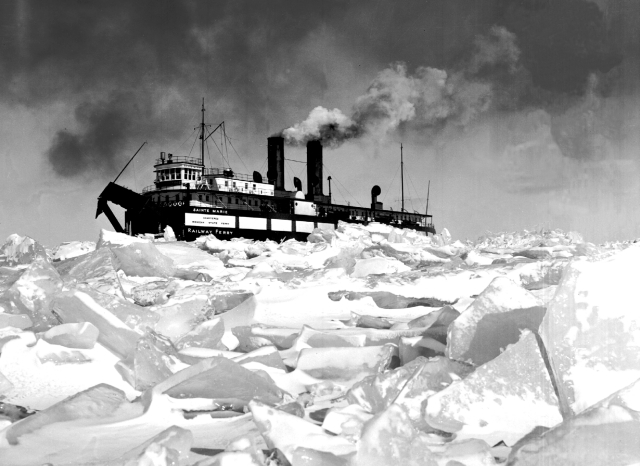
80 years of ice on the Straits of Mackinaw

Winter Service, photo courtesy Mackinac Bridge Authority

The Michigan State Ferry Album says:

Winter service began in 1931 when the Highway Department arranged with the Mackinaw Transportation Company to carry cars across the Straits on a railroad icebreaker during the cold months. This arrangement turned out to be poor business for the State, so in 1936 the Highway Department leased the railroad icebreaker “Sainte Marie” for winter operations on a regular schedule.Winter service began in 1931 when the Highway Department arranged with the Mackinaw Transportation Company to carry cars across the Straits on a railroad icebreaker during the cold months. This arrangement turned out to be poor business for the State, so in 1936 the Highway Department leased the railroad icebreaker “Sainte Marie” for winter operations on a regular schedule.

In case you’re wondering, the ice on the Straits of Mackinaw hasn’t changed a whole lot in 80 years, as this photo from February of 2008 titled Triangles by Dominique shows. See it bigger in her Snow/Ice slideshow or check out the whole set.

Triangles

Worlds (3rd) Largest Cherry Pie

Worlds (3rd) Largest Cherry Pie

Worlds (3rd) Largest Cherry Pie, photo by Allen Gathman.

February is National Cherry Month and there’s nothing more cherry than the cherry pie. The folks at Roadside America (who keep track of stuff like this) have this to say about the titanic battle for the World’s Largest Cherry Pie:

Charlevoix was the first into the mix. In 1976 a man named Dave Phillips, in a burst of bicentennial fervor, convinced local businesses in Charlevoix to bake the World’s Largest Cherry Pie as part of the town’s annual cherry festival. A giant pan was built, along with an equally titanic oven. Local farmers supplied the ingredients. The result: a cherry pie weighing 17,420 pounds. It was a world record.

Further south, the town of Traverse City had its own cherry festival. It had perhaps heard one too many boasts from Charlevoix, and in 1987 it decided to do something about it…

The Chef Pierre Bakeries went to work, and on July 25 it baked a cherry pie that put Charlevoix to shame: 28,350 pounds; 17 feet, 6 inches in diameter. As an added snub, the town had Guinness Book of World’s Records certify its pie as the largest ever. Charlevoix’s days in the spotlight were ended after only 11 years.

But time has a way of humbling the proud. The Chef Pierre Bakeries were bought out by Sara Lee. The cherry farms around Traverse City were turned into golf courses. Yuppies from downstate began invading the town, as they were invading Charlevoix. And in 1992, after only five years, Traverse City’s cherry pie crown was knocked clear into Canada when the tiny town of Oliver, British Columbia, baked a cherry pie for the ages — 39,683 pounds.

For some reason Oliver failed to save its pan, so you can still see the largest cherry pie pan in Traverse City here and get a sense of the scale right here.

Check Allen’s photo out bigger.