Shaytown

Shaytown by Joel Dinda

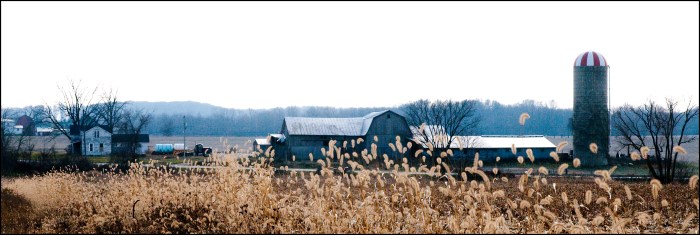
Shaytown, photo by joeldinda.

A few years ago we ran an old photo of a Shay Locomotive on Michigan in Pictures. The other day, I came across this photo in our Absolute Michigan pool on Flickr. Joel writes:

I was wandering around the local backroads a few days ago when I spotted this sprawling barn and these tall grasses; seemed like a possible photograph….

Further research about the location turned up an unexpected gem. Seems that Shaytown was named for Ephraim Shay, inventor of the classic narrow-gauge lumbering locomotive, who became famous after bestowing his name on this corner. Recovering railfan that I am, I knew who he was, but hadn’t recognized the local connection.

Near as I can tell, Shay owned this property for four years or so shortly after the Civil War, where he ran a sawmill and (probably) a general store. Those are gone, and to all appearances the existing barn and house were built by later owners.

Nonetheless, a delightful surprise. Unfortunately, and despite the truck parked in the yard, both the house and barn seem to be abandoned.

Check this out nearly lifesize and also in his The Showcase slideshow.

The Legend of Sleeping Bear and the Sleeping Bear

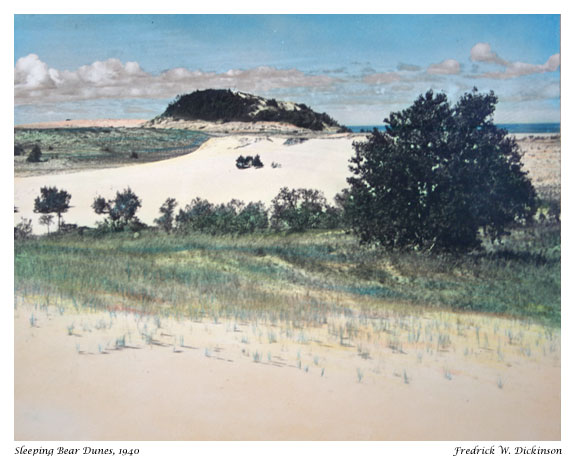
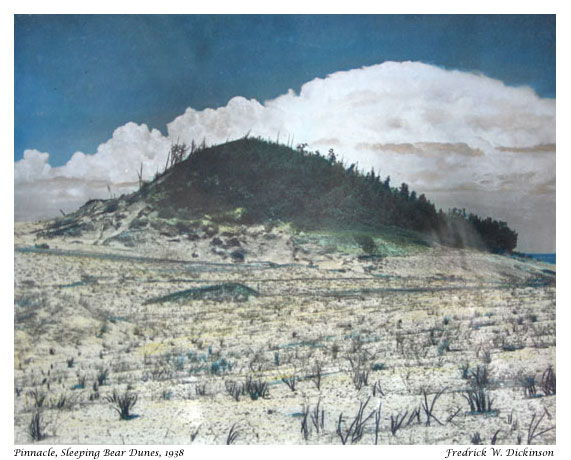
Sleeping Bear Dunes, 1940, photo by Fred Dickinson/Dickinson Photography

As we know, my laziness knows no bounds, so here’s the story behind “the Bear” on the Sleeping Bear Dunes that I wrote for Leelanau.com this morning!

The other day we posted the Legend of the Sleeping Bear to Leelanau.com. After thinking about it, I wondered if folks knew that “the Bear” was also an actual formation atop a dune about a mile north of the Pierce Stocking Overlook. The Sleeping Bear Dunes National Lakeshore says that the formation pictured above known as “the Bear”…

…hardly looks like a bear now, for it has been changing rapidly in recent years. At the turn of the century, it was a round knob completely covered with trees and shrubs. You can still see some of the thick vegetation that gave it a dark shaggy appearance.

…For a long time, the sleeping Bear Dune stood at about 234 feet high with a dense plant cover. However, trough most of the twentieth century, erosion has prevailed. By 1961, the dune was only 132 feet high, and by 1980, it was down to 103 feet. The process is a continuing one. The major cause of the dune’s erosion was wave action wearing away the base of the plateau on which the dune rests. As the west side of the dune loses its support, it cascades down the hill. The wind, too, is a major agent of erosion, removing sand and destroying the dune’s plant cover.

The photo above was taken by Leelanau photographer Fred Dickinson. You can see a closer view right here and definitely check out the Dickinson Photo Gallery to view & purchase great photography of the dunes and other Leelanau spots by Fred and his daughter Grace. On Michigan in Pictures there’s a photo of Fishtown in 1940 that explains Dickinson’s hand coloration technique and another shot by Fred of some folks taking a break from a Sleeping Bear Dune ride.

You can see a couple more photos of the Bear from MSU and don’t forget to click over to Leelanau.com for the Legend of the Sleeping Bear!

Women and children first: The Sea Scouts near Mackinac

Sea Scout whaleboat

Sea Scout whaleboat photo by otisourcat

As a Sea Scout, I promise to do my best
To guard against water accidents;
To know the location and proper use of the lifesaving devices on every boat I board;
To be prepared to render aid to those in need and;
To seek to preserve the motto of the sea, “Women and children first.”
~Sea Scout Motto (via Wikipedia)

otisourcat writes that this shows a ship’s boat used in the 1920’s by the Sea Scouts. The photo was taken somewhere near Mackinac. See it (and many more) in his amazing Photographica Nauticalia set (slideshow).

Indian Village and the 12 Days of Christmas in Detroit

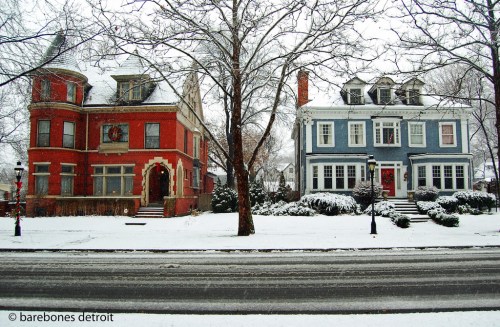
Untitled, photo by BareBonesDetroit

The folks at BareBones Detroit are doing the Twelve Days of Christmas in Detroit, a series on some of the best things to do and see around the holidays. Check their set out on Flickr at the link above (view slideshow) and don’t miss their cool map of Detroit! Of this photo they write:

Day 2: Indian Village. There’s never a better time to take a drive through Detroit’s historic Indian Village neighborhood. Just east of downtown, many of these homes were owned by some of the city’s most prominent, wealthy families. Grab some hot chocolate, turn the radio to 100.3 WNIC and tour some of the Detroit’s most historic homes lit up for the season.

Detroit’s historic Indian Village by Zena Simmons of The Detroit News says that the architecturally diverse Indian Village was home to famous Detroiters including Edsel Ford & Bernard Stroh. Their homes were designed by some of Detroit’s most renowned architects including Albert Kahn, Louis Kamper and William Stratton. The first Village home was built in 1895 at Jefferson and Iroquois and later became the headquarters for WXYZ and the home of the Lone Ranger.

According to the Indian Village Historical Collections, originally, the land belonged to Francois Rivard and Jacques St. Aubin, recipients of French land-grant “ribbon” farms, long narrow strips of land that gave each farmer some river frontage. Abraham Cook acquired the farms between 1811 and 1815. The area consisted mostly of farms, and a couple of upper-class river cottages, but the main attraction was a mile long oval race track. The track was the site of several Michigan State Fairs during the 1860s and was known as the Hamtramck Race Course.

Around 1893, Cook’s heirs formed the Cook Farm Company, Ltd. to develop a “first class residential district on a generous scale”, and the prices were set high so that only the wealthy could build there.

Many assumed that at one time Indians lived on the land. That may be, but John Owen Jr., a key player in the development of the area, selected the name “Indian Village” because he felt the romantic title would add to the sales appeal.

You can also check out Wikipedia’s entry for the Indian Village Historic District and the Historic Indian Village neighborhood site.

The Best of the Detroit Lions: Barry Sanders

barry barry

barry barry, photo by daveraoul.

Yahoo has a feature on the five greatest Detroit Lions players. Though them might have missed the tackle on kick-returner Mel Gray (Charlie Sanders anyone?), they definitely nailed the rest with defensive back Dick “Night Train” Lane, linebacker Joe Schmidt, quarterback Bobby Layne and their unquestioned #1, Hall of Fame running back Barry Sanders.

The Barry Sanders entry at the Pro Football Hall of Fame begins:

One of the game’s most electrifying runners, Barry Sanders rushed for more than 1,000 yards in each of his 10 seasons with the Detroit Lions (1989-1998). He was the first running back ever to do so. The 1988 Heisman Trophy winner was also just the third person to gain more than 2,000 yards in a season, a feat he accomplished in 1997.

Sanders, after forgoing his senior season at Oklahoma State, made his pro debut just three days after signing with the Lions, who had made him their first-round pick and the third overall pick in the 1989 draft. He absolutely dazzled a Pontiac Silverdome crowd when he dashed for an 18-yard gain on his first carry as an NFL running back. But that was just the beginning. His 1,470 yards rushing that season, a-then Lions record, fell just 10 yards short of the league’s best for the year.

Read the rest and if you want to put a little jingle in Barry’s probably already jingling pockets, head over to barrysanders.com. If you need a little Barry to wash the Lions dismal decade out of your thoughts, head over to YouTube for the Barry Sanders highlight reel.

Dave writes that he misses this guy. Check the photo out bigger and in his slideshow.

Streamline Moderne: Airstream on the Mac

Airstream on the Mac

Airstream on the Mac, photo by Brian Gudas Photography.

Yesterday I posted about Knapp’s Office Centre in Lansing. With its smooth contours and glass brick, the building is considered an excellent example of an design & architectural style known as Streamline Moderne which is a late variant of the Art Deco design style which emerged during the 1930s. It can be referred to by either name alone and emphasized curving forms, long horizontal lines, and sometimes nautical elements.

As the depression decade of the 1930s progressed, Americans saw a new aspect of the Art Deco style emerge in the marketplace: Streamlining. The Streamlining concept was first created by industrial designers who stripped Art Deco design of its fauna and flora in favor of the aerodynamic pure-line concept of motion and speed developed from scientific thinking. As a result an array of designers quickly ultra-modernized and streamlined the designs of everyday objects. Manufacturers of clocks, radios, telephones, cars, furniture and numerous other household appliances embraced the concept with open arms.

The venerable Airstream is of course an iconic example of this style and Brian’s shot of an Airstream on the Mackinac Bridge captures that style perfectly. Check it out bigger and in his his slideshow.

The Knapp Building says “Lansing has next”

Knapp's Office Centre

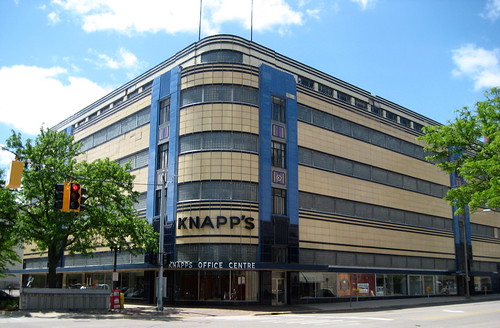
Knapp’s Office Centre, photo by Eridony.

Last week on Absolute Michigan we had a story about Lansing being named the Next American City. The article by Ivy Hughes in Next American City is titled Lansing: There’s No Place We’d Rather Be and might change your view of Michigan’s changing capital city. I had selected this photo for a quick link over to the article because I have always thought the building is neat. I soon learned that the long vacant Knapp’s Office Centre building is being renovated, another tangible sign of the new energy that is rising in Lansing.

Wikipedia’s J.W. Knapp Company Building entry says:

The J.W. Knapp Company Building is a historic five-story, 190,000-square-foot (18,000 m2) Streamline Moderne building in Lansing, Michigan, United States. Designed by Orlie Munson of the Bowd–Munson Company, which also designed several other Art Deco landmarks in Lansing, including the Ottawa Street Power Station, it was constructed by the Christman Company in 1937 through 1938. The curvilinear look of the streamlined structure comes from huge plates of concrete faced with enamel, called “Maul Macotta”, a copyrighted product of the Maul Macotta Company and prismatic glass brick windows. Alternating horizontal bands of yellow macotta and glass block are interrupted by vertical blue macotta pylons, rising from the building’s four principal entrances. The pylons are pierced by windows. The entrance portals, display window aprons, and decorative banding are dark blue macotta. Red, yellow and blue spandrels, incorporating the letter “K” as a design element, decorate the entrance portals

The building housed the main department store of the Lansing-based J.W. Knapp Company. When completed in 1939, it was hailed in the contemporary press as “the most modern building in the Midwest”. Today, it is considered to be one of the finest intact examples of Streamline Art Moderne commercial buildings in the Midwest, notable for its size, clarity of design and brilliant colors.

Don’t miss this great set of Historic photos of J.W. Knapps Building in the Lansing State Journal.

See this photo big as a building and see this and other shots of the building in Brandon’s massive Downtown Lansing slideshow.

Elberta Beach During the Hang Gliding Heydays

Elberta Beach During the Hang Gliding Heydays

Elberta Beach During the Hang Gliding Heydays, photo by jimflix!.

As a payback for yesterday’s icy cruelty, here’s a warm remembrance of summer in the 1970s.

Frankfort & Elberta on Lake Michigan was a hang gliding and soaring hotspot in the 1970s and earlier. Here’s a shot of sailplanes in the 1930s, a little Frankfort-Elberta Area Hang Gliding information and a video of present-day hang-gliding at Green Point Dunes. About this photo Jim writes:

Not a lot of beach that year (and the water was high), so there was not a lot of room to land! Then you had to hope folks would Get Out Of The Way! (And usually they did, as they were mostly hang gliding families or followers.)

Taken at the Elberta beach on Lake Michigan in the late 1970s

Check it out big as the sky and see more in his Hang gliding and hang gliders slideshow!

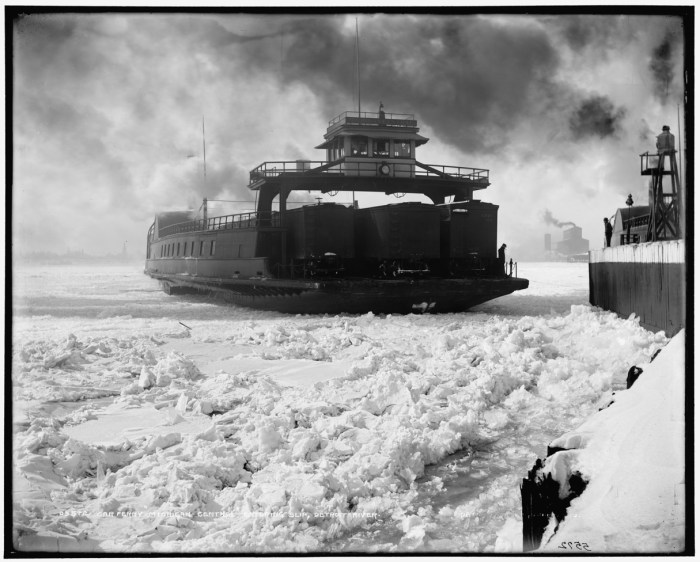
Rail Car Ferry Michigan Central on the Detroit River

Car ferry, Michigan Central, entering slip, Detroit River, photo by Detroit Publishing Co.

It’s kind of cruel to post a photo like this while it’s still November. I think we all know what’s coming though…

I spent some time learning about this photo I found in the Library of Congress aka maybe the coolest place on the internet. (You probably paid 3 cents for it last year, so check it out sometime). I finally found the same photo on the fantastic photo blog Shorpy. One of the commentors writes:

This is the Detroit side. The river flows extremely fast, and the ferry docks were set up so the boats always entered dock facing upstream. Michigan Central was built in 1884 by Detroit Dry Dock in Wyandotte, while Transport was built there in 1880. Both were cut down to barges by the 1930’s. A nearly identical boat, Lansdowne of 1884, survived in steam until 1970 for CN/Grand Trunk, until she blew a cylinder head (I remember the shock among the Detroit trainwatching community at the time).

You can see the Lansdowne of Windsor on Michigan in Pictures and check the comments at Shorpy for more including a shot of this location from the Ambassador Bridge in 1957.

See the photo background bigtacular at Shorpy.

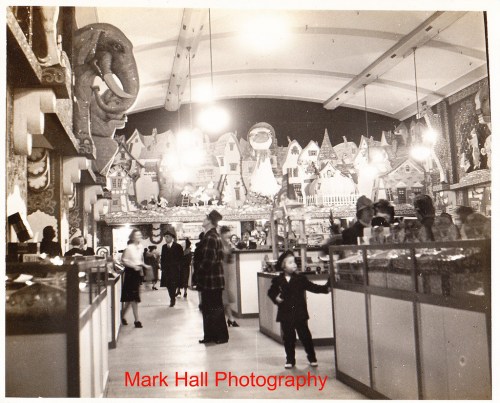
Holiday shopping at J.L. Hudson’s in Detroit

Hudson's detroit
Hudson’s detroit, photo by Detroitmi97.

If you grew up in or around Detroit, chances are you went to Hudson’s at some point for the holidays, maybe even taking a photo on Santa’s lap. In honor of my own memories of my grandmother who often took me to Hudson’s, here’s the best I could find about this legendary Detroit store.

Wikipedia’s Hudson’s entry relates that was founded in 1881 at 1200 Woodward Avenue by Joseph L. Hudson. The store operated for 102 years at that location and also opened a number of branches across the region. After closing the downtown store on January 17, 1984, the company merged into the Dayton Hudson Corp. On October 24, 1998 to make room for Ford Field, the 439 foot tall, 2.2 million square feet J.L. Hudson Building became the world’s largest building to be imploded.

Probably the best page to check out is How J.L. Hudson changed the way we shop from The Detroit News. It looks at how the canny store owner bucked popular wisdom by siting his store off the main drag of Jefferson and used publicity stunts like their signature gint flag and sponsoring a Thanksgiving parade. His moves paid off and:

By 1953 the 49-acre store had 12,000 employees and was making 100,000 sales per day. It used as much electricity as the city of Ypsilanti. It had a legendary delivery force of 500 drivers and 300 trucks. It boasted five restaurants which made 14,000 meals per day. The Hudson’s Maurice salad delighted lunchers for many years, its recipe a closely guarded secret until the store bowed to thousands of requests and made it public.

Despite warning signs, the downtown store hung in there. In 1961, the 25 story building was the world’s tallest department store. It had five basements, 51 passenger elevators, 17 freight elevators, 51 display windows, 706 fitting rooms, 2 million square feet, and 5,000 drafty windows. And the customers loved it.

In 1962, the store had two $1 million dollar sales days, topping the branches. In 1963, the founder’s great-nephew, Joseph L. Hudson Jr. took over and opened the store’s fine art gallery and a fine wine department.

Something I didn’t know was that Hudson was one of the first to reach out to minorities and in 1960 hired the city’s first black bus girl, a Cass Tech student by the name of Diana Ross! Click through for much more including a great photo gallery!

On their J. L. Hudson Department Store in downtown Detroit, Detroit Yes writes that the abandonment of the store in the early 80s was the death knell of downtown Detroit. The Department Store Museum page for Hudson’s – yes, Virginia, the internet has absolutely everything – has a listing of all the store departments by floor along with photos of the Woodward location and branch stores across Michigan.

You may also enjoy this slideshow of Hudson photos which showcases the incredible energy the store put into creating displays.

Check this out bigger and in Mark’s old detroit slideshow. He also has this view from above of the exterior of Hudson’s.